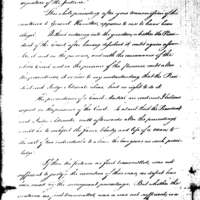
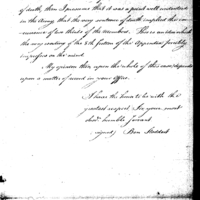
Secretary of the Navy's Opinion Regarding Presidential Power Over Officers' Commissions, Relative to the Court Martial of Richard Hunt
Type
Autograph Letter Signed
Title
Secretary of the Navy's Opinion Regarding Presidential Power Over Officers' Commissions, Relative to the Court Martial of Richard Hunt
Description
The Secretary of the Navy expresses his opinions on the matter of presidential power of military appointment, and its relation to the recent court martial of Sgt. Richard Hunt. Notes that the officers who comprised the court had received notification of appointment and each sent word of his acceptance; states his view that a commission is a sign of appointment, not the appointment itself. Believes it most ideal for proving authority that officers have their commissions in hand, but notes that this is not vital, and that many officers served in the Revolution for years without having received their commissions. Notes that the perceived issue of a lack of a 2/3 concurrence of the court upon the death sentence was purportedly caused by an omitted line in the report, not a breach in procedure, and this was added later by the president and judge advocate of the court -- believes this later addition, outside of the proceedings of the court itself, to have been illegal. Says that only the sentence as originally transmitted can be legal -- but whether that sentence was sufficiently authoritative to sentence death depends upon Army precedent in similar cases. In his opinion, all depends on whether the inclusion of a line signifying the 2/3 majority has been considered necessary or merely a formality by the army.
year created
1799
month created
07
day created
06
author
sent from location
Navy Department
recipient
in collection
in image
note
Enclosed in McHenry to Adams, 07/12/1799.
notable person/group
James McHenry
Benjamin Stoddert
Sergeant Hurt
Hart
officers
General Alexander Hamilton
President of the Court
Judge Advocate
prisoner
notable location
Navy Department
notable item/thing
sentence
court martial
Commissions
appointment
evidence
certificate
proceedings
execution
opinion
notable idea/issue
legality
notable phrase
sentenced to death by a court martial
document number
1799070640301
page start
12