Notes for National Defense: Page #6
Original title: 1800/TJH02_6.jpg
Transcription
6
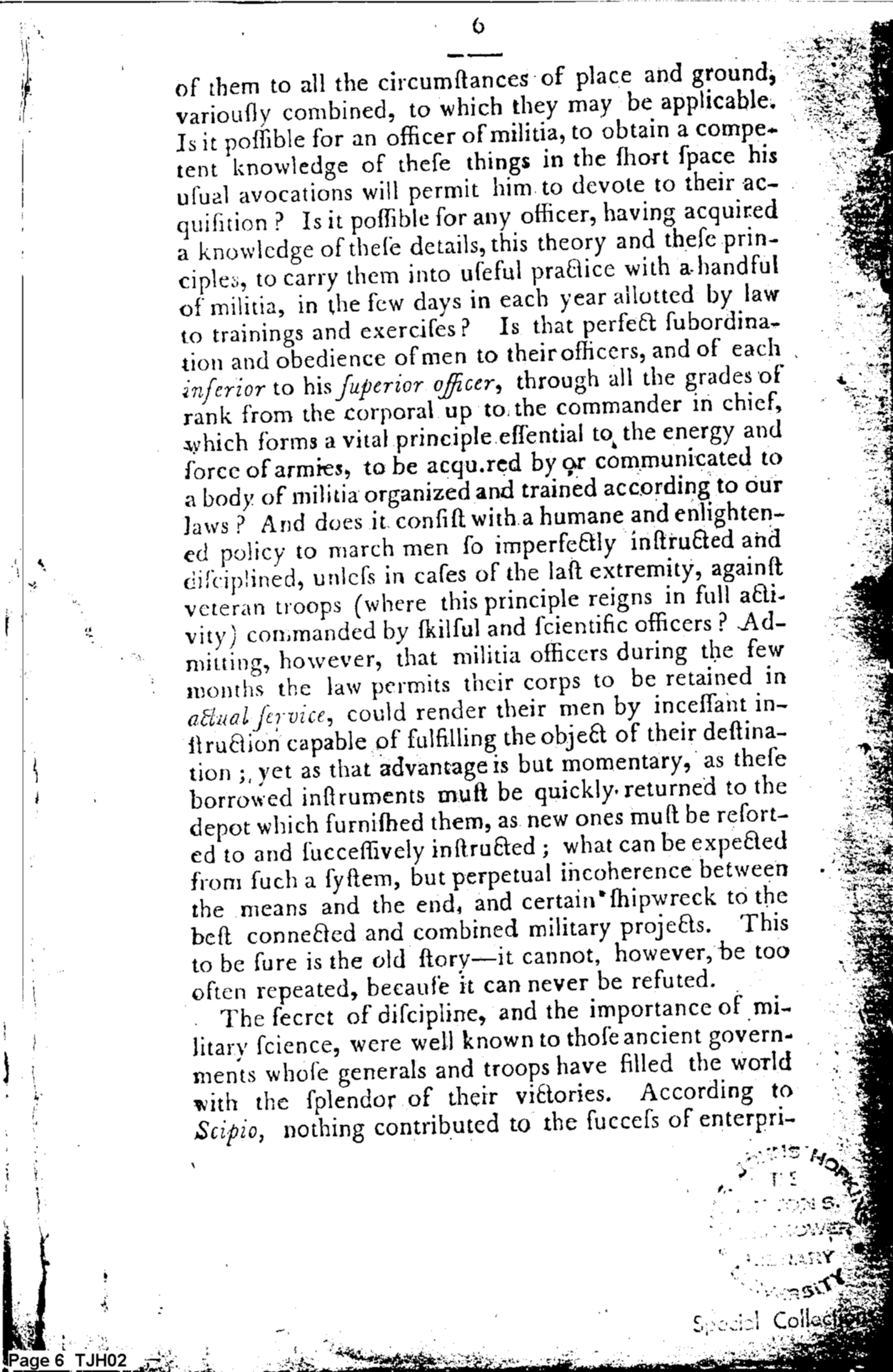
of them to all the circumstances of place and ground, variously combined, to which they may be applicable. Is it possible for an officer of militia, to obtain a competent knowledge of these things in the short space his usual avocations will permit him to devote to their acquisition? Is it possible for any officer, having acquired a knowledge of these details, this theory and these principles, to carry them into useful practice with a handful of militia, in a few days in each year allotted by law to trainings and exercises? Is that perfect subordination and obedience of men to their officers, and of each inferior to his superior officer, though all the grades of rank from the corporal up to the commander in chief, which forms a vital principle essential to the energy and force of armies, to be acquired by or communicated to a body of militia organized and trained according to our laws? And does it consist with a humane and enlightened policy to march men so imperfectly instructed and disciplined, unless in cases of the last extremity, against veteran troops (where this principle reigns in full activity) commanded by skillful and scientific officers? Admitting, however, that militia officers during the few months the law permits their corps to be retained in actual service, could render their men by incessant instruction capable of fulfilling the object of their destination; yet as that advantage is but momentary, as these borrowed instruments must be quickly returned to the depot which furnish them, as new ones must be resorted to an successively instructed; what can be expected from such a system, but perpetual incoherence between the means in the end, and certain shipwreck to the best connected and combined military projects. This to be sure is the old story––it cannot, however, be too often repeated, because it can never be refuted.
The secret of discipline, and the importance of military science, or well known to those ancient government whose generals and troops have filled the world with the splendor of their victories. According to Scipio, nothing contributed to the success of the enterpri-