
Collection
Documents
-
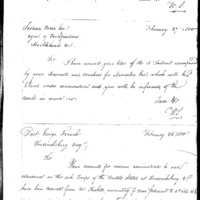
Ensuring the Pay of a Former Private in Captain Thompson's Company
Replying to Stille's letter of the 4th of October, Simmons says he must inform Stille that Ebeneezer Swan, formerly a private in Captain Thompson's company, was at the time of his discharge owed the sum of $22.14 for pay, which was paid to Elijah Paine, an attorney acting on behalf of Swan, on the 7th of February. -
Simmons Addressing the Secretary of War on the Subject of Additional Accounts and Vouchers Rendered by the Quartermaster General
Simmons writes the Secretary of War about additional accounts and vouchers that have recently been brought forward by the Quartermaster General, John Wilkins, Jr. Simmons wishes for information and direction from the Secretary of War on this issue. Simmons writes that, according to Wilkins himself, he was never given particular instructions regarding his duties, and thus Simmons is not sure how to properly examine his accounts. The normal course for settling an account is first to figure out the particular instructions under which the expenditures were made, and secondly to evaluate the validity of the vouchers produced. Since in the present situation Wilkins received no orders, Simmons is unable to judge how valid the expenditures and vouchers are. These difficulties had already occurred in the past and had been stated to James McHenry, the previous Secretary of War. However, McHenry was of the opinion that it was not his bailiwick to give instructions to or render judgment on the expenditures of the Quartermaster General. Thus, Wilkins' accounts have remained without a comprehensive settlement ever since. To Simmons, it appears that there are two guiding principles which have governed Wilkins' actions: The first is that he has only authorized expenditures which pertain expressly to, and within the boundaries of, the office of the Quartermaster General's Department. This includes the appointment of agents, making purchases and fixing compensation. Secondly, when Wilkins has been called upon to authorize expenditures which do not fall under or belong to his department, he considers the authority of the commanding officer of the post to be a sufficient warrant to allow him to act. Simmons writes that with regard to the first principle, Wilkins considers himself imbued with certain powers as Quartermaster General, which he is to exercise according to his best judgment. Should he improperly authorize payments from public monies, Wilkins understands that the responsibility will fall squarely on his shoulders. Regarding the second principle, Simmons states that Wilkins has the opinion that the commanding officer has the power of comptroller over his funds, and that anything the commanding officer may directed to be executed is the responsibility of that officer. In this way, the Quartermaster General is obligated to comply, but he is also absolved of responsibility by this order. Simmons states that two questions remain that must be decided by Dexter. The first, whether the Secretary considers all the appointments and expenditures made by the Quartermaster General have been in his capacity and within his duties, and thus should be authorized and credited to his account, holding Wilkins responsible only for providing the proper documentation of all the articles purchased under his orders. Secondly, whether Dexter considers the authority of the commanding officer to be a sufficient source of a voucher due the Quartermaster General, even if the commanding officer orders the funds to be applied to objectives other than ones pertaining expressly to the Quartermaster General's Department. Simmons states that a decision on these points will allow him to pass off the accounts of the Quartermaster General, however, it still remains to be laid out the extent to which the duties of the Quartermaster General reach. Without instructions, it is impossible for Simmons to ascertain what properly belongs to the Quartermaster General's duty or whether or not he has exceeded his authority. Simmons cannot assume that any authority would be vested in the Quartermaster General without control. Simply examining the vouchers with regard to their amount is a trifle compared with the vastness of the purchases and appointments made by the Quartermaster General. Simmons ends the letter by writing that it still remains to be determined how far the Quartermaster General's authority extends, and what Dexter believes Wilkins' duties to be. -
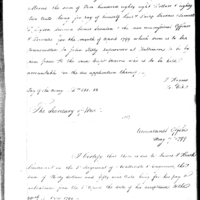
Certification of payment; Captain Samuel Eddins, 2d Regiment Artillerists and Engineers for expenses while stationed at City of Washington by order of Brigadier General Wilkinson
Certification of payment; $10.50 to Captain Samuel Eddins, 2d Regiment Artillerists and Engineers for expenses while stationed at City of Washington by order of Brigadier General Wilkinson. -
Regarding the Quarter Master General's duties and accounts
Relative to accounts of John Wilkins Jr., Quarter Master General. Notes that Wilkins was not furnished with with any instruction as to his particular duties. -
Information Respecting Discharged Storekeepers
Dexter wants to know if any of the storekeepers have been discharged due to the removal of their stores to places of general deposit. The closing of the estimate is retarded for the want of this knowledge. -

Cover
Requests information on the value of land. -
Certificates for Land for Canadian Refugees
Submitted two certificates for land granted to refugees by Congress as compensation for abandoning their property in Canada. In order to obtain land in the Refugee Tract, applicants had to have left Canada for the duration of the war and supported the American war effort. -
Reasonable Price for a Horse-Mill, Etc.
Since Cranch is about to depart, he wants to know if the public will give him a reasonable price for a horse-mill he built for grinding and polishing bayonets and gun furniture as well as window glass in the shop, two pairs of smith's bellows, two anvils, twelve vices, and a number of small tools. -

Bill of Exchange from Dodridge Crocker, Contractor, Charleston, South Carolina
Crocker paid William Crafts $700. -
Simmons is Unwilling to Settle Thomas Lewis' Account While Lewis Receives Salary Advances from David Henley
Simmons has received the account of Thomas Lewis relating to his salary as a temporary Agent for the Cherokee Nation of Indians. Simmons has examined David Henley's accounts and found that Henley has been providing advances on Lewis' salary. As a result, Simmons feels it would be improper to attempt a settlement on Lewis' account and has suspended Lewis' salary until his accounts are settled vis-à-vis the advances he has received. -
Simmons Writing Creary on Monies for the Fortifications at New Port
Simmons writes Crary to inform him that the Treasurer of the United States will send him $5000 for the fortifications being erected in New Port, Rhode Island, and asks Crary to forward the requisite receipts. -
Account of Thomas Billington
The late contractor Thomas Billington of Philadelphia is anxious to have his account settled. Dexter is no less anxious because he advanced $5000 to Billington just before the removal of the offices from Philadelphia [to Washington]. This advance remains to be covered by warrant. -
Hopes for a President Charles Pinckney
Requests that Hamilton deliver the enclosed letter to Oliver Wolcott, Jr. as he passes through New York to visit Connecticut. McHenry also states emphatically that "Gen. Pinckney will be our next President." -

Annuities for Indians of Indiana Territory
Informs Whelan of plans for annuities to Indians of Indiana Territory, and lists the planned presents. -
Restoration of Lyman's Health, Etc.
Williams happily reports that he has received the two thousand dollars sent from Hodgdon. Amidst a discussion of supply and accounting matters, Williams refers to Mr. Lyman and his gratitude to Hodgdon for his friendly wishes respecting the restoration of Lyman's health. Lyman is mending slowly and Williams is apprehensive regarding his prospects of getting out and about, if ever. -
Estimate of Expenditures for Armory at Springfield for October
Estimate of expenditures on account of the United States at Springfield Massachusetts for iron, steel, charcoal, incidental expenses totaling $4500. -
Letter Citation
Cited in Williams to Hodgdon, 10/15/1800. -
Delivery of Powder for Filling Coffins
Harris is to deliver musket powder to Henry Frailley for the purpose of filling coffins. -
Request for Company Book
Letter, directs delivery of company book for Hodgdon's office. -
Delivery of Swords, Belts for Fourth Regiment of Infantry
Letter, directs delivery of swords, belts, etc. for Fourth Regiment of Infantry. -
Simmons Discussing Charges with Alexander Gibson and Requesting the Orders of Alexander Hamilton
Alexander Humphrey's late contractor produced for Simmons an account of logs harvested and stone mined for building 27 huts, the amount being $636 along with a charge of $141.42 for the use of blacksmiths' shops, barracks and store houses. The order to put the soldiers under cover at Staunton apparently came from Alexander Hamilton; however, these orders have not been produced, and the Secretary of War cannot sign off on orders that have not been provided him. Simmons requests Gibson's reply, especially with regard to charges for house rents when public huts had been built, and what the fates of these huts were when the soldiers left the station. -
Certification of payment; Samuel Hodgdon, Superintendant of Military Stores, for his salary, and that of John Harris, Store Keeper, and clerks employed in office
Certification of payment; $1350 to Samuel Hodgdon, Superintendant of Military Stores, for his salary, and that of John Harris, Store Keeper, and clerks employed in office. -

This State is Lost to the Federals, Etc.
Secured repayment for Hodgdon. Hagner expresses his willingness to serve Hodgdon without a commission. The health of Washington City is much better. The election of his State is lost to the Federals, a majority of ten or twelve "Antis" have been elected. -
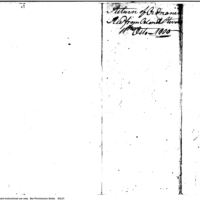
Return of US Ordnance and New York Ordnance in New York City
A return of ordnance stores belonging to both the U.S. and the state of New York in the vicinity of New York City. Places of storage listed are Fort Jay, York Island, and "Arsenal," all belonging to the U.S., and Ellis Island, whose stores belong to New York. -
Our Approaching Election, Etc.
Neither the general nor the Quartermaster General have arrived so the troops continue in their encampment without orders to go into garrison or cantonment. Craig apprehends that the approaching election will be attended with considerable warmth.