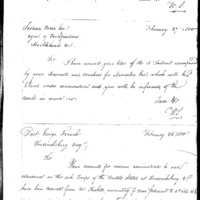
Simmons received Crary's letter of October 20th which contained accounts for expenditures relating to the fortifications at Newport for August, September, and October. Reference to War Department fire.
Simmons received Jackson's letter of November 3rd along with his receipts and expenditures relating to the fortifications at Boston last September. Reference to War Department fire.
Simmons received Hodgdon's letter of November 8th which carried with it a statement of the provisions delivered to Mr. O'Hara by the Commissary General as per Simmons' request. Reference to War Department fire.
Wilkins' letter of October 31st was received along with its accompanying accounts. Because they were below stairs and removed before the fire reached them, Simmons' papers were saved, whereas the Secretary of War lost the majority of his. Simmons states that there is now a fixed principle which will govern Simmons in the settling of Wilkins' accounts, and as soon as normalcy returns he will deal with them.
Simmons received Whelen's letter of November 6th with packages of accounts. Simmons will have to spend a considerable amount of time organizing his papers, precluding an immediate reply. Simmons mentions the recent fire in the War Department, noting that a good number of Simmons' papers were saved, whereas those of the Secretary of War were for the most part lost.
Dexter, responding to Adams' request for War Department issues to address at the annual speech to Congress [State of the Union address], officially states that there is only one noteworthy matter. He reports that the nation's military stores are now well-stocked, saying that more cannon and small arms might be needed in case of war, but that these could now be produced with such speed and quality as to rival Europe. Asks that Congress make it known to European nations that America is materially prepared for war. Also notes that the fortification of ports and harbors remains incomplete, as knowledge of fortification is the weak point of American military knowledge; asks that more money be appropriated for the purpose of fortification.
Those Gentlemen who have applied for military appointments in the service of the United States are informed that their applications with all the recommendatory letters accompanying were consumed by fire in the War Office on Saturday evening last. Those who desire to be considered as candidates will see the propriety of renewing their applications.
Respecting the accounts of James O'Hara, Contractor for Supplying the Troops, and John Wilkins, Quartermaster General, it is incumbent upon Simmons to expedite their adjustment as well as all other accounts in which similar doubts may be entertained.
Dexter refers to the sale of sulphur. Mentions obtaining correct information on the quantity on hand in the public stores. Says there is so much now in the present circumstances that it is unnecessary to contract for the purchase of more.
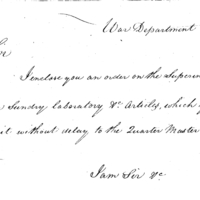
This letter encloses an order placed with Samuel Hodgdon to send stores to Pittsburgh. The Secretary at War directs Miller to send these items to the Quartermaster General without delay.
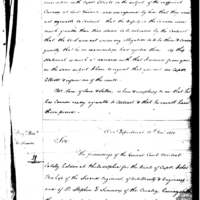
Letter, discusses results of court martial proceedings; discusses presidential order. Captain John Bishop of 2nd Regiment Artillerists and Engineers and Lieutenant Stephen Simmons of cavalry are to be dismissed from service of United States.
The Secretary at War directs Lieutenant Colonel Lewis Tousard to consult Captain Elliot regarding the serviceability of designated cannon. Mentions defects in the cannon as greater than those stated to be tolerated by the contract.
Williams is concerned about the coal that has been contracted for. The Superintendent refuses to certify the account of the contractors believing there is a mistake in the measurement. The captain of the vessel that brought the coal and the contractors will testify that it was rightly measured. The coal has caused Williams much vexation and trouble due purely to the caprice and ill-natured motives of the Superintendent.