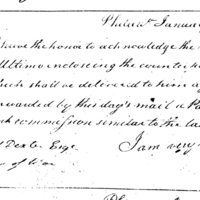
Simmons informs Mr. Davis that there is no evidence that Messrs. Ray and John Followell participated in General Scott's expedition of 1794. The muster rolls outweigh any certificates that may be provided, and thus Simmons cannot satisfy any claim made for services rendered by these two men.
Certification of payment; $45.40 to estate of Richard Mason, for boarding in prison James Douglas, deserter, from Lieutenant Harris detachment, 2d Regiment Artillerists and Engineers
Simmons mentions a sum of $500 charged as paid for purchases made or to be made by Jonathan Smith. Simmons states that no advances made on account can be admitted to Whelen's credit at Simmons' office, and that Whelen must draft a separate abstract of advances if they are indispensable to the execution of his duties.
Cannons were received a while ago, General directed they be mounted on carriages immediately. Received notification that the "good old man" has lost the election.
Acknowledges receipt of Dexter's acceptance of the office of Secretary of the Treasury, and asks that Dexter continue as Secretary of War for the time being.
Refers to an enclosed set of instructions which details works to be performed for the public service. Hodgdon appears to be saying that normal procedure would dictate submitting the proposed work to the Quartermaster General's agent for payment, but that he knows this would result in delay or denial of the proposal. Further, he says that appropriations for such things are only made in "contingencies;" therefore he orders Whelen to have the work done and charge it, since once the work is done the government is bound to pay for it. He gives Whelen instructions on where to find him so they can meet as necessary.
Simmons received Hodgdon's letter of December 29th with the accompanying accounts. The account of disbursements Hodgdon mentions will lay over until those for the last quarter are received.
Simmons received Gilmor's letter of December 31st 1800 (the previous day) which contained a bundle of accounts for the fortifications of Baltimore. The postscript informs Gilmor that the Secretary of War issued a warrant asking the Treasurer to remit Gilmor $4216.04.
Certification of payment; $20 to David Kennedy, a reward for apprehending and committing to prison James Douglas and M. Stanford, deserters from Artillerists and Engineers.
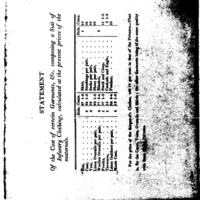
Samuel Hodgdon, Commissary of Military Stores, requests that John Harris, Public Storekeeper, deliver to the order of the quarter master general for transportation to New York to Col. Ebenezer Stevens, Agent of the War Department in New York, the following articles of clothing, for the use of Capt. Irwine's Company of artillery. Includes hats, privates' coats, woolen overalls, and musicians' coats.
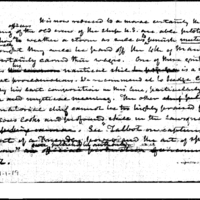
The author uses the metaphor of the United States as a foundering ship whose able officers have certainly earned their wages. One of these gentlemen is adept at proclamations so Judge Chase is urged to study his last composition for hidden and mystical meaning. The other gubernatorial chief cannot be too highly praised for his sagacity and profound skills in the laws of nations.
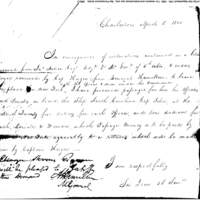
Passage secured for Captain Huger, his officers and privates to leave Charleston South Carolina for New York on the ship South Carolina, Captain Pebor commanding.
Separated the corps of artillerists and engineers by those on foot and those on horse. Details on how the corps should be subdivided and who should be in which group. Gave President power to raise two regiments of horse artillerists if danger is imminent.