No human transcription currently available for this document.
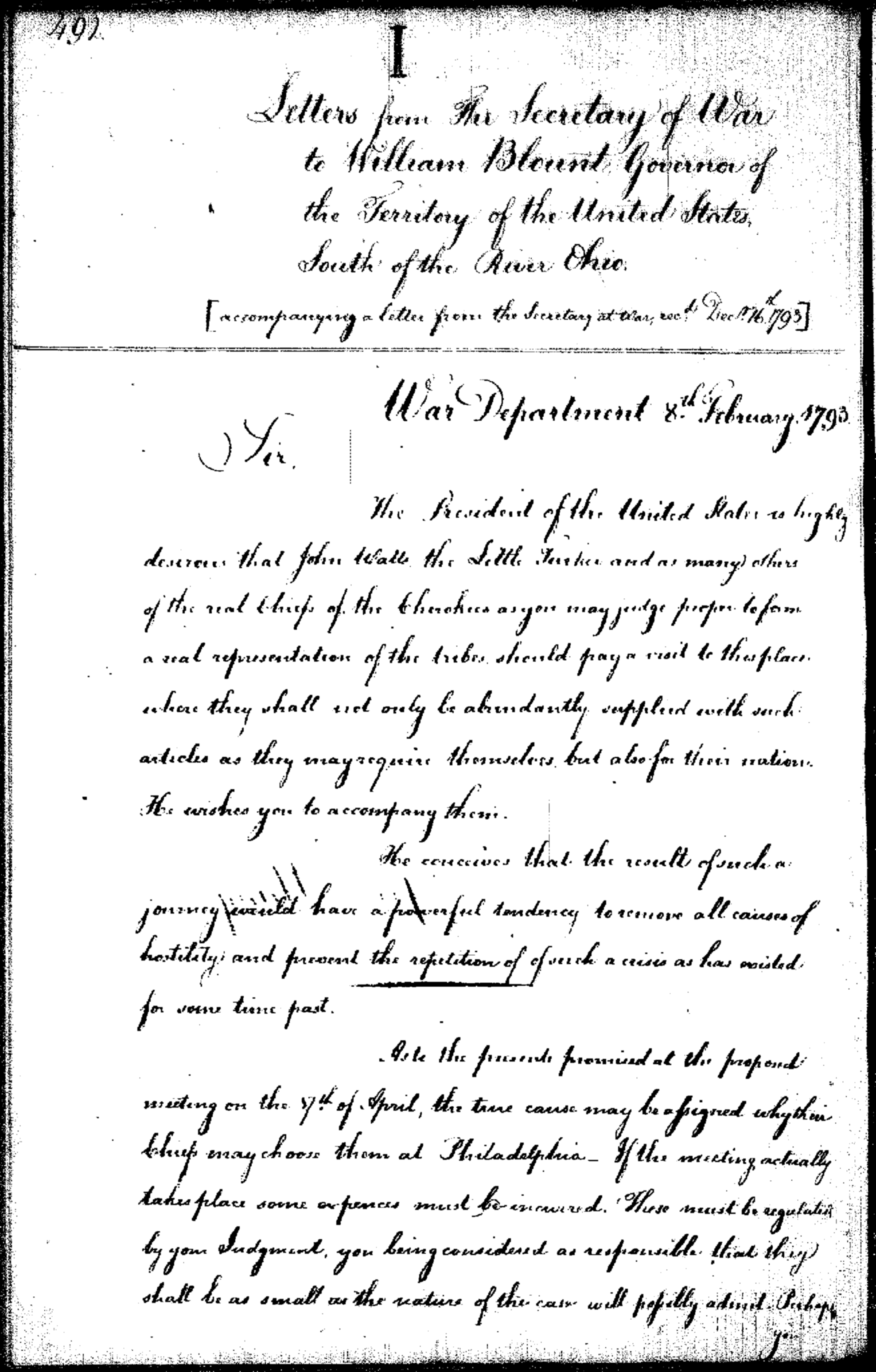
Letters from the Secretary of War
to William Blount Governor of
the Territory of the United States,
South of the River Ohio.
[accompanying a letter from the Secretary at war, rec'd Dec 16, 1795]
War Department 8th February 1795
Sir,
The President of the United States is highly desirous that John Watts the Little Turkee and as many others of the real chiefs of the Cherokees as you may judge proper to form a real representation of the tribes, should pay a visit to this place, where they shall not only be abundantly supplied with such articles as they may require themselves, but also for their nations. He wishes you to accompany them.
He conceives that the result of such a journey would have a powerful tendency to remove all causes of hostility, and prevent the repetition of such a crisis as has existed for some time past.
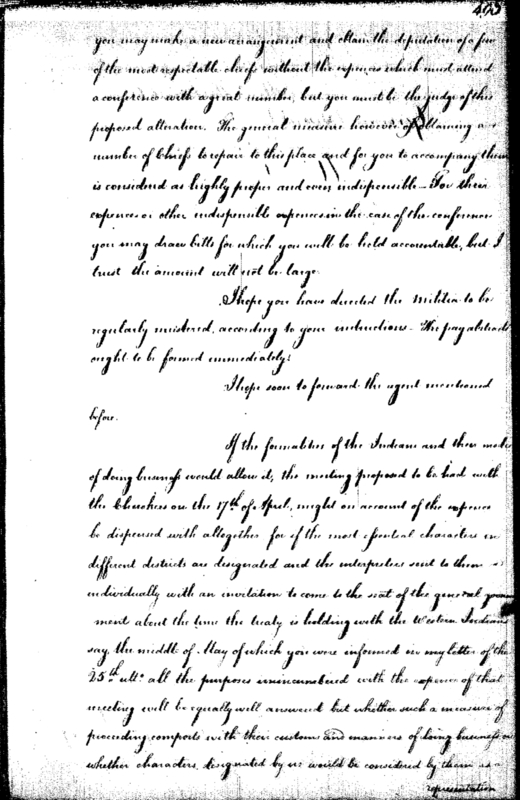
Aside the presents promised at the proposed meeting on the 7th of April, the true cause may be assigned why the chiefs may choose them at Philadelphia. If the meeting actually takes place some expenses must be incurred. These must be regulated by your Judgment, you being considered as responsible that they shall be as small as the nature of the case will possibly admit. Perhaps you may make a new arrangement and obtain the deputation of a few of the most respectable chiefs without the expenses which must attend a conference with a great number, but you must be the judge of this proposed alteration. The general measure however of obtaining a number of chiefs to repair to this place and for you to accompany them is considered as highly proper and even indispensible. For their expenses or other indispensible expenses in the case of the conference you may draw bills for which you will be held accountable, but I trust the amount will not be large.
I hope you have directed the Militia to be regularly mustered, according to your instructions. The pay abstracts ought to be formed immediately.
I hope soon to forward the agent mentioned before.
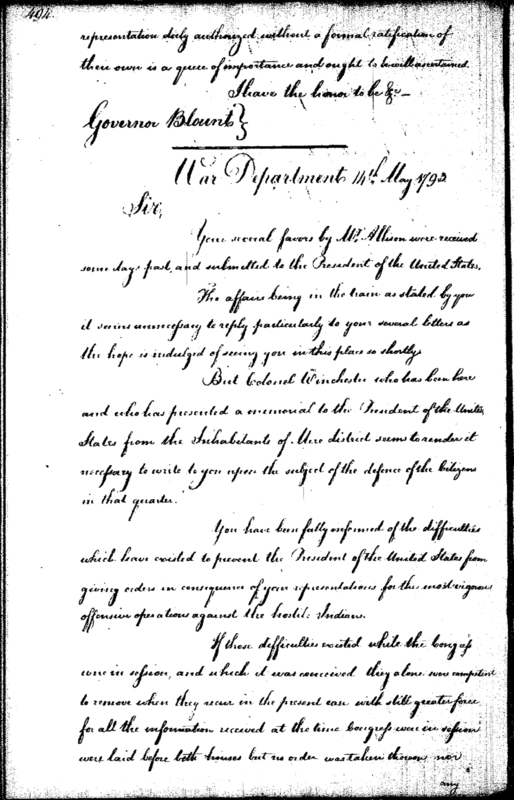
If the formalities of the Indians and their modes of doing business would allow it, the meeting proposed to be had with the Cherokees on the 17th of April, might on account of the expense be dispensed with altogether for if the most reputable characters in different districts are designated and the interpreters sent to them individually with an invitation to come to the seat of the general government about the time the treaty is holding with the Western Indians say the middle of May of which you were informed in my letter of the 25th ulto: all the purposes unincumbered with the expense of that meeting will be equally well answered but whether such a measure of proceeding comports with their customs and manners of doing business or whether characters designated by us would be considered by them as a representation duly authorized without a formal ratification of their own is a question of importance and ought to be well ascertained.
I have the honor to be &c —
Governor Blount
War Department 14th May 1795
Sir,
Your several favors by Mr. Allison were received some days past, and submitted to the President of the United States.
The affairs being in the train as stated by you it seems unnecessary to reply particularly to your several letters as the hope is indulged of seeing you in this place so shortly.
But Colonel Winchester who has been here and who has presented a memorial to the President of the United States from the Inhabitants of this district seem to render it necessary to write to you upon the subject of the defence of the citizens in that quarter.
You have been fully informed of the difficulties which have existed to prevent the President of the United States from giving orders in consequence of your representations for the most vigorous offensive operations against the hostile Indians.
If those difficulties existed while the Congress were in session, and which it was conceived they alone were competent to remove when they recur in the present case with still greater force for all the information received at the time Congress were in session were laid before both houses but no order was taken thereon nor