

Soldier never discharged
Document 1784Brearley protests that he was never officially discharged from the Army and was in fact an officer at the time of the reduction of the Army.
No human transcription currently available for this document.
This transcription was generated by machine using Anthropic's Claude Code (model sonnet 4.6). It may contain errors or inaccuracies. Please verify against the document image. Learn more about our generative AI methodology.
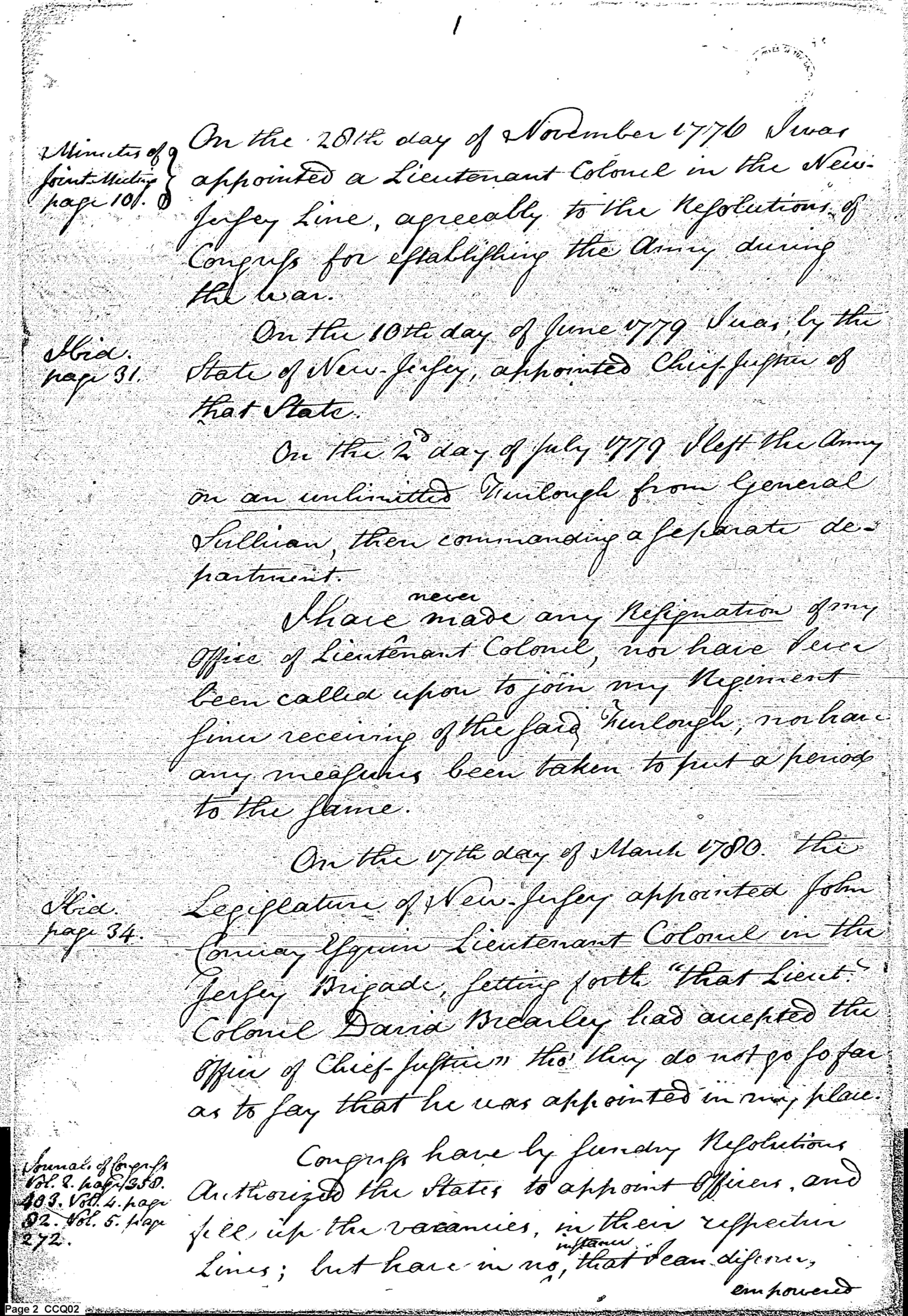
[Minutes of Joint Meeting page 101.] On the 28th day of November 1776 I was appointed a Lieutenant Colonel in the New-Jersey Line, agreeably to the Resolutions of Congress for establishing the Army during the war.
[Ibid. page 31.] On the 10th day of June 1779 I was, by the State of New-Jersey, appointed Chief Justice of that State.
On the 2d day of July 1779 I left the Army on [underline: an unlimited] Furlough from General Sullivan, then commanding a separate department.
I have never made any [underline: Resignation] of my Office of Lieutenant Colonel, nor have I ever been called upon to join my Regiment since receiving of the said Furlough; nor have any measures been taken to put a period to the same.
[Ibid. page 34.] On the 17th day of March 1780, the Legislature of New-Jersey appointed John Conray Egsim Lieutenant Colonel in the Jersey Brigade, setting forth "that Lieut. Colonel David Brearley had accepted the Office of Chief-Justice" tho' they do not go so far as to say that he was appointed in my place.
[Journals of Congress Vol. 2. page 350. Vol. 3. Vol. 4. page 92. Vol. 5. page 272.] Congress have by sundry Resolutions Authorized the States to appoint Officers, and fill up the vacancies, in their respective Lines; but have in no, instance that I can discover, empowered them to displace or supersede such Officers.
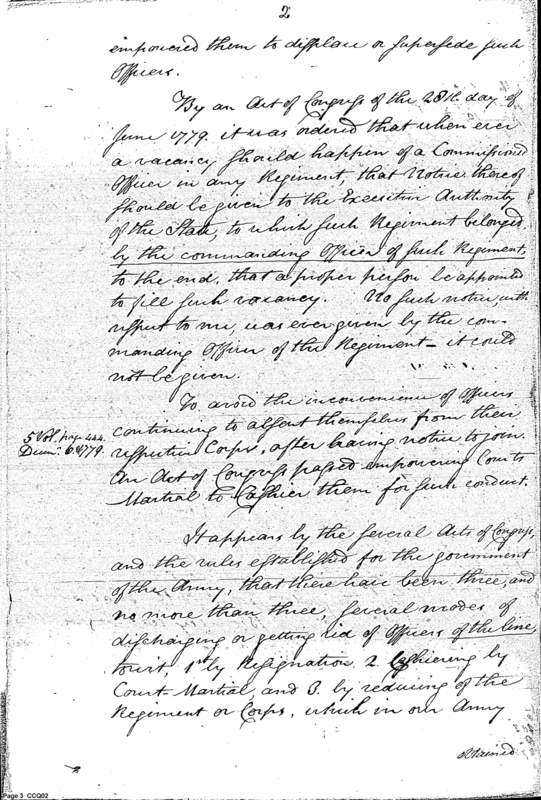
By an Act of Congress of the 28th day of June 1779, it was ordered that when ever a vacancy should happen of a Commissioned Officer in any Regiment, that Notice thereof should be given to the Executive Authority of the State, to which such Regiment belonged, [underline: by the commanding Officer of such Regiment,] to the end, that a proper person be appointed to fill such vacancy. No such notice, with respect to me, was ever given by the commanding Officer of the Regiment — it could not be given.
[5 Vol. page 444. Decm. 6. 1779.] To avoid the inconvenience of Officers continuing to absent themselves from their respective Corps, after having notice to join. An Act of Congress passed empowering Courts Martial to cashier them for such conduct.
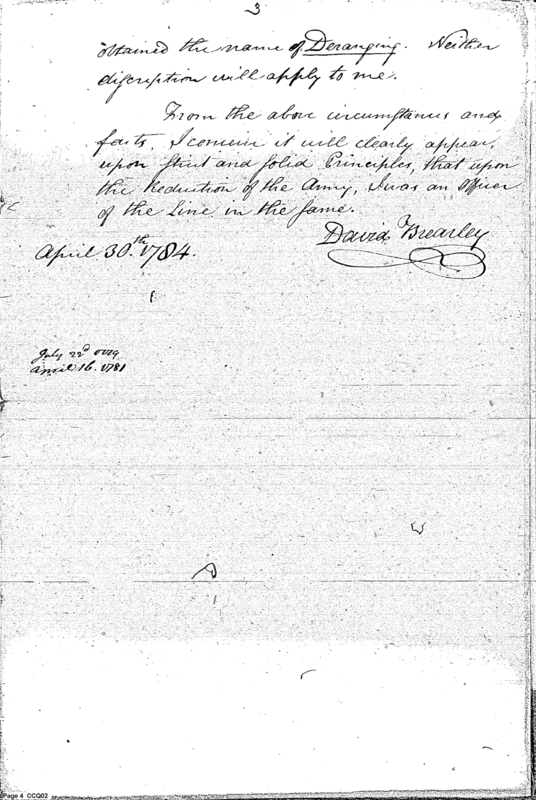
It appears by the several Acts of Congress, and the rules established for the government of the Army, that there have been three, and no more than three, several modes of discharging or getting rid of Officers of the line, towit, 1st by Resignation. 2. Cashiering by Court-Martial, and 3. by reducing of the Regiment or Corps, which in our Army obtained the name of [underline: Deranging.] Neither discription will apply to me.
From the above circumstances and facts, I conceive it will clearly appear, upon firm and solid Principles, that upon the Reduction of the Army, I was an Officer of the Line in the same.
David Brearley
April 30.th 1784.
[July 22d orig. annid 16. 1781]
Type
Autograph Letter Signed
Description
Brearley protests that he was never officially discharged from the Army and was in fact an officer at the time of the reduction of the Army.
Date
04/30/1784
Author
Recipient
Document number
1784043090010
Notable persons
David Brearley
Army
General Sullivan
regiment
John Conway
Courts Martial
Notable locations
New Jersey
Notable items
Minutes of Joint Meetings
Lieutenant Colonel in the New Jersey line
Resolutions of Congress for establishing the army during the war
Chief Justice of the that State
unlimited furlough
separate department
resignation
Legislature of New Jersey
vacancies
Journal of Congress, Vols. 8,4,5
Act of Congress of the 20th day of June 1779
rules established for the government of the Army
cashiering by court-martial
reducing of the regiment or corps
deranging