No human transcription currently available for this document.
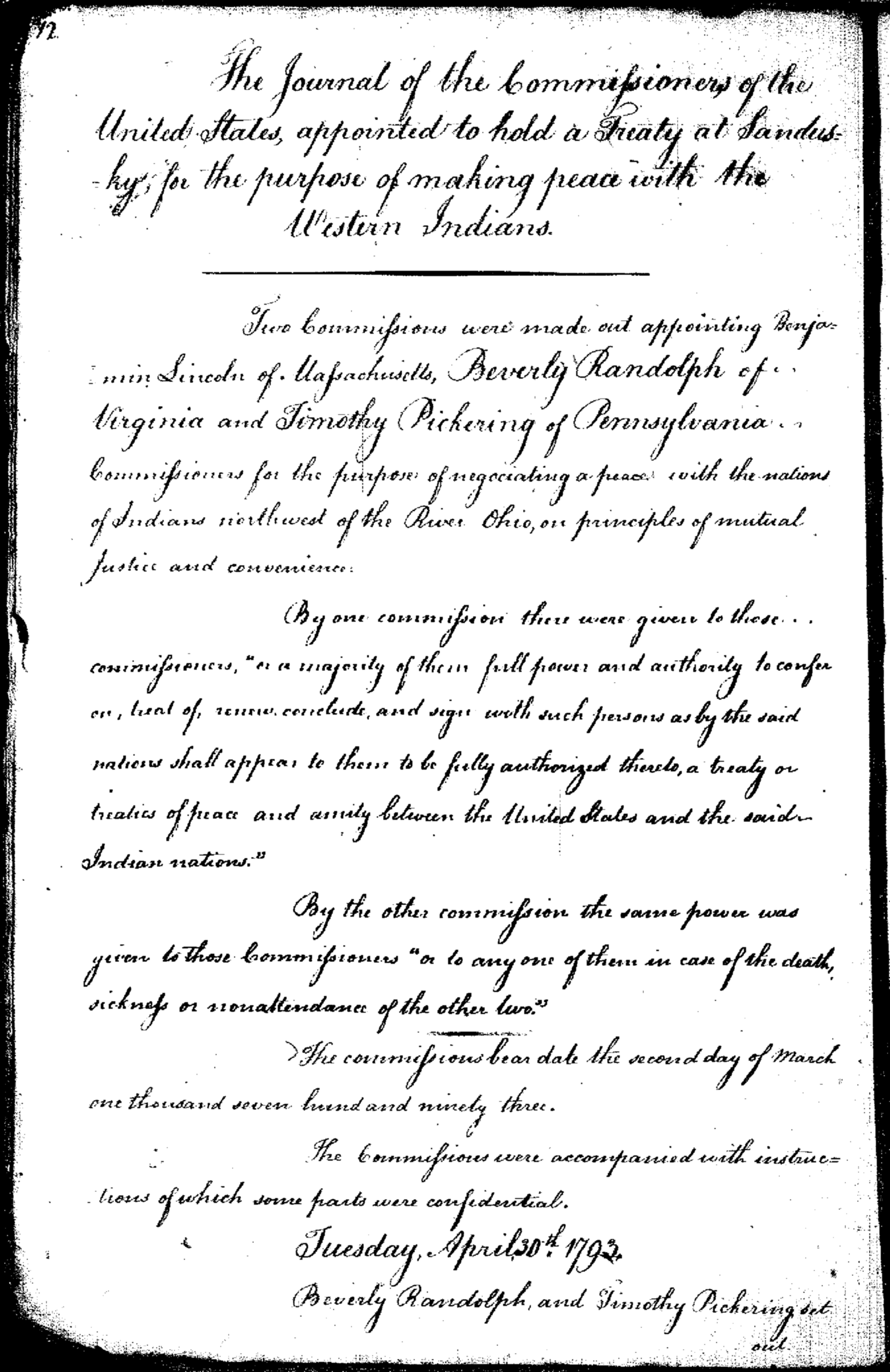
The Journal of the Commissioners of the United States, appointed to hold a Treaty at Sandusky, for the purpose of making peace with the Western Indians.
Two Commissions were made out appointing Benjamin Lincoln of Massachusetts, Beverly Randolph of Virginia and Timothy Pickering of Pennsylvania Commissioners for the purpose of negotiating a peace with the nations of Indians northwest of the River Ohio, on principles of mutual Justice and convenience.
By one commission there were given to these commissioners, "or a majority of them full power and authority to confer on, treat of, renew, conclude, and sign with such persons as by the said nations shall appear to them to be fully authorized thereto, a treaty or treaties of peace and amity between the United States and the said Indian nations."
By the other commission the same power was given to those Commissioners "or to any one of them in case of the death, sickness or nonattendance of the other two."
>The commissions bear date the second day of March one thousand seven hundred and ninety three.
The Commissions were accompanied with instructions of which some parts were confidential.
Tuesday, April 30th 1793.
Beverly Randolph, and Timothy Pickering set out from Philadelphia to go to Niagara by the way of Sunbury, Northumberland, Muncy, Lecoming in Pennsylvania; the painted post, Bath, and Williamsburg on Genesee river in the State of New York.
Benjamin Lincoln had set off from Philadelphia on Saturday the 27th of April to go by the way of New York, Albany, the Mohawk river and Oswego, taking under his care the Stores and baggage. —
Beverly Randolph and Timothy Pickering arrived at Williamsburg the 11th of May and on Monday the 13th at Canawaugus on Genesee met with the Farmers Brother, Red Jacket, and some other chiefs of the Seneca nation with whom they had some conversation.
The Commissioners informed them of the time they expected to proceed from Niagara to Sandusky, and when the treaty was to be opened. They encouraged them to attend the Treaty and mentioned the reliance of the United States on their aid in bringing about a peace.
The Chiefs said that when some of them were hunting about Canandaigua the answer of the President to the speech of the Western Indians arrived, relative to the holding of the treaty. That this answer was deficient because the British were not invited to attend the Treaty. And that it was necessary they should attend because they originally called the Indians to War against the United States. That nevertheless Governor Simcoe had ordered Colonel Butler to attend the Treaty. That all the provisions were ready, and that the British seemed now more than ever desirous to have peace take place between the United States and the Western Indians, and to give all the assistance in their power in promoting it.
With respect to the Presidents answer to the Western Indians the Commissioners observed that he had given such an answer as his wisdom directed; and therefore that they could say nothing about it.
The commissioners received from the chiefs a written speech and four strings of white Wampum sent by the Western Indians to the President. In this they insisted on Sandusky as the place of Treaty. This speech and strings the Commissioners enclosed in a Letter to General Knox, and sent it by a man going to Williamsburg to be put into the post office there.
The chiefs handed to the Commissioners some papers which they desired to have explained to them. This was done. They were the speeches between General Wayne, and the Complainter, last March at Pittsburg.
The Commissioners entertained the chiefs and their followers with victuals and drink, and at their request furnished some provisions for their journey to Canandaigua, whether they were going for the clothing procured by General Chapin for those who went last year to the Council of the Western Indians.
Friday May 17th 1793.
This day Beverly Randolph and Timothy Pickering arrived at Queenston, seventeen miles up Niagara river above Niagara Fort, and the landing place for goods to be transported above the falls, here they met Thomas Morris of Canandaigua, to whom had been committed, in order to be delivered to the Commissioners, the extract of a letter from Colonel McKee, of which the following is a copy;
"Extract of a letter from Colonel McKee, to Major of Brigade Littlehales, dated Detroit April 11th 1793.
"I have the honor to acknowledge the receipt of your letter dated 23d March. The Speech of the United States to the Western Indians was forwarded yesterday to the Glaize by some chiefs of the Shawanese, who came here soon after its arrival to hasten the meeting, and I beg to acquaint you for the information of his Excellency, that at present it appears generally understood by all the chiefs whom I have seen that the proposed interview with the Commissioners will certainly take place at Sandusky: but the time fixed by the United States (Viz the first of June) appears too early for the Indians to be able to collect themselves, as in all probability the Major part of them will not return from their Wintering grounds before the latter end of May exclusively of the Southern chiefs expected with the messengers who were sent last fall and also those who were sent last fall, and those who are to attend from Michilimackinac and the Mississippi in order to accomplish a full and permanent settlement of all the existing differences between the confederated Indians and the United States.
"And I should apprehend from their accustomary slowness in all their deliberations that it may be the latter end of June before they able to adjust all their business at their private Councils at the Miamies rapids preparatory to their meeting the Commissioners.
"His Excellency will therefore be enabled to state to the Commissioners, should they arrive at that early period proposed, the cause of the delay and should he think proper to recommend to them to stay at Niagara, until the Chiefs are nearly ready I shall not neglect to give him early information thereof, that they may have sufficient time to be at the appointed place as soon as the Indians who are to meet them. Their being at Sandusky so long before the meeting may be extremely Inconvenient to them and cannot answer any good purpose."
(A true Copy E. B. Littlehales.)
Mr Morris being just then setting off for Canandaigua, the Commissioners wrote a short letter to the Secretary of War mentioning their at Queenston and enclosed therein the foregoing extract of Colonel McKees letter, which they delivered to Mr Morris desiring him to forward the same to Philadelphia the first opportunity.
The Commissioners then sent off a note by Jasper Parrish the Interpreter who had just before arrived to Governor Simcoe to advertise him of their arrival and that they would wait upon him in the afternoon. To which the following answer was received.
"Navy Hall"
"Lieutenant Governor Simcoe presents his compliments to Mr. Randolph, and Mr. Pickering and he desires the pleasure of seeing them at Navy Hall as soon as shall be convenient. The Lieutenant Governor had expected the pleasure of their companies to dinner, but must insist upon their taking beds at his house, and of partaking of such accomodations with him as this settlement can afford."
May 17th.
There being no public house at New Ark, which is the name of the village where the Lieutenant Governor resides, near a mile from Niagara Fort on the opposite side of the river Niagara and the Lieutenant Governor's invitation being so peremptory, the Commissioners complied therewith, and took lodgings at Navy Hall, which is the name he has given the House in which he dwells, having been formerly occupied by the Naval department.