No human transcription currently available for this document.
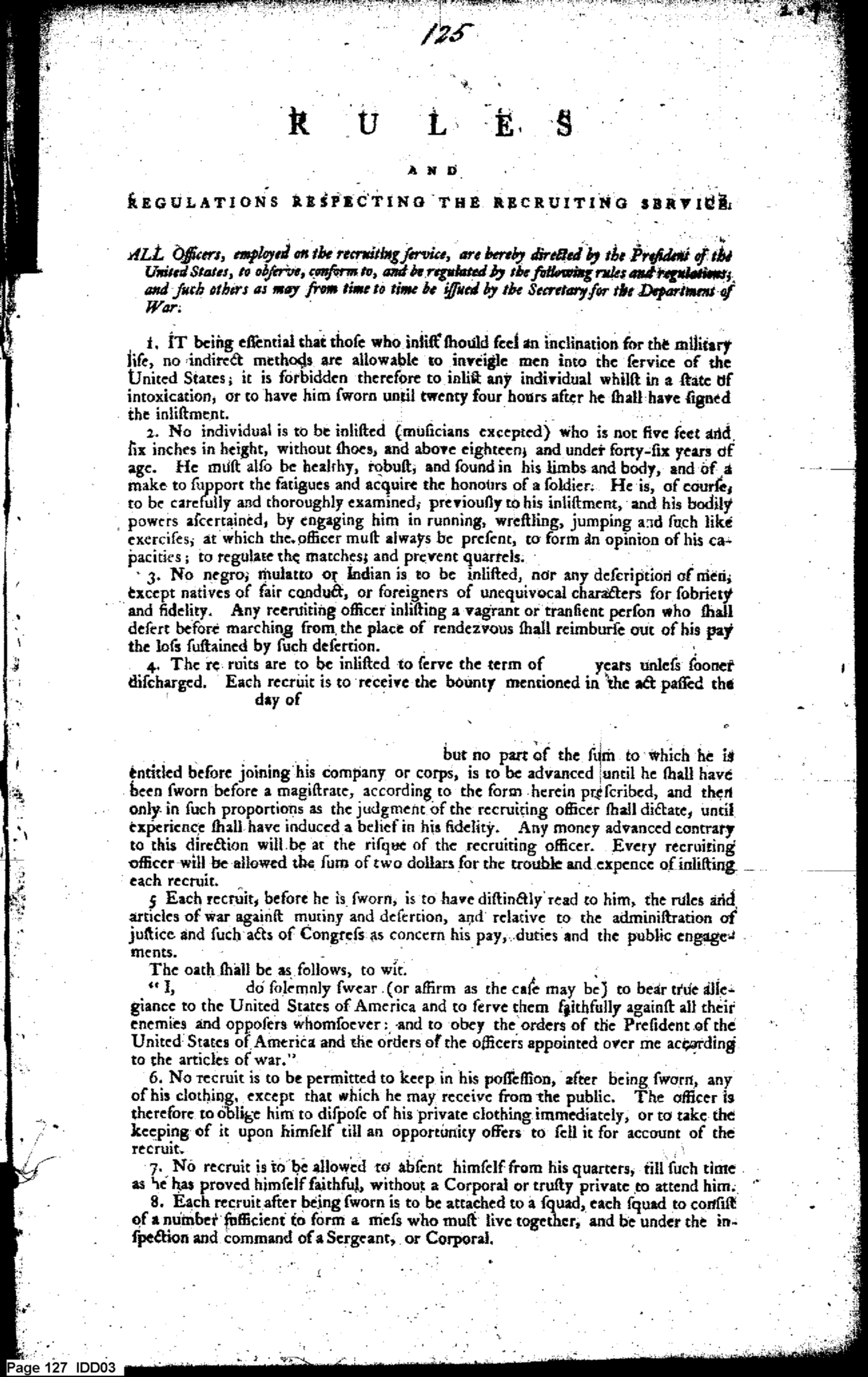
R U L E S
AND
REGULATIONS RESPECTING THE RECRUITING SERVICE.
*ALL Officers, employed on the recruiting service, are hereby directed by the President of the United States, to observe, conform to, and be regulated by the following rules and regulations; and such others as may from time to time be issued by the Secretary for the Department of War.*
1. IT being essential that those who inlist should feel an inclination for the military life, no indirect methods are allowable to inveigle men into the service of the United States; it is forbidden therefore to inlist any individual whilst in a state of intoxication, or to have him sworn until twenty four hours after he shall have signed the inlistment.
2. No individual is to be inlisted (musicians excepted) who is not five feet and six inches in height, without shoes, and above eighteen; and under forty-six years of age. He must also be healthy, robust, and found in his limbs and body, and of a make to support the fatigues and acquire the honours of a soldier. He is, of course, to be carefully and thoroughly examined; previously to his inlistment, and his bodily powers ascertained, by engaging him in running, wrestling, jumping and such like exercises; at which the officer must always be present, to form an opinion of his capacities; to regulate the matches; and prevent quarrels.
3. No negro, mulatto or Indian is to be inlisted, nor any description of men; except natives of fair conduct, or foreigners of unequivocal characters for sobriety and fidelity. Any recruiting officer inlisting a vagrant or transient person who shall desert before marching from the place of rendezvous shall reimburse out of his pay the loss sustained by such desertion.
4. The recruits are to be inlisted to serve the term of years unless sooner discharged. Each recruit is to receive the bounty mentioned in the act passed the day of
but no part of the sum to which he is entitled before joining his company or corps, is to be advanced until he shall have been sworn before a magistrate, according to the form herein prescribed, and then only in such proportions as the judgment of the recruiting officer shall dictate, until experience shall have induced a belief in his fidelity. Any money advanced contrary to this direction will be at the risque of the recruiting officer. Every recruiting officer will be allowed the sum of two dollars for the trouble and expence of inlisting each recruit.
5 Each recruit, before he is sworn, is to have distinctly read to him, the rules and articles of war against mutiny and desertion, and relative to the administration of justice and such acts of Congress as concern his pay, duties and the public engagements.
The oath shall be as follows, to wit.
"I, do solemnly swear (or affirm as the case may be) to bear true allegiance to the United States of America and to serve them faithfully against all their enemies and opposers whomsoever: and to obey the orders of the President of the United States of America and the orders of the officers appointed over me according to the articles of war."
6. No recruit is to be permitted to keep in his possession, after being sworn, any of his clothing, except that which he may receive from the public. The officer is therefore to oblige him to dispose of his private clothing immediately, or to take the keeping of it upon himself till an opportunity offers to sell it for account of the recruit.
7. No recruit is to be allowed to absent himself from his quarters, till such time as he has proved himself faithful, without a Corporal or trusty private to attend him.
8. Each recruit after being sworn is to be attached to a squad, each squad to consist of a number sufficient to form a mess who must live together, and be under the inspection and command of a Sergeant, or Corporal.
9. The Officer will regulate the hours of eating and will not suffer the corporal or any of the squad to be absent from meals.
10. Every recruiting Officer shall cause the roll of his recruits to be called three times every day; to wit at nine o'clock in the morning, at noon and at sunsetting.
11. The purposes to which recruits apply their money ought to be attended to as it will give indications to the officer of their dispositions.
12. A recruiting party is to be composed of a noncommissioned officer, music and one or a few privates, qualified for that service, whose known conduct is calculated to afford a good example to the recruits, and whose knowledge can be employed in [strikethrough: training them for actual services and military subordination.]
13. No recruiting officer is to promise a recruit that he shall be a non-commissioned Officer; but he is permitted to empower any recruit to act as a non-commissioned officer to a squad, or to the first or second class, and till such time only as he shall join the company or regiment to which he is destined, to the end that he may have an opportunity to shew by his conduct whether he is qualified for promotion, when it can take place in the course of service.
14. The artificers inlisted in pursuance of law, are to consist of the following branches viz. *Wheelwrights, Blacksmiths, Armourers and Carpenters.* Recruiting officers will receive written instructions as to the number of each kind they may inlist as such. No person to be inlisted for an artificer who has not served a regular apprenticeship to his trade, and who cannot produce a good character from two reputable citizens for sobriety and industry, and who will not condition, that he may, on his arrival at the corps for which he is destined, be reduced to the rank and pay of a private, if it shall appear that he is disqualified for the purpose for which he inlisted.
15. Every recruiting officer will cause his recruits to be separated into two classes, and will commence their instructions immediately after their being sworn.
The first Class to consist of those recruits who have learned the step and the management of their arms.
The new recruits to form the second class and be instructed in their positions, to march, and in the manual exercise, at least once every day, Sundays excepted, by a veteran sergeant, corporal, or well informed soldier. These instructions may be given to the recruits of the second class in quarters, on parade, or under cover in bad weather, first one by one, then two by two, and lastly in company. But they are not to be taught the management of their arms till after they have been habituated to the different positions and steps, commencing by the simplest and progressively advancing to the most complex.
When the officer shall judge a recruit qualified to pass to the first class, he will give orders accordingly to the sergeant or soldier instructor, and to the first class to receive him.
The exercise of the first class will be directed and superintended by the recruiting officer, and be the same as is usual for the perfecting of a company for actual service.
16. The commanding officer of a recruiting party shall make out on every Saturday, a return of the number of recruits under his command, and of the number joined, and the incidents that have taken place, and the arms, accoutrements and clothing delivered them during the course of the week, and transmit the same to the secretary for the department of war.
He shall also keep a recruiting book in which he shall record,
1. The name, trade and description of every recruit.
2. A copy of the oath taken before the magistrate, signed by the magistrate and recruit.
3. The money advanced every recruit, whether on account of bounty or pay.
4. The articles of cloathing, arms, and accoutrements delivered each recruit.
17. Each recruiting officer shall, besides, transmit weekly to the accountant to the department of war, a duplicate receipt signed by each recruit, for the bounty he shall have had advanced him within that period. This regulation is to be strictly observed till the recruits have joined their respective corps, after which it is not allowable for the officer to make them any payment on account of their bounty. It is to be understood also, that no credit will be allowed to a recruiting officer in the settlement of his accounts, which is not substantiated by such receipts thus transmitted; and that whatever part of the bounty remains due to a recruit on his union with his corps or company, shall not be paid by the recruiting officer, but be stated in the first pay roll after his arrival and paid to him at the same time as his pay.
18. The commanding officer at each rendezvous will sign returns for the issues of all rations and other necessary supplies for the troops, and on the Saturday of each week, the returns made in the week are to be taken up, and one general return made out and signed for the rations received in the course of the week, noticing the daily issues.
19. On the desertion of a recruit, besides the usual exertions and means to be employed on such occasions, the recruiting officer will transmit as soon as possible, a description of the deserter to the secretary of war, and will cause all descriptions of deserters that may be sent to him to be entered in a book kept for that purpose, and will use his endeavours to discover and apprehend all deserters.
20. Every recruiting officer shall send with the officer or other person having charge of any recruits inlisted by him and directed to join their regiment or corps, a return containing a particular description of each recruit, the date of his inlistment, the amount of what bounty and clothing he may have received, and the time to which he has been paid; which return must be delivered by the officer or person having charge of the detachment to the commanding officer at the place of destination.
*Given at the WAR-OFFICE of the United States,*
*in Philadelphia, this*
*day of*