

Ratification of the deed of Assignment for the two Indian children of Ebenezer Allan.
Document 1791Document, ratification of a deed of assignment executed by the Chiefs of the Seneka Nation to the two Indian Children of Ebenezer Allan.



No human transcription currently available for this document.
This transcription was generated by machine using Anthropic's Claude Code (model sonnet 4.6). It may contain errors or inaccuracies. Please verify against the document image. Learn more about our generative AI methodology.
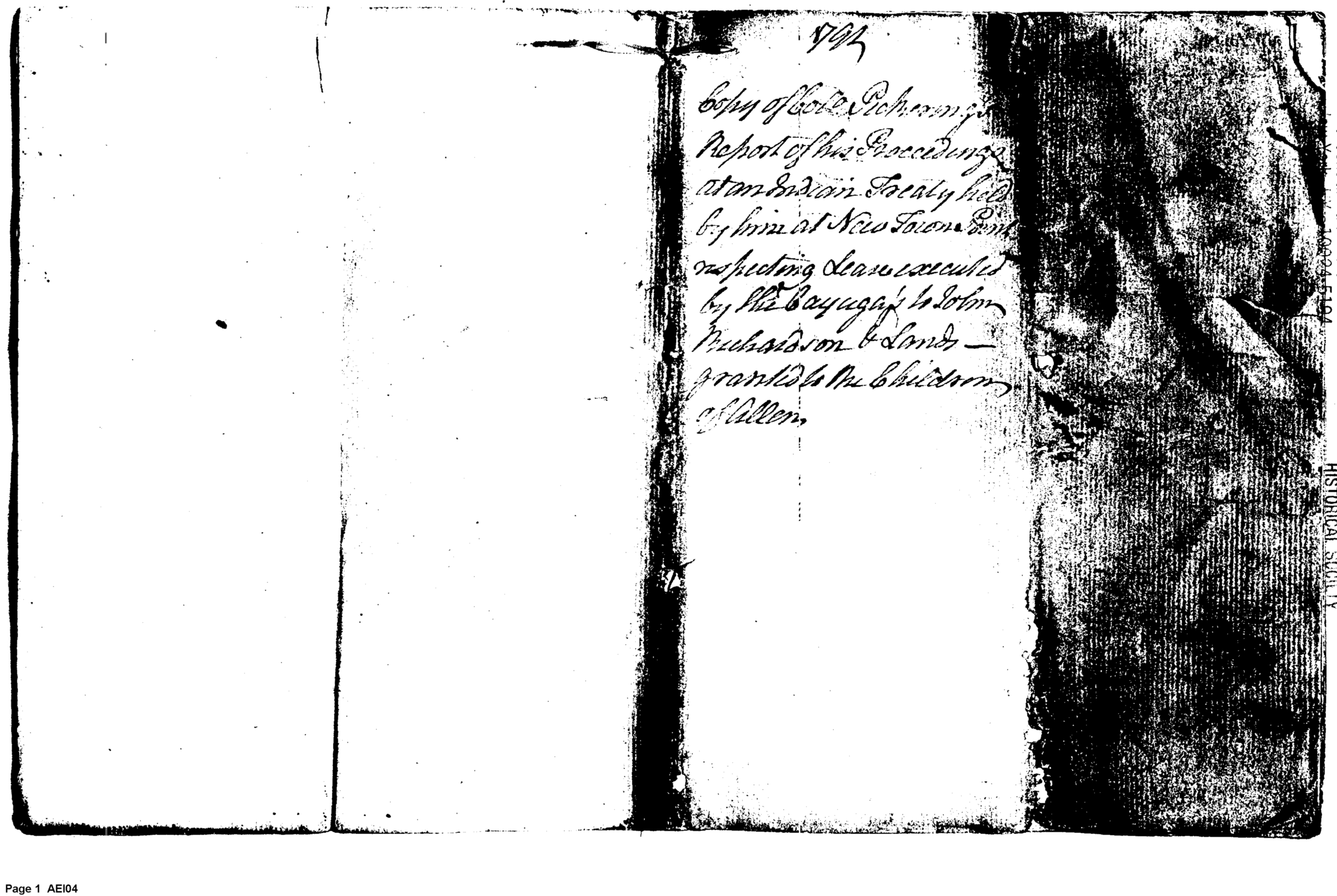
[Copy — Cover/Wrapper:]
1791
Copy of Col: Pickering's
Report of his Proceedings
at an Indian Treaty held
by him at New Town [Point?]
respecting Lease executed
by the Cayugas to John
Richardson & Lands —
granted to the Children
of Allen.
Philadelphia. August 16.th 1791
Sir
In addition to the information given in my report of the proceedings at the late treaty with the Six nations of Indians, relative to the land assigned by the Sencha Nation, to the Children of one of their women, by Ebenezer Allan— and to the Cayuga reservation leased to John Richardson for twenty years.— it may be expedient for me to mention more particularly, the grounds and inducements to a public ratification of both; at that treaty.
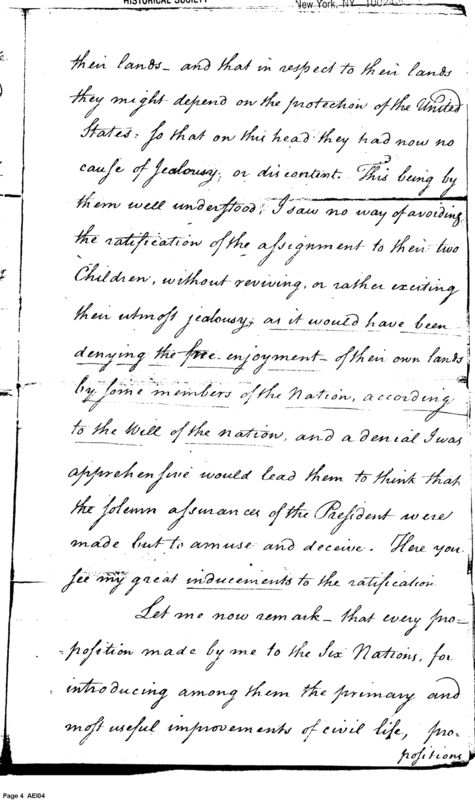
It appeared to be understood by the Senchas that Mess.rs Morris & Ogden, as the grantees of Massachusetts, had the right of pre-emption of all their lands. But at the same time there existed their lands— and that in respect to their lands they might depend on the protection of the United States: so that on this head they had now no cause of Jealousy; or discontent. This being by them well understood; I saw no way of avoiding the ratification of the assignment to their two Children, without reviving, or rather exciting their utmost jealousy; as it would have been denying the [underline: free enjoyment_] of their own lands by some members of the Nation, according to the will of the nation, and a denial I was apprehensive would lead them to think that the solemn assurances of the President were made but to amuse and deceive. Here you see my great [underline: inducements to the ratification]
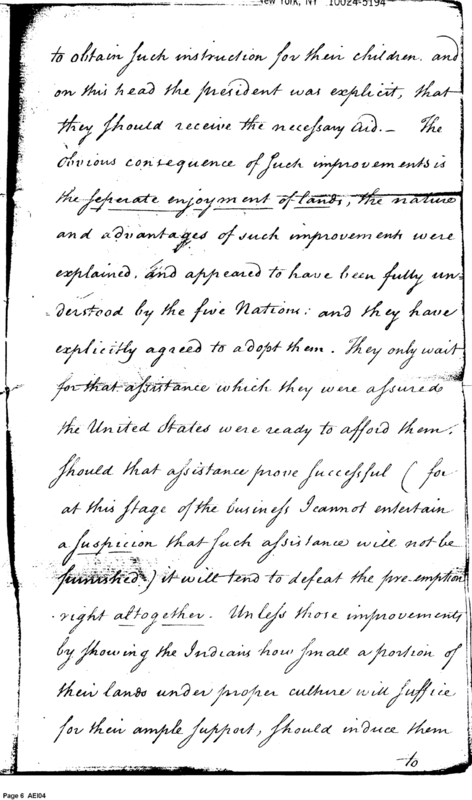
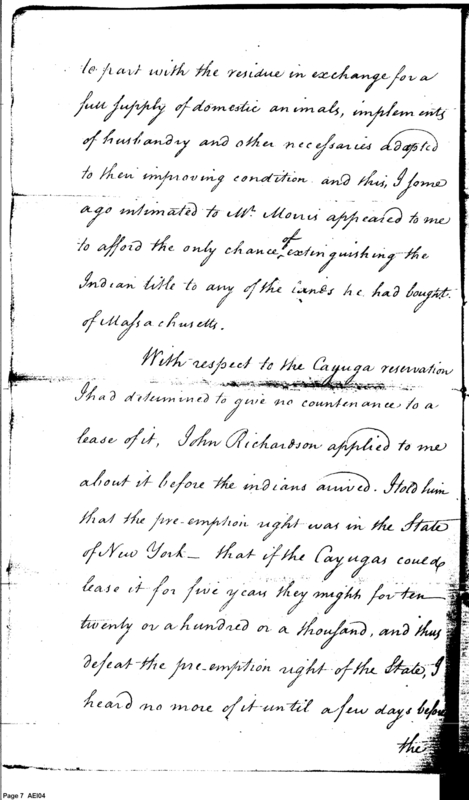
Let me now remark— that every pro-position made by me to the Six Nations, for introducing among them the primary and most useful improvements of civil life, pro-positions grounded on the Presidents declarations to the Complanter, which I was enjoined to repeat, and on your particular instruction on this point )— leads to a seperate occupancy, and enjoyment of land. The introduction of the art of Husbandry in its improved State was the great object; but improvements in husbandry could not take place without exclusive property, that the improver might enjoy the fruit of his labor— Neither could the improving husbandman exist without the Smith and the Carpenter; and his [underline: flax] and [underline: wool] would furnish employment to the spinner and [underline: weaver]. These were all the Manual arts I mentioned, Instruction in the arts of [underline: reading] and writing was at least equally desirable to the Indians, some of their cheifs have even manifested an anxiety to obtain such instruction for their children. and on this head the President was explicit, that they should receive the necessary aid.— The obvious consequence of such improvements is the [underline: seperate enjoyment of lands]; the nature and advantages of such improvements were explained. and appeared to have been fully understood by the five Nations: and they have explicitly agreed to adopt them. They only wait for that assistance which they were assured the United States were ready to afford them. Should that assistance prove successful ( for at this stage of the business I cannot entertain a suspicion that such assistance will not be [underline: furnished].) it will tend to defeat the pre-emption right altogether. Unless those improvements by showing the Indians how small a portion of their lands under proper culture will suffice for their ample support, should induce them to part with the residue in exchange for a full supply of domestic animals, implements of husbandry and other necessaries adapted to their improving condition. and this, I some ago intimated to Mr. Morris appeared to me to afford the only chance of extinguishing the Indian title to any of the lands he had bought of Massachusetts.
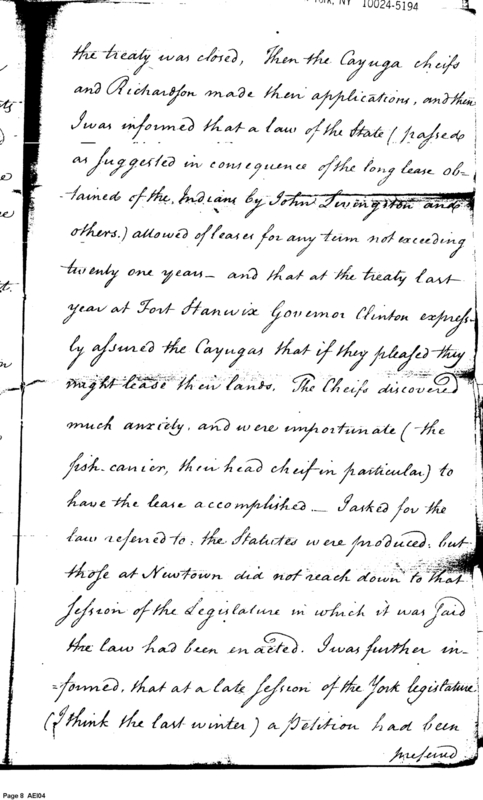
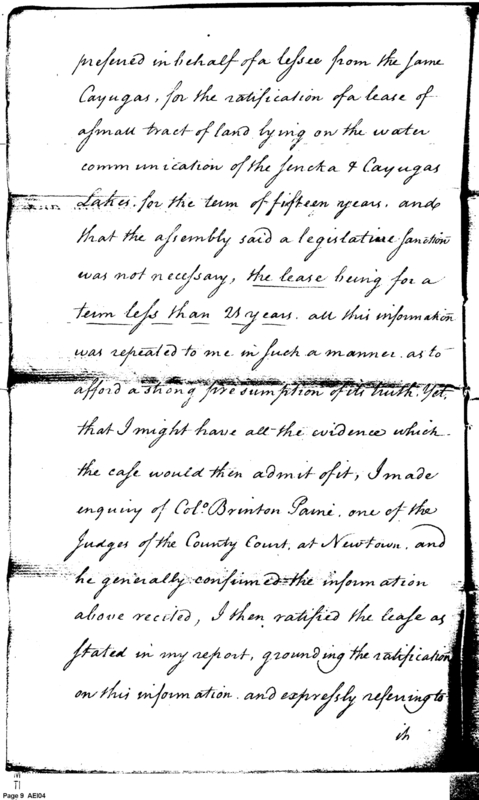
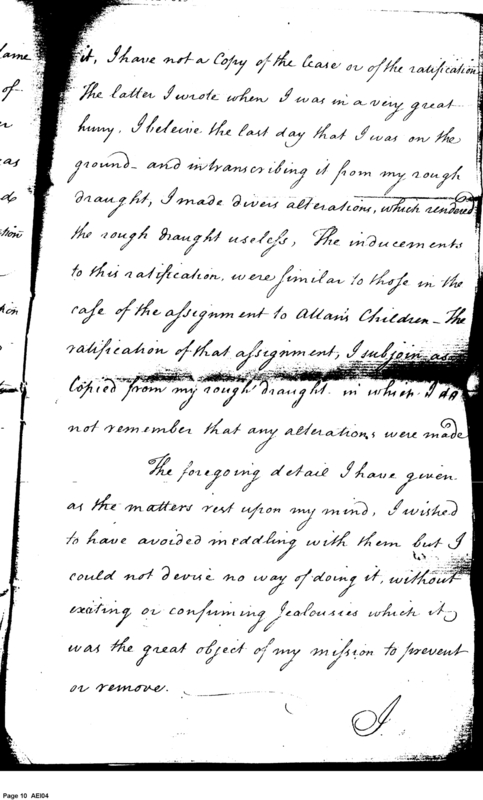
With respect to the Cayuga reservation I had determined to give no countenance to a lease of it, John Richardson applied to me about it before the indians arrived. I told him that the pre-emption right was in the State of New York— that if the Cayugas could lease it for five years they might for ten twenty or a hundred or a thousand, and thus defeat the pre-emption right of the State; I heard no more of it until a few days before the treaty was closed. Then the Cayuga cheifs and Richardson made their applications, and then I was informed that a law of the State ( passed as suggested in consequence of the long lease obtained of the Indians by John Livingston and others.) allowed of leases for any turn not exceeding twenty one years— and that at the treaty last year at Fort Stanwix Governor Clinton expressly assured the Cayugas that if they pleased they might lease their lands. The Cheifs discovered much anxiety, and were importunate (the fish-carrier, their head cheif in particular) to have the lease accomplished.— I asked for the law referred to: the Statutes were produced: but those at Newtown did not reach down to that Session of the Legislature in which it was said the law had been enacted. I was further in-formed, that at a late Session of the York legislature (I think the last winter) a Petition had been presented in behalf of a lessee from the same Cayugas, for the ratification of a lease of a small tract of land lying on the water communication of the Seneka & Cayugas Lakes. for the term of fifteen years. and that the assembly said a legislative sanction was not necessary, [underline: the lease] being for a term less than 21 years. all this information was repeated to me in such a manner as to afford a strong presumption of its truth. Yet, that I might have all the evidence which the case would then admit of it; I made enquiry of Colo. Brinton Paine. one of the Judges of the County Court. at Newtown. and he generally confirmed the information above recited. I then ratified the lease as stated in my report, grounding the ratification on this information. and expressly referring to it. I have not a Copy of the lease or of the ratification. The latter I wrote when I was in a very great hurry. I believe the last day that I was on the ground— and in transcribing it from my rough draught, I made divers alterations, which rendered the rough draught useless. The inducements to this ratification, were similar to those in the case of the assignment to Allan's Children. The ratification of that assignment, I subjoin as copied from my rough draught. in which I do not remember that any alterations were made.
The foregoing detail I have given as the matters rest upon my mind, I wished to have avoided meddling with them but I could not devise no way of doing it, without exating or confirming Jealousies which it was the great object of my mission to prevent or remove.
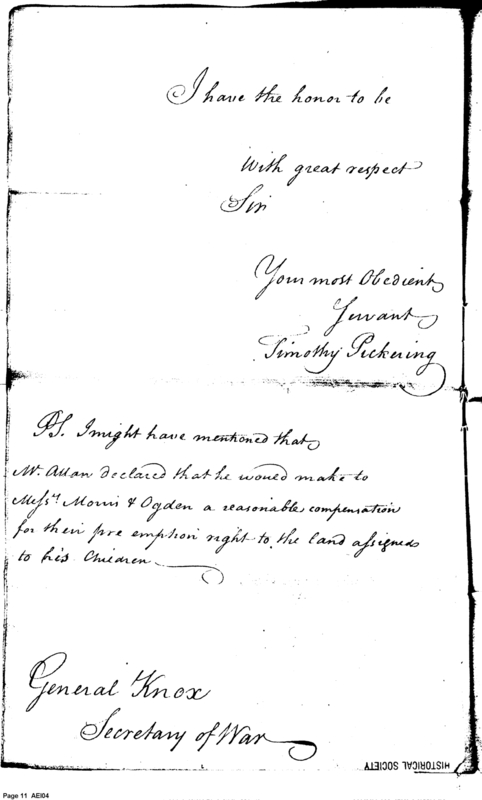
I have the honor to be
With great respect
Sir
Your most Obedient
Servant
Timothy Pickering
P.S. I might have mentioned that, Mr. Allan declared that he would make to Mess.rs Morris & Ogden a reasonable compensation for their pre emption right to the land assigned to his Children.
General Knox
Secretary of War
[Endorsement: The foregoing is a true Copy —
War-Office }
Aug. 10 1791 } [undecipherable] Stagg Junr
[undecipherable]]
[Enclosure]
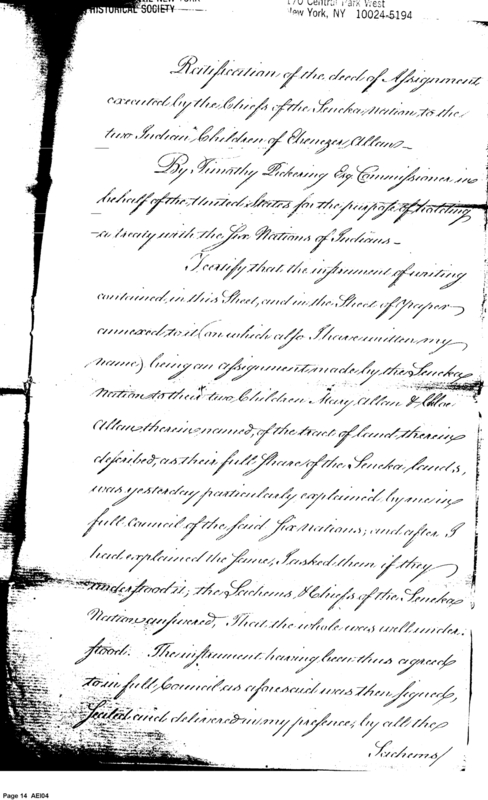
Ratification of the deed of Assignment executed by the Chiefs of the Seneka Nation, to the two Indian Children of Ebenezer Allan—
By Timothy Pickering Esq Commissioner on behalf of the United States for the purpose of holding a treaty with the Six Nations of Indians—
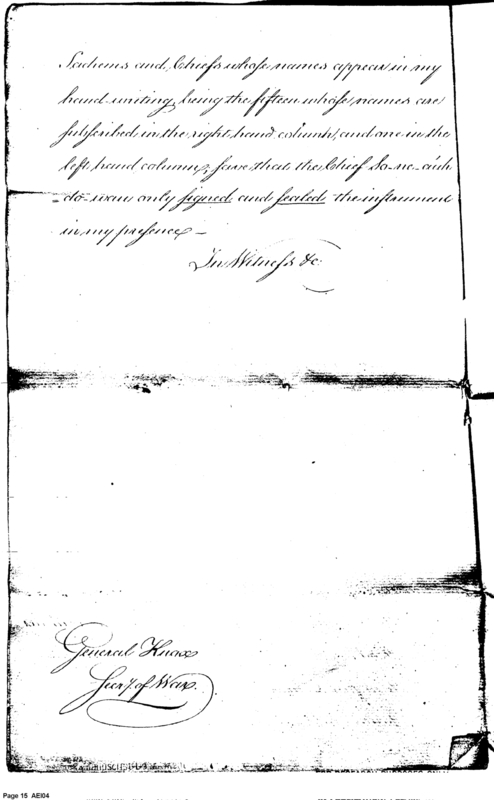
I certify that the instrument of writing contained in this Sheet, and in the Sheet of paper annexed to it (on which also I have written my name) being an assignment made by the Seneka Nation to their two Children Mary Allan & Chloe Allen therein named, of the tract of land therein described, as their full Share of the Seneka lands, was yesterday particularly explained by me in full Council of the said Six Nations; and after I had explained the same; I asked them if they understood it; the Sachems & Chiefs of the Seneka Nation answered, That the whole was well understood. The instrument having been thus agreed to in full Council as aforesaid was then signed, [underline: sealed] and delivered in my presence; by all the Sachems/ Sachems and Chiefs whose names appear in my hand-writing, being the fifteen whose names are subscribed in the right hand column; and one in the left hand column; save that the Chief So-no-cah-do-wean only [underline: signed] and [underline: sealed] the instrument in my presence—
In Witness &c.
General Knox
Secy of War.
Type
Letterbook
Description
Document, ratification of a deed of assignment executed by the Chiefs of the Seneka Nation to the two Indian Children of Ebenezer Allan.
Date
1791
Recipient
Collection
Document number
1791999900101
Page start
13
Note
Enclosed in Pickering to Knox, 08/16/1791.
Notable persons
Henry Knox
Ebenezer Allan
Timothay Pickering
Chiefs of the Seneka Nation
Six Nations of Indians
Mary Allan, Chelore Allan
Council of the Six Nations
Chief Sa-ne-aich-do-wan
Mr. Morris
Mr. Ogden
Notable locations
United States
New Town
Notable items
ratification of the deed of assignment
Indian children
treaty
writing
sheet of papers
assignment
track of land
their full share of the Seneka lands
yesterday
council
sachems
instrument
agreed to in whole
signed, sealed and delivered
preemption right