No human transcription currently available for this document.
Now I have all 30 pages. Let me compile the complete transcription, using the primary source (pages 3–9) with the cleaner copies (pages 12–22) to resolve the heavily damaged passages.
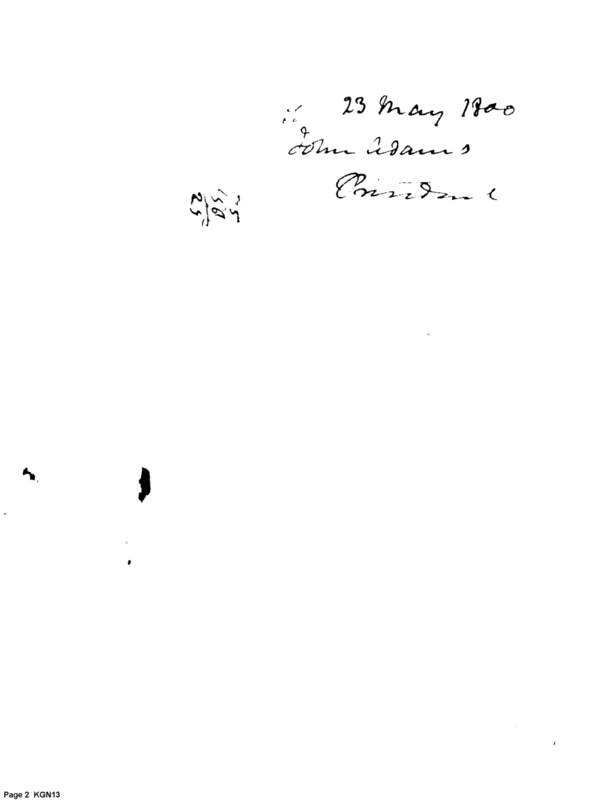
[23 May 1800
John Adams
President]
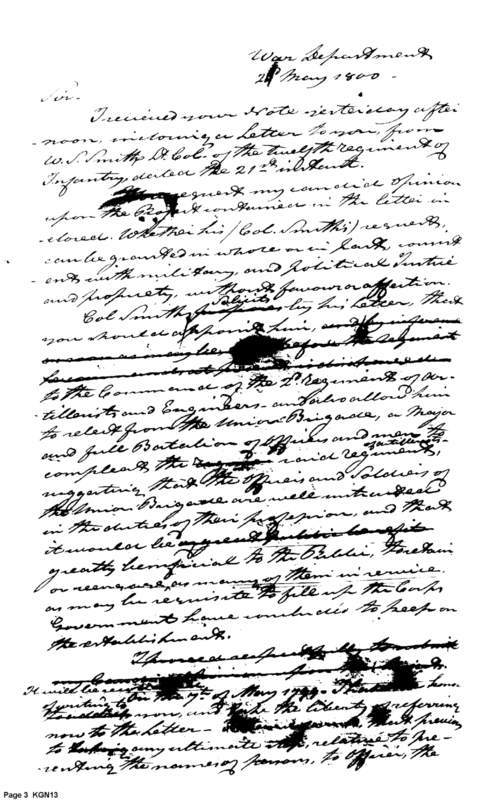
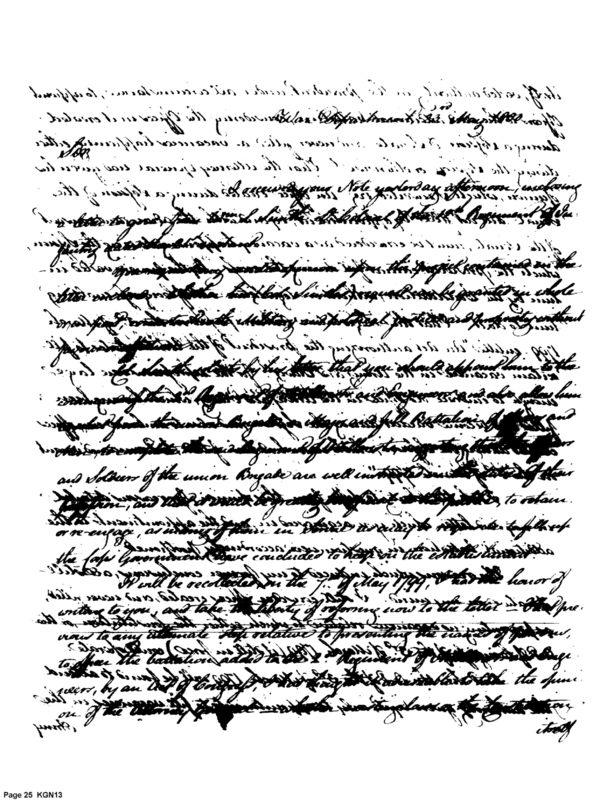
War Department,
23d May 1800
Sir-
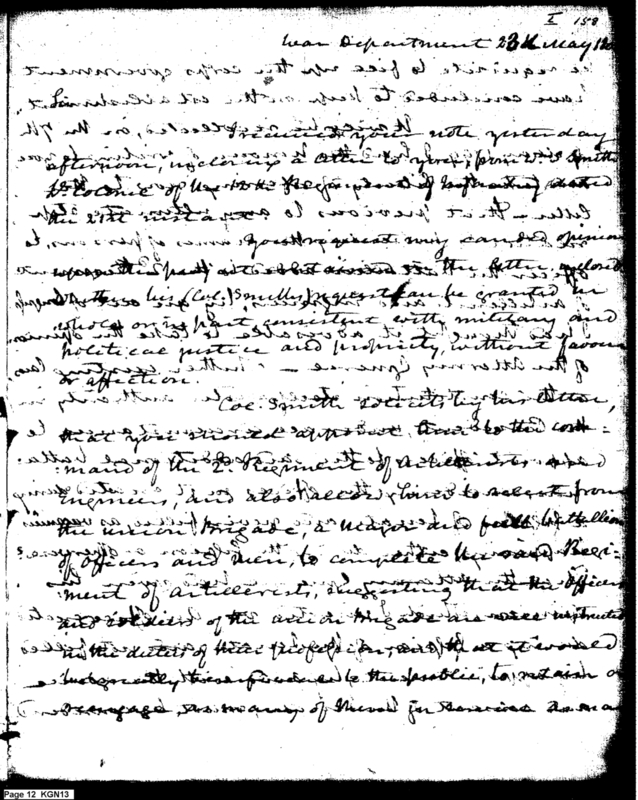
I received your Note yesterday afternoon, inclosing a Letter to you, from W.S. Smith D. Col. of the twelfth Regiment of Infantry, dated the 21st instant.
You request my candid Opinion upon the [topics] contained in the letter enclosed. Whether his (Col. Smith's) requests, can be granted in whole or in part, consistent with military, and political Justice and propriety, without favour or affection.
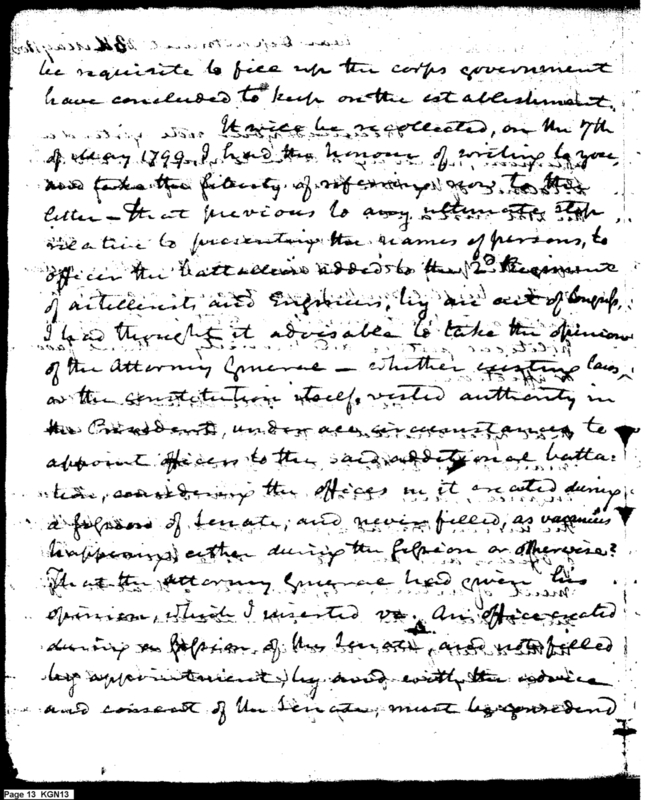
Col Smith solicits by his Letter, that you should appoint him, and [by inference as many as] [undecipherable] to the Command of the 2d Regiment of Artillerists and Engineers; and also allow him to select from the union Brigade, a Major and full Battalion of Officers and men to complete the [undecipherable] said Regiment, suggesting that the Officers and Soldiers of the union Brigade are well instructed in the duties of their profession, and that it would be greatly beneficial to the Public, to retain or re-engage, as many of them in service, as may be requisite to fill up the Corps Government have concluded to keep on the establishment.
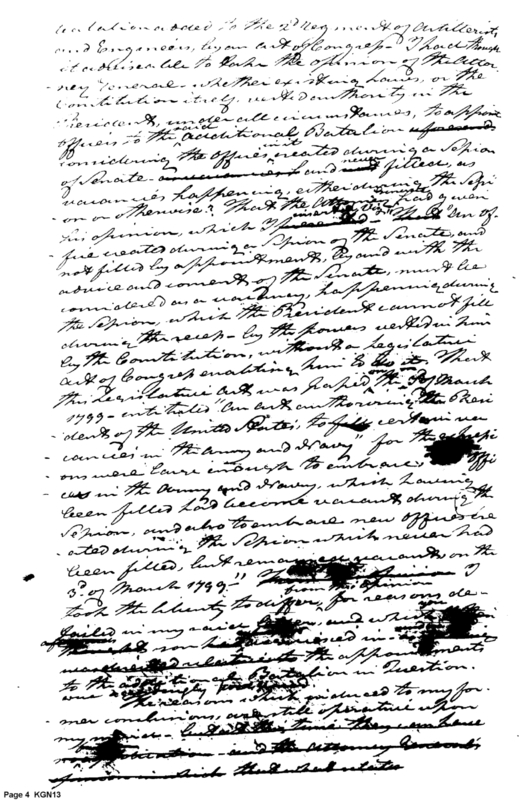
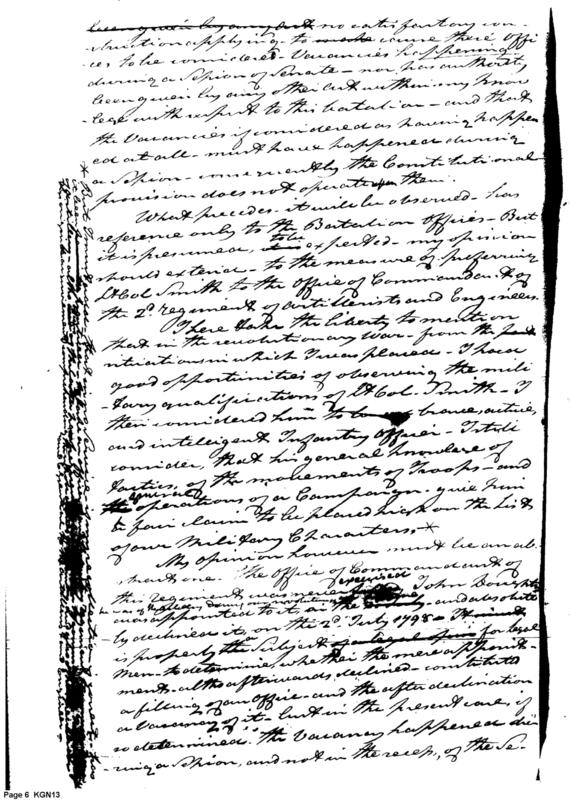
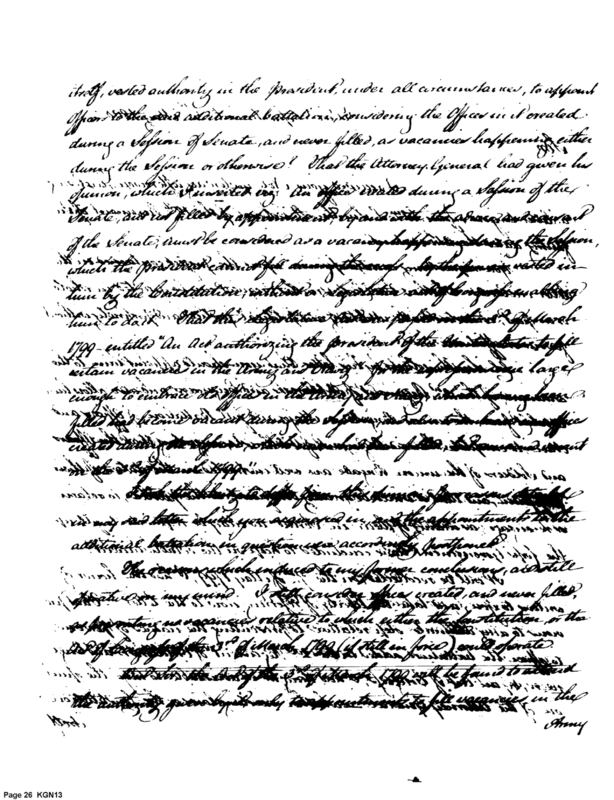
[undecipherable] It will be recollected, on the 7th of May 1799, I had the honour of writing to you, and take the liberty of referring now to the letter — that previous to any ultimate step, relative to presenting the names of persons, to officer the battalions added to the 2d Regiment of Artillerists and Engineers, by an act of Congress. I had thought it advisable to take the opinion of the Attorney General — whether existing laws, or the Constitution itself, vested authority in the President, under all circumstances, to appoint officers to the said additional Battalion, considering the offices created during a Session of Senate — [undecipherable] and never filled, as vacancies happening either during the Session or otherwise? That the Attorney General had given his opinion, which [I had seen] — An office created during a Session of the Senate, and not filled by appointment, beyond with the advice and consent of the Senate, must be considered as a vacancy, happening during the Session, which the President cannot fill during the recess — by the powers vested in him by the Constitution, without a legislative act of Congress enabling him to do it. That this legislative act was passed the 3d of March 1799 — entitled "An act authorizing the President of the United States, to fill certain vacancies in the Army and Navy" for the subscriptions were large enough to embrace offices in the Army and Navy, which having been filled had become vacant during the Session, and also to embrace new offices created during the Session which never had been filled, but remained vacants on the 3d of March 1799. [From this] opinion I took the liberty to differ, for reasons [detailed] in my advice [to you, and which you have discovered in your] measures relating to the appointments to the additional battalion in question. The reasons which induced to my former conclusions, are still operative upon my mind — and the Attorney General's opinion in which the [undecipherable] states [undecipherable]
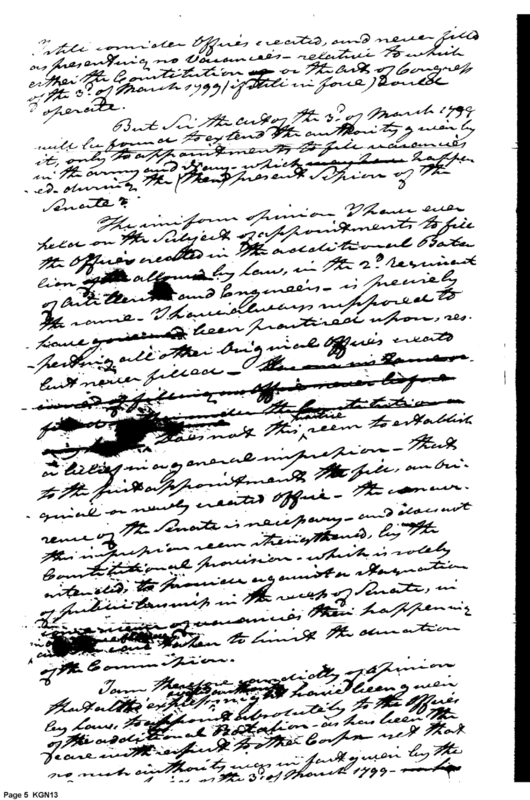
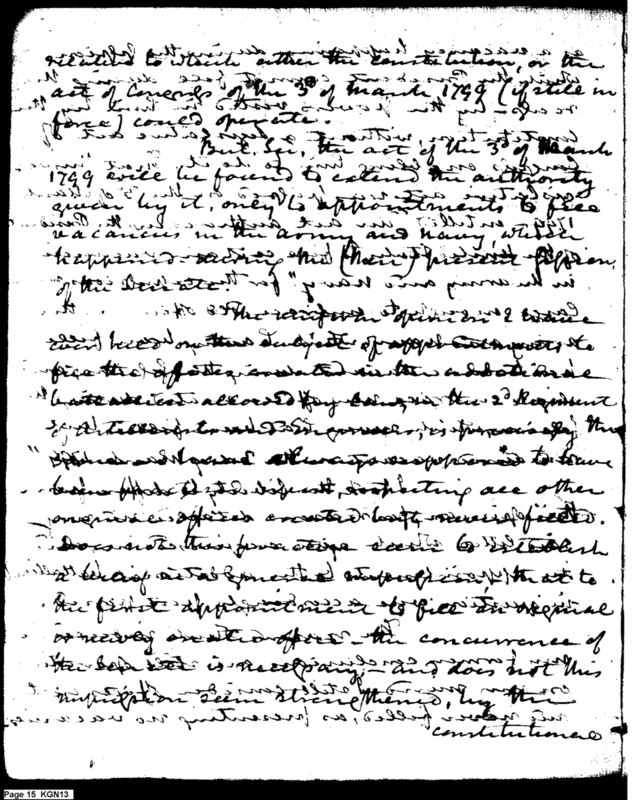
still consider offices created, and never filled, as presenting no vacancies — relative to which either the Constitution, or the act of Congress of the 3d of March 1799 (if still in force) could operate.
But Sir, the act of the 3d of March 1799 will be found to extend the authority given by it, only to appointments to fill vacancies in the army and navy, which happened during [the present] Session of the Senate.
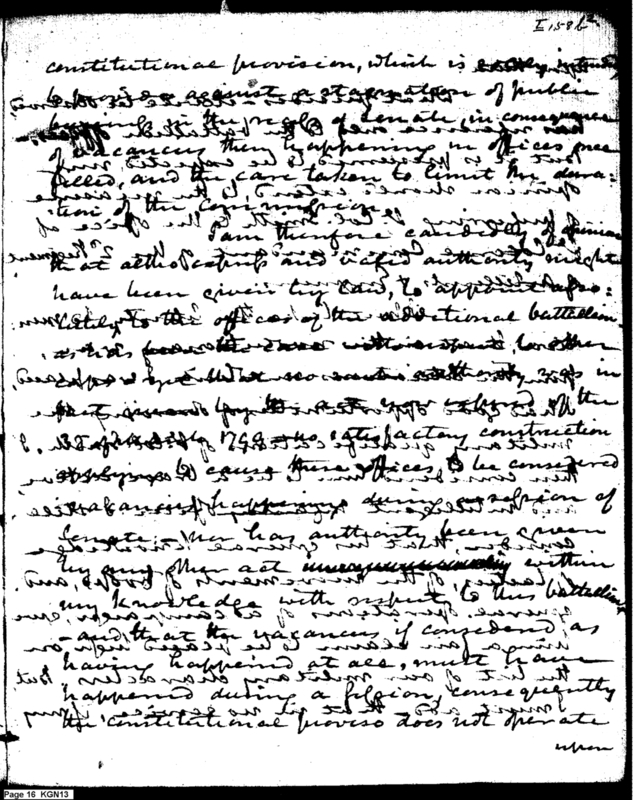
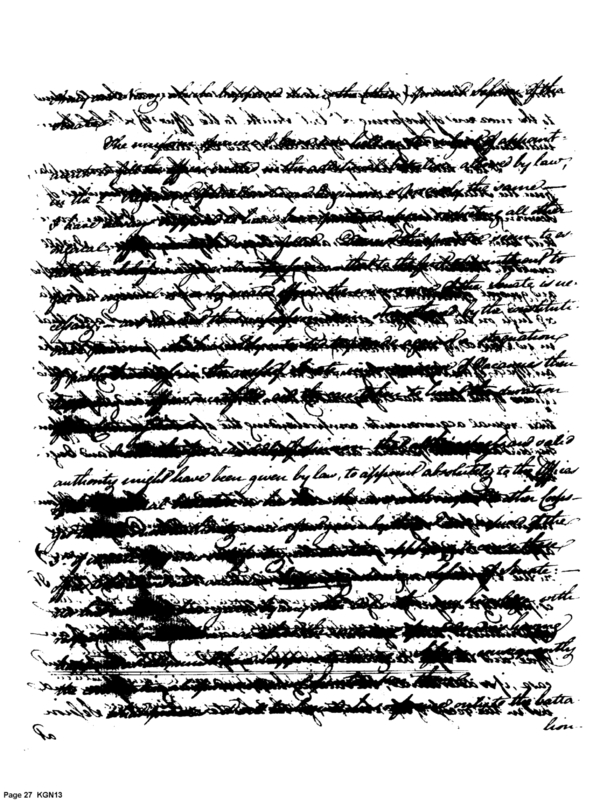
The uniform opinion I have ever held on the subject of appointments to fill the offices created in the additional Battalion allowed by law, in the 2d Regiment of Artillerists and Engineers — is precisely the same. I have always supposed to have been practiced upon, respecting all other original offices created but never filled — [the case is the same] — [and] [of] [creating an] office [never filled under] the Constitution [which] does not [this] seem to establish, or [settling] in a general [impression] — That to the first appointments [to fill an] original or newly created office — The concurrence of the Senate is necessary — and does not this [impression] seem strengthened, by the Constitutional provision — which is solely intended to [provide] against a [stagnation] of public business in the recess of Senate, in [the occurrence] of vacancies, their happening [and] [when] to limit the duration of the Commission.
I am therefore candidly of opinion that [the] [authority] of appointment [which] has been given by law, to appoint absolutely to the Officers of the additional Battalion — as has been the practice with respect to [the] Corps [and] that no such authority was in [part] given by the [3d of March] 1799 — [not]
been given by any [authority] no satisfactory [construction] applying to [the] [undecipherable] Officers to be considered — Vacancies happening during a Session of Senate — nor has authority been given by any other act within my knowledge with respect to this battalion — and that the vacancies if considered as having happened at all — must have happened during a Session — consequently the Constitutional provision does not operate upon them.
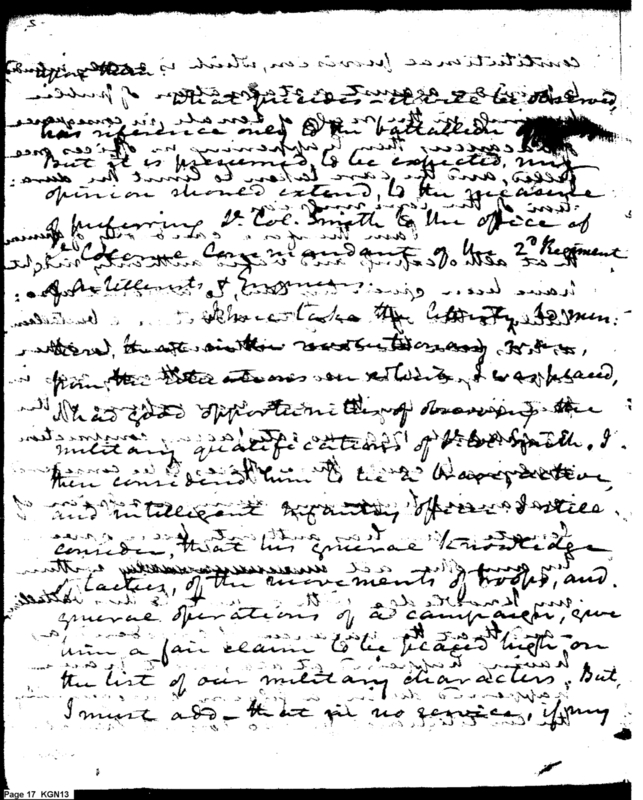
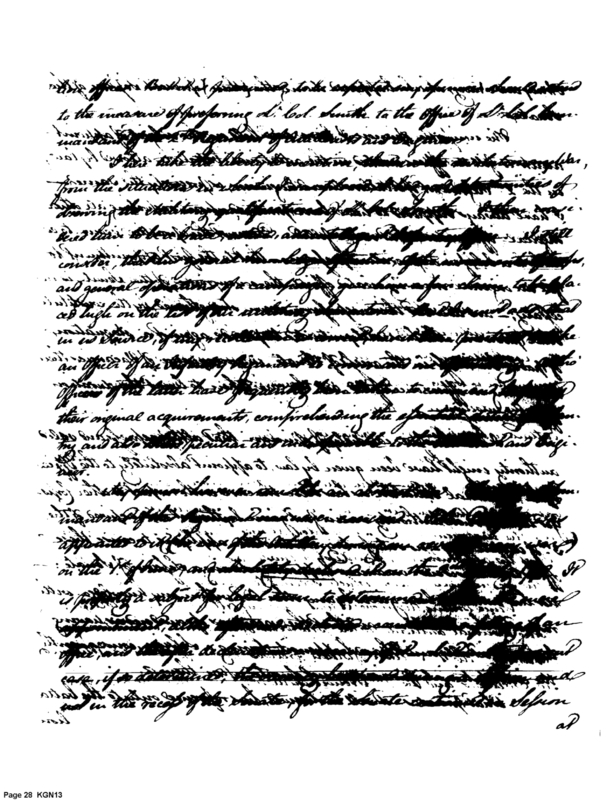
What precedes it will be observed — has reference only to the Battalion offices — But it is presumed, [to be] as expected — my opinion should extend — to the measure of preferring Lt Col Smith to the office of Commander of the 2d Regiment of Artillerists and Engineers.
[I] here take the liberty to mention that in the revolutionary War — from the [position] and [situations] in which I was placed — I have had good opportunities of observing the military qualifications of Lt Col. Smith — I then considered him to be a brave, active, and intelligent Infantry officer — I still consider, that his general knowledge of tactics, of the movements of Troops — and the operations of a Campaign. give him a fair claim to be placed high on the list of our Military Characters. *
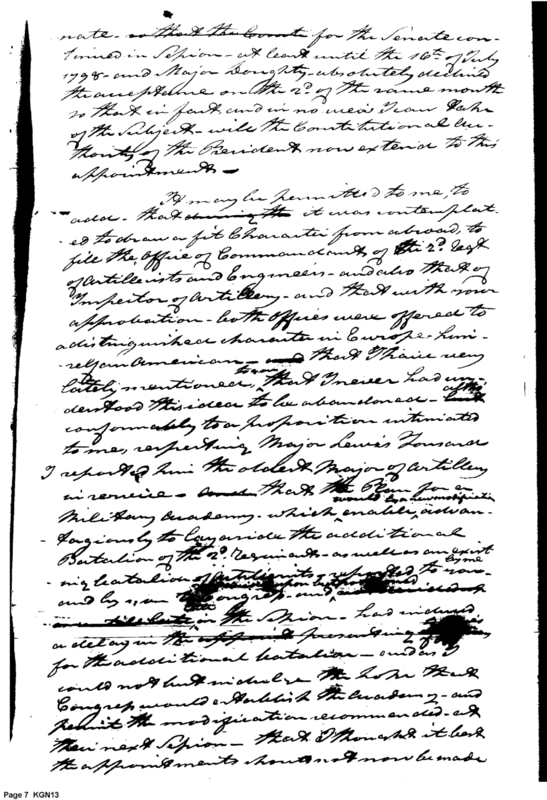
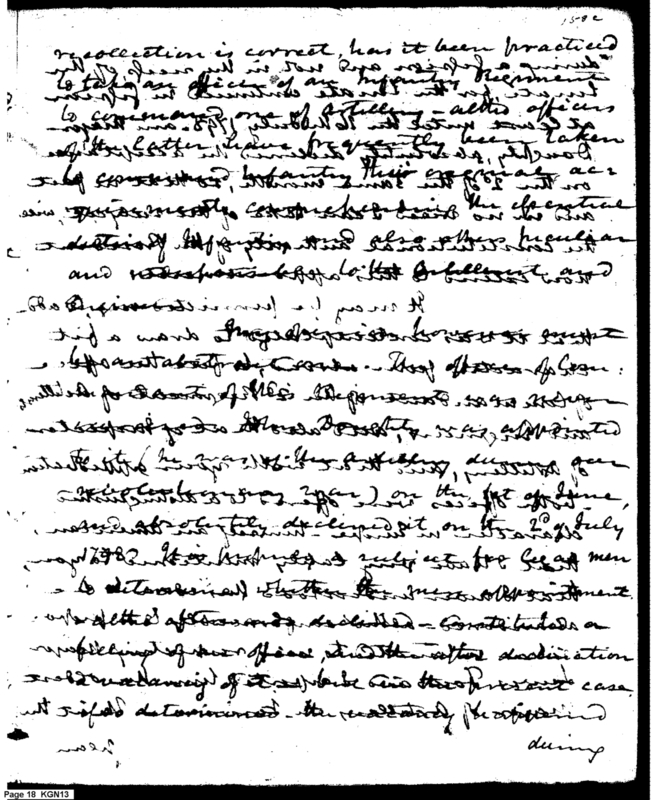
My opinion however must be an adverse one. The Office of Commander of this regiment was never [filled during the] revolutionary [war] — and [John Doughty] was appointed to it, on the [undecipherable] — and also [it was] absolutely [appointed to] it, on the 2d July 1798 — [and it] is properly the subject of a legal opinion for [the legal] men — to determine whether the mere appointment [after] — all the afterwards declined — constituted a filling of an office — and the after declination [created] a vacancy of it — but in the present case, it [is] determined — the vacancy happened during
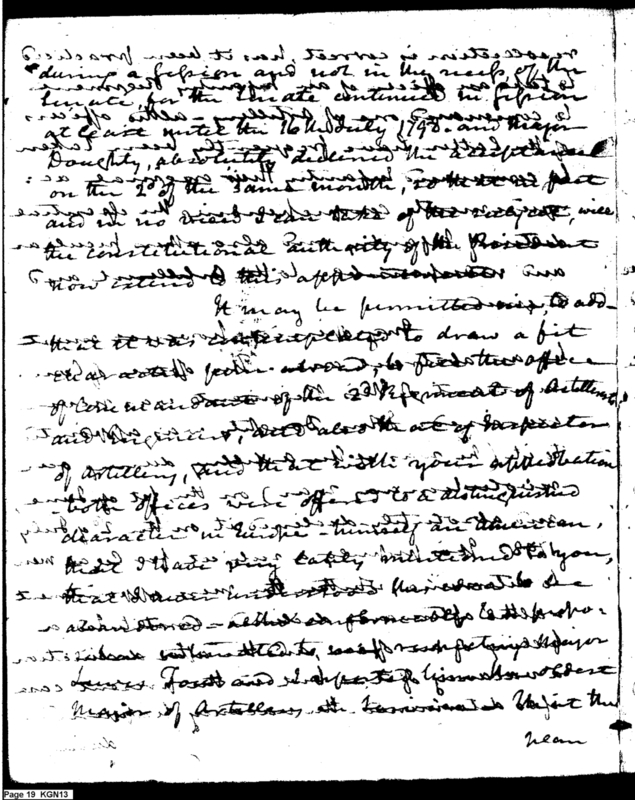
nate — so that the [consent for the] Senate continued in Session — at least until the 16th of July 1798 — and Major Doughty absolutely declined the appointment on the 2d of the same month — so that in fact, and in no new view I take of the subject — will the Constitutional authority of the President now extend to this appointment —
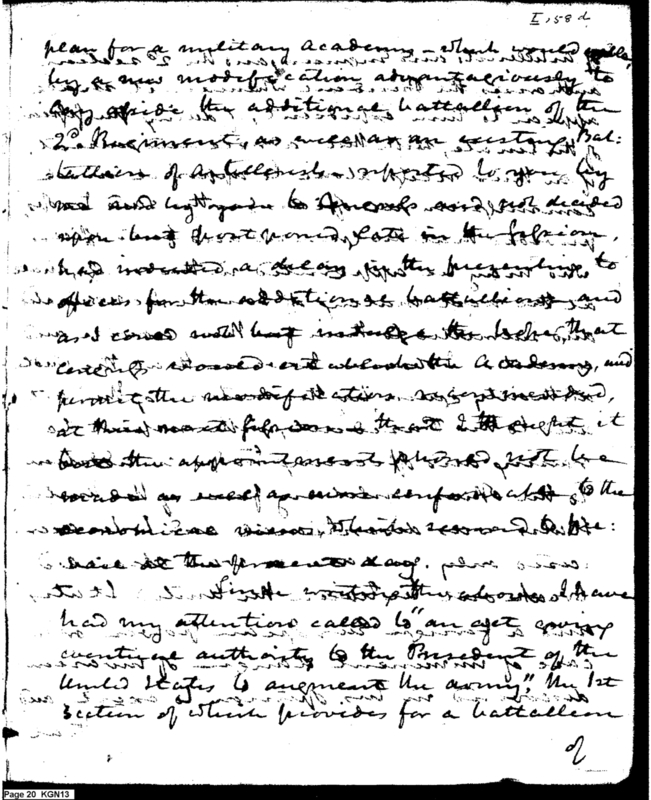
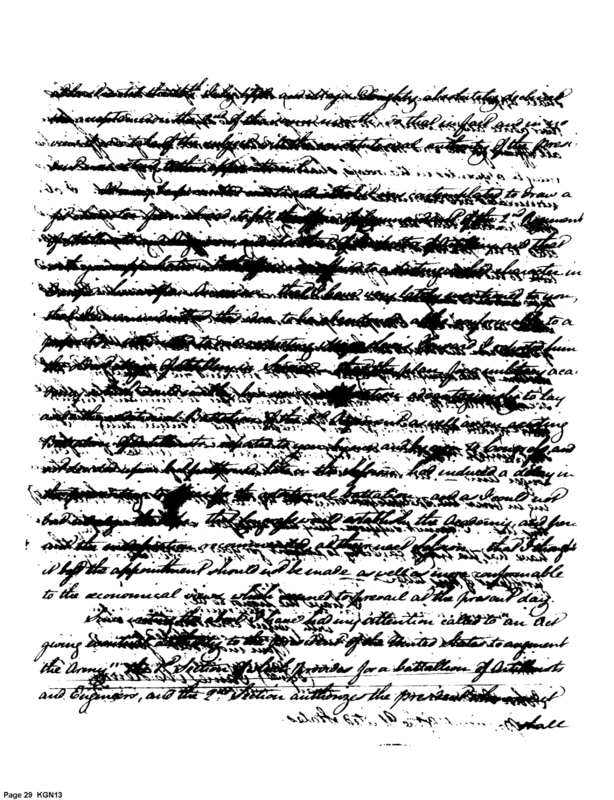
It may be permitted to me, to add — that during [the time] it was contemplated to draw a fit character from abroad, to fill the Office of Commandant of the 2d Regiment of Artillerists and Engineers — and also that of Inspector of Artillery — and that with your approbation — both offices were offered to a distinguished character in Europe — himself an American — and that [I have] very lately mentioned, [to you] that I never had understood this idea to be abandoned — and conformably to a proposition intimated to me, respecting Major Lewis Tousard I reported him the oldest Major of Artillery in service — and that the plan for a Military Academy — which enable, advantagiously to [lay aside] the additional Battalion of the 2d Regiment — as well as an existing [undecipherable] battalion [of artillerists] reported to you — and by [some] Congress — and, [has been decided upon] in the Session — had induced a delay in the [appointments for] the additional battalion — and as I could not but hope that Congress would establish the Academy — and permit the modification recommended — at the next Session — that I thought the appointments should not now be made
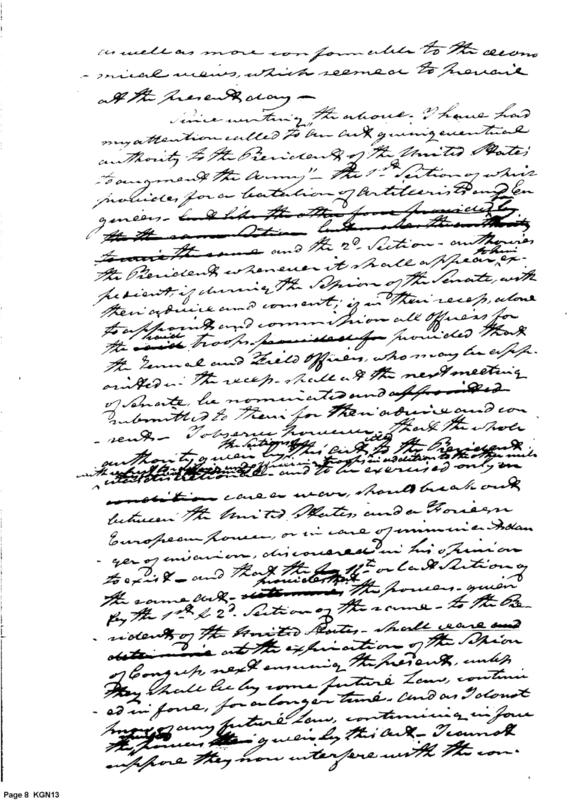
as well as more conformable to the economical views, which seemed to prevail at the present day —
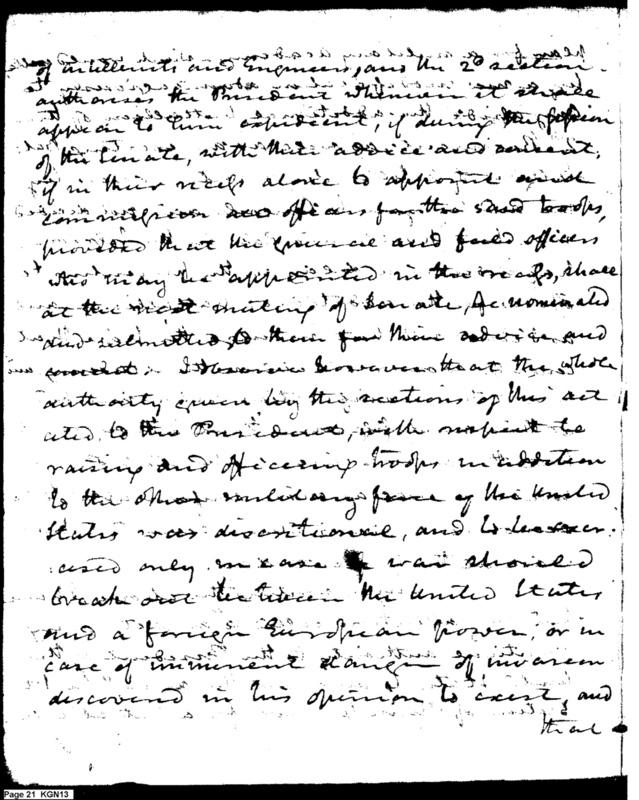
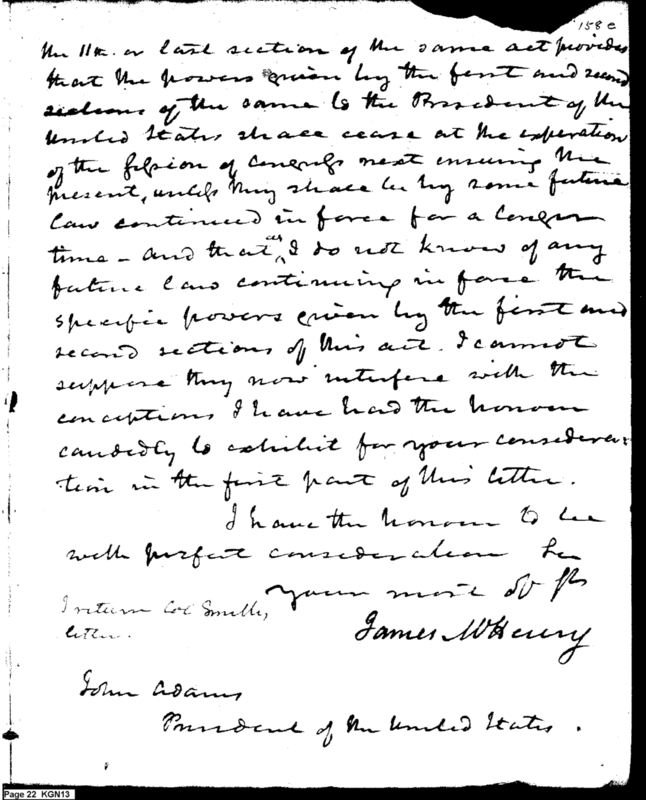
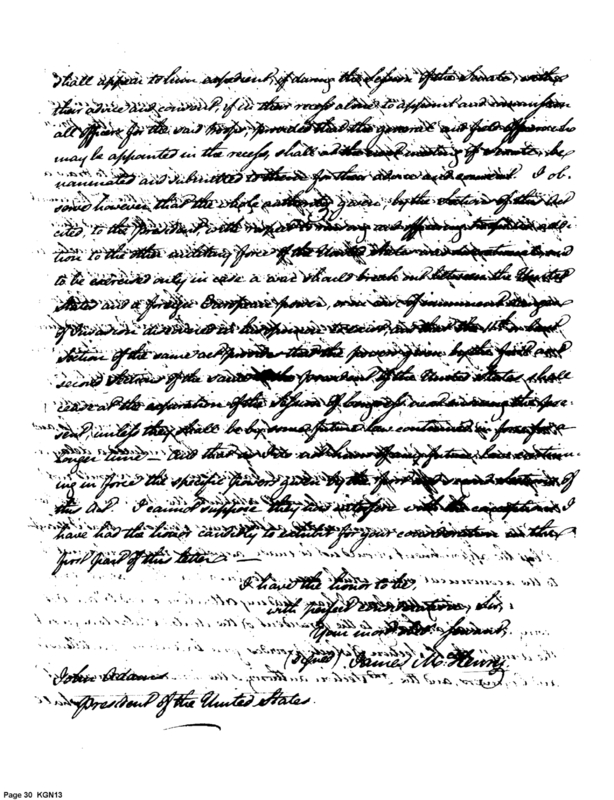
Since writing the above — I have had my attention called to an Act giving eventual authority to the President of the United States "to augment the Army" — The 1st Section of which provides for a battalion of Artillerists and Engineers — and [undecipherable] — and the 2d Section — authorizes the President whenever it shall appear, expedient, if during the Session of the Senate, with their advice and consent, if in their recess, alone to appoint and commission all officers for the said troops — provided that the General and field officers, who may be [appointed in] the recess — shall at the next meeting of Senate, be nominated and [appointment] submitted to them for their advice and consent — I observe however that the whole authority given by this [Act] to the President [is] [in addition to the other] military [situation] — and to be exercised only in a case [a] war should break out between the United States and a Foreign European power, or in case of imminent danger of invasion, discovered in his opinion to exist — and that the 11th or last Section of the same act — [determines] the powers given by the 1st & 2d Sections of the same — to the President of the United States — shall cease and [otherwise] at the expiration of the Session of Congress next ensuing the present, unless they shall be by some future laws, continued in force — and as I do not know any future law, continuing in force the powers given by this Act — I cannot suppose they now interfere with the con-
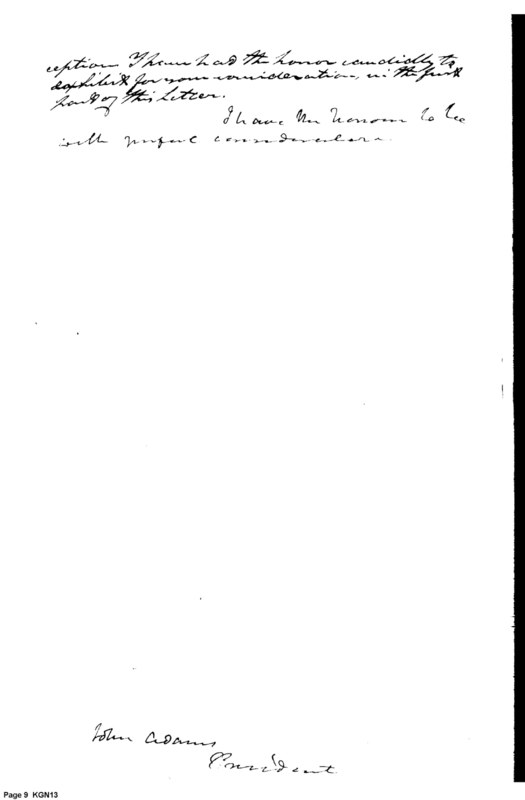
ceptions I have had the honor candidly to exhibit for your consideration, in the first part of this letter.
I have the honour to be
with perfect consideration —
James McHenry
John Adams
President