Now I have all the images. Let me compile the full transcription from both the primary letterbook copy and the Clements Library copy, which together form a complete document.
War Department
On the Table I have used while in the Department of War, you will find a packet inscribed "Letters to be referred to my successor." James Mc Henry. These papers relate to several subjects which will require and are recommended to your serious deliberation. On all or most of them I have made some Notes.
I take the liberty also to mention some measures I have taken, directions I have lately given, and a few general objects of the Department which may deserve your peculiar attention.
Directions have been given to the Major Generals Hamilton and Pinckney to [receive?] your orders and to keep organized the [undecipherable] sufficient [undecipherable] the last act, to carry out [undecipherable] efficient, to ensure the discharge, on the 1st day of June next, of all such officers, non-commissioned officers and privates, as have heretofore been appointed, commissioned or raised, under and by virtue of "An Act to augment the Army of the United States and for other purposed" and the 7 Section of "An Act for the better organizing of the Troops of the United States and for other purposes" conformably to the express orders of the President. And the directions of the Commanding General to the paymaster general have been enforced by me to forward sufficient monies to the proper Officers, to pay the officers and men, within the purview of "An act supplementary to the act to suspend part of an act entitled 'An Act to augment the Army of the United States, and for other purposes'" passed the [undecipherable] instant, as well as to the 1st June, when they are to be discharged, or the three months additional pay allowed by the third Section of the last cited act, to every such discharged officer;
officers, non-commissioned officers & privates respectfully.
[2.] To the Superintendant of Military Stores to take effectual measures for securing and transporting through the agency of the Quarter master General, to proper places of deposit, the residue of Clothing, Tents, Camp Equipage, and all military articles with every part of the Army, to be discharged. And to direct [undecipherable] to take [undecipherable] from the residue of the Clothing for the Twelve Regiments, the proportion of one Regiment of Infantry, one half to be deposited with the Agent for the War Department at Savannah, the other half with the Agent at [undecipherable] Tennessee, subject to the orders of Lieutenant Colonel Thomas Butler. Also from the same address [undecipherable] agreeably to returns made, to Natchez [undecipherable] on the Mississippi, complete suits of Infantry Clothing for Forty one Sergeants, twenty three musicians and five hundred and fifty three privates and to Pittsburgh to the address of Major Isaac Craig complete suits of Infantry clothing for fifty Sergeants, thirty musicians and seven hundred privates, being and intended for the enduing year.
year. I have for this advised Brigadier General Wilkinson of the quantity sent to the Mississippi and Pittsburg, and that it is expected he will cause the same to be divided into the parcels he may destine for different Garrisons or Detachments on the Mississippi, Tombigbee and North western Frontiers, and direct the Quarter Master to have parcels duly transported. I have also given similar information and wrote to Lieut. Col. Butler relative to the Clothing destined for the Troops under his Command. Army Clothing should not be received insufficient — I have directed the quantity when found deficient, to be "be provided and forwarded out of the public store." A sufficiency of new Clothing has been ordered to be cut out for the Regiments of Artillery and Engineers, and will wait the orders of the Secretary respecting its distribution. Clothing also has been cut out for the Infantry on the old Establishment — but to what amount, having received no report, cannot be ascertained. It was a proposition of the General officers, that the Army Clothing should be cut out and sent to the respective Corps & Detachments,
to be made up by the Taylors in each Company, at the stated allowance, by far believing that beneficial effects would result from its adoption, and the men certainly be better fitted.
In pursuance of the twenty fourth section of "An act for the better organizing of the troops of the United States and for other purposes" passed the 3d of March 1799, by my directions, Cloth & other materials, except buttons for clothing the army, have been imported thro the agency of Mr. William Chancellor of Philadelphia, to the amount of [undecipherable] Dollars; and I have specially instructed the Superintendant of military stores, to attend to the preservation of this Cloth. It will however in my opinion be proper, my successor in office should renew these instructions, and from time to time, ascertain that his orders are strictly attended to — otherwise the white Cloth in particular, may be greatly injured or totally destroyed by moths.
The Indian stipends engaged by Treaties, have been directed to be purchased & forwarded
Viz: Those for the North western Indians to Cincinnati, that for the Chickasaw to the Chickasaw Bluffs, that for the Cherokees to Tellico Block house, that for the Creeks to the Factory at Fort Wilkinson, that for the Choctaws to the Natchez — that for the Six Nations to Canandaigua.
6. It is especially and respectfully recommended to my successor, to make himself as soon as possible, minutely acquainted with the actual state of the Indian Superintendencies, and also with the system, which has been adopted, and is now in execution for ameliorating the condition of the Indians, and keeping them at peace with, and attached to the United States. I cannot but flatter myself, that the efficiency of this system, conceived by the late President, will not be impaired, under the direction of my successor, having had its success much at heart, and leaving under its beneficial influence, which must increase with time, the great body of Indians in
in all parts of the United States, well affected to the interests of our Country — friendly to each other — indisposed to war, and progressing in Civilization.
To aid this system, a series of Medals in Silver and Bronze have been procured from England, with devices elegantly executed, emblematic of the progressive states of Man, from the savage, to the earliest arts of civilized life. These were intended to be distributed, by the superintendants as encouragements, to those of the Indians, who should make the greatest advances in raising Cattle, the cultivation of their lands, and the domestic manufactures of Spinning and weaving. They are deposited in four Boxes in the Bank of the United States, except a few which are in a desk in the Secretarys room at the War office — the key of which will be left enclosed for my successor. I have taken to myself two of each of the three sets forming the series, wishing to preserve these evidences of the benevolent intentions of the administration of General Washington towards the Indians.
7. The Indian Trading houses or Factories upon the Oconee and at Tellico, will also demand particular attention. The law for establishing them contemplates, that the Capital shall be employed on such a manner, as not to be reduced, or the public suffer no loss. The President has lately authorised the sending an intelligent, confidential and disinterested person along the Western Frontiers, to examine into the state, condition kinds and mode of preserving and distributing the public property in that quarter. He will also be especially charged to examine into, and report the state of the Factories, mode of conducting business at them, capacities and character of the Conductors.
8. Early attention will be requisite to the execution of existing Contracts for casting Cannon within the United States. It is recommended that no person be permitted to inspect and prove cannon, under said Contracts whose skill and integrity
integrity do not furnish a compleat guarantee to the public against every improper influence in [undecipherable].
And for this is recommended to my successor to direct the Accountant for the Department to proceed without delay to the final settlement of the accounts of the paymaster general, which has it is understood, been delayed, under different pretences, until the amount unsettled is seriously great, and to use the same conduct with respect to the accounts of the Quarter Master General, and all other public agents, and Contractors — it being my opinion that the best security to the public against frauds and improper expenditures, will be found in the practice of obliging every person charged with public money, to settle his accounts for disbursements at short and fixed periods.
10. With respect to the contingent expences and extra compensation to officers for extra services, I have with regard to inform you, that a new principle lately
lately set up by the accountant, viz: "that whenever a person holds an office, to which the law has annexed pay and emoluments, he cannot be allowed extra compensation for extra services, except by Congress, and in virtue of an express law" has stagnated the discretion always heretofore used by the Secretary of War on such subjects. That as the Department is by its constitution, to be conducted in such manner as the President of the United States shall order or instruct, I have referred this principle, with a few cases obstructed by it, to the President for his orders and instructions, but have not yet had the honor to receive them. In this reference which is recorded under date of the 2d April last, I stated the new principle to be in my opinion, utterly incompatible with the good of the military service, inconsistent with all former practice during the revolutionary war,
and throughout all the Departments, it will greatly embarrass [undecipherable] the emergency of this Executive throughout all its branches in the Government.
The improvement of the Corps of Artillerists and Engineers has been to me an object of much attention. I have attempted modifications of them, the attainment of a Corps of Engineers, peculiarly indispensible to the Country, possessing forts or permanence, the establishment of a Military Academy. These projects have not been successful, although [by?] myself they have not been absolutely rejected. I will however observe, that the importance of the Corps of Artillerists and Engineers, even as now arranged, must be too evident to need elucidation — but that without the greatest care being taken in filling up future vacancies, and to induce further improvements in them, they will
they will prove a deadly weapon, without giving any promise of carrying, as far as possible, the decisive advantage [undecipherable].
12. Will it be permitted to mention, that I have employed on the Fortifications erecting at Baltimore, in the capacity of Engineer, a French Gentleman of the name of Foncin, and that evidences of ability in his profession, by correcting errors of much consequence in the original plan of the works, as well as of productivity in superintending and directing those engaged, induced me to raise the compensation, he was first engaged at, this Gentleman returned would recommended to be continued in employ, and not heretofore, being much mistaken, if he will not be found worthy of that competent to what he has undertaken, judicious, unassuming [undecipherable] his conduct.
13. For the purpose of establishing an Armoury or Manufacture of Small Arms, a site was selected on the Potomac, near Harpers Ferry, particularly recommended by the late President, and the ground with certain buildings already erected on it, purchased. Progress has been made in this establishment, and the commencement of the fabrication of Arms, has been some time made; much however yet remains to be done, to carry it to maturity; the completing of a Canal begun and in considerable forwardness, and the necessary buildings, at this Armory for the comfortable accomodation of the Superintendant &c, will demand your immediate & minute attention. Detachments from the troops under the Command of Major General Pinckney, have been from motives of economy employed on the Canal. As however these men must be withdrawn on the 1st of June next, the day fixed for disbanding the
the new Army, it will be proper, that seasonable arrangements should be made, to supply their places, by hired labourers — or delay will be occasioned in completing an important establishment.
Major General Pinckney mentions in a letter to me dated the 22 instant "the huts in this cantonment, already erected, purchased, and still building in the vicinity of the Armory are well built & valuable; some person should be appointed to take charge of them, as well as those on the hill. You may perhaps think it proper to apply such of the materials of these huts, as are fit for the purpose, towards the direction of the necessary buildings at the Armory."
14. Impressed with a conviction, that the Cannon contemplated to be purchased by "An Act to enable the President of the United States to procure Cannon, Arms and Ammunition, and for other purposes" passed the 4 of May 1798, were intended to be efficient, and the best adapted to the several kinds of service to which they must be applied, and knowing that the measures which
which have nor any that can be taken, to procure Cannon by purchase, for the use of the United States, either by importation from abroad, or manufacture at the different private Founderies at home, could never insure that perfect uniformity in model, weight, caliber and consistency of Metal necessary to the perfection and full utility of the Ordnance of every country — also having a well grounded expectation, that Metal could be had in the United States adjacent to one of our National Armourie[s], superior to any that had been used for the Guns procured by purchase — and believing provision was made by the third Section of the Act cited, enabling to purchase Founderies in case such establishments should be found necessary, I wrote a letter to the Secretary of the Navy on the 10 of March last, proposing that the two Departments should join in a representation to the President, recommending the purchase of a site for a Cannon Foundry, and of Ore, the best adapted for Ordnance in exclusive propriety to the United States — and also a permanent National establishment for casting Cannon and shot. I inclosed a report by Major Tousard relative
relative to some experiments made by him on a very light Gun, cast from Metal, the Ore of which is found near Harpers Ferry, and cursorily touched upon advantages I supposed to be peculiar to the site, from its vicinity to a National Armory, and added, that the lightness combined with strength of the Guns, which would probably be cast from that Metal, seem to recommend it for those designed for ships, and to promise that the Iron fabricated from it, would be very suitable for small arms. To this letter the Secretary of the Navy replied on the 7 of March last, expressing a decided opinion, that the United States ought to possess one or more such establishments as the one proposed, a belief that the vicinity of Harpers Ferry, on the Potomac, was a very proper place for one such establishment — and a full consent that he be considered as joining in an application to the President, recommending the measure proposed, suggesting however, that further experiments should be made on the Ore in question, to ascertain precisely the
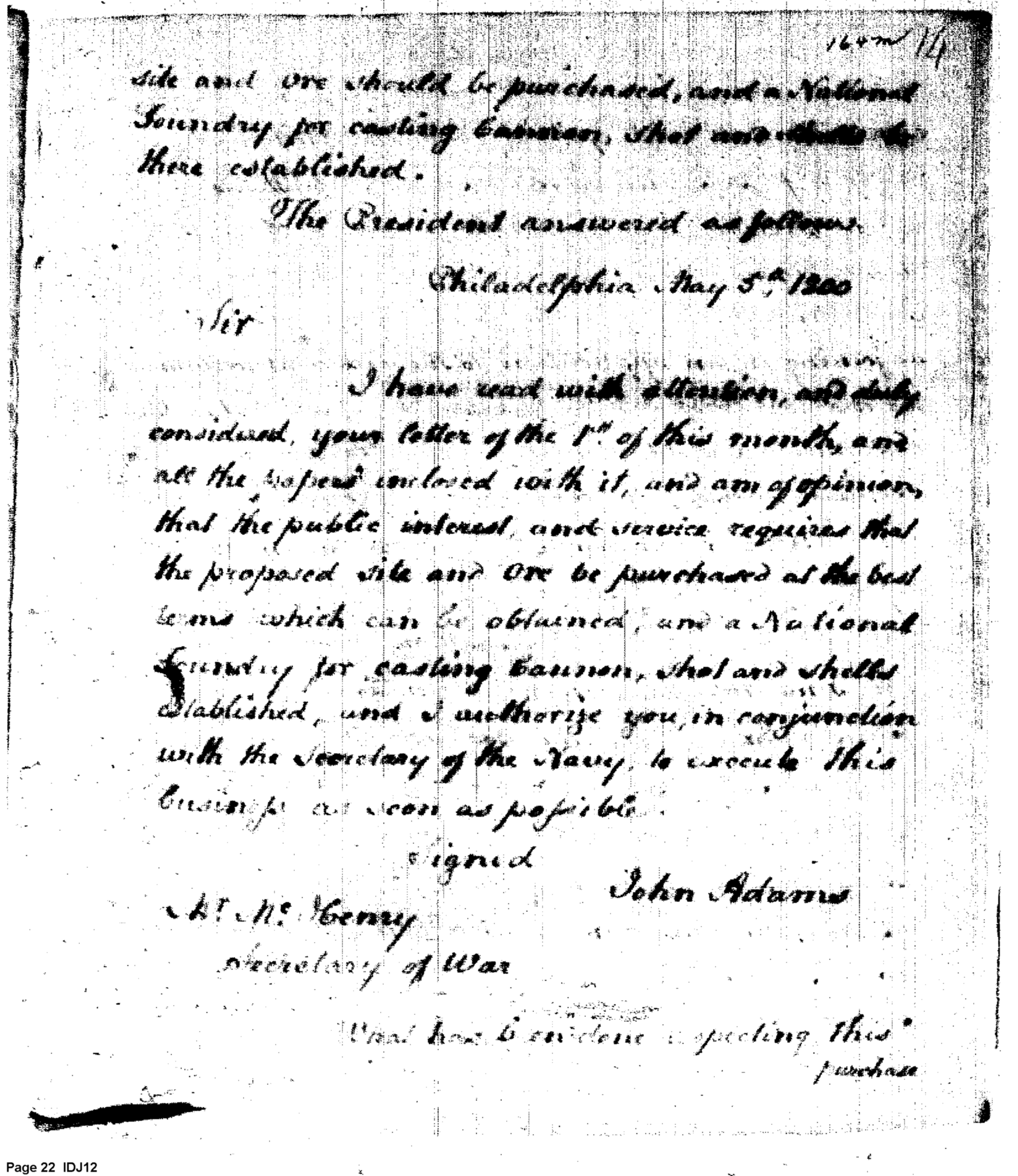
the expectations that might be formed respecting it. Ulterior experiments being made and the results reported on the 26 and 30 of April last, by Major Tousard, on light Guns cast from the same Metal, and some necessary enquiries made respecting the value of the land, and the wood and water on the proposed site, as well as the title of the same — all of which have been communicated to the Secretary of the Navy, I on the 1st of May by letter detailing as far as known to me every circumstance, and enclosing every paper I was possesed of relative to the measure, solicited the Presidents direction whether the proposed site and ore should be purchased, and a National Foundry for casting Cannon, Shot and shells be there established.
The President answered as follows.
Philadelphia May 5th 1800
Sir
I have read with attention, and duly considered, your letter of the 1st of this month, and all the papers inclosed with it, and am of opinion, that the public interest, and service requires that the proposed site and Ore be purchased at the best terms which can be obtained, and a National Foundry for casting Cannon, Shot and Shells established, and I authorize you, in conjunction with the Secretary of the Navy, to execute this business as soon as possible.
signed John Adams
Mr. Mc Henry
Secretary of War
What has been done respecting this purchase, was done in conjunction with the Secretary of the Navy, whom I leave in the execution of the duties of the War Department, the business of which he will of course, upon your arrival at the seat of Government, turn over to you. To him I respectfully refer you, for the progress now made, and which shall
shall be made by him in completing this purchase.
A lot of ground was purchased last summer near Philadelphia and on the River Schuylkil, for the purpose of another establishment, that of a Military Laboratory, Magazines for the safe keeping of all the powder, Military Stores and other property under the Controul of the War Department, and thought expedient to be deposited in the middle district of the Union. This measure, documents on file will evince, was undertaken after mature reflection, consultation with the Heads of Departments, and with their approbation as well as that of the President. The necessary Buildings were commenced, as soon as practicable after the purchase of the lot, and some of them are far advanced. In a short time one or more of the [strikethrough: Stores] magazine will be ready to receive the articles they were intended to preserve. Orders will be necessary for the removal of the Military articles, now stored in Philadelphia, to
to the new Deposits as they are progressively completed, and Regulations will be indispensible for the government of the persons employed as laboratory Officers, Directors, Superintendants, Storekeepers, or in such other capacities as may be thought proper, as well as for the arrangement and preservation of the Ammunition, Small Arms, Cannon, Cannon Carriages, Clothing or materials therefor, and other articles when [removed]. The regulations mentioned will demand peculiar attention; if a good system is adopted, the public will in a little time, not only attain an exemption from the payment of large sums in store rent, but from the higher state of preservation in which every article will be kept, be very soon fully remunerated for the cost of the Establishment.
Hitherto Military articles when wanted have been to seek for, in a great number of private deposits scattered throughout the United States, consequently considerable expense has
has been incurred in Rents & Salaries to Storekeepers, and as the very extended Superintendance required from the proper officer (the Superintendant of Military Stores) made it impossible, it should in all cases be very particular — the property itself, has been much exposed to loss, or destruction, either from inattention in those charged with its care, or other causes.
I have long thought, and have directed the Superintendant accordingly, that beneficial results would arise from his visiting the several depositaries of Military Stores on the Sea-Board, at least once a year, on account of the certainty he would then have, that the different kinds of articles, were stored in Buildings, suitable for them respectively, and the superior vigilence that would be excited in the persons charged with their custody. The answer however has always been, that it was impracticable for him, the Superintendant, to leave the Seat of Government. It may deserve consideration
It may deserve consideration, whether it would not be right to send a person of sufficient intelligence to visit these scattered depositaries, and report generally and specially, from actual inspection, the quantity and kinds of articles in each, the suitableness of the store for the kinds, as well as the character and attention paid to his trust, by every person charged with the custody of Military Articles.
To produce an exemption from expence in Rents and waste or loss from their being divided into so many distinct deposits and superintendances, and a certainty of having our military articles well preserved, and at all times prepared for use, it has been contemplated, to erect in addition to the one in question, in two or three other parts of the Union, Military Depots. Documents in the Office will shew the several places where it was thought best to establish them, having reference to the
the convenience and possible wants of the different States.
16. The Armory or Manufactory for Small Arms at Springfield Massachusetts, an establishment of some continuance, I had supposed was well conducted, and likely to become important to the Public. The Superintendant employed there, was constantly represented by respectable Gentlemen, many of them in Congress, and was acquainted with him, to be a man of integrity, industry and attention to his trust, and the work done at the Armory, especially of late has been satisfactory. Apparent facts and circumstances have however recently evolved, which affect the character of the Superintendant and discover improper practices, necessary to be checked. The measures taken to investigate the facts and circumstances, by an enquiry to be made by respectable and intelligent Gentlemen in the vicinity of Springfield, and
and above all influence, will be seen, as approved by the President, on the Books of the Office. Perhaps immediate orders would be proper, to prevent in future, apprentices to private persons, from being employed as workmen in the Armory, borne on the Muster rolls and paid for the benefit of their Masters, this practice would appear to lead to abuses. At his War [undecipherable], a young Gentleman some time since introduced into the office of the Secretary of War, as a Clerk, has been employed in the extra business, as Translator of the French & German Languages. I had reserved a sum out of the appropriation for the whole number of Clerks, to compensate him for this service, which I request may be attended to. I would also suggest, that it was my intention to encrease his salary,
at first fixed at [undecipherable]
Salary, which was [strikethrough: eight] [undecipherable] eight hundred Dollars per annum, having found him faithful, diligent, unassuming & possesed of talents sufficient, with a little more experience to become extremely useful.
11. A young Gentleman whose name I cannot at present recollect, a native of Virginia, on the recommendation of General Henry Lee, has been invited some time since to fill a vacant Clerkship in the Office. From the specimens I have seen of his epistolary style, and the account given me of his talents I flatter myself he will be found deserving of the appointment and of the Salary, Six hundred Dollars, which he has been promised.
This letter has been written in too much haste to be correct, and during my engagements in the current business of the
the Department and those indispensible arrangements preparatory to my divesting myself of an official situation. It was intended to comprize most of the objects of the Department of sufficient importance to require your particular attention. I may have omitted several, which will appear to you equally interesting with those I have noticed. As such, present, I shall esteem it my duty to give you every information & explanation in my power.
With the most sincere wish that you may fill the Office of Secretary of War, with reputation to yourself and advantage to your Country, I have the honor to be,
Sir
your Most Ob. Hb. Ser.
James McHenry
The Secretary of War