

Administrating compensation for officers
Document 1800Criticizes Col. Timothy Taylor's observations about officers and their accounts, arguing instead that officers need extra funds. States that it may be expedient to extend the powers of the Paymaster General to give officers compensation for extra services, pay them for traveling expenses, compensate them for apprehending deserters, and pay them for postage and stationary.
No human transcription currently available for this document.
This transcription was generated by machine using Anthropic's Claude Code (model sonnet 4.6). It may contain errors or inaccuracies. Please verify against the document image. Learn more about our generative AI methodology.
[Copy
Major Gen. Hamilton
to the Secretary of War
New York May 5. 1800]
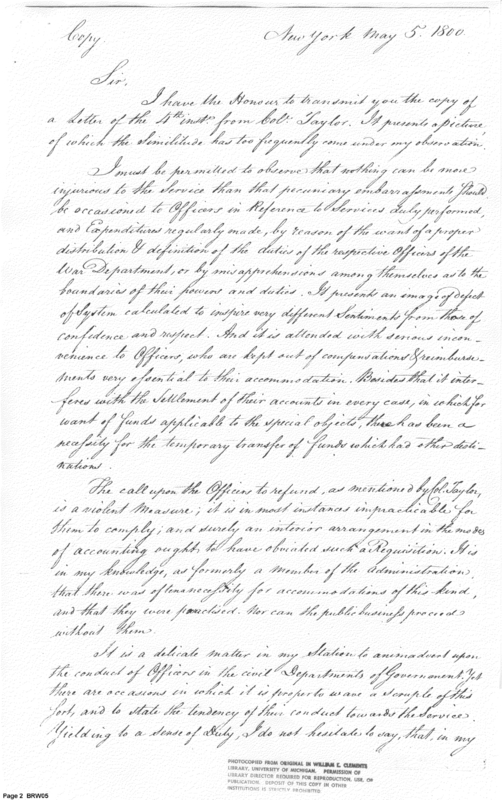
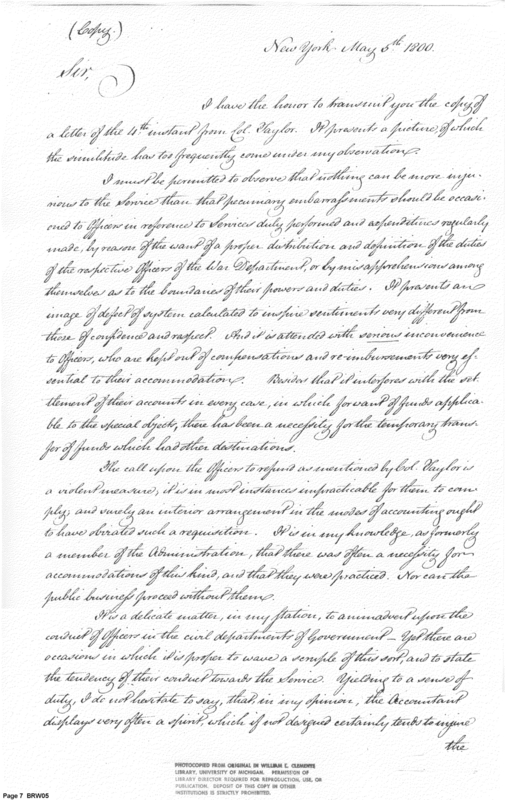
[Copy] New York May 5. 1800.
Sir,
I have the Honour to transmit you the copy of a letter of the 1st inst. from Col. Taylor. It presents a picture of which the Similitude has too frequently come under my observation.
I must be permitted to observe that nothing can be more injurious to the Service than that pecuniary embarrassments should be occasioned to Officers in Reference to Services duly performed, and Expenditures regularly made, by reason of the want of a proper distribution & definition of the duties of the respective Officers of the War Department, or by misapprehensions among themselves as to the boundaries of their powers and duties. It presents an image of defect of System calculated to inspire very different Sentiments from those of confidence and respect. And it is attended with serious inconvenience to Officers, who are kept out of compensations & reimbursements very essential to their accommodation. Besides that it interferes with the Settlement of their accounts in every case, in which for want of funds applicable to the special objects, there has been a necessity for the temporary transfer of funds which had other destinations.
The call upon the Officers to refund, as mentioned by Col. Taylor, is a violent Measure; it is in most instances impracticable for them to comply; and surely an interior arrangement in the modes of accounting ought to have obviated such a Requisition. It is in my knowledge, as formerly a Member of the Administration, that there was often a necessity for accommodations of this kind, and that they were practised. Nor can the public business proceed without them.
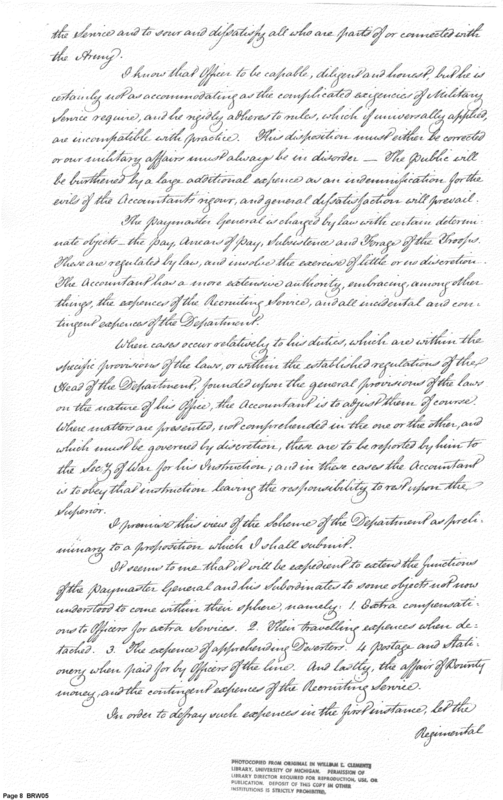
It is a delicate matter in my Station to animadvert upon the conduct of Officers in the civil Departments of Government. Yet there are occasions in which it is proper to wave a Scruple of this Sort, and to state the tendency of their conduct towards the Service. Yielding to a sense of Duty, I do not hesitate to say, that, in my opinion, the Accountant displays very often a Spirit, which, if not designed, certainly tends to injure the Service, and to sour and dissatisfy all who are parts of, or connected with the Army.
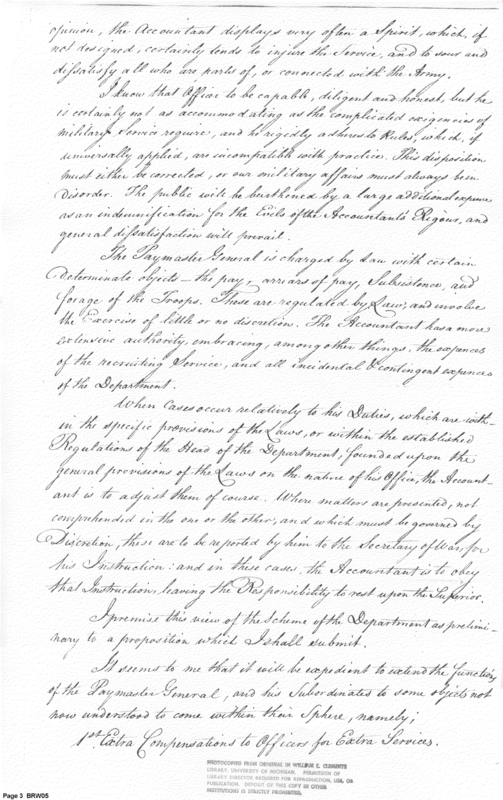
I know that Officer to be capable, diligent and honest, but he is certainly not as accommodating as the complicated exigencies of Military Service require, and he rigidly adheres to Rules, which, if universally applied, are incompatible with practice. This disposition must either be corrected, or our military affairs must always be in Disorder. The public will be burthened by a large additional expense as an indemnification for the Evils of the Accountant's Rigour, and general dissatisfaction will prevail.
The Paymaster General is charged by law with certain determinate objects — the pay, arrears of pay, Subsistence, and Forage of the Troops. These are regulated by Law, and involve the Exercise of little or no discretion. The Accountant has a more extensive authority, embracing, among other things, the expenses of the recruiting Service, and all incidental & contingent expenses of the Department.
When cases occur relatively to his Duties, which are within the specific provisions of the Laws, or within the established Regulations of the Head of the Department, founded upon the general provisions of the Laws on the nature of his Office, the Accountant is to adjust them of course. Where matters are presented, not comprehended in the one or the other, and which must be governed by Discretion, these are to be reported by him to the Secretary of War for his Instruction: and in these cases the Accountant is to obey that Instruction, leaving the Responsibility to rest upon the Superior.
I premise this view of the Scheme of the Department as preliminary to a proposition which I shall submit.
It seems to me that it will be expedient to extend the functions of the Paymaster General, and his Subordinates to some objects not now understood to come within their Sphere, namely;
1st Extra Compensations to Officers for Extra Services.
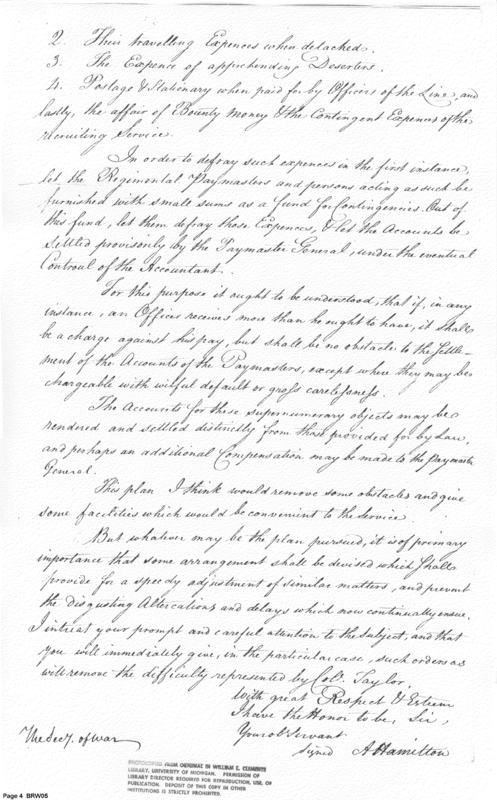
2. Their travelling Expenses when detached.
3. The Expense of apprehending Deserters.
4. Postage & Stationary when paid for by Officers of the Line, and lastly, the affair of Bounty money & the Contingent Expenses of the Recruiting Service.
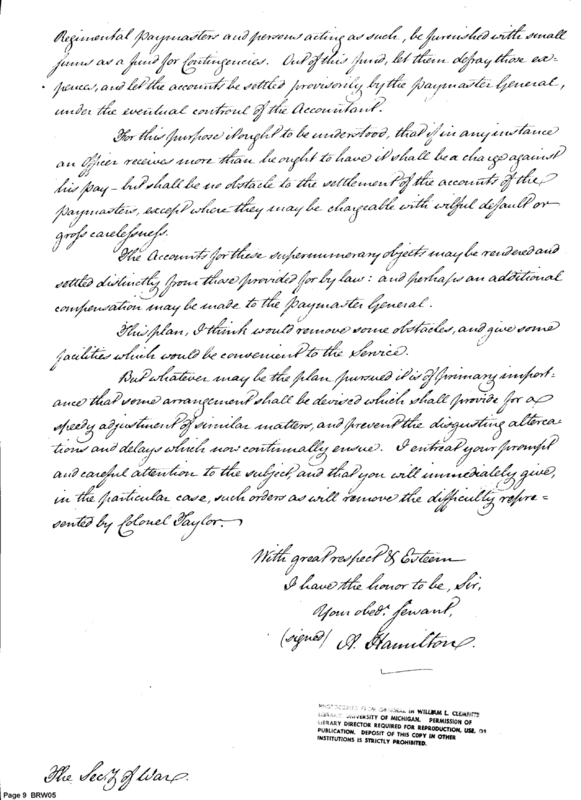
In order to defray such expenses in the first instance, let the Regimental Paymasters and persons acting as such be furnished with small sums as a fund for Contingencies. Out of this fund, let them defray those Expenses, & let the Accounts be Settled provisorily by the Paymaster General, under the eventual Controul of the Accountant.
For this purpose it ought to be understood, that if, in any instance, an Officer receives more than he ought to have, it shall be a charge against his pay, but shall be no obstacle to the Settlement of the Accounts of the Paymasters, except when they may be chargeable with wilful default or gross carelessness.
The Accounts for these supernumerary objects may be rendered and settled distinctly from those provided for by Law, and perhaps an additional Compensation may be made to the Paymaster General.
This plan I think would remove some obstacles and give some facilities which would be convenient to the Service.
But whatever may be the plan pursued, it is of primary importance that some arrangement shall be devised which Shall provide for a speedy adjustment of similar matters, and prevent the disgusting Altercations and delays which now continually ensue. I intreat your prompt and careful attention to the Subject, and that you will immediately give, in the particular case, such orders as will remove the difficulty represented by Col. Taylor.
With great Respect & Esteem
I have the Honor to be, Sir,
Your ob Servant
Signed A Hamilton
[The Sec.y of War]
---
[Copy
Col. Jno. Taylor
to Major Gen. Hamilton
Union Brigade, [undecipherable]]
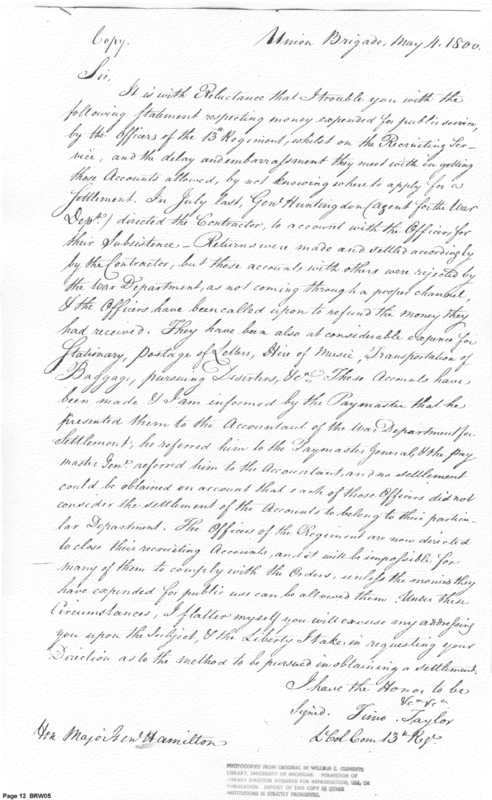
[Copy] Union Brigade, May 1. 1800.
Sir,
It is with Reluctance that I trouble you with the following Statement respecting money expended for public service, by the Officers of the 13th Regiment, whilst on the Recruiting Service, and the delay and embarrassment they meet with in getting those Accounts allowed, by not knowing where to apply for a Settlement. In July last, Gen. Huntingdon (Agent for the War Dep.t) directed the Contractor, to account with the Officers for their Subsistence — Returns were made and settled accordingly by the Contractor, but those accounts with others were rejected by the War Department, as not coming through a proper channel, & the Officers have been called upon to refund the money they had received. They have been also at considerable Expense for Stationary, postage of Letters, Hire of Music, Transportation of Baggage, pursuing Deserters, &c. These Accounts have been made & I am informed by the Paymaster that he presented them to the Accountant of the War Department for Settlement; he referred him to the Paymaster General, & the Paymaster Gen.l referred him to the Accountant, and no settlement could be obtained on account that each of those Officers did not consider the settlement of the Accounts to belong to their particular Department. The Officers of the Regiment are now directed to close their recruiting Accounts, and it will be impossible for many of them to comply with the Orders, unless the monies they have expended for public use can be allowed them. Under these Circumstances, I flatter myself you will excuse my addressing you upon the Subject, & the Liberty I take, in requesting your Direction as to the method to be pursued in obtaining a settlement.
I have the Honor to be
H.o & c.
Signed. Jno. Taylor
Lt Col. Com 13th Reg.t
[To Major Gen. Hamilton]
Type
Draft Letter
Description
Criticizes Col. Timothy Taylor's observations about officers and their accounts, arguing instead that officers need extra funds. States that it may be expedient to extend the powers of the Paymaster General to give officers compensation for extra services, pay them for traveling expenses, compensate them for apprehending deserters, and pay them for postage and stationary.
Date
05/05/1800
Author
Recipient
Sent from
New York
Repository
Collection
Document number
1800050540001
Page start
1
Note
Cited in McHenry to Hamilton, 05/16/1800.
Notable persons
James McHenry
Alexander Hamilton
Timothy Taylor
officers
accountant
army
deserters
paymaster general
Notable locations
New York
Notable items
Expenditures
compensation
reimbursement
accomodation
accounts
pay
subsistence
forage
funds