

Report on the Petitions of William Milton, and Others, exhibiting Claims for Militia Services in the State of Georgia.
Document 1800Report on the Petitions of William Milton, and Others, exhibiting Claims for Militia Services in the State of Georgia. Addresses some of the jurisdictional issues that came up between state and federal authorities regarding provision of common defense.

















No human transcription currently available for this document.
This transcription was generated by machine using Anthropic's Claude Code (model sonnet 4.6). It may contain errors or inaccuracies. Please verify against the document image. Learn more about our generative AI methodology.
Now I have all 41 pages. Compiling the complete transcription:
LETTER
FROM THE
Secretary of War,
ACCOMPANYING
HIS REPORT
ON THE
PETITIONS
OF
WILLIAM MILTON, AND OTHERS,
EXHIBITING
*C L A I M S*
FOR MILITIA SERVICES IN THE STATE OF GEORGIA.
14*th March*, 1800.
Committed to a Committee of the whole House on Monday next.
Printed by order of the House of Representatives of the United States.
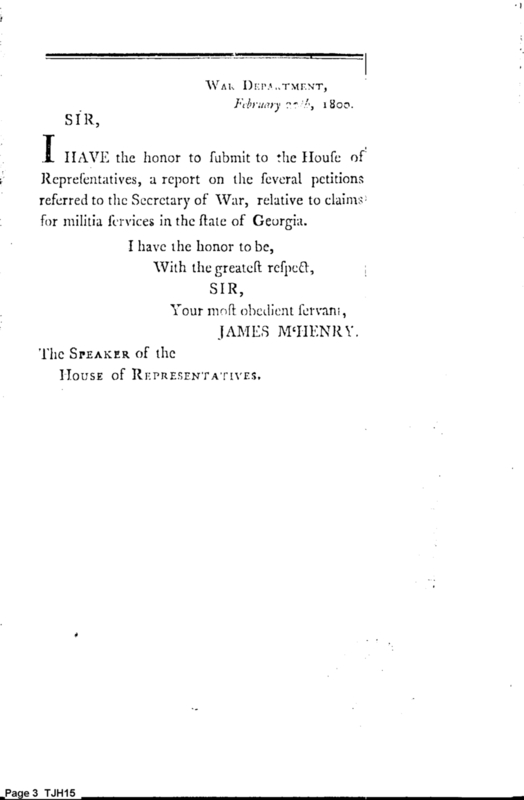
WAR DEPARTMENT,
*February 20th*, 1800.
SIR,
I HAVE the honor to submit to the House of Representatives, a report on the several petitions referred to the Secretary of War, relative to claims for militia services in the state of Georgia.
I have the honor to be,
With the greatest respect,
SIR,
Your most obedient servant,
JAMES McHENRY.
The SPEAKER of the
House of REPRESENTATIVES.
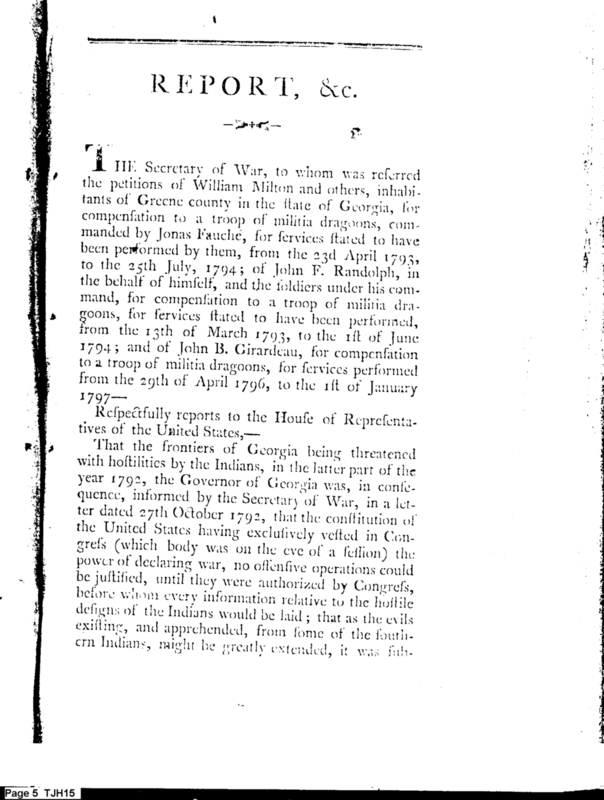
REPORT, &c.
THE Secretary of War, to whom was referred the petitions of William Milton and others, inhabitants of Greene county in the state of Georgia, for compensation to a troop of militia dragoons, commanded by Jonas Fauche, for services stated to have been performed by them, from the 23d April 1793, to the 25th July, 1794; of John F. Randolph, in the behalf of himself, and the soldiers under his command, for compensation to a troop of militia dragoons, for services stated to have been performed, from the 13th of March 1793, to the 1st of June 1794; and of John B. Girardeau, for compensation to a troop of militia dragoons, for services performed from the 29th of April 1796, to the 1st of January 1797—
Respectfully reports to the House of Representatives of the United States,—
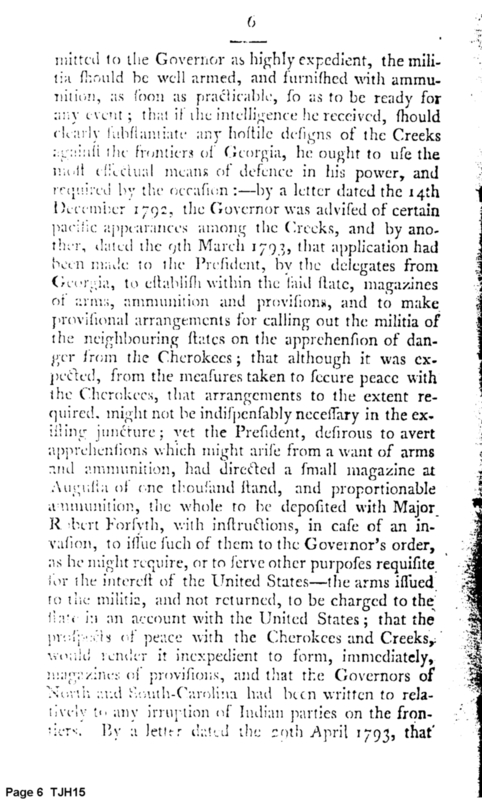
That the frontiers of Georgia being threatened with hostilities by the Indians, in the latter part of the year 1792, the Governor of Georgia was, in consequence, informed by the Secretary of War, in a letter dated 27th October 1792, that the constitution of the United States having exclusively vested in Congress (which body was on the eve of a session) the power of declaring war, no offensive operations could be justified, until they were authorized by Congress, before whom every information relative to the hostile designs of the Indians would be laid; that as the evils existing, and apprehended, from some of the southern Indians, might be greatly extended, it was submitted to the Governor as highly expedient, the militia should be well armed, and furnished with ammunition, as soon as practicable, so as to be ready for any event; that if the intelligence he received, should clearly substantiate any hostile designs of the Creeks against the frontiers of Georgia, he ought to use the most effectual means of defence in his power, and required by the occasion:—by a letter dated the 14th December 1792, the Governor was advised of certain pacific appearances among the Creeks, and by another, dated the 9th March 1793, that application had been made to the President, by the delegates from Georgia, to establish within the said state, magazines of arms, ammunition and provisions, and to make provisional arrangements for calling out the militia of the neighbouring states on the apprehension of danger from the Cherokees; that although it was expected, from the measures taken to secure peace with the Cherokees, that arrangements to the extent required, might not be indispensably necessary in the existing juncture; yet the President, desirous to avert apprehensions which might arise from a want of arms and ammunition, had directed a small magazine at Augusta of one thousand stand, and proportionable ammunition, the whole to be deposited with Major Robert Forsyth, with instructions, in case of an invasion, to issue such of them to the Governor's order, as he might require, or to serve other purposes requisite for the interest of the United States—the arms issued to the militia, and not returned, to be charged to the state in an account with the United States; that the prospects of peace with the Cherokees and Creeks, would render it inexpedient to form, immediately, magazines of provisions, and that the Governors of North and South-Carolina had been written to relatively to any irruption of Indian parties on the frontiers. By a letter dated the 20th April 1793, that information had been recently received from Governor Blount, of the hostile disposition of the Upper Creeks, and mals of the Lower Cherokees, and of an existing war between the Chickasaws and Upper Creeks;—that Governor Blount was on his way to Philadelphia to concert with the Executive the most advisable measures;—that the President was desirous general principles should be adopted applicable to the whole southern frontier, and that the result would be transmitted. By a letter dated the 30th May 1793, that from considerations of policy, at this critical period, relative to foreign powers, and the pending treaty with the northern Indians, the President deemed it advisable to avoid offensive expeditions into the Creek Country, but from the circumstances of late depredations on the frontiers of Georgia, thought it expedient to increase the force in that quarter for defensive purposes;—that he therefore authorized him (the Governor) to call into, and keep in service, in addition to the regular force stationed in Georgia, one hundred horse, and one hundred militia foot, to be employed under the orders of Lieutenant Colonel Gaither, in repelling inroads; the corps to be engaged of proper characters, to serve until the first day of May or June next (1794) unless sooner discharged, which the government must hold the right of doing:—that an additional thousand stand of arms and accoutrements, fifty barrels of powder, and a proportional quantity of lead and flints, would be forwarded to Major Habersham, to be by him forwarded to Augusta, to the care of Major Forsyth, under like provisions with the former quantity:—that as it did not appear the whole of the Creek nation were disposed for, or engaged in hostility, it was considered the above force would be sufficient for the object designated; that the case of a serious invasion of Georgia by large bodies of Indians, must be referred to the provisions of the constitution, and that the proceeding with efficacy in future, (the necessity for which appeared too probable) required absolutely that no unnecessary expense should be incurred in the mean time; and that nothing might be wanting on the part of government for defence of the frontiers of Georgia, scouts were authorized to be raised, at the rate of five-sixths of a dollar per day, as a better defence than block-houses, two men being considered equal to cover ten or twelve miles of a frontier.
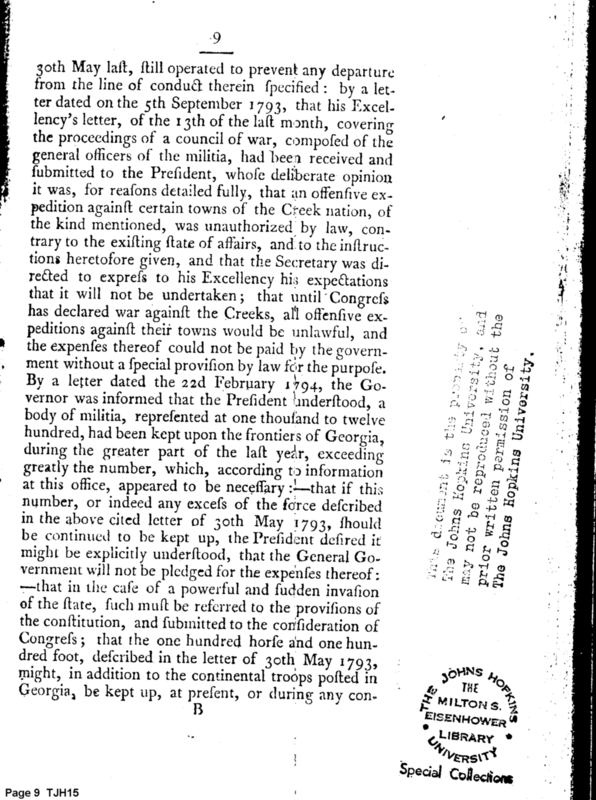
That the force mentioned in the last above recited letter, of the 30th of May 1793, continued to be all (except, perhaps, a few men necessary to complete the garrisons for block-houses, authorized for every twenty-five miles of a line exposed to danger, by a letter to the Governor dated the 14th May 1794) that was authorized by the General Government, until the 25th September 1794, when an additional troop of horse was adopted by authority of the President; although it appears that the Governor of Georgia had, in the mean time, called out a considerable body of militia:—as soon, however, as information was received of this circumstance, it was made known to him by the Secretary's letter, dated the 10th June 1793, that in the case of invasion or imminent danger only, the measure taken could be considered indispensable, (placing it upon constitutional ground) and a hope expressed, that as soon as the danger was over, he would reduce the troops to the number already authorized by the letter of the 30th May 1793; that a general Creek war, in the then crisis of European affairs, would be a complicated evil of great magnitude, and that to avoid it, Mr. Seagrove would be sent into the heart of the Creek country, if compatible with a reasonable degree of safety: by a letter dated the 19th July 1793, that the reasons given by the President's order, in the Secretary's letter of the 30th May last, still operated to prevent any departure from the line of conduct therein specified: by a letter dated on the 5th September 1793, that his Excellency's letter, of the 13th of the last month, covering the proceedings of a council of war, composed of the general officers of the militia, had been received and submitted to the President, whose deliberate opinion it was, for reasons detailed fully, that an offensive expedition against certain towns of the Creek nation, of the kind mentioned, was unauthorized by law, contrary to the existing state of affairs, and to the instructions heretofore given, and that the Secretary was directed to express to his Excellency his expectations that it will not be undertaken; that until Congress has declared war against the Creeks, all offensive expeditions against their towns would be unlawful, and the expenses thereof could not be paid by the government without a special provision by law for the purpose. By a letter dated the 22d February 1794, the Governor was informed that the President understood, a body of militia, represented at one thousand to twelve hundred, had been kept upon the frontiers of Georgia, during the greater part of the last year, exceeding greatly the number, which, according to information at this office, appeared to be necessary:—that if this number, or indeed any excess of the force described in the above cited letter of 30th May 1793, should be continued to be kept up, the President desired it might be explicitly understood, that the General Government will not be pledged for the expenses thereof:—that in the case of a powerful and sudden invasion of the state, such must be referred to the provisions of the constitution, and submitted to the consideration of Congress; that the one hundred horse and one hundred foot, described in the letter of 30th May 1793, might, in addition to the continental troops posted in Georgia, be kept up, at present, or during any considerable danger, on condition it should be monthly stated to the War-Office, to be submitted to the President, what reasons existed for the continuance of this force, that no returns had been received of the numbers kept in service last year, and if expected, that the said militia are to be compensated by the United States, it would be necessary that returns, musters and pay-rolls should be given to the agent of this department in Georgia, in order to submitting the whole case to Congress—for it was deemed that Congress alone are competent to decide, under a full view of the circumstances of the case, whether any or what proportion of the expenses incurred, are to be defrayed by the United States. By a letter dated 14th May 1794, that the President consented to certain propositions made by the Governor relative to the protection of Georgia, so far as to the establishment of a block-house every twenty-five miles of the line exposed to danger, to be garrisoned with one subaltern, one corporal and fifteen privates of the militia, and directed the men to be engaged to the 1st of January ensuing, unless sooner discharged—the Governor was further given to understand that the one hundred foot heretofore ordered, were to be considered as a part of this arrangement, and that the President conceived the one hundred horse also heretofore allowed would be sufficient for the present, that no returns or musters of the number of militia kept up last year had been received, that when received the President would impartially consider whether he could give authority to pay them, or if he could not, as was most probable, submit the question to Congress.
That it appears the Governor of Georgia had ordered an additional troop of horse into service, commanded by captain Fauché, the adoption of which by the United States was authorised explicitly, from the 25th July, 1794, (when it was stated the Governor called it into service) until the first of November following, in letters to Mr. John Habersham, and major Constant Freeman, the Agent of the War Department in Georgia; and by a letter from Alexander Hamilton, in the absence of the Secretary of War, to the Governor of Georgia, dated the 25th September, 1794. The adoption of this new troop was authorized, from the time it was ordered by the Governor into service, until the 1st of November ensuing, when it was directed to be disbanded.
That from this period it does not appear that a second corps of horse was ever authorised, on the contrary, that it was explicitly discountenanced and forbid—and that the authorised defensive protection of the frontiers of Georgia continued on the footing formerly established, of one hundred horse, one hundred foot, and a chain of block-houses, the one hundred foot being applied towards garrisoning them. That in the year 1795, measures began to be taken to hold a treaty with the Creek nation, and Commissioners for the purpose were appointed, but circumstances obliged a postponement until the middle of May, 1796—that after the treaty, at which the Creeks agreed that military and trading posts might be established within their boundaries, and that all animosity for past aggressions should cease, the Governor of Georgia was informed by a letter, dated the 23d August, 1796, that such an arrangement and use of the troops of the United States was ordered, as ought to satisfy the Indians that their rights will be protected, and the inhabitants of the frontiers that they have nothing to apprehend; that this arrangement rendered it unnecessary to keep up the militia corps of infantry and cavalry, and in consequence, the Agent of the War Department in Georgia would be directed to settle their muster and pay rolls, up to the 15th September ensuing, after which they would be considered discharged. That it appears from a statement of the Agent of the War Department, that captain Fauché's troop was paid from the 25th July, 1794, the time when the Governor is supposed to have ordered them into service, until the 31st October, 1794, inclusive; and for subsequent authorized services up to the 29th February, 1796, and was not paid for unauthorised services prior to the 25th of July, 1794. That captain Randolph's troop was not paid for services from the 13th of March, 1793, to the 1st June, 1794, they being deemed unauthorized, but was paid for authorized services from the 1st January to the 31st December, 1795, inclusive. That captain Girardeau's troop was paid from the 29th April to the 15th September, 1796, including so much of the time for which the petition prays a settlement, and not for the residue, it being subsequent to the date at which the troops were ordered to be discharged.
That a letter from the Agent of the War Department, dated 17th May, 1797, to the Secretary, advised, that he did not receive a letter of the 23d August, 1796, ordering him to have captain Girardeau's troop mustered to the 15th September, after which they were not to be considered in service, before the 23d September; that he communicated his orders to the Governor and to colonel Gaither on the 24th September, and requested of the latter an officer, for the purpose of mustering the troop; that Mr. Whitney was appointed, and received instructions; that it must have been some time before the necessary letters could have reached the persons to whom they were addressed; that Mr. Whitney mustered captain Girardeau's troop to the 24th October, and has since mustered them to the 31st December, 1796.
That the Secretary can find no documents to establish that the services of the particular troops, which are the subjects of reference, were authorized by the President for the several periods for which they petition compensation, except for that portion of time included in captain Girardeau's petition, viz. From the 29th April to the 15th September, 1796, and for which the troop is stated to have been paid; he is however of opinion, that as the letter, ordering the discharge of the latter troop, was not received by the Agent until the 23d September, subsequent to the time at which they were ordered to be discharged, and they could not probably be mustered before the 24th October following, that they ought and may be paid by this department to the latter date, but it is doubted whether they could be paid with propriety to the 31st December, the circumstances inducing to the second muster being unknown.
That from the foregoing statement, which is made entirely from documents, unaided by a knowledge of circumstances attending facts which preceded the Secretary's coming into office, it would appear, that the Executive of the United States, when perfectly informed of the situation of the frontiers of Georgia, persisted in apportioning a given force for their protection; in discountenancing all offensive measures understood to have been contemplated, and in referring the expense of a much larger force of militia, called out by the Governor, in virtue, as was considered, of the powers given to him by the constitution, in case of actual invasion, or such imminent danger as will not admit of delay, to the provision of Congress.
That it is however proper to mention, letters from the Governor of Georgia, and resolves passed at different times by the legislature thereof, convey a strong conviction, that the people of that state did not consider the force, apportioned and authorised for the protection of their frontiers, in any part of the period from 1792 to the latter part of the year 1796, adequate to their security.
That from documents herewith transmitted it would appear, the whole or nearly all the authorized services in Georgia have been compensated by the General Government.
That the unauthorized claims for militia services in Georgia, as far as the same have been communicated to this department, amount to one hundred and twenty-nine thousand, three hundred and seventy-five dollars, and sixty-six cents; but it is supposed by Major Freeman, agent of the department of war for a number of years in Georgia, there may be further claims, to a considerable amount, the muster-rolls for which have not yet been forwarded.
As the petitions to be decided upon at this time, are evidently precursors of claims to a much larger amount for services stated to have been performed by the militia of Georgia, but unauthorised by the Executive of the United States, and the determination of Congress thereon, may influence or conclude the grounds of decision in all such cases, the Secretary, therefore, prays leave to represent the magnitude and delicacy of the principles, which, upon a due consideration, he conceives to be involved in the subject.
The constitution of the United States expresly sets forth, that it was ordained and established by the people, among other intents, "to provide for the common defence."
To carry this intention into effect, it is declared by article 1st, section 3d, that *the Congress* shall have power "to provide for the common defence"—"to declare war"—"to raise and support armies"—"to provide and maintain a navy"—"to make rules for the government and regulation of the land and naval forces"—"to provide for calling forth the militia to execute the laws of the Union, suppress insurrections and repel invasions"—and "to make all laws necessary and proper for carrying into execution the foregoing powers."
To make the protection of the whole and every part of the United States the sole duty of the general government, when informed of existing danger, without competition or interference, by section 10th of the same article it takes from the several states the right, without the consent of Congress,—"to keep *troops*, or ships of war, in *time of peace*, or engage in war unless actually invaded, or in such imminent danger as will not admit of delay."
By article 2d, section 2d, it determines, "that the President shall be Commander in Chief of the army and navy of the United States, and of the militia of the several states, when called into the actual service of the United States."
And to prevent apprehensions, or actual danger, to the states from the restriction on them, not to keep troops or ships of war in time of peace, unless with the consent of Congress, the same article and section of the constitution—article 4, section 4—which guarantees to each of the states a republican form of government, solemnly engages that "the United States shall protect each of them against invasion, and on application of the Legislature, or of the Executive (when the Legislature cannot be convened) against domestic violence."
From the view of the intention of the constitution, and of the powers vested in the General Government, for carrying that intention into effect, exhibited by the preceding citations, the Secretary respectfully assumes, that the whole power of making war, and of repelling invasions, is vested absolutely in the General Government, save only in the cases, and under the circumstances expresly reserved and excepted; that the only excepted cases are actual invasion, or such imminent danger as will not admit of delay; and that from the nature of the General authority, and of the specified exception, the state authority to engage in war, under the specified exception, must be held to cease with the pressure of circumstances, and to continue no longer than until the power of the General Government can be fully and competently applied to the exigency.
Now, as the President of the United States did, in fact, apply such part of the force of the General Government, to the defence of the menaced territory, as from a full knowledge of all circumstances, in his judgment appeared proper, it follows, from the principles assumed, that the special authority of the state government was, from that moment, superseded, or was legitimate only, so far as it pursued the line prescribed by the paramount authority. Any deviation from the prescribed limitation, after the President began to act, would appear incapable of attaching to itself the merit and remuneration of lawful service.
The General Government is indeed bound to provide for the general defence, and in virtue of this obligation, is bound to defray the expense of necessary military preparation and equipment for the defence of any particular portion of the Union, which may be menaced or invaded. But the obligation would seem to extend only to such preparation as is made, or service rendered, conformably to the constitutional distribution of powers and authorities, not to gratuitous equipments, and much less to such as have been interdicted by the competent department of the Government.
If the preceding citations have been well considered by the Secretary, and the deductions therefrom justly drawn, it must be admitted that the General Government has, by the constitution, full power to provide for the defence of the territory of the United States, in any part of it which may be threatened or invaded:—That the power reserved to the several states applies only to the case of such particular immediate and pressing emergency, as will not admit of the delay necessarily incident, on a recurrence to the Federal power:—That the reserved power can therefore continue no longer than the emergency:—That the emergency can be considered to continue no longer than until the Government of the United States has been enabled to assume the exercise of its powers for the general defence:—That, as applicable to the claims in question, or contemplated, the paramount and general authority having been in fact assumed and brought into action, every subsequent exertion of state authority, beyond a prescribed limit, was illegitimate and gratuitous, inducing consequently no obligation of payment on the United States.
This conclusion, it is presumed, will derive strength and confirmation from a consideration of the laws of the United States, connected with the subject.
By the act of September 29th, 1789, entitled "An act to recognize and adopt to the constitution of the United States, the establishment of the troops raised under the resolves of the United States in Congress assembled, and for other purposes therein mentioned," section 5, it is enacted, "That for the purpose of *protecting the inhabitants of the frontiers* of the United States from the *hostile incursions* of the Indians, the President is hereby authorised to call into service, from time to time, such part of the militia of the states respectively, as he may judge necessary for the purpose aforesaid."
This act was repealed by an act of April 30th, 1790; but the fifteenth section of the repealing act, entitled "An act for regulating the military establishment of the United States," expresly repeats the preceding provision, and enacts "That for the purpose of *aiding the troops now in service*, or to be raised by this act, in *protecting the inhabitants of the frontiers* of the United States, the President is hereby authorised to call into service, from time to time, such parts of the militia of the states respectively, as he may judge necessary for the purposes aforesaid."
By an act of March 3d, 1791, entitled "An act for raising and adding another regiment to the military establishment of the United States, and for making *further provision for the defence of the frontiers*," section 7, it is enacted, "That if, in the opinion of the President, it will be conducive to the good of the service to engage a body of militia to act as cavalry, they furnishing their own horses, arms, and provisions, it shall be lawful for him to offer such allowances to encourage their engaging in the service, for such time, and on such terms, as he shall deem it expedient to prescribe."
And by the 8th section of the same act, it is further provided, "That if the President should be of opinion, that it will be conducive to the public service, to employ troops inlisted under the denomination of levies, *in addition* to, or *in place of the militia*, which, in virtue of the power vested in him by law, he is authorized to call into the service of the United States, it shall be lawful for him to raise, for a term not exceeding six months, (to be discharged sooner if the public service will permit) a corps not exceeding two thousand non-commissioned officers, privates and musicians, with a suitable number of commissioned officers, &c."
By an act of March the 5th, 1792, entitled, "An act for making further and *more effectual provision for the defence of the frontiers* of the United States," section 13, it is enacted, "That the President be and he hereby is authorized, from time to time, to call into service, and for such periods as he may deem requisite, such number of cavalry as, in his judgment, may be necessary for the *protection of the frontiers*."
By an act of May 2d, 1792, entitled, "An act for calling forth the militia to execute the laws of the Union, suppress insurrections, and repel invasions," section 1st, it is enacted, "That whenever the United States shall be invaded, or be in imminent danger of invasion, from any foreign nation or *Indian tribe*, it shall be lawful for the President of the United States to call forth such number of the militia of the state or states most convenient to the place of danger or scene of action, as he may judge necessary to repel such invasion, and to issue his orders for that purpose to such officer or officers of the militia as he shall think proper."
This act was limited to two years, and from thence to the end of the next session of Congress; but, before it expired, this provision was re-enacted without limitation, by an act of February the 20th, 1795, in the same words.
At all times, therefore, since the 29th September, 1789, in virtue of one or other of these acts, has the President of the United States been in full and ample possession, exclusive of the ordinary regular military establishment, of all necessary power and authority to call into service for the express purpose of protecting the frontiers, and repelling Indian invasions actual or menaced, such portions of the militia as he should deem necessary to the occasion. The constitutional authority of Congress "to provide for calling forth the militia to repel invasions," has never been in abeyance or unexecuted; and the power of the General Government "to provide for the common defence" of the whole and every part of the United States, has been, in theory and in fact, at all times commensurate with any emergency of the kind in question.
The President is the constitutional organ to apply this power or any part of it as to him shall seem proper. In the case under consideration, he did apply a part only, and forbade the employment of a greater force. How then can militia he did not call into service, or those he authorized, but afterwards ordered to be disbanded, be deemed, after the period prescribed by him for their discharge, as "in the service of the United States," *in which case only* they can be entitled to receive pay from the United States?
From a document submitted, and before referred to, (a letter from major Constant Freeman to the Accountant, dated the 13th February last,) it would appear, although his statement of particular cases is not so circumstantial as could be wished, that the claims for compensation are for services which occurred or commenced in 1793, a period when the power of the President, as delineated in the laws, was as great, if not greater, than at present to provide for the protection of the frontiers; and the Secretary takes the liberty to suggest, that to him it does not admit of a doubt, that the power of the President to call into service, so many of the militia, or *such number*, or *such part* of the militia, as he may judge necessary for the protection of the frontiers, or for repelling invasions, agreeably to the stile of all the acts upon the subject, is, to all intents and purposes, a power to *declare* the number, and consequently to *limit* the number to be *employed*; and that there can be no reasonable ground for saying that his authority is not as complete to *reduce* as to *increase*, or confirm, or continue, the force engaged on such occasions. No difference is perceived in the law on this subject now, and that of any former period since September, 1789.
The letter of major Freeman, and the correspondence of the office, shew, that representations of the alarming situation of the frontiers of Georgia in 1793, induced the President to authorise the Governor thereof, to call into service, for a given time, at the expense of the Union, one hundred horse, and one hundred foot, and afterwards to add scouts, proportioned to a certain extent of frontier, which force he (the President) believed would be equal to the protection required. That the Governor was directed to avoid offensive operations against the Creeks, and arms, ammunition and equipments, for the force authorized, and a much larger contemplated to be held in readiness, although not called into service, were sent to Georgia, subject to the requisition of the Governor. That the Governor however did not think proper, to obey his constitutional superior, did not call out all the troops authorized, but drew out the militia to a large amount in contemplation of an expedition into the Creek country, which was not abandoned until after repeated intimations of its illegality, and the positive interdictions of the President; and continued the whole force on the frontier for a considerable time, at least until May, 1794, about which period Governor Matthews, who had succeeded Governor Telfair, pointed out certain parties of the force employed, which were to be considered as the troops authorized by the President, and these have been all or nearly all paid in full.
It cannot be necessary to enter into any consideration of the wisdom, the policy or the expediency of the constitutional rule, or of the provisions by act of Congress. *Ita lex scripta est.* It would be equally unavailing and irrelevant to discuss the competency of the measures adopted by the Executive on the particular occasion: for he acted under a high constitutional responsibility, and in pursuance of an adequate authority.
The question of compensation to the unauthorized militia would seem to be of easy solution, as between the United States and the particular State, which called its militia into service. As between the United States and the individual militia man, it may seem to present more difficulty, and yet perhaps the same answer may apply, because the claim of the individual can only be founded on his having been "in the actual service of the United States," because every citizen is bound to know and to respect the constitution and the laws; and because the facts which have been exhibited shew, that the services rendered, were called for by the executive of the state, under the constitutional provision, to which the Executive of the United States could alone refer, and actually did refer the proceeding. The power exercised by the Governor derived from this source, was uncontrollable, in its commencement, but if the position be true, that it applies only to the case of exigence, or imminent danger admitting of no delay, and could exist no longer, than until the paramount authority of the General Government was called into action, then it would seem, that all services rendered after the Executive of the United States, informed of the extraordinary force, kept in the field, had declined to authorize it, and not only so, but reiterated its prohibition of employing more than a limited force, were not rendered in the employment of the United States. And may not the Governor's exercise of his constitutional power be referred from the first, to a high responsibility, and if improperly exercised, his constituents be involved in the same? The Governor is a chosen functionary of a state. The constitution of the United States by the tenth section of its first article, when it restricts a state from the right, without the consent of Congress, "to keep troops or ships of war in time of peace, or engage in war, unless actually invaded, or in such imminent danger, as will not admit of delay," gives by implication the right to a state, in case of *actual invasion* or *imminent danger* not admitting of delay, "to keep troops, ships of war, and engage in war, in time of peace," that is, when war has not been declared by Congress—but designates no organ, by which the state is to act. Whatever functionary the state shall act by in such presumed cases, the state would seem responsible for, and a discretionary power should ever be restricted by the rules of found reason.
Another state of facts might furnish some better ground, for the claim of the individual—if the President had devolved his whole authority, on the Executive of the state, or the militia commander of the expedition, limited only by confidential orders or instructions. If contrary to these orders and instructions, the commanding officer kept up the whole force that had been, by the President's authority, placed originally under his command, notwithstanding directions to disband a part thereof or the whole—If the service was actually performed under an officer so authorised—If no specific portion or corps of the levies or militia, were directed to be disbanded, but the order was merely to disband a certain number, and to continue a certain number in service, and if under such circumstances, the whole were nevertheless kept in service, the Secretary certainly should, in such case, think that the whole ought to be paid by the United States, under a congressional provision, and that responsibility should attach on the officer alone, who thus neglected, or disobeyed the orders of the President, because the individual militia-man could not justly be referred to the source, but only to the channel of authority, because it would be impossible to say what individuals should be admitted to, and who should be excluded from compensation, and because from the nature of military subordination, there would, under such circumstances, be no protection for the individual, against the penalties of disobedience, to his immediate military superior. But it will be seen, that the ground or support of this latter conclusion, does not apply to the unauthorized services now in question. The President never devolved a general authority, to call out the militia, when he might judge circumstances required, upon the Governor of Georgia: he vested him only with a special authority, to call out a limited number of horse and foot, and these were to be put under the direction of a continental officer—he restricted him to the exact number, and when a greater number were known to have been employed, he referred the employment of them, to the Governor's responsibility—and the constitutional powers vested in him, in cases of actual invasion or such imminent danger as would not admit of delay, expresly advising him, that such a situation of things could alone justify his measures.
Although the general theory of the constitution, and the laws as heretofore stated, is supposed to be incontestible in an abstract view, to wit, that the power reserved to the states, cannot be legitimately exercised, even in cases of invasion, or such imminent danger thereof, as will not admit of delay, longer than until a recurrence can be had to the authority of the President, and until he can apply his powers, for the defence of the country, to the particular exigency: yet embarrassment may seem to occur in applying this general theory to particular cases, and especially when the claims are to be determined on the application of the individual soldier for his pay—This embarrassment the Secretary presumes, may arise from a consideration of the power which each respective state has, to provide for its own immediate protection and defence, by calling out its own militia, in the cases specified in the constitution—and of the rule which pervades all the laws, that the militia-man shall be paid, "when called into the actual service," or "while employed in the actual service of the United States." It may be said that no rule or principle, has been devised, for referring to any other authority, than the state itself, to determine, what particular combination of circumstances, shall constitute a case of imminent danger, and that the militia called out by the state so circumstanced, under the constitutional provision, must be deemed to be in the service of, and entitled to pay, from the United States. That from the necessity of the case, the state must determine in the first instance, and that there is no power to revise or controul its decision, so as to annul what is has constitutionally done. That the power itself is founded in strong expediency, particularly in relation to Indian hostilities, which are not governed by any of the established rules of warfare, are for the most part sudden in their design and execution, and always break out in states remote from the seat of the General Government. That the state has an authority which it may exclusively exercise in the first instance, according to its discretion, and to fulfil the intention for which it was reserved to it, may even after a reference to the Executive of the Union still exercise it, whenever future intelligence or indications of increased hostile preparations, imminently threatening the safety of its citizens, and too great to be repelled by the force ordered by the President, shall make it necessary. But it should be recollected, that this power or authority of the state, is a reserved power, and as such should be strictly construed; that among individuals this is always the case; that it cannot be allowed to interfere with the duty of the General Government, or release from, except in cases of manifest necessity, general restrictions intended for the welfare of all the states in the Union, and without which, that harmony, and mutual dependence, which gives strength to the whole, would not exist; that by the constitution, which is a compact of every citizen with the whole community—"No state shall, without the consent of Congress, keep troops or ships of war in time of peace, or engage in war *unless actually invaded* or in such imminent *danger*, *as will not*
*admit of delay*"—that the power given by these words, is evidently restricted, or in other words, it is given upon conditions, and only in case of certain events or a given situation of things occurring, that when properly exercised, it is to affect all the other states, and all the citizens of the Union, by the expenses it will occasion—and that as in the cases of compacts among individuals, the other parties must reasonably have a right of enquiring whether the authority, by the exercise of which they are to be affected, had actually accrued, whether the events upon which it was dependant, had happened, and of refusing, if the events had not happened, to participate in its expense.
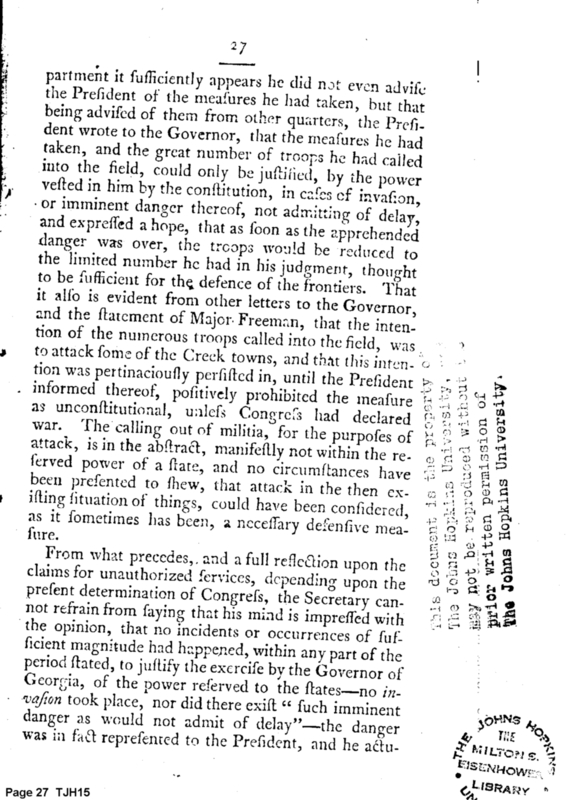
To apply the last observations to the cases of claims for militia services in Georgia, for the period before stated, it will be necessary to repeat that no proof of invasion, or of such imminent danger of invasion, as would not admit of delay, by any Indian nation, has been produced by the Executive of Georgia at any time—that the correspondence of the War Department within the period in question, exhibits strong evidence, that the communications to the Executive of the United States evinced nothing more, than indications of predatory incursions, by detached Indians, and by no means a general, or national combination to invade the state of Georgia—that so informed, the President applied such a force, as in his judgment was sufficient to resist predatory incursions, and advised and took measures, for providing and preparing the militia in general to meet a more serious state of things, but not to call them into immediate service. That the Governor of Georgia, while the proper functionary of the General Government was actually exercising his powers according to his judgment, and the demand of the exigency, undertook without consulting the President, to order out large bodies of militia—That by the correspondence of the War Department it sufficiently appears he did not even advise the President of the measures he had taken, but that being advised of them from other quarters, the President wrote to the Governor, that the measures he had taken, and the great number of troops he had called into the field, could only be justified, by the power vested in him by the constitution, in cases of invasion, or imminent danger thereof, not admitting of delay, and expressed a hope, that as soon as the apprehended danger was over, the troops would be reduced to the limited number he had in his judgment, thought to be sufficient for the defence of the frontiers. That it also is evident from other letters to the Governor, and the statement of Major Freeman, that the intention of the numerous troops called into the field, was to attack some of the Creek towns, and that this intention was pertinaciously persisted in, until the President informed thereof, positively prohibited the measure as unconstitutional, unless Congress had declared war. The calling out of militia, for the purposes of attack, is in the abstract, manifestly not within the reserved power of a state, and no circumstances have been presented to shew, that attack in the then existing situation of things, could have been considered, as it sometimes has been, a necessary defensive measure.
From what precedes, and a full reflection upon the claims for unauthorized services, depending upon the present determination of Congress, the Secretary cannot refrain from saying that his mind is impressed with the opinion, that no incidents or occurrences of sufficient magnitude had happened, within any part of the period stated, to justify the exercise by the Governor of Georgia, of the power reserved to the states—no *invasion* took place, nor did there exist "such imminent danger as would not admit of delay"—the danger which was in fact represented to the President, and he actually provided against it by directing such a force to be employed, as he thought necessary for the purpose, and such preliminary measures to be taken as would ensure a greater when circumstances should require it. That the conduct of the Governor evinced a peremptory and systematic disregard of the President's orders, and interference with his functions, not justified by emergency, and persevered in during a long period, obviously predicated on an opinion, that the President had insufficiently provided, not for a case of *imminent and sudden danger*, but either for a *regular* and *permanent* defence, or as is very probable, for a meditated attack upon the Indian territory, and that he (the Governor) had a right to assume authority to make a more adequate provision for such permanent defence, or meditated attack. That such conduct was a manifest and flagrant violation of the constitution on the part of the Governor of Georgia, and was not in its commencement, or outset, such an exercise of the powers reserved to the state, of engaging in war in case of imminent danger, as can at all bring the militia called out by his sole authority, within the predicament of having been called into, or employed in the actual service of the United States.
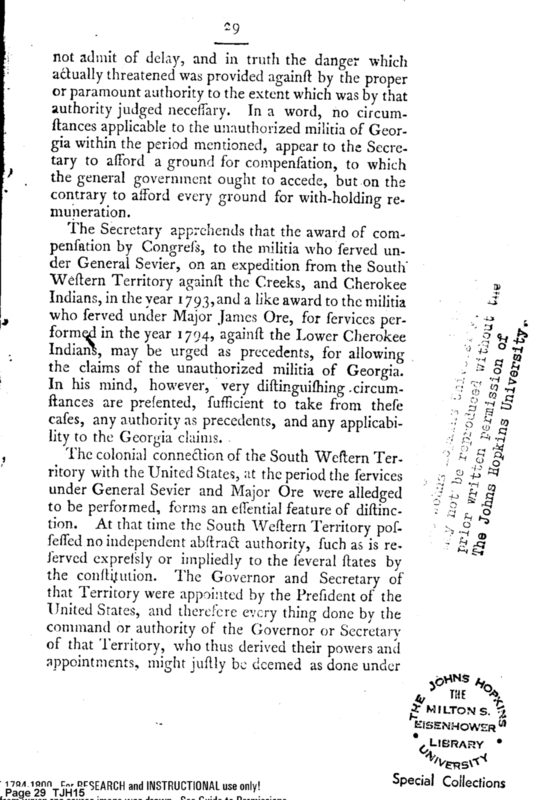
The interdiction of the constitution is two-fold: First, the states shall not keep troops in *time of peace*, without the consent of Congress. Second, they shall not engage in war, but in certain excepted cases. If the Georgia militia who claim compensation, were called out by the Governor as a mere defensive preparation, against a possible or distant danger, it was unconstitutional according to the first branch of the prohibition, and can unquestionably form no legitimate basis, for a demand of pay from the United States, and if they were called out with a view to offensive operations, it was equally unlawful, inasmuch as no imminent danger appears to have existed which would not admit of delay, and in truth the danger which actually threatened was provided against by the proper or paramount authority to the extent which was by that authority judged necessary. In a word, no circumstances applicable to the unauthorized militia of Georgia within the period mentioned, appear to the Secretary to afford a ground for compensation, to which the general government ought to accede, but on the contrary to afford every ground for with-holding remuneration.
The Secretary apprehends that the award of compensation by Congress, to the militia who served under General Sevier, on an expedition from the South Western Territory against the Creeks, and Cherokee Indians, in the year 1793, and a like award to the militia who served under Major James Ore, for services performed in the year 1794, against the Lower Cherokee Indians, may be urged as precedents, for allowing the claims of the unauthorized militia of Georgia. In his mind, however, very distinguishing circumstances are presented, sufficient to take from these cases, any authority as precedents, and any applicability to the Georgia claims.
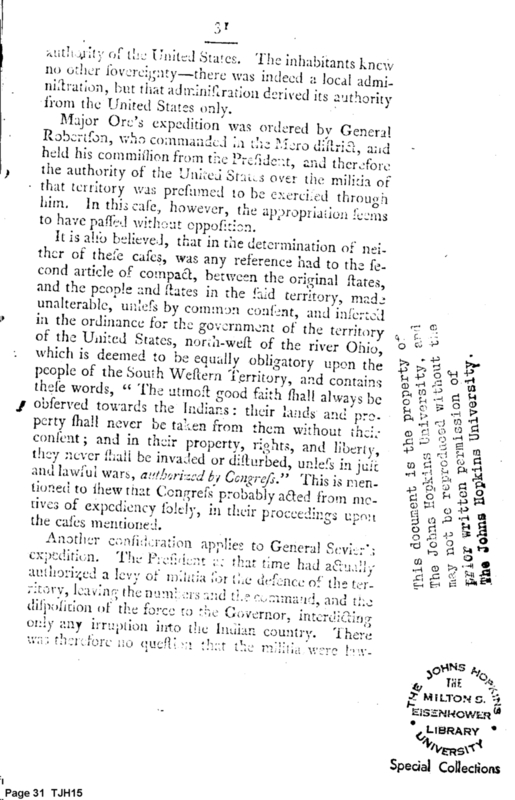
The colonial connection of the South Western Territory with the United States, at the period the services under General Sevier and Major Ore were alledged to be performed, forms an essential feature of distinction. At that time the South Western Territory possessed no independent abstract authority, such as is reserved expresly or impliedly to the several states by the constitution. The Governor and Secretary of that Territory were appointed by the President of the United States, and therefore every thing done by the command or authority of the Governor or Secretary of that Territory, who thus derived their powers and appointments, might justly be deemed as done under the authority of the United States. The inhabitants knew no other sovereignty—there was indeed a local administration, but that administration derived its authority from the United States only.
Major Ore's expedition was ordered by General Robertson, who commanded in the Mero district, and held his commission from the President, and therefore the authority of the United States over the militia of that territory was presumed to be exercised through him. In this case, however, the appropriation seems to have passed without opposition.
It is also believed, that in the determination of neither of these cases, was any reference had to the second article of compact, between the original states, and the people and states in the said territory, made unalterable, unless by common consent, and inserted in the ordinance for the government of the territory of the United States, north-west of the river Ohio, which is deemed to be equally obligatory upon the people of the South Western Territory, and contains these words, "The utmost good faith shall always be observed towards the Indians: their lands and property shall never be taken from them without their consent; and in their property, rights, and liberty, they never shall be invaded or disturbed, unless in just and lawful wars, *authorized by Congress.*" This is mentioned to shew that Congress probably acted from motives of expediency solely, in their proceedings upon the cases mentioned.
Another consideration applies to General Sevier's expedition. The President at that time had actually authorized a levy of militia for the defence of the territory, leaving the numbers and the command, and the disposition of the force to the Governor, interdicting only any irruption into the Indian country. There was therefore no question that the militia were lawfully *called into service* by the authority of the United States, and were, when assembled under this call, in the *actual service of the United States*, and therefore entitled to be paid. When in the field under a regular authority, they certainly could not be held individually accountable for the direction their commanding officer gave to the force under his command, or for the conformity of his proceedings to his instructions. The objection reported to Congress by the Secretary of War was grounded on the direction of the force being contrary to the President's inhibition, but circumstances sufficient appeared to Congress to excuse the deviation from the letter of the President's orders, and beneficial results were strongly urged to justify the grant of compensation.
As the preceding cases, from their difference in essential features, and the relative situation of the parties, and the omission in their determination to investigate any constitutional question, are supposed to afford no precedent in the cases from Georgia, so neither does the Secretary suppose they can derive any support from the allegation that rations were issued to the men by the continental commissaries, unless it can be shewn that orders were given for the purpose with the consent, knowledge and approbation of the President. The payment of interest upon certificates irregularly issued by an executive officer, without the sanction of any order or resolution of Congress, has been decided not to confer validity upon a claim originally destitute of it, any more than like payments of interest by the mistake of public officers upon counterfeit and forged certificates, could give validity to those of the latter description. And between individuals, the payment of interest by an agent upon the *presumed*, but not *real* obligation of his principal, has never been held to give validity to such an obligation. "The same rules of right which govern cases between individuals, must appear to be the proper guides in cases between the public and individuals."
The Secretary has delayed his report on the subject of these claims, in the expectation of being able to give an extended and correct view of their *whole* magnitude by the receipt of muster rolls stated by major Freeman to be not yet forwarded—he has been disappointed. The exhibition he has presented of the principles conceived to be involved in the subject, he believes to be enjoined by duty. And whatever may be the present determination of Congress, he presumes to suggest the propriety, and even indispensable necessity of a legislative provision:—That whenever in future any state under the powers reserved to it by the constitution, calls its own militia into service, the troops thus called into service shall be paid directly by the state, and that the United States, if the exercise of the reserved power was regular and proper, shall re-imburse the state all lawful expenditure on this account. Such a legislative provision would give to future questions of this kind, very different aspects; but there is certainly great difficulty in resisting a demand for the pay of an individual in the present state of the law on this subject.
The House of Representatives on the eleventh, and the Senate of the United States on the twelfth of February instant, referred also a new petition from Jonas Fauché, in behalf of himself and the officers and soldiers of a troop of militia dragoons, formerly under his command, praying for compensation for services from the 23d of April, 1793, until the 10th of May, 1794, a period short of that for which compensation is prayed by the former petition. These petitions the Secretary takes the liberty to apply to the foregoing Report, which is intended to comprehend all the unauthorized services of the militia of Georgia, from 1792, to the year 1796 inclusive.
All which is most respectfully submitted.
JAMES McHENRY,
SECRETARY OF WAR.
WAR DEPARTMENT,
*February 20th*, 1800.
[COPY.]
PHILADELPHIA,
*13th February*, 1799.
SIR,
IN compliance with the request contained in your letter of the 19th of last month, I make the following statement of facts relative to the militia claims of the state of Georgia, which have been heretofore denominated unauthorized.
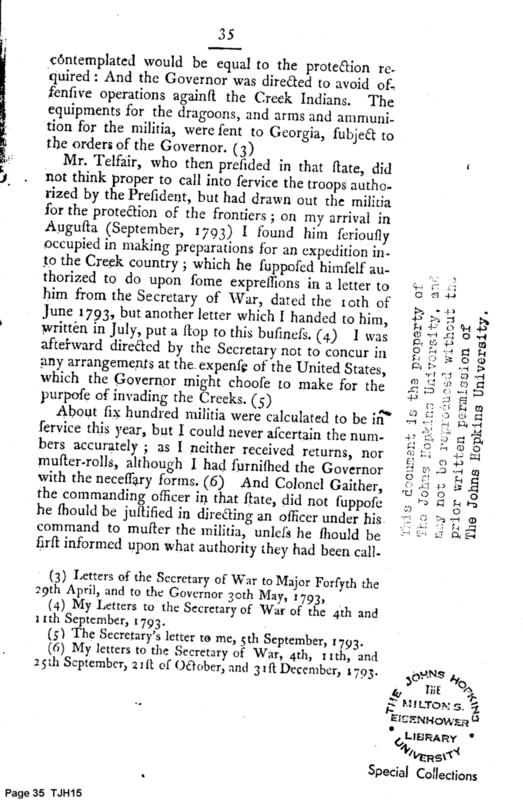
The alarming situation of the frontiers in 1793, induced the President of the United States to authorize the Governor of Georgia to call into service, at the expense of the Union, one hundred horse and one hundred foot; and scouts or spies in proportion of two to every ten miles of the extent of the frontier. (1) Several detachments of militia dragoons had been called into service in 1792, and paid by the United States. (2) It was, however, supposed the force now contemplated would be equal to the protection required: And the Governor was directed to avoid offensive operations against the Creek Indians. The equipments for the dragoons, and arms and ammunition for the militia, were sent to Georgia, subject to the orders of the Governor. (3)
Mr. Telfair, who then presided in that state, did not think proper to call into service the troops authorized by the President, but had drawn out the militia for the protection of the frontiers; on my arrival in Augusta (September, 1793) I found him seriously occupied in making preparations for an expedition into the Creek country; which he supposed himself authorized to do upon some expressions in a letter to him from the Secretary of War, dated the 10th of June 1793, but another letter which I handed to him, written in July, put a stop to this business. (4) I was afterward directed by the Secretary not to concur in any arrangements at the expense of the United States, which the Governor might choose to make for the purpose of invading the Creeks. (5)
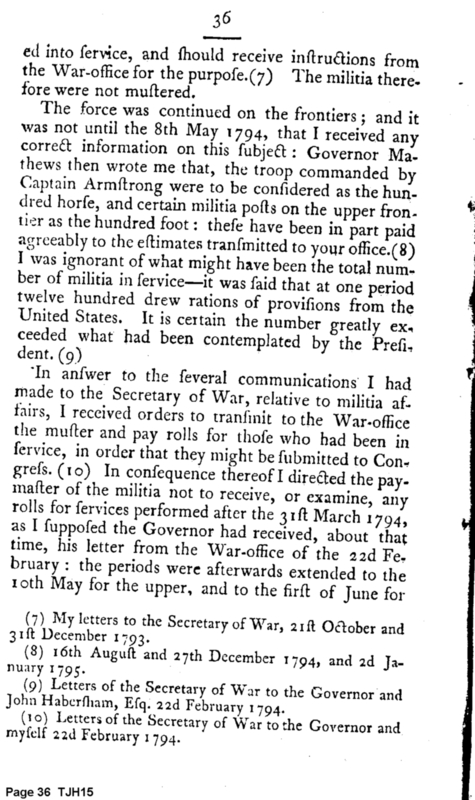
About six hundred militia were calculated to be in service this year, but I could never ascertain the numbers accurately; as I neither received returns, nor muster-rolls, although I had furnished the Governor with the necessary forms. (6) And Colonel Gaither, the commanding officer in that state, did not suppose he should be justified in directing an officer under his command to muster the militia, unless he should be first informed upon what authority they had been called into service, and should receive instructions from the War-office for the purpose. (7) The militia therefore were not mustered.
The force was continued on the frontiers; and it was not until the 8th May 1794, that I received any correct information on this subject: Governor Matthews then wrote me that, the troop commanded by Captain Armstrong were to be considered as the hundred horse, and certain militia posts on the upper frontier as the hundred foot: these have been in part paid agreeably to the estimates transmitted to your office. (8) I was ignorant of what might have been the total number of militia in service—it was said that at one period twelve hundred drew rations of provisions from the United States. It is certain the number greatly exceeded what had been contemplated by the President. (9)
In answer to the several communications I had made to the Secretary of War, relative to militia affairs, I received orders to transmit to the War-office the muster and pay rolls for those who had been in service, in order that they might be submitted to Congress. (10) In consequence thereof I directed the paymaster of the militia not to receive, or examine, any rolls for services performed after the 31st March 1794, as I supposed the Governor had received, about that time, his letter from the War-office of the 22d February: the periods were afterwards extended to the 10th May for the upper, and to the first of June for the lower counties. (11) It is therefore to be understood that all the militia services performed in Georgia in the year 1793, and to the periods before mentioned in 1794, except the hundred horse, hundred foot and the spies, for which appropriations have not already been made, are termed *unauthorized*; because they exceeded the numbers limited in the letter of the Secretary of War, to the Governor, of the 30th May 1793.
On the 7th of November 1794, I transmitted to your office the Estimate No. 1, accompanied with one set of the muster and pay rolls: I refer you to my letters to the Secretary of War, and to your predecessor, of that date, for the fullest information upon this subject. The receipt of these rolls was acknowledged by the Accountant on the 10th of December 1794.
As the Estimate No. 1, did not comprehend all the militia claims, other muster and pay rolls for similar services were received by the pay-master. On the 27th February, 1796, the Estimate No. 2, was transmitted to your office; and the receipt thereof acknowledged on the 8th April, 10th and 17th of June.
I now submit to you two other Estimates, No. 2 and 3, these four contain all the claims for unauthorized services which have been received either by the pay-master of the militia or myself, to the 12th September, 1798, except some rolls which have been returned to be corrected, particularly for services performed in Washington county, under the command of captains Shepherd and Hampton. There are also some to be expected from the counties of Chatham, Effingham, Burke, Columbia and Elbert.
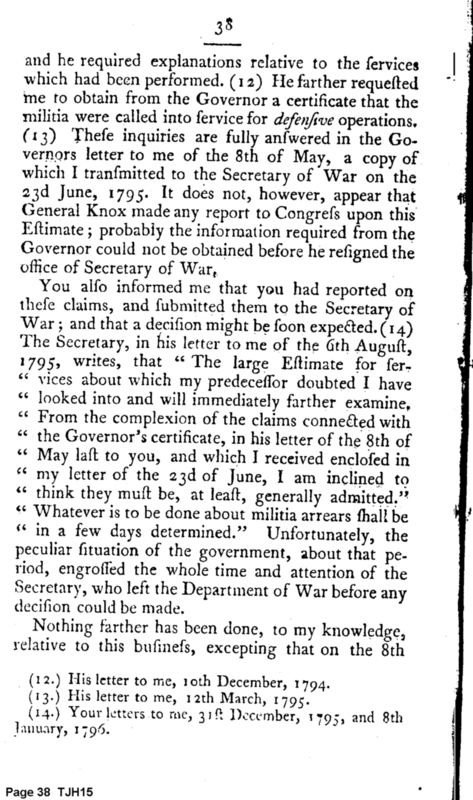
The Accountant informed me that the Estimate, No. 1, had been submitted to the Secretary of War, and he required explanations relative to the services which had been performed. (12.) He farther requested me to obtain from the Governor a certificate that the militia were called into service for *defensive* operations. (13.) These inquiries are fully answered in the Governors letter to me of the 8th of May, a copy of which I transmitted to the Secretary of War on the 23d June, 1795. It does not, however, appear that General Knox made any report to Congress upon this Estimate; probably the information required from the Governor could not be obtained before he resigned the office of Secretary of War.
You also informed me that you had reported on these claims, and submitted them to the Secretary of War; and that a decision might be soon expected. (14.) The Secretary, in his letter to me of the 6th August, 1795, writes, that "The large Estimate for services about which my predecessor doubted I have looked into and will immediately farther examine. From the complexion of the claims connected with the Governor's certificate, in his letter of the 8th of May last to you, and which I received enclosed in my letter of the 23d of June, I am inclined to think they must be, at least, generally admitted." "Whatever is to be done about militia arrears shall be in a few days determined." Unfortunately, the peculiar situation of the government, about that period, engrossed the whole time and attention of the Secretary, who left the Department of War before any decision could be made.
Nothing farther has been done, to my knowledge, relative to this business, excepting that on the 8th March, 1797, I accompanied Mr. Baldwin, member of Congress for Georgia, on a visit to the Secretary of War, to whom I explained the nature of the claims: It is probable that had not the Secretary been engaged in more weighty concerns, that he would have reported thereon to Congress. Independent of the press of business, another cause has operated to retard a decision:—since the Estimates were transmitted two Secretaries have left the War Department.
It is proper to observe that the citizens of Georgia never thought the force authorized by the President adequate to the protection of the frontiers; as may be seen in the representations made from the Governors of that state to the Secretary of War. And the General Government have from time to time made appropriations for extra bodies of troops for this service.
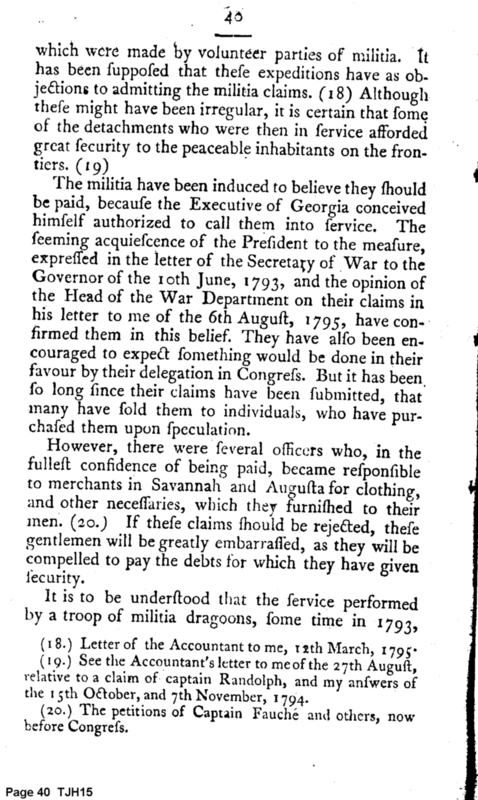
The periods within which these unauthorized claims are made, are particularly marked in the history of that state for misunderstandings between the Creeks and the frontier settlers. There were faults on both sides. The Indians were continually stealing horses, murdering and doing other injuries to the inhabitants, who in retaliation made incursions into their country: Such were the Oakmulgee expedition under general Twiggs in June 1793, (15.) which consisted of about seven hundred and fifty horse and foot; the destruction of Oakfuskee village by colonel Melton in September, who had under his command about eighty-eight officers and men; (16.) the detachment of one hundred and twenty-five men, who marched under the orders of major Brenton against the Little Chehaw village, on Flint river, (17.) and several of less note which were made by volunteer parties of militia. It has been supposed that these expeditions have as objections to admitting the militia claims. (18.) Although these might have been irregular, it is certain that some of the detachments who were then in service afforded great security to the peaceable inhabitants on the frontiers. (19.)
The militia have been induced to believe they should be paid, because the Executive of Georgia conceived himself authorized to call them into service. The seeming acquiescence of the President to the measure, expressed in the letter of the Secretary of War to the Governor of the 10th June, 1793, and the opinion of the Head of the War Department on their claims in his letter to me of the 6th August, 1795, have confirmed them in this belief. They have also been encouraged to expect something would be done in their favour by their delegation in Congress. But it has been so long since their claims have been submitted, that many have sold them to individuals, who have purchased them upon speculation.
However, there were several officers who, in the fullest confidence of being paid, became responsible to merchants in Savannah and Augusta for clothing, and other necessaries, which they furnished to their men. (20.) If these claims should be rejected, these gentlemen will be greatly embarrassed, as they will be compelled to pay the debts for which they have given security.
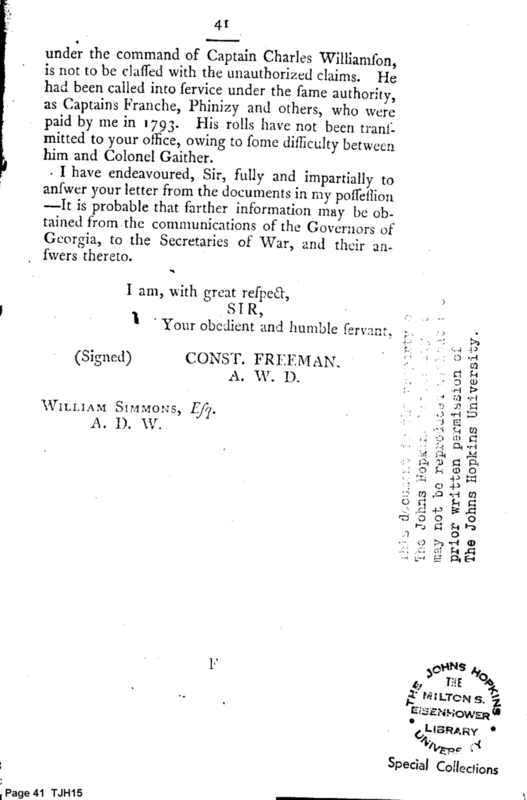
It is to be understood that the service performed by a troop of militia dragoons, some time in 1793, under the command of Captain Charles Williamson, is not to be classed with the unauthorized claims. He had been called into service under the same authority, as Captains Franche, Phinizy and others, who were paid by me in 1793. His rolls have not been transmitted to your office, owing to some difficulty between him and Colonel Gaither.
I have endeavoured, Sir, fully and impartially to answer your letter from the documents in my possession—It is probable that farther information may be obtained from the communications of the Governors of Georgia, to the Secretaries of War, and their answers thereto.
I am, with great respect,
SIR,
Your obedient and humble servant,
(Signed) CONST. FREEMAN.
A. W. D.
WILLIAM SIMMONS, *Esq.*
A. D. W.
Type
Document
Description
Report on the Petitions of William Milton, and Others, exhibiting Claims for Militia Services in the State of Georgia. Addresses some of the jurisdictional issues that came up between state and federal authorities regarding provision of common defense.
Date
03/14/1800
Author
Recipient
Sent from
War Department
Collection
Document number
1800031400001
Page start
1
Notable persons
James McHenry
militia
William Milton
congress
House of Representatives
committee
Speaker House of Representatives
militia dragoons
Jonas Fauche
John F. Randolph
Creeks
Cherokees
President Washington
Major Robert Forsyth
Governor Telfair
Governor Blount
Lieutenant Colonel Henry Gaither
James Seagrove
Indian Agent
Secretary of War
Henry Knox
Alexander Hamilton
John Habersham
Constant Freeman
agent war department in Georgia
Captain Girardeau
General Sevier
Major John Ore
General Robertson
Notable locations
War Department
Georgia
Greene County
Southwestern Territory
Mero District
Notable items
petitions
claims
report
constitution