

Treaty Allocations for Roads
Document 1800Tellico Treaty, Kentucky Treaty, and Holsten Treaty cited in reference to the building of permanent roads from northern and southern settlements in the U.S. Difficulties building roads due to Cherokees discussed.
No human transcription currently available for this document.
This transcription was generated by machine using Anthropic's Claude Code (model sonnet 4.6). It may contain errors or inaccuracies. Please verify against the document image. Learn more about our generative AI methodology.
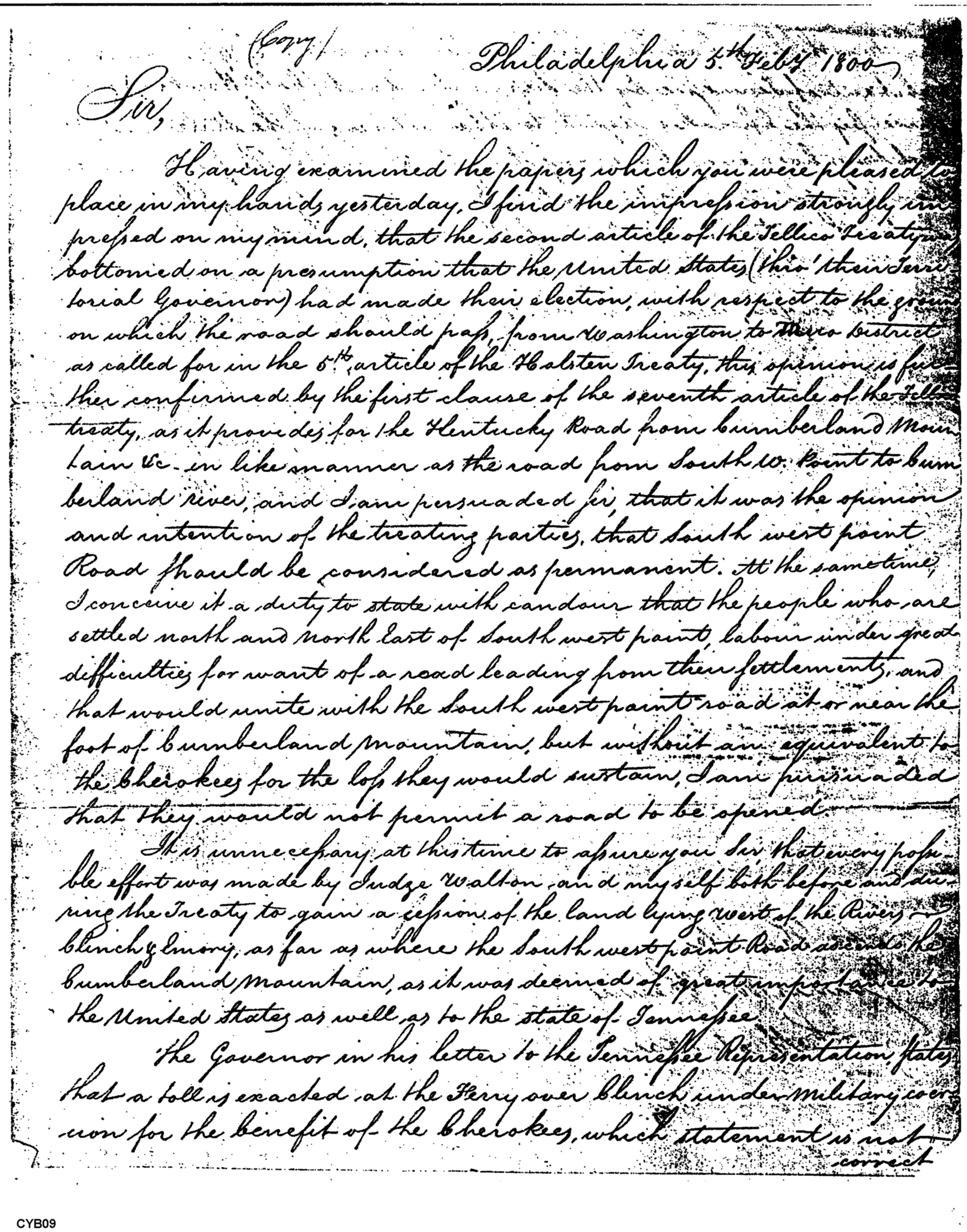
[Copy]
Philadelphia 5th Feby 1800
Sir,
Having examined the papers which you were pleased to place in my hands yesterday, I find the impression strongly impressed on my mind, that the second article of the Tellico Treaty, is bottomed on a presumption that the United States (thro' their territorial Governors) had made their election with respect to the road on which the road should pass, from Washington to these States, as called for in the 5th article of the Holston treaty, this opinion is further confirmed by the first clause of the seventh article of the same treaty, as it provides for the Kentucky Road from Cumberland Mountain &c. in like manner as the road from South W. Point to Cumberland River, and I am persuaded in that it was the opinion and intention of the treating parties, that South west point Road should be considered as permanent. At the same time I conceive it a duty to state with candour that the people who are settled north and north east of South west point, labour under great difficulty for want of a road leading from their settlements, and that would unite with the South west point road at or near the foot of Cumberland mountains, but without [undecipherable: a grant?] to the Cherokees for the loss they would sustain, I am persuaded that they would not permit a road to be opened.
It is unnecessary at this time to apprise you Sir that every possible effort was made by Judge Walton, and myself both before [undecipherable] ning the treaty, to gain a cession of the land lying west of the River, Clinch, & Emory, as far as where the South west point Road [undecipherable] Cumberland mountains, as it was deemed of great importance to the United States as well as to the State of Tennessee.
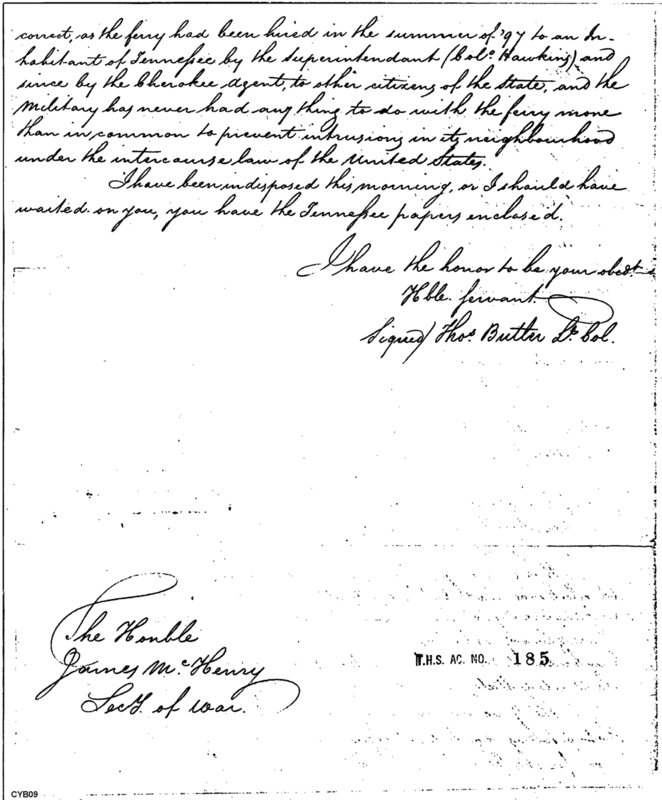
The Governor in his letter to the Tennessee [undecipherable] states that a ferry enacted at the ferry over Clinch under military con[undecipherable] ion for the benefit of the Cherokees, which statement is not correct, as the ferry had been hired in the summer of 97 to an inhabitant of Tennessee by the Superintendant (Colo Hawkins) and since by the Cherokee Agent, to other citizens of the State, and the Military has never had any thing to do with the ferry more than in common to prevent intrusions in its neighbourhood under the intercourse law of the United States.
I have been indisposed this morning, or I should have waited on you, you have the Tennessee papers enclosed.
I have the honor to be your obt. & Hble. Servant.
Signed Thos. Butler Lt. Col.
The Honble
James McHenry
Sect. of War.
Type
Copy of Signed Document
Description
Tellico Treaty, Kentucky Treaty, and Holsten Treaty cited in reference to the building of permanent roads from northern and southern settlements in the U.S. Difficulties building roads due to Cherokees discussed.
Date
02/05/1800
Author
Recipient
Sent from
Philadelphia
Collection
Document number
1800020540001
Page start
1
Notable persons
James McHenry
Thomas Butler
Cherokees
Indians
settlers
Notable locations
Philadelphia
north
south west point
settlements
land
territory
roads
Cumberland Mountain
river
Notable items
roads