LETTER
FROM THE
Secretary of War,
TO THE
CHAIRMAN OF THE COMMITTEE,
Appointed on the 9th of December last,
ON SO MUCH OF THE
SPEECH of the PRESIDENT,
AS RELATES TO
"A System of National Defence, Commensurate with our Resources, and the situation of our Country."
13th February, 1800.
Ordered to lie on the Table.
LETTER.
WAR DEPARTMENT,
*January* 31*st*, 1800.
SIR,
I HAVE the honor to submit, in compliance with your requisition, a few supplementary observations, and a view of the probable expence of the Military Schools respectfully recommended to consideration in my report, communicated to Congress, by a message dated the 13th instant, from the President of the United States.
The report contemplates certain military schools as an essential mean, in conjunction with a small military establishment, to prepare for, and perpetuate to the United States, at a very moderate expence, a body of scientific officers and engineers, adequate to any future exigency, qualified to discipline for the field, in the shortest time, the most extended armies, and to give the most decisive and useful effects to their operations.
It is not conceived the United States will ever think it expedient to employ militia upon their frontiers, or to garrison their fortified places in time of peace, nor that they will be disposed to place their reliance, for defence, against a foreign invading enemy, upon militia alone; but that they will at all times maintain a body of regular troops, commensurate with their ability to maintain them, and the necessity or policy that may demand such an establishment.
To qualify and keep our citizens in general, of suitable bodily ability, prepared to take the field, against regular forces, would demand the most radical changes in our militia system, and such an uninterrupted series of training, discipline and instruction, to be applied, as well to the officers, as to the men, as comports with regular troops only,—while in its results, the measure would be found on account of the loss to the community, occasioned by the abstraction from labour or occupation, and direct cost, greatly to exceed in expence, what would be required to support a moderate military establishment. This position, which is thought to be a sound one, does not bring into view, the effects of the measure upon the morals, industry and habits of the citizens.
Practically considered, may we not as well calculate to be commodiously lodged, and have the science of building improved, by employing every man in the community in the construction of houses, and by exploding from society as useless, architects, masons and carpenters, as expect to be defended efficiently from an invading enemy, by causing every citizen to endeavour to make himself master of the several branches of the art of war, and excluding engineers, scientific officers and regular troops.
There is certainly, however, a system as it respects our militia, which if resorted to and persevered in, may secure the utility of their services in times of danger, without much injury to the morals, or materially affecting the general industry of the nation.
When the perfect order and exact discipline which are essential to regular troops are contemplated, and with what ease and precision they execute the different manœuvres indispensable to the success of offensive or defensive operations, the conviction cannot be resisted, that such troops will always have a decided advantage over more numerous forces composed of uninstructed militia or undisciplined recruits.
It cannot yet be forgotten, that in our revolutionary war, it was not until after several years practice in arms, and the extension of the periods for which our soldiers were at first enlisted, that we found them at all qualified to meet in the field of battle those to whom they were opposed. The occasional brilliant and justly celebrated acts, of some of our militia, during that eventful period, detract nothing from this dear bought truth. With all the enthusiasm which marked those days, it was perceived and universally felt, that regular and disciplined troops were indispensable, and that it was utterly unsafe for us to trust to militia alone the issue of the war. The position therefore is illustrated, that even in times of the greatest danger, we cannot give to our militia, that degree of discipline, or to their officers that degree of military science upon which a nation may safely hazard its fate.
The Great Man who conducted the war of our revolution, was continually compelled to conform his conduct to the circumstances growing out of the experimental lessons just mentioned. What was the secret of his conduct? Must it be told? It may, and without exciting a blush or uneasy sensation in any of his surviving companions in arms. He had an Army of Men, but he had few Officers or Soldiers in that army. Both were to be formed, which could not be effected in a single campaign, or while his regiments were continually returning home, and like the waves of the sea, each in their turn lost in the abyss and succeeded by new ones. It was not till after he was furnished with a less fluctuating and more stable kind of force, that he could commence with a prospect of advantage, military instructions or inforce the ordinances of discipline: and even then he felt that *time and instructors* were required to render his labours useful and enable his army to meet the enemy upon any thing like *equal terms*. Are we to profit by or is this experience to be lost to our country?
The art of war, which gives to a small force the faculty to combat with advantage superior numbers, *indifferently instructed,* is subjected to mechanical, geometrical, moral and physical rules; it calls for profound study; its theory is immense; the details infinite, and its principles rendered useful only by a happy adaptation of them to all the circumstances of place and ground, variously combined, to which they may be applicable. Is it possible for an officer of militia, to obtain a competent knowledge of these things in the short space his usual avocations will permit him to devote to their acquisition? Is it possible for any officer, having acquired a knowledge of these details, this theory and these principles, to carry them into useful practice with a handful of militia, in the few days in each year allotted by law to trainings and exercises? Is that perfect subordination and obedience of men to their officers, and of each *inferior* to his *superior officer,* through all the grades of rank from the corporal up to the commander in chief, which forms a vital principle essential to the energy and force of armies, to be acquired by or communicated to a body of militia organized and trained according to our laws? And does it consist with a humane and enlightened policy to march men so imperfectly instructed and disciplined, unless in cases of the last extremity, against veteran troops (where this principle reigns in full activity) commanded by skilful and scientific officers? Admitting, however, that militia officers during the few months the law permits their corps to be retained in *actual service,* could render their men by incessant instruction capable of fulfilling the object of their destination; yet as that advantage is but momentary, as these borrowed instruments must be quickly returned to the depot which furnished them, as new ones must be resorted to and successively instructed; what can be expected from such a system, but perpetual incoherence between the means and the end, and certain shipwreck to the best connected and combined military projects. This to be sure is the old story—it cannot, however, be too often repeated, because it can never be refuted.
The secret of discipline, and the importance of military science, were well known to those ancient governments whose generals and troops have filled the world with the splendor of their victories. According to *Scipio,* nothing contributed to the success of enterprises so much as skill in the individual officers. The severity of the Roman discipline is well understood, and the estimation in which it was held by *Cæsar. Livy* has observed, that *science* does more in war than *force. Vigicius,* that it is neither *numbers,* nor *blind valor* which insures victory, but that it generally follows *capacity* and *science in war. Machiavel,* who has written upon military affairs, placed so much dependence on an *exact discipline,* and *military science,* as to efface from his list of great generals, all those, who with *small armies,* did not execute *great things:* but to the committee, it is unnecessary to repeat the authorities of generals and writers of the first reputation, to shew the high importance attached to military science and discipline in all ages of the world, or resort to history for evidence of its effects. They must be well acquainted with the facts, and no doubt will give them their due weight in considering the subjects now before them.
There is however an authority, so much in point relative to the essentiality of the institution in question, that I cannot forbear to mention it.
The Marshal de *Puisegur,* who has left an excellent treatise on the art of war, the result of his experience, observes:
"I have been perhaps at as many sieges as any of those in service, and in all forts of grades; as subaltern I have commanded troops and working parties in a siege; as Major I have conducted to the trenches and posts to which they were destined troops and labourers; I have been Major of Brigade, Marshal de camp, and Lieutenant General: however, as I have not learned fortification, my practice has not enabled me to acquit myself in conducting attacks, so that I should be obliged to suffer myself to be instructed in many things by the lights of Engineers, their practice being founded upon principles which are known to them, an advantage I have not in this branch of war."
This is the candid acknowledgement of a man who had served sixty years in the army, who had learned the military art under a father, that in forty years service, had been present at two hundred sieges, and who had himself passed through all the military grades, and arrived from an inferior to a superior rank, but after having deserved each successive promotion by some distinguished action.
A slight attention to circumstances, and the actual position of our country, must lead to the conviction, that a well connected series of fortifications, is an object of the highest importance to the United States, not only as these will be conducive to the general security, but as a mean of lessening the necessity, and consequently the expence of a large military establishment.
By strongly fortifying our harbours and frontiers, we may reasonably expect, either to keep at a distance the calamities of war, or render it less injurious when it shall happen. It is behind these ponderous masses only, that a small number of men can maintain themselves for a length of time against superior forces. Imposing therefore upon an enemy, who may have every thing to transport across the Atlantic, the necessity of undertaking long and hazardous sieges, encreases the chances against his undertaking them at all, or if he does, in despite of such circumstances, insures to us the time he must consume in his operations, to rally our means to a point and unite our efforts to resist him.
We must not conclude from these brief observations, that the services of the Engineer is limited to constructing, connecting, consolidating, and keeping in repair fortifications. This is but a single branch of their profession, though indeed a most important one. Their utility extends to almost every department of war, and every description of general officers, besides embracing whatever respects public buildings, roads, bridges, canals and all such works of a civil nature. I consider it therefore of vast consequence to the United States, that it should form in its own bosom, and out of its own native materials, men qualified to place the country in a proper posture of defence, to infuse science into our army, and give to our fortifications that degree of force, connection and perfection, which can alone counterbalance the superiority of attack over defence.
With these advantages in prospect, is it not incumbent upon us to hasten with all reasonable diligence, the commencement and completion of an institution essential to realize them. And are expenditures which give such valuable results, to be otherwise viewed than as real œconomy. It is a well known fact, that England had neither native artillerists or engineers before the time of the Duke of Cumberland, and till after she established military schools.
I shall now, having respectfully submitted these observations, present an estimate of the expence of the military schools which it appears to me ought to be immediately instituted.
Agreeably to the plan of the military academy, the directors thereof are to be officers taken from the army, consequently no expence will be incurred by such appointments.
The plan also contemplates, that officers of the army, cadets and non-commissioned officers, shall receive instruction in the academy. As the rations and fuel which these are entitled to in the army, will suffice for them in the academy, no additional expence will be required for these objects of maintenance while there.
The expences of servants and certain incidental charges relative to the police and administration may be defrayed by those who shall be admitted out of their pay and emoluments.
According to the plan contemplated, fifty officers, cadets, or non-commissioned officers may be annually instructed in the fundamental school and an equal number in the school of artillerists and engineers; the only schools which it is deemed expedient to bring into operation.
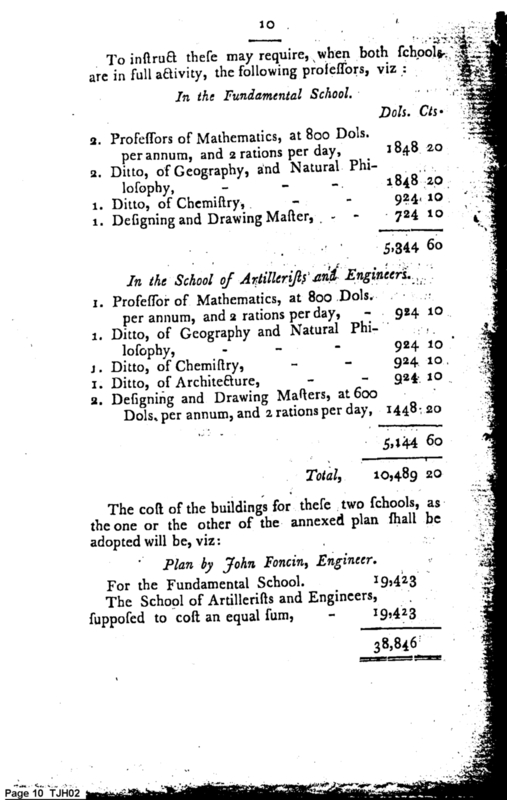
To instruct these may require, when both schools are in full activity, the following professors, viz:
*In the Fundamental School.*
Dols. Cts.
2. Professors of Mathematics, at 800 Dols. per annum, and 2 rations per day, 1848 20
2. Ditto, of Geography, and Natural Philosophy, 1848 20
1. Ditto, of Chemistry, 924 10
1. Designing and Drawing Master, 724 10
5,344 60
*In the School of Artillerists and Engineers.*
1. Professor of Mathematics, at 800 Dols. per annum, and 2 rations per day, 924 10
1. Ditto, of Geography and Natural Philosophy, 924 10
1. Ditto, of Chemistry, 924 10
1. Ditto, of Architecture, 924 10
2. Designing and Drawing Masters, at 600 Dols. per annum, and 2 rations per day, 1448 20
5,144 60
*Total,* 10,489 20
The cost of the buildings for these two schools, as the one or the other of the annexed plan shall be adopted will be, viz:
*Plan by John Foncin, Engineer.*
For the Fundamental School. 19,423
The School of Artillerists and Engineers, supposed to cost an equal sum, 19,423
38,846
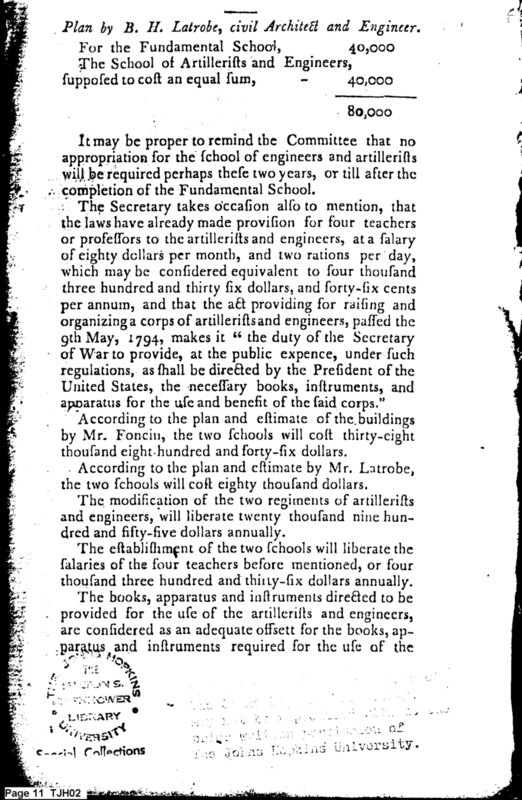
*Plan by B. H. Latrobe, civil Architect and Engineer.*
For the Fundamental School, 40,000
The School of Artillerists and Engineers, supposed to cost an equal sum, 40,000
80,000
It may be proper to remind the Committee that no appropriation for the school of engineers and artillerists will be required perhaps these two years, or till after the completion of the Fundamental School.
The Secretary takes occasion also to mention, that the laws have already made provision for four teachers or professors to the artillerists and engineers, at a salary of eighty dollars per month, and two rations per day, which may be considered equivalent to four thousand three hundred and thirty six dollars, and forty-six cents per annum, and that the act providing for raising and organizing a corps of artillerists and engineers, passed the 9th May, 1794, makes it "the duty of the Secretary of War to provide, at the public expence, under such regulations, as shall be directed by the President of the United States, the necessary books, instruments, and apparatus for the use and benefit of the said corps."
According to the plan and estimate of the buildings by Mr. Foncin, the two schools will cost thirty-eight thousand eight hundred and forty-six dollars.
According to the plan and estimate by Mr. Latrobe, the two schools will cost eighty thousand dollars.
The modification of the two regiments of artillerists and engineers, will liberate twenty thousand nine hundred and fifty-five dollars annually.
The establishment of the two schools will liberate the salaries of the four teachers before mentioned, or four thousand three hundred and thirty-six dollars annually.
The books, apparatus and instruments directed to be provided for the use of the artillerists and engineers, are considered as an adequate offsett for the books, apparatus and instruments required for the use of the schools; consequently no charge has been stated in the estimate for these objects.
If, therefore, we oppose the sums thus annually liberated to the annual salary of the professors and original cost of the buildings, whichever of the plans is adopted, we shall find the measure proposed, viewed merely in the light of an operation of finance, to result in a considerable saving to the United States.
An individual would think it a good bargain to receive twenty-five thousand two hundred and ninety-one dollars, annually, the sum liberated, and to give in lieu thereof ten thousand four hundred and sixty-six dollars, annually, the salary of the professors, and a principal sum equal to the cost of the buildings. In other words, he would receive fourteen thousand seven hundred and twenty-five dollars, annually, which is equivalent at six per cent, to a capital or principal of two hundred and forty-five thousand four hundred and sixteen dollars; a sum greatly exceeding the estimated cost of the buildings upon either estimate.
The committee while they perceive that the seed which it is now proposed to sow, is to yield a future harvest, will at the same time, justly appreciate the various beneficial consequences which must result from the immediate adoption, and the striking inconveniences and danger to be apprehended from a postponement of the measure.
Whether our country is to be plunged into a war or enjoy for a length of time the blessings of peace and interior tranquility; whether the portentous events which have afflicted Europe, and in their progress threatened the United States are to subside into a settled state of things; whether the blessings of peace and the customary relations among the transatlantic powers, are to take place, or hostilities shall be continued protracted and extended beyond their present limits, in either view it is equally a suggestion of policy and wisdom to improve our means of defence, and give as much perfection as possible to such establishments as may be conceived essential to the maintenance of our rights and security from insults.
The unavoidable collisions growing out of trade and the reciprocal restrictions of great commercial states; the apprehensions and jealousies natural to powers possessing contiguous territory; the inefficacy of religion and morality to controul the passions of men, or the interest and ambition of nations; the impossibility at times, for governments to adjust their differences or preserve their rights without making sacrifices more to be dreaded than the hazards and calamities of war; all these considerations, illustrated by volumes of examples, teach the soundness of the axiom, *Si vis pacem para bellum.* And what time more proper to prepare the materials for war, than a time of peace, or more urgent than that in which a nation is threatened with war.
I have the honor to be,
With the greatest respect,
S I R,
Your most obedient servant,
JAMES M'HENRY,
*Secretary of War.*
Harrison G. Otis, Esq.
Chairman of the Committee of Defence.