

Exhibit of the Expenses of the National Armory at Springfield
Document 1800"The Secretary of War lays before the Senate of the United States, an exhibit of the expenses of the national armory at Springfield, Massachusetts together with the fullest information he has been able to obtain relative to the said establishment."
No human transcription currently available for this document.
This transcription was generated by machine using Anthropic's Claude Code (model sonnet 4.6). It may contain errors or inaccuracies. Please verify against the document image. Learn more about our generative AI methodology.
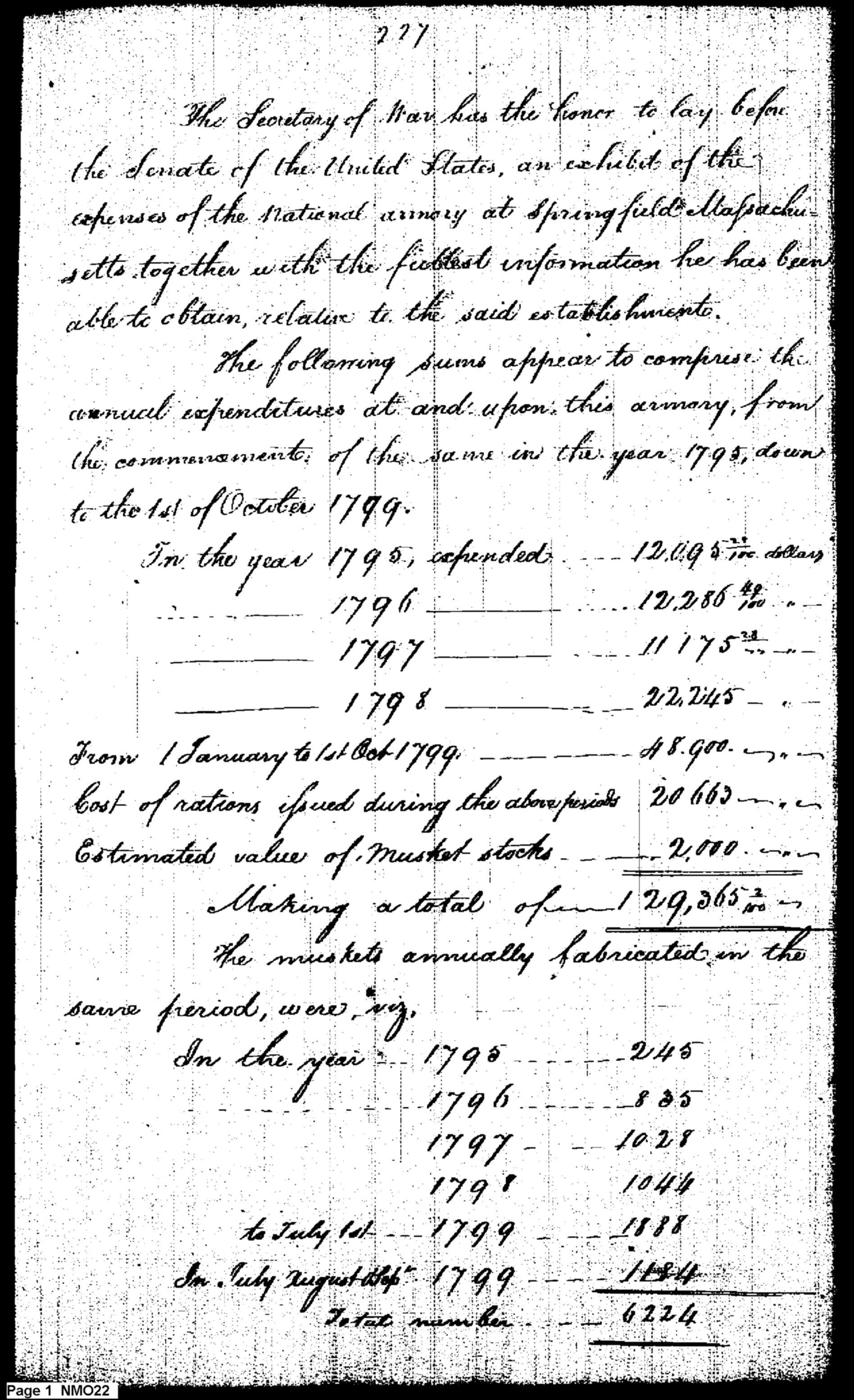
The Secretary of War has the honor to lay before the Senate of the United States, an exhibit of the expenses of the National armory at Springfield Massachusetts, together with the fullest information he has been able to obtain, relative to the said establishment.
The following sums appear to comprise the annual expenditures at and upon this armory, from the commencement of the same in the year 1795, down to the 1st of October 1799.
In the year 1795, expended ........................ 12,095[undecipherable] dollars
—————————— 1796 —————————— ............ 12,28648/100
—————————— 1797 —————————— ............ 11,17534/100
—————————— 1798 —————————— ............ 22,245
From 1 January to 1st Oct 1799 ——————— 48,900 ——
Cost of rations issued during the above periods 20,663 ——
Estimated value of Musket stocks —— —————— 2,000 ——
Making a total of ——————————————————— 129,3652/100
The muskets annually fabricated in the same period, were, viz.
In the year —— 1795 ———— 245
1796 ———— 835
1797 —— 1028
1798 1044
to July 1st —— 1799 ———— 1888
In July August Sept 1799 ——— 1184
Total number ——————————— 6224
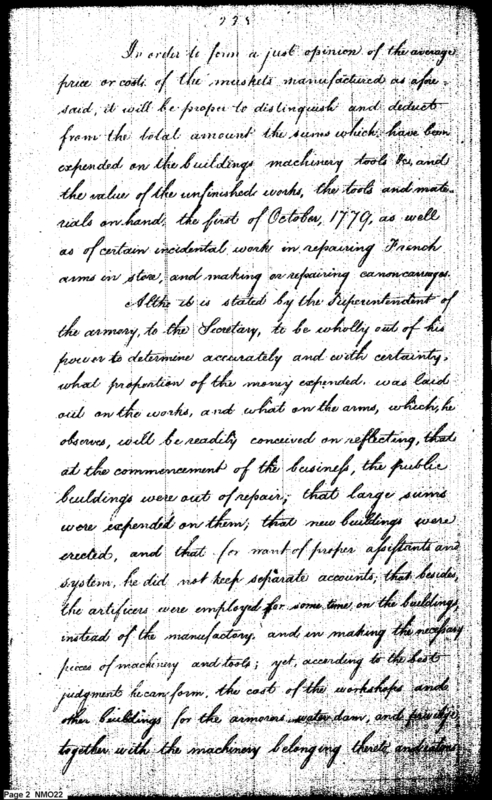
In order to form a just opinion of the average price or costs of the muskets manufactured as aforesaid, it will be proper to distinguish and deduct from the total amount the sums which have been expended on the buildings, machinery, tools &c, and the value of the unfinished works, the tools and materials on hand, the first of October, 1799, as well as of certain incidental works in repairing French arms in store, and making or repairing canon carriages.
Altho it is stated by the Superintendent of the armory, to the Secretary, to be wholly out of his power to determine accurately and with certainty, what proportion of the money expended, was laid out on the works, and what on the arms, which, he observes, will be readily conceived on reflecting, that at the commencement of the business, the public buildings were out of repair; that large sums were expended on them; that new buildings were erected, and that for want of proper assistants and system, he did not keep separate accounts; that besides, the artificers were employed for some time on the buildings, instead of the manufactory, and in making the necessary pieces of machinery and tools; yet, according to the best judgment he can form, the cost of the workshops and other buildings for the armorers, water dam, and [undecipherable] together with the machinery belonging thereto and [undecipherable]
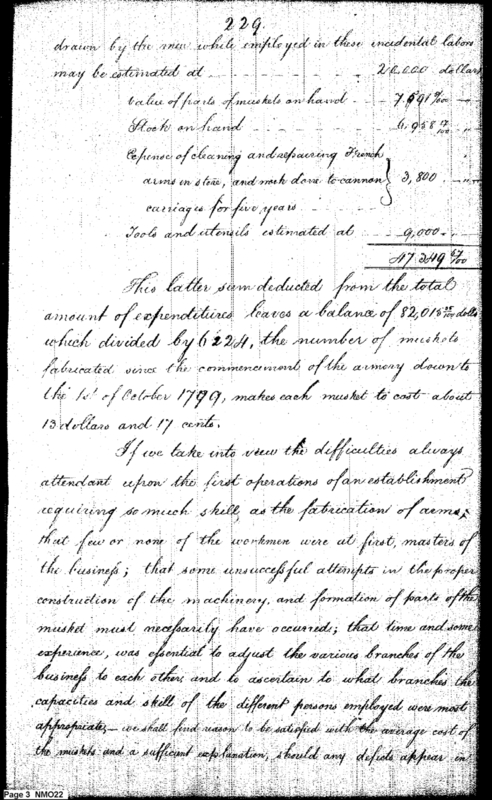
drawn by the men while employed in these incidental labors may be estimated at .... 20,000 dollars
value of parts of muskets on hand ——————————————— 7,591[undecipherable]
Stock on hand ——————————————————————————— 6,958[undecipherable]
Expense of cleaning and repairing French
arms in store, and work done to cannon } 3,800 ——
carriages for five years
Tools and utensils estimated at ————————————————— 9,000 ——
—————————————————————————————————————— 47,34967/100
This latter sum deducted from the total amount of expenditures, leaves a balance of 82,016[undecipherable] dollars, which divided by 6224, the number of muskets fabricated since the commencement of the armory down to the 1st of October 1799, makes each musket to cost about 13 dollars and 17 cents.
If we take into view the difficulties always attendant upon the first operations of an establishment requiring so much skill as the fabrication of arms; that few or none of the workmen were at first, masters of the business; that some unsuccessful attempts in the proper construction of the machinery, and formation of parts of the musket must necessarily have occurred; that time and some experience, was essential to adjust the various branches of the business to each other, and to ascertain to what branches the capacities and skill of the different persons employed were most appropriates — we shall find reason to be satisfied with the average cost of the muskets and a sufficient explanation, should any defects appear in some of the earliest manufactured.
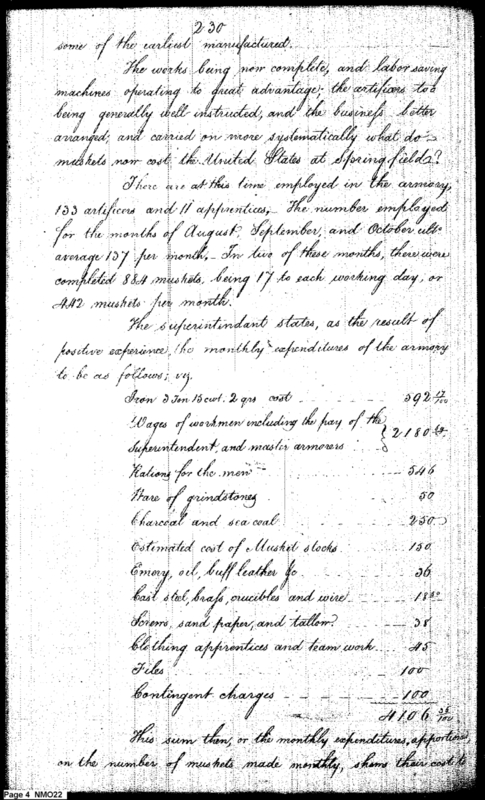
The works being now complete, and labor saving machines operating to great advantage; the artificers too being generally well instructed; and the business better arranged; and carried on more systematically what do muskets now cost the United States at Springfield?
There are at this time employed in the armory, 133 artificers and 11 apprentices. The number employed for the months of August, September, and October ulto average 157 per month. In two of these months, there were completed 884 muskets, being 17 to each working day, or 442 muskets per month.
The Superintendant states, as the result of positive experience, the monthly expenditures of the armory to be as follows; viz.
Iron 3 Ton 15 cwt. 2 qrs cost ————————————————————————— 59217/100
Wages of workmen including the pay of the }
Superintendent, and master armorers } 218044/100
Rations for the men ————————————————————————————— 546
Ware of grindstones ——————————————————————————— 50
Charcoal and sea coal ——————————————————————————— 250
Estimated cost of Musket stocks —————————————————— 150
Emory, oil, buff leather &c ——————————————————————— 36
Cast steel, brass, crucibles and wire ————————————— 18[undecipherable]
Screws, sand paper, and tallow ———————————————————— 38
Clothing apprentices and team work ———————————————— 45
Files ——————————————————————————————————————— 100
Contingent charges ——————————————————————————— 100
—————————————————————————————————————————— 410635/100
This sum then, or the monthly expenditures, apportioned on the number of muskets made monthly, shows their cost to the United States, to be about 929/100 dollars per musket.
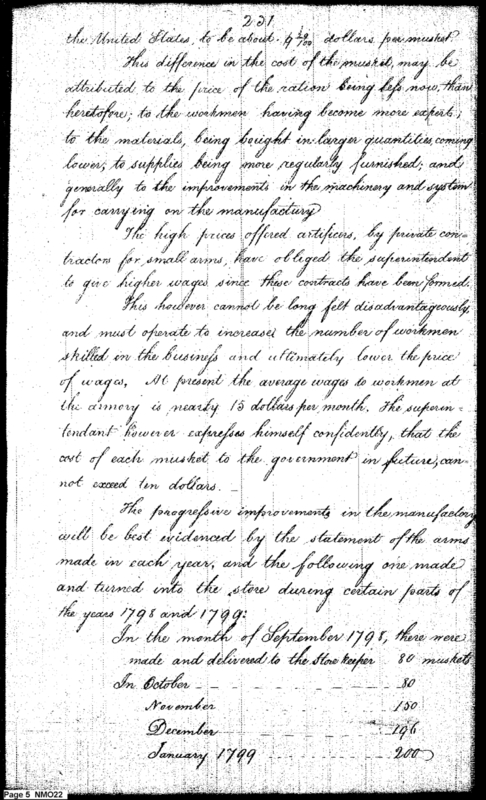
This difference in the cost of the musket, may be attributed to the price of the ration being less now, than heretofore; to the workmen having become more expert; to the materials, being bought in larger quantities coming lower; to supplies being more regularly furnished; and generally to the improvements in the machinery and system for carrying on the manufactory.
The high prices offered artificers, by private contractors for small arms, have obliged the superintendent to give higher wages since these contracts have been formed.
This however cannot be long felt disadvantageously, and must operate to increase the number of workmen skilled in the business and ultimately lower the price of wages. At present the average wages to workmen at the armory is nearly 15 dollars per month. The superintendent however expresses himself confidently, that the cost of each musket to the government in future, cannot exceed ten dollars.
The progressive improvements in the manufactory will be best evidenced by the statement of the arms made in each year, and the following one made and turned into the store during certain parts of the years 1798 and 1799:
In the month of September 1798, there were
made and delivered to the Store Keeper 80 muskets
In October ——————————————————————————————— 80
November ————————————————————————————————— 150
December ————————————————————————————————— 196
January 1799 ————————————————————————————— 200
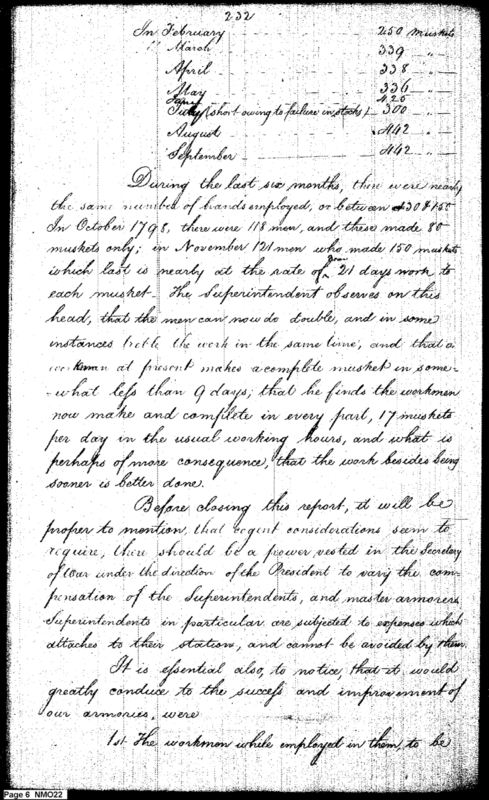
In February ————————————————————————————————— 250 muskets
" March —————————————————————————————————— 339 "
April ——————————————————————————————————— 338 "
May ————————————————————————————————————— 336 "
[June] ——————————————————————————————————— 425
July (short owing to failure in stocks) ———— 300 "
August ——————————————————————————————————— 442 "
September ———————————————————————————————— 442 "
During the last six months, there were nearly the same number of hands employed, or between 130 & 150. In October 1798, there were 118 men, and these made 80 muskets only; in November 121 men who made 150 muskets, which last is nearly at the rate of [from] 21 days work to each musket. The Superintendent observes on this head, that the men can now do double, and in some instances treble the work in the same time; and that a workman at present makes a complete musket in somewhat less than 9 days; that he finds the workmen now make and complete in every part, 17 muskets per day in the usual working hours, and what is perhaps of more consequence, that the work besides being sooner is better done.
Before closing this report, it will be proper to mention, that cogent considerations seem to require, there should be a power vested in the Secretary of War under the direction of the President to vary the compensation of the Superintendents, and master armorers. Superintendents in particular are subjected to expenses which attaches to their station, and cannot be avoided by them.
It is essential also, to notice, that it would greatly conduce to the success and improvement of our armonies, were
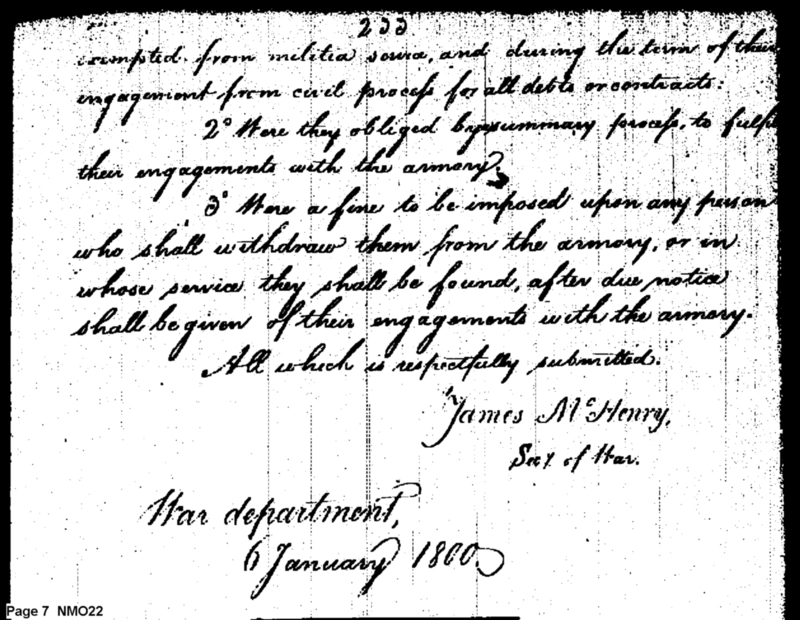
1st The workmen while employed in them, to be exempted from militia service, and during the term of their engagement from civil process for all debts or contracts:
2° Were they obliged by summary process, to fulfil their engagements with the armory.
3° Were a fine to be imposed upon any person who shall withdraw them from the armory, or in whose service they shall be found, after due notice shall be given of their engagements with the armory.
All which is respectfully submitted.
James McHenry,
Secy of War.
War department,
6 January 1800
Type
Document Signed
Description
"The Secretary of War lays before the Senate of the United States, an exhibit of the expenses of the national armory at Springfield, Massachusetts together with the fullest information he has been able to obtain relative to the said establishment."
Date
01/06/1800
Author
Recipient
Sent from
War Department
Document number
1800010600201
Notable persons
James McHenry
Senate of the United States
Superintendent of the Armory
artificers
apprentices
Notable locations
War Department
Notable items
annual expenditures
muskets annually fabricated
public buildings
machinery
tools
fabrication of arms
separate accounts
workshops
works
labor-saving machines
defects
iron
wages of workmen
rations
wear of grindstones
charcoal
sea coal
musket stocks
emery
oil
buff leather
cast steel
brass
crucibles
wire
screws
sand paper
tallow
clothing
files
contingent charges
cost to the United States
price of the ration
high prices offered artificers
private contractors