

Recommendations for Improving the Military System
Document 1800Secretary McHenry requests action from President Adams respecting certain measures and assignments which he deems indispensable to the improvement of the military system. This report should also be submitted to the Congress. Discusses the Military Academy and schooling for members of the military (including studies of mathematics, geography, and natural philosophy).
No human transcription currently available for this document.
This transcription was generated by machine using Anthropic's Claude Code (model sonnet 4.6). It may contain errors or inaccuracies. Please verify against the document image. Learn more about our generative AI methodology.
Now I have all the images. Let me compile the complete transcription.
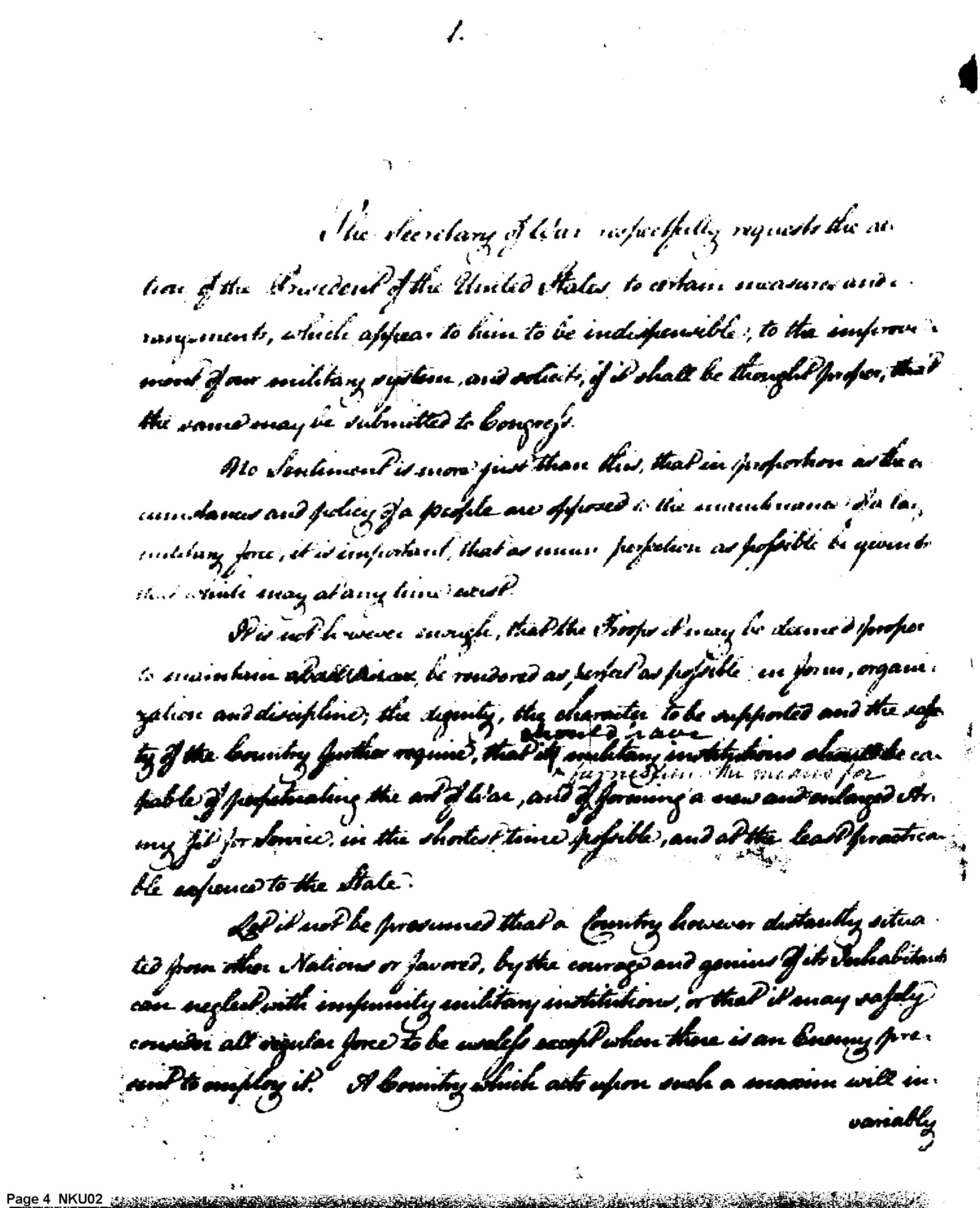
The Secretary of War respectfully requests the action of the President of the United States to certain measures and arrangements, which appear to him to be indispensible, to the improvement of our military system, and which, if it shall be thought proper, that the same may be submitted to Congress.
No Sentiment is more just than this, that in proportion as the circumstances and policy of a people are opposed to the maintenance of a large military force, it is important, that as much perfection as possible be given to that little which may at any time exist.
It is not however enough, that the Troops it may be deemed proper to maintain shall be rendered as useful as possible in force, organization and discipline; the dignity, the character to be supported and the safety of the Country further require, that its military institutions should be capable of perpetuating the art of War, and of forming a new and enlarged Army fit for service, in the shortest time possible, and at the least practicable expense to the State.
Let it not be presumed that a Country however distantly situated from other Nations or favored, by the courage and genius of its Inhabitants can neglect with impunity military institutions, or that it may safely consider all regular force to be useless except when there is an Enemy present and to employ it. A Country which acts upon such a maxim will invariably
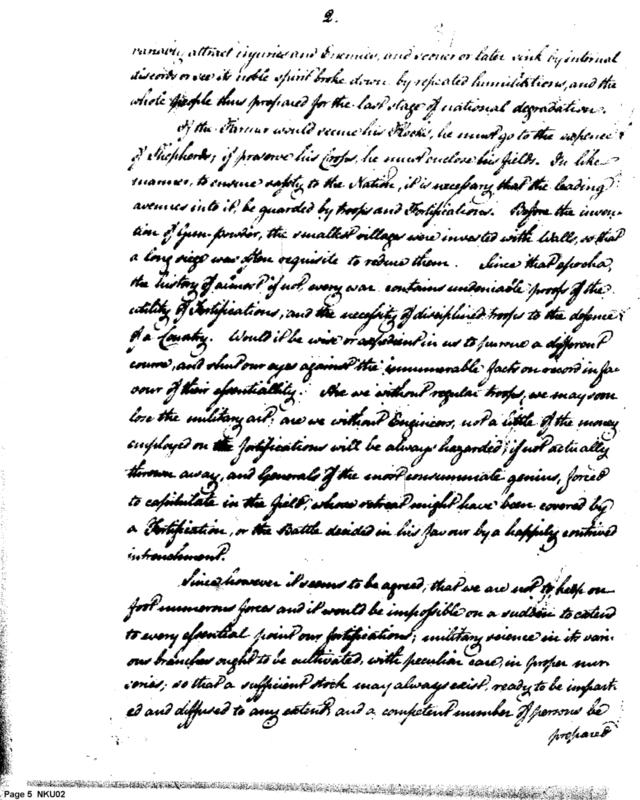
variously attract injuries and Enemies, and sooner or later sink by internal discords or see its noble spirit broke down by repeated humiliations, and the whole people thus prepared for the last stage of national degradation.
If the Farmer would secure his flocks, he must go to the expence of Shepherds; if preserve his crops, he must enclose his fields. In like manner, to ensure safety to the Nation, it is necessary that the leading avenues into it, be guarded by troops and fortifications. Before the invention of gun-powder, the smallest villages were invested with Walls, so that a long siege was then requisite to reduce them. Since that epocha, the history of almost if not every war contains undeniable proofs of the utility of fortifications, and the necessity of disciplined troops to the defence of a Country. Would it be wise or expedient in us to pursue a different course, and shut our eyes against the innumerable facts on record in favour of their essentiallity. Are we without regular troops, we may soon lose the military art; are we without Engineers, not a little of the money employed on the fortifications will be always hazarded; if not actually thrown away, and Generals of the most consummate genius, forced to capitulate in the field, whose retreat might have been covered by a fortification, or the Battle decided in his favour by a happily contrived intrenchment.
Since however it seems to be agreed, that we are not to keep on foot numerous forces and it would be impossible on a sudden to extend to every essential point our fortifications; military science in its various branches ought to be cultivated, with peculiar care, in proper nurseries, so that a sufficient stock may always exist, ready to be imparted and diffused to any extent and a competent number of persons to
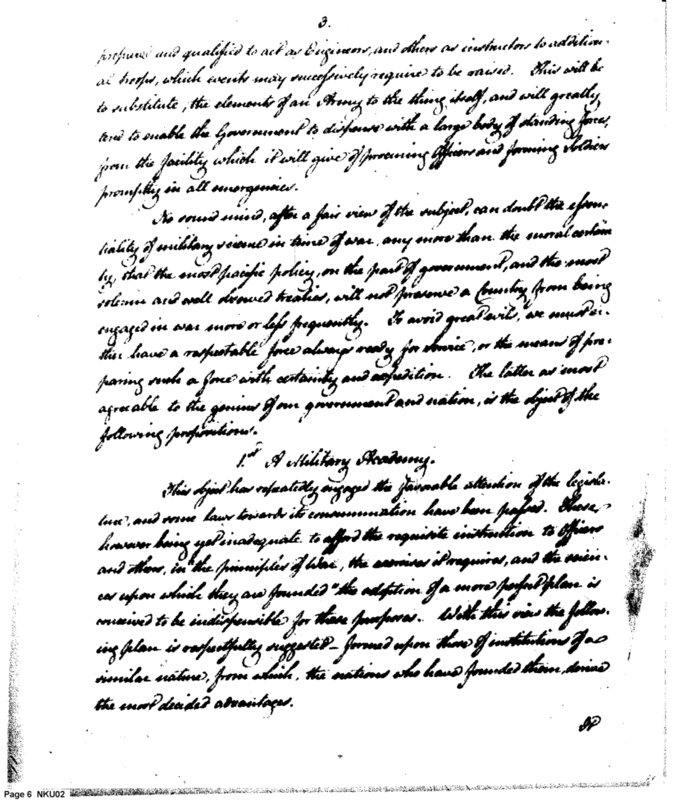
be prepared and qualified to act as Engineers, and others as instructors to additional troops, which events may successively require to be raised. This will be to substitute, the elements of an Army to the thing itself, and will greatly tend to enable the Government to dispense with a large body of standing force, from the facility which it will give of procuring Officers and forming Soldiers promptly in all emergencies.
No sound mind, after a fair view of the subject, can doubt the essentiality of military science in times of war, any more than the moral certainty, that the most pacific policy, on the part of governments, and the most solemn and well devised treaties, will not preserve a Country from being engaged in war more or less frequently. To avoid great evils, we must either have a respectable force always ready for service, or the means of preparing such a force with certainty and expedition. The latter as most agreeable to the genius of our government and nation, is the object of the following propositions.
1st A Military Academy.
This object has repeatedly engaged the favorable attention of the legislature, and some laws towards its commmunication have been passed. These, however being yet inadequate to afford the requisite instruction to Officers and men, in the principles of War, the exercises it requires, and the sciences upon which they are founded "the adoption of a more perfect plan is conceived to be indispensible for those purposes. With this view the following plan is respectfully suggested—formed upon those of institutions of a similar nature, from which, the nations who have founded them, derive the most decided advantages.
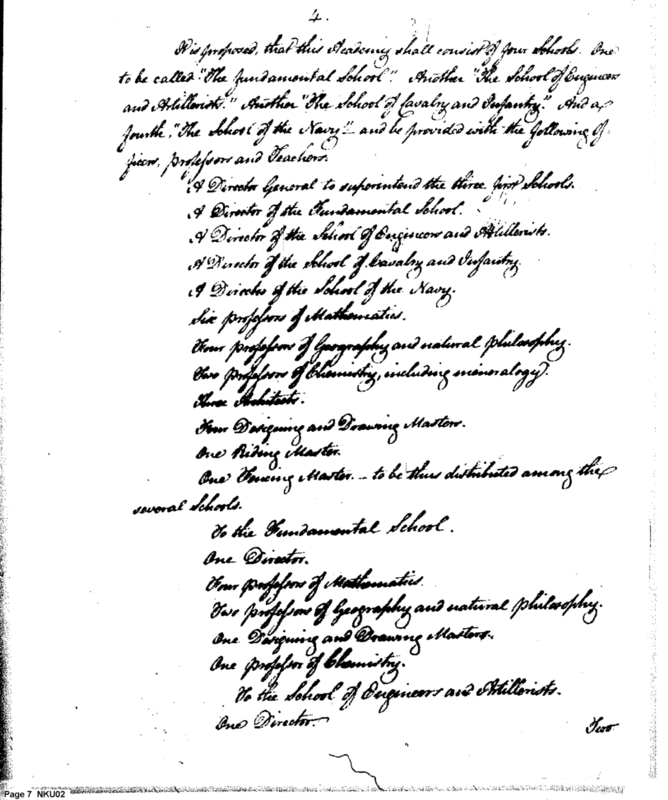
It is proposed, that this Academy shall consist of four Schools. One to be called "The fundamental School." Another "The School of Engineers and Artillerists." Another "The School of Cavalry and Infantry." And a fourth "The School of the Navy." and be provided with the following Officers, professors and teachers.
A Director General to superintend the three first Schools.
A Director of the Fundamental School.
A Director of the School of Engineers and Artillerists.
A Director of the School of Cavalry and Infantry.
A Director of the School of the Navy.
Six professors of Mathematics.
Three professors of Geography and natural philosophy.
Two professors of Chemistry, including mineralogy.
Three Architects.
Four Designing and Drawing Masters.
One Riding Master.
One Fencing Master. — to be thus distributed among the several Schools.
To the Fundamental School.
One Director.
Four professors of Mathematics.
Two professors of Geography and natural philosophy.
One Designing and Drawing Masters.
One professor of Chemistry.
To the School of Engineers and Artillerists.
One Director. Two
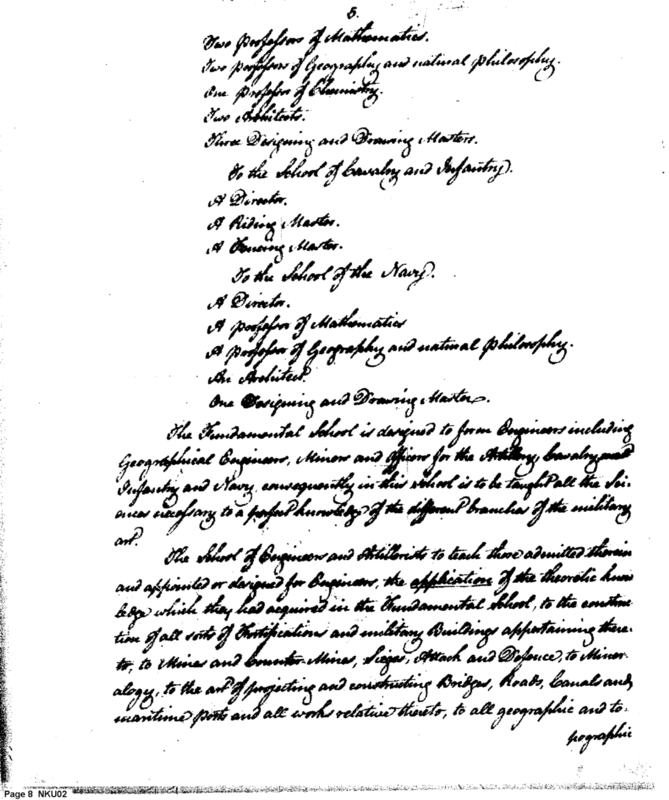
Two professors of Mathematics.
Two professors of Geography and natural philosophy.
One professor of Chemistry.
Two Architects.
Three Designing and Drawing Masters.
To the School of Cavalry and Infantry.
A Director.
A Riding Master.
A Fencing Master.
To the School of the Navy.
A Director.
A professor of Mathematics
A professor of Geography and natural philosophy.
An Architect.
One Designing and Drawing Masters.
The Fundamental School is designed to form Engineers including Geographical Engineers, Miners and Officers for the Artillery, Cavalry and Infantry and Navy, consequently in this school is to be taught all the Sciences necessary to a perfect knowledge of the different branches of the military art.
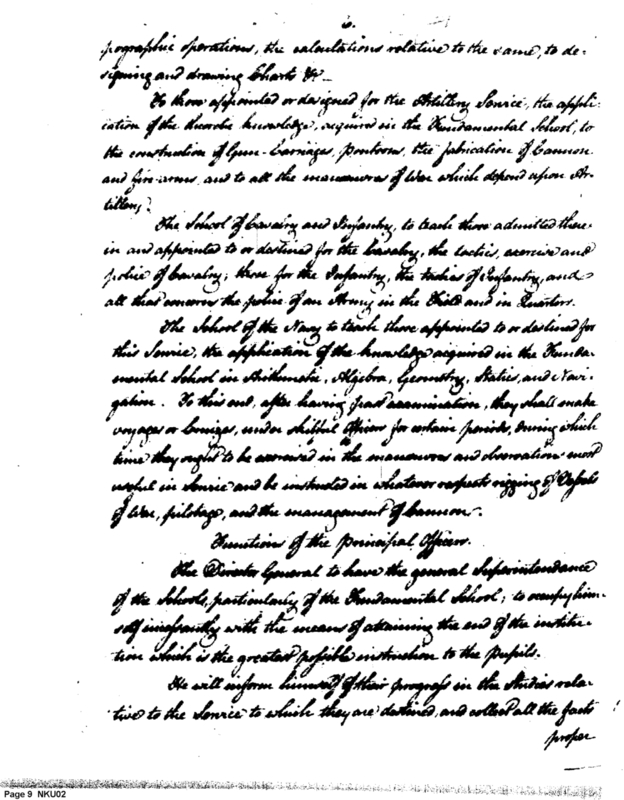
The School of Engineers and Artillerists to teach those admitted therein and appointed or designed for Engineers, the applications of the theoretic knowledge which they had acquired in the Fundamental School, to the construction of all sorts of fortifications and military Buildings appertaining thereto, to Mines and Counter-Mines, Siege, Attack and Defence, to Mineralogy, to the art of projecting and constructing Bridges, Roads, Canals and, maritime ports and all works relative thereto, to all geographic and to geographic
geographic operations, the calculations relative to the same, to designing and drawing Charts &c.
To those appointed or designed for the Artillery Service, the application of the theoretic knowledge, acquired in the Fundamental School, to the construction of Gun-Carriages, pontoons, the fabrication of Cannon and fire-arms and to all the manœuvres of War which depend upon Artillery.
The School of Cavalry and Infantry, to teach those admitted therein and appointed to or destined for the Cavalry, the tactics, exercise and police of Cavalry; those for the Infantry, the tactics of Infantry, and all that concerns the police of an Army in the field and in Quarters.
The School of the Navy to teach those appointed to or destined for this Service, the application of the knowledge acquired in the fundamental School in Arithmetic, Algebra, Geometry, Statics, and Navigation. To this end, after having past examination, they shall make voyages or cruises, under skillful Officers for certain periods, during which time they ought to be exercised in the manœuvres and observations most useful in service and be instructed in whatever respects rigging of Vessels of War, pilotage, and the management of Cannon.
Functions of the principal Officers.
The Director General to have the general Superintendance of the Schools, particularly of the Fundamental School; to occupy himself incessantly with the means of attaining the end of the institution which is the greatest possible instruction to the Pupils.
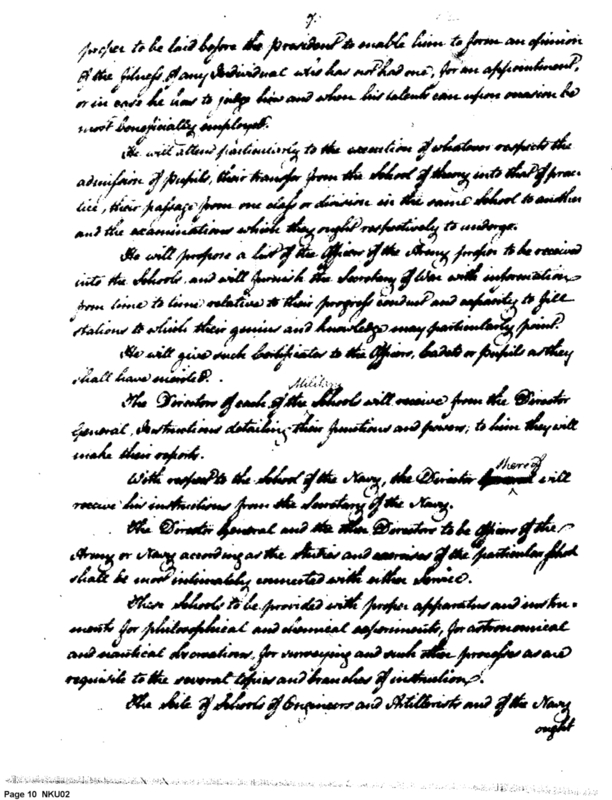
He will inform himself of their progress in the Studies relative to the service to which they are destined, and collect all the facts proper
proper to be laid before the president to enable him to form an opinion of the fitness of any Individual who has not had one, for an appointment; or in order he may judge him and where his talents can upon occasion be most beneficially employed.
He will attend particularly to the execution of whatever respects the admission of Pupils, their transfer from the School of theory into that of practice, their passage from one class or division in the same School to another and the examinations which they ought respectively to undergo.
He will propose a list of the Officers of the Army proper to be received into the Schools, and will furnish the Secretary of War with information from time to time relative to their progress, conduct and capacity to fill stations to which their genius and knowledge may particularly point.
He will give such certificates to the Officers, Cadets or Pupils as they shall have merited.
The Directors of each of the Military Schools will receive from the Director General, Instructions detailing their functions and powers; to him they will make their reports.
With respect to the School of the Navy, the Director [thereof] will receive his instructions from the Secretary of the Navy.
The Director General and the other Directors to be Officers of the Army or Navy according as the Studies and exercises of the particular School shall be most intimately connected with either Service.
These Schools to be provided with proper apparatus and instruments for philosophical and chemical experiments, for astronomical and nautical observations, for surveying and such other purposes as are requisite to the several topics and branches of instruction.
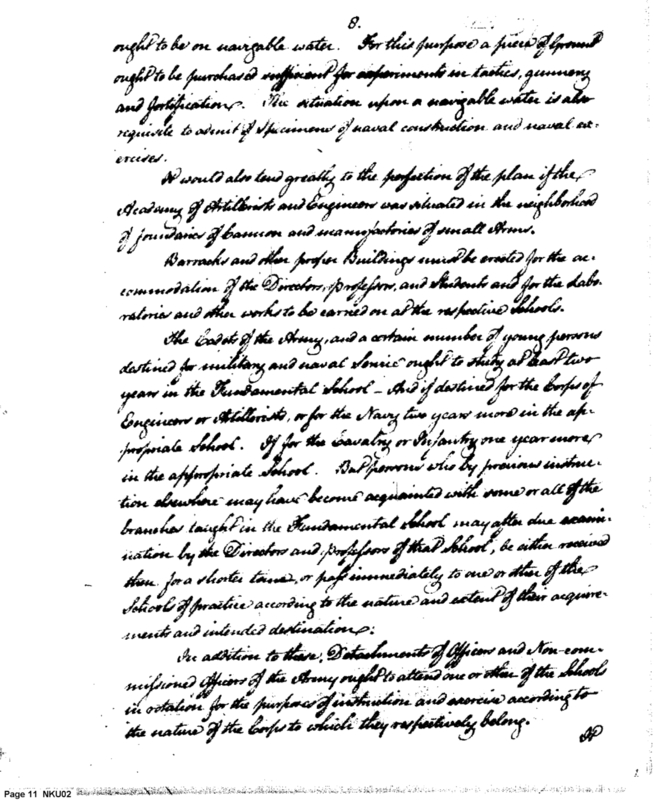
The site of Schools of Engineers and Artillerists and of the Navy ought
ought to be on navigable water. For this purpose a piece of ground ought to be purchased sufficient for experiments in tactics, gunnery and fortifications. The situation upon a navigable water is also requisite to admit of specimens of naval construction and naval exercises.
It would also tend greatly to the perfection of the plan if the Academy of Artillerists and Engineers was situated in the neighborhood of foundaries of Cannon and manufactories of small Arms.
Barracks and other proper Buildings must be erected for the accommodation of the Directors, professors, and Students and for the laboratories and other works to be carried on at the respective Schools.
The Cadets of the Army, and a certain number of young persons destined for military and naval Service ought to study at least two years in the Fundamental School — And if destined for the Corps of Engineers or Artillerists, or for the Navy two years more in the appropriate School. If for the Cavalry or Infantry one year more in the appropriate School. But persons who by previous instruction elsewhere may have become acquainted with some or all of the branches taught in the Fundamental School may after due examination by the Directors and professors of that School, be either received there for a shorter time, or pass immediately to one or other of the Schools of practice according to the nature and extent of their acquirements and intended destinations.
In addition to these, Detachments of Officers and Non-commissioned Officers of the Army ought to attend one or other of the Schools in rotation for the purposes of instruction and exercise according to the nature of the Corps to which they respectively belong.
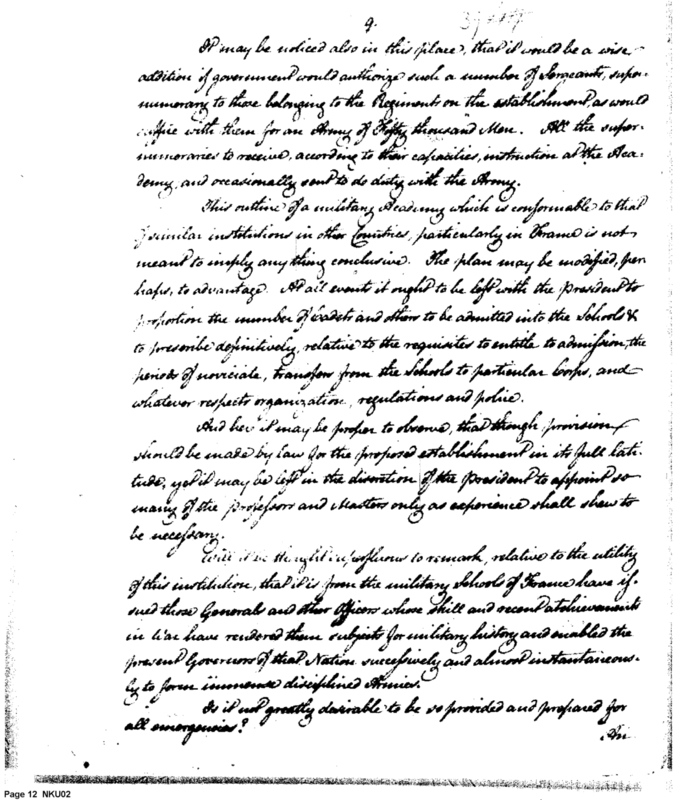
It may be noticed also in this place, that it would be a wise addition if government would authorize such a number of Sergeants, supernumerary to those belonging to the Regiments on the establishment, as would suffice with them for an Army of Fifty thousand Men. All the supernumeraries to receive, according to their capacities, instruction at the Academy, and occasionally sent to do duty with the Army.
This outline of a military Academy which is conformable to that of similar institutions in other Countries, particularly in France is not meant to imply any thing conclusive. The plan may be modified, perhaps, to advantage. At all events it ought to be left with the President to proportion the number of Cadets and others to be admitted into the Schools, to prescribe definitively, relative to the requisites to entitle to admission, the periods of noviciate, transfers from the Schools to particular Corps, and whatever respects organization, regulations and police.
And here it may be proper to observe, that though provisions should be made by law for the proposed establishment in its full latitude, yet it may be left in the discretion of the President to appoint so many of the professors and masters only as experience shall show to be necessary.
Will it be thought improper to remark, relative to the utility of this institution, that it is from the military schools of France have issued those Generals and other Officers whose skill and accomplishments in War have rendered them subjects for military history and enabled the present Governors of that Nation successively and almost instantaneously to form immense disciplined Armies.
Is it not greatly desirable to be so provided and prepared for all emergencies? An
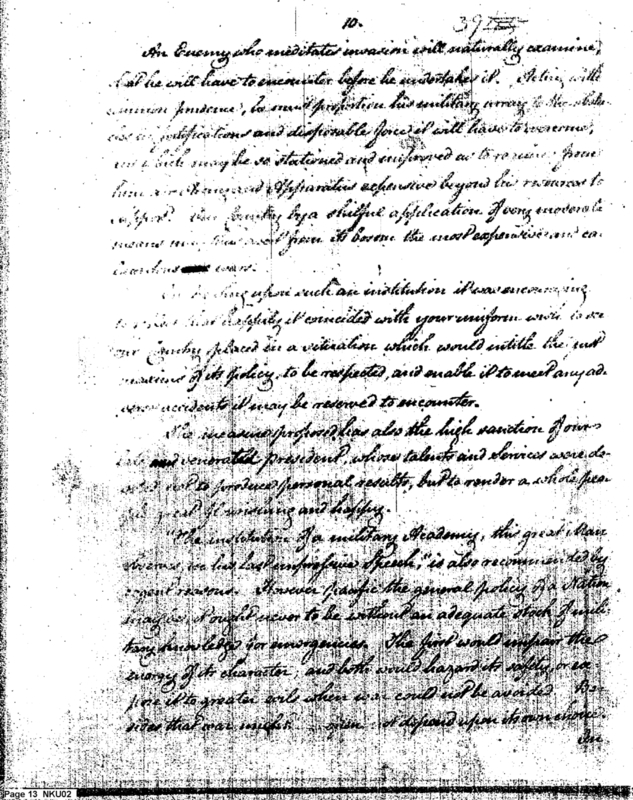
An Enemy who meditates invasion will naturally examine, what he will have to encounter before he undertakes it. Acting with common prudence, he must proportion his military array to the obstacles, fortifications and disposable forces it will have to overcome; and such may be so stationed and informed as to render him from them [undecipherable] an apparatus expensive beyond his resources to afford. The Country by a skillful application of even moderate means may have been the most expensive and extensive measures.
In being long upon such an institution it was necessary to state what validity it coincided with your uniform wish to see our Country placed in a situation which would inditle the continuance of its policy, to be respected, and enable it to meet any adverse accidents it may be reserved to encounter.
The measure proposed has also the high sanction of our late and venerated President, whose talents and services were devoted not to produce personal results, but to render a whole people great in wisdom and happy.
The institution of a military Academy, this great Man stressed, in his last emphatic Speech," is also recommended by urgent reasons. However pacific the general policy of a Nation may be, it ought never to be without an adequate stock of military knowledge for emergencies. The first would impair the energy of its character, and both would hazard its safety, or expose it to greater evils when war could not be avoided. Besides that war itself is much [undecipherable] and depends upon its own virtue. The
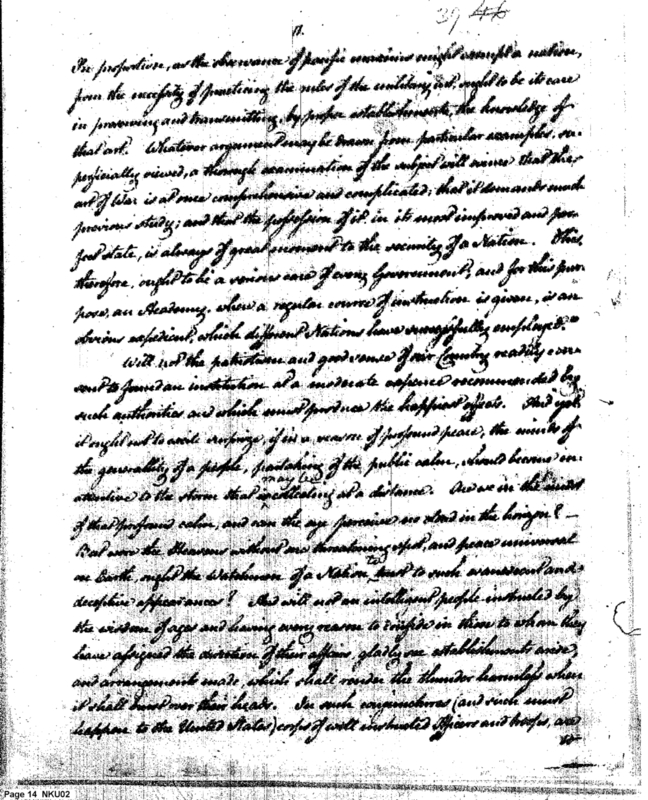
In proportion, as the observance of pacific maxims might exempt a nation, from the necessity of practising the rules of the military art, ought to be its care in preserving and transmitting, by proper establishments, the knowledge of that art. Whatever arguments may be drawn from particular examples, superficially viewed, a thorough examination of the subject will evince that the art of War is at once comprehensive and complicated; that it demands much previous study; and that the possession of it, in its most improved and perfect state, is always of great moment to the security of a Nation. This therefore, ought to be a serious care of every Government; and for this purpose, an Academy, where a regular course of instruction is given, is an obvious expedient, which different Nations have successfully employed."
Will not the patriotism and good sense of our Country readily concede to found an institution at a moderate expense recommended by such authorities and which must produce the happiest effects. And yet it ought not to avoid creating, if in a season of profound peace; the minds of the generality of a people, partaking of the public calm, should be more [may be] attentive to the storm that approaches at a distance. And we are in the midst of that profound calm, and even the eye scarce perceives are clouds in the horizon? — But even the Heavens without one threatening speck, and peace universal on Earth, ought the Watchman of a Nation, heed to such deceitful appearances! And will not an intelligent people instructed by the wisdom of ages and having every reason to confide in those to whom they have assigned the direction of their affairs, gladly see establishments arise, and arrangements made, which shall render the thunder harmless when it shall burst over their heads. In such conjunctures (and such must happen to the United States) corps of well instructed Officers and troops, are
to a Country, what Anchors are to a Ship, driven by a tempest towards a rocky Shore.
2. A modification of the two Regiments of Artillerists and Engineers, so as to create in lieu thereof one Regiment of Foot Artillerists, another of Horse Artillerists and a third of Engineers.
It is conceived that the entire union of the Officers of Artillerists and Engineers in one Corps, as in our present establishment, is not advisable. The art of fortification, and the service of Artillery, though touching each other in many points, are in the main distinct branches, and even so comprehensive that their separation is essential to perfection in either. This has been ascertained by long experience. Among the powers of Europe, there is not one recollected which at the present day is not conscious of this truth. When any of them have attempted to unite these Corps the disadvantages which resulted were soon felt to be so numerous as to produce conviction, that each required a separate organization. Such an union was once attempted in France.
According to an ordinance of the 8th of December 1755, the Artillery and Engineer Corps of that Nation which had been separate, were combined into one. The experiment however was of short duration. In 1758 the Engineer Corps was disjoined from the Corps of Artillery, and called as before the Corps of Engineers, since which time these Corps have remained separate.
The two Regiments of Artillerists and Engineers consist of the following Officers, Non-commissioned Officers and Privates; each of viz: 1 Lieut:
1 Lieutenant Colonel Commandant.
4 Majors.
1 Adjutant
1 Quarter Master } Each being a Lieutenant.
1 Paymaster
1 Surgeon
2 Surgeons Mates.
16 Captains
32 Lieutenants, besides the 3 above mentioned.
32 Cadets
4 Sergeant Majors
4 Quarter Master Sergeants
64 Sergeants
64 Corporals.
1 Chief Musician
10 Musicians
128 Artificers
768 Privates.
Let the Regiment of Foot Artillerists, and Horse-Artillerists, consist each as follows, viz:
1 Lieutenant Colonel Commandant.
2 Majors
1 Adjutant
1 Quarter Master } Each being a Lieutenant.
1 Paymaster
1 Surgeon
2 Surgeons Mates
12 Captains
24 Lieutenants, besides the 3 above mentioned
24 Cadets. 3
3 Sergeant Majors
3 Quarter Master Sergeants
48 Sergeants
48 Corporals
1 Chief Musician
12 Musicians
700 privates including Artificers.
The Artificers forming a part of each Company in the Regiments as they now exist, to form two Companies of Miners, and two Companies of Artificers to be arranged as will be hereafter noticed.
It is also proposed, First—In the event of a War, that these two Regiments shall be augmented to the compliment of Officers and Men, composing the existing Regiments of Artillerists and Engineers. Second—That the Regiment of Horse-Artillerists shall perform their service on horse-back during War only. [Third—] That provision be made to enable the President of the United States, in case war shall break out between the United States and a foreign European power, or in case of imminent danger of invasion of their Territory by any such power shall, in his opinion be deemed to exist, to organize, and cause to be organized two additional Regiments of Horse-Artillery. Fourth—That the Officers which shall become supernumerary, by that aforementioned
said organization, shall at the discretion of the president, be transferred to fill Vacancies in other Regiments on the establishment, corresponding with their grades, or be retained to fill appropriate Vacancies which shall happen in their respective Regiments, by Deaths, Resignations &c.
In addition to the economical effect of the latter arrangement, it may be mentioned that the Officers to one whole Battalion of the Second Regiment of Artillerists and Engineers have not yet been appointed.
The Regiment of Engineers consisting entirely of Officers, if we exclude the Companies of Miners, it remains to speak of its organization.
Let it consist of, viz:
2 Lieutenant Colonels, one first and one second as already provided by law.
3 Majors
12 Captains
24 First Lieutenants
24 Second Lieutenants
24 Cadets.
The Companies of Miners and their labours to be under the direction and immediate command of Officers of this Corps, and to make a part thereof.
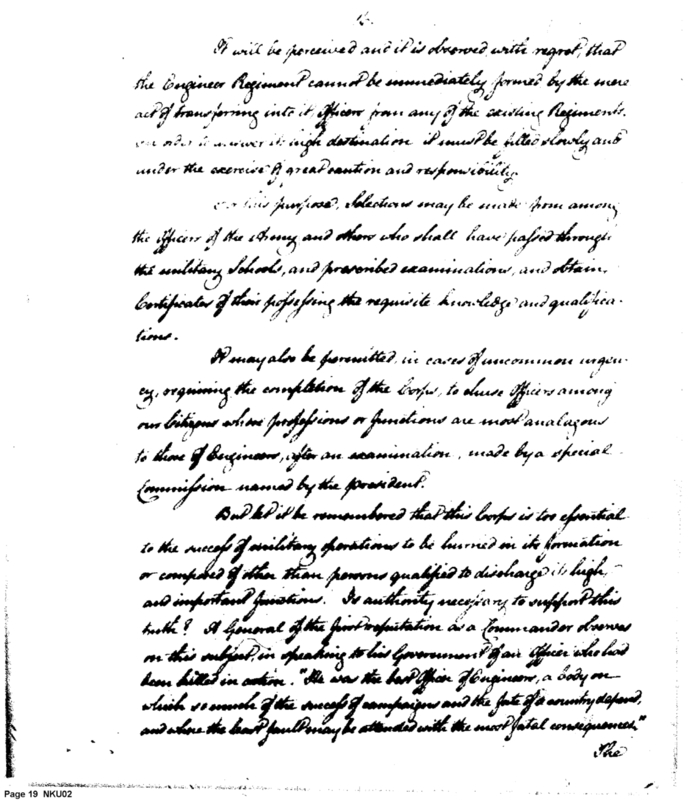
It will be perceived and it is adverted to with regret, that the Engineer Regiment cannot be immediately formed by the mere act of transferring into it Officers from any of the existing Regiments. In order it answers its high destination it must be filled slowly and under the exercise of great caution and responsibility.
For this purpose, Selections may be made from among the Officers of the Army and others who shall have passed through the military Schools, and prescribed examinations, and obtained Certificates of their possessing the requisite knowledge and qualifications.
It may also be permitted, in cases of uncommon urgency, requiring the completion of the Corps, to choose Officers among our Citizens whose professions or functions are most analogous to those of Engineers, after an examination, made by a special Commission named by the president.
And let it be remembered that this Corps is too essential to the success of military operations to be hurried in its formation or composed of other than persons qualified to discharge its high and important functions. Is authority necessary to support this truth? A General of the first reputation as a Commander observed on this subject, in speaking to his Government of an Officer who had been killed in action. "He was the best Officer of Engineers, a body on which so much of the success of campaigns and the fate of a country depends, and where the least fault may be attended with the most fatal consequences."
The
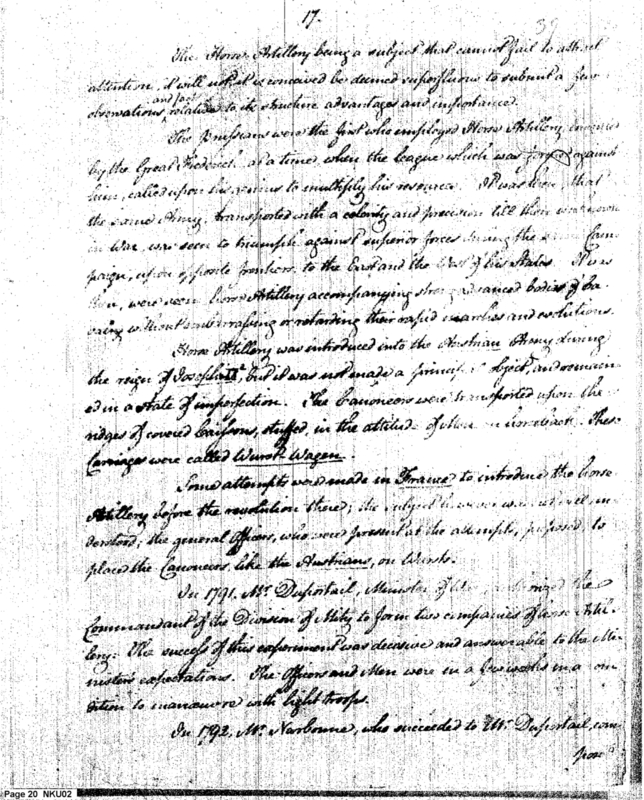
The Horse Artillery being a subject that cannot fail to attract attention, it will not then be deemed superfluous to submit a few observations, and for their relative to its structure, advantages and importance.
The Prussians were the first who employed Horse Artillery, invented by the Great Frederic, at a time when the league which was formed against him, called upon his resources to multiply his resources. It was then, that the armed Army, transported with a celerity and precision till then unknown in War, was soon to triumph against superior forces during the [undecipherable] Campaign, upon the opposite frontiers to the East and the [undecipherable] of his States. It was then, were seen Horse Artillery accompanying those advanced bodies of light cavalry without embarrassing or retarding their rapid marches and evolutions.
Horse Artillery was introduced into the Austrian Army during the reign of Joseph II, but it was not made a principal object, and remained in a State of imperfection. The Canoneers were transported upon the ridges of covered Uniforms, draped, in the attitude of [undecipherable] in a circuit. These carriages were called [underline: Wurst Wagen].
Some attempts were made in France to introduce the Horse Artillery before the revolution there; the subject however was not well understood; the general Officers, who were present at the attempt, proposed to place the Canoneers, like the Austrians, on Worstos.
In 1791, Mr Dufontail, Minister of [undecipherable] organized the Commandant of the Division of [undecipherable] to form two companies of Horse Artillery. The success of this experiment was decisive and answerable to the utmost expectations. The Officers and Men were in a fortnight in a condition to manœuvre with light troops.
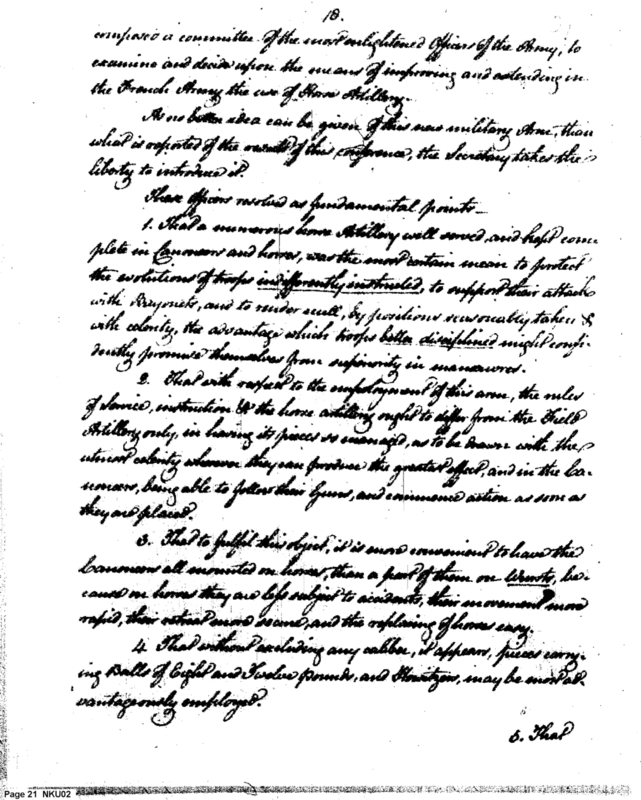
In 1792, Mr Narbonne, who succeeded to Mr Dufontail, composed a committee of the most enlightened Officers of the Army, to examine and decide upon the means of improving and extending in the French Army the use of Horse Artillery.
As no better idea can be given of this new military Arm, than what is reported of the events of this conference, the Secretary takes the liberty to introduce it.
These Officers resolved as fundamental points—
1. That a numerous horse Artillery well served, and kept complete in Cannon and horses, was the most certain mean to protect the evolutions of troops [underline: indifferently instructed], to support their attack with Bayonets, and to render null, by judicious movements unavoidably taken, with celerity, the advantages which troops better disciplined might confidently promise themselves from superiority in manœuvres.
2. That with respect to the employment of this arm, the rules of service, instruction & the horse artillery ought to differ from the field Artillery only, in having its pieces so managed, as to be drawn with the utmost celerity wherever they can produce the greatest effect; and in the Canoneers, being able to follow their guns, and commence action as soon as they are placed.
3. That to fulfil this object, it is more convenient to have the Canoneers all mounted on horses, than a part of them on Wurst, because on horses they are less subject to accidents, their movement more rapid, their retreat more secure, and the replacing of horses easy.
4. That without excluding any calibre, it appears, pieces carrying Balls of Eight and Twelve pounds, and Howitzers, may be most advantageously employed.
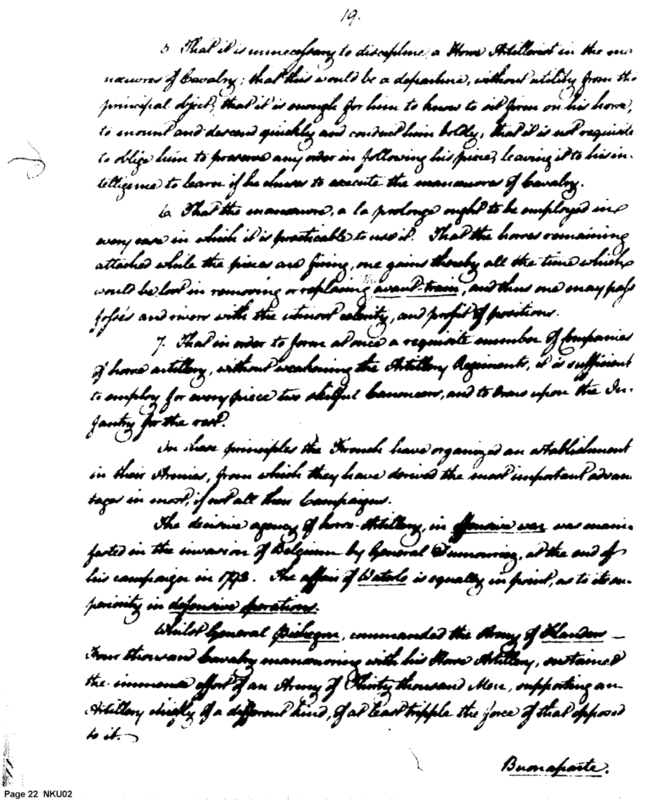
5. That
5. That it is unnecessary to discipline a Horse Artillerist in the manœuvres of Cavalry; that this would be a departure, without utility from the principal object; that it is enough for him to know to sit firm on his horse, to mount and descend quickly and conduct him boldly, that it is not requisite to oblige him to preserve any order in following his piece, leaving it to his intelligence to learn if he chuses to execute the manœuvres of Cavalry.
6. That the manœuvres, a la prologue ought to be employed in every case in which it is practicable to use it. That the horses remaining attached while the piece are firing, one gains thereby all the time which would be lost in removing or replacing [underline: avant-train], and thus one may pass fossés and rivers with the utmost celerity, and profit of positions.
7. That in order to form at once a requisite number of Companies of horse artillery, without weakening the Artillery Regiments, it is sufficient to employ for every piece two skillful Canoneers, and to draw upon the Infantry for the rest.
On these principles the French have organized an establishment in their Armies, from which they have derived the most important advantages in most if not all their Campaigns.
The decisive agency of horse-Artillery, in offensive war was manifested in the invasion of Belgium by General Dumouriez, at the end of his campaign in 1792. The affair of [underline: Watelo] is equally in point, as to its superiority in defensive operations.
Whilst General [underline: Pillegne], commanded the Army of Flandre — three thousand Cavalry manœuvring with his Horse Artillery, sustained the immense efforts of an Army of Thirty thousand Men, opposing an Artillery wholly of a different kind, of at least triple the force of that opposed to it. —
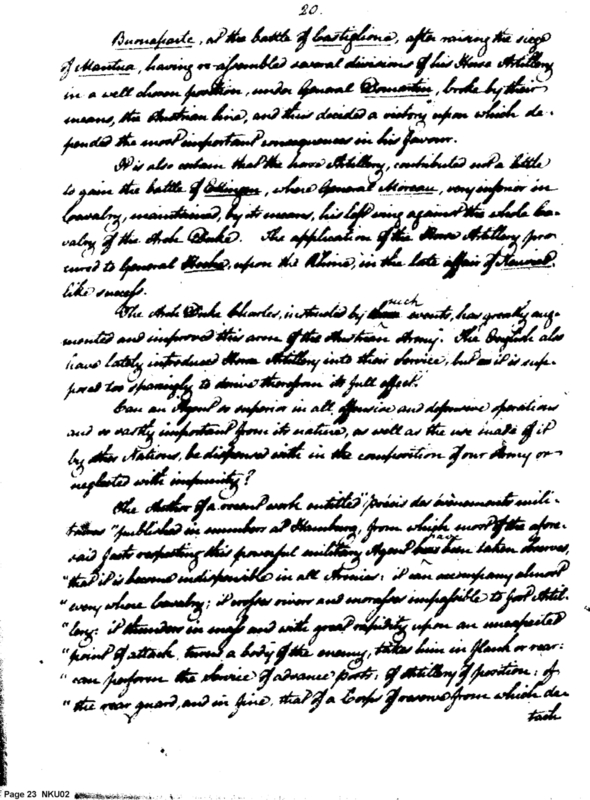
[underline: Buonaparte.]
[underline: Buonaparte], at the battle of [underline: Castiglione], after raising the siege of [underline: Mantua], having re-assembled several divisions of his Horse Artillery in a well chosen position, under General [underline: Domantis], broke by their means, the Austrian line, and thus decided a victory upon which depended the most important consequences in his favour.
It is also certain that the horse Artillery, contributed not a little to gain the battle of [underline: Allingen], where General [underline: Morean], very inferior in Cavalry, maintained, by its means, his left wing against the whole Cavalry of the Arch Duke. The application of the Horse Artillery procured to General [underline: Hoeke], upon the Rhine, in the late affair of [underline: Rastadt]. like success.
The Arch Duke Charles, instructed by [such] events, has greatly augmented and improved this arm of the Austrian Army. The English also have lately introduced Horse Artillery into their Service, but as it is supposed too sparingly to derive therefrom its full effect.
Can an Army so superior in all offensive and defensive operations and so vastly important from its nature, as well as the use made of it by other Nations, be dispensed with in the composition of our Army or neglected with impunity?
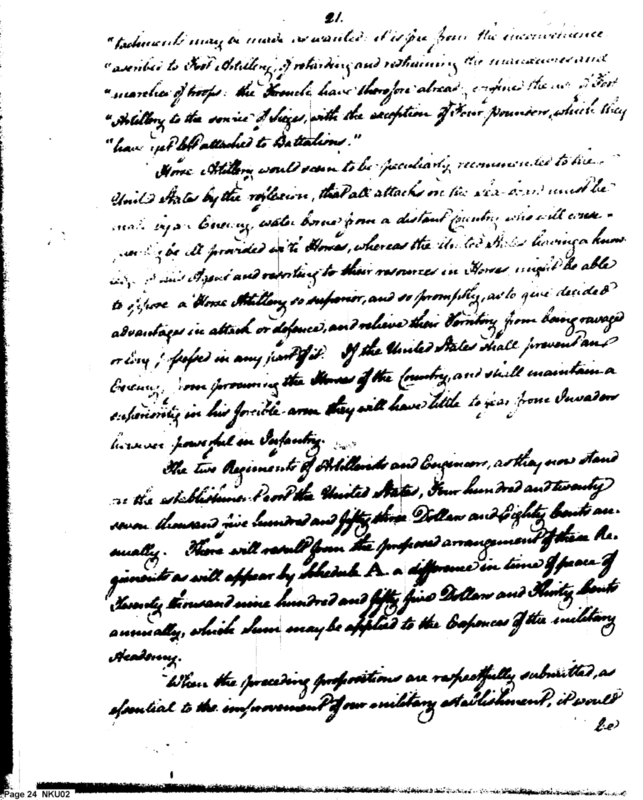
The Author of a recent work entitled "précis des événements militaires" published in numbers at Hamburg, from which most of the aforesaid facts respecting this powerful military Agent have been taken, observes, "that it is become indispensable in all Armies; it can accompany almost every where Cavalry; it crosses rivers and morasses impracticable to foot Artil- lery; it thunders on a way and with great rapidity upon an unexpected "point of attack, turns a body of the enemy, takes him in flank or rear; "can perform the service of advance posts; of Artillery of position; of "the rear guard, and in fine, that of a Corps of Javeins from which de- tach-
"ments may be made as wanted: it is free from the inconvenience "annexed to Foot Artillery, of retarding and restraining the marches and "marches of troops. The French have therefore already consigned the use of "Horse Artillery to the service of Sieges, with the exception of Four pounders, which they "have yet left attached to Battalions."
Horse Artillery would seem to be peculiarly recommended to the United States by the reflexion, that all attacks on the sea-board must be made by an Enemy, water borne from a distant Country who will come and be all provided with Horses, whereas the United States having a knowledge in their resources in Horses might be able to oppose a Horse Artillery so superior, and so promptly, as to give decided advantages in attack or defence, and relieve their Territory from being ravaged or long possessed in any just right. If the United States shall prevent and keep an Enemy from possessing the Horses of the Country, and shall maintain a superiority in his forcible arms they will have little to fear from Invasion however powerful in Infantry.
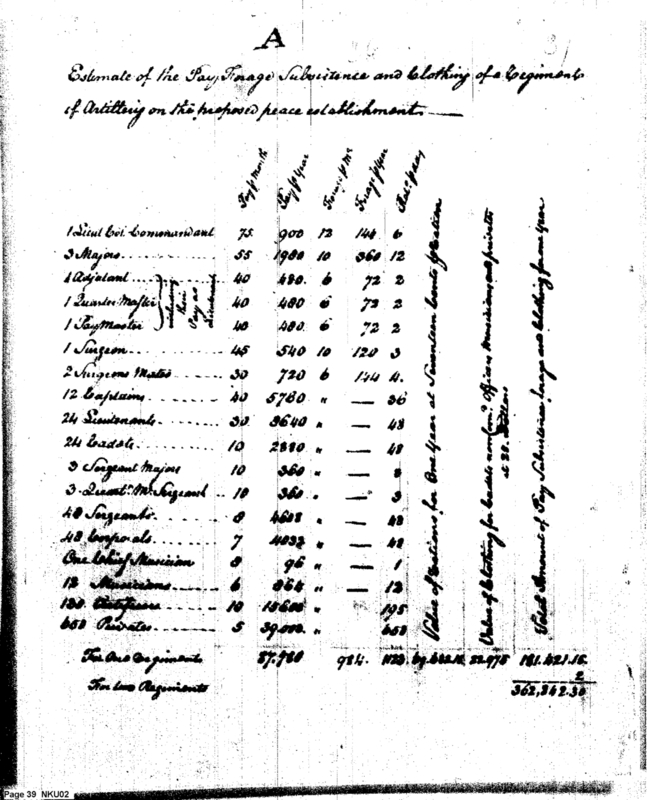
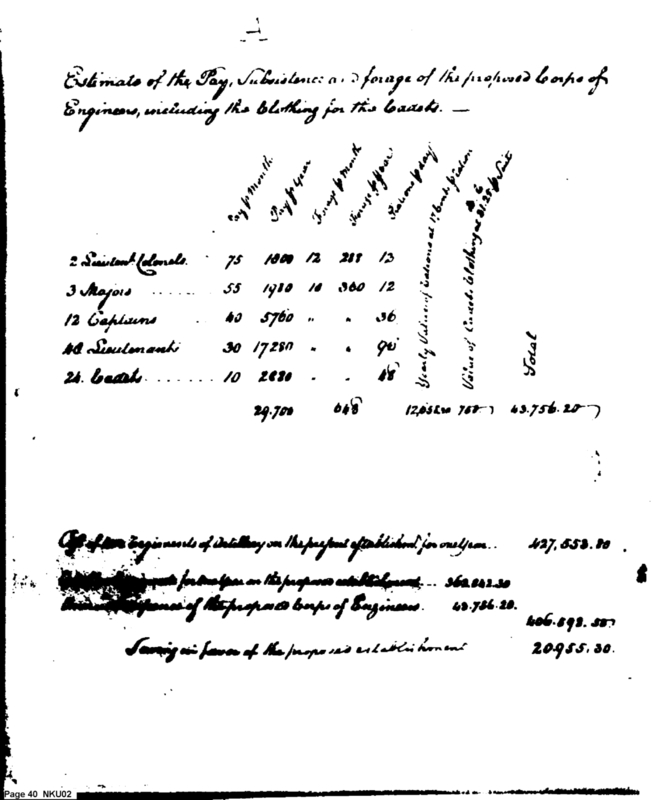
The two Regiments of Artillerists and Engineers, as they now stand on the establishment of the United States, cost Four hundred and twenty-seven thousand, five hundred and fifty-three Dollars and Eighty cents annually. There will result from the proposed arrangement of these Regiments as will appear by schedule A. a difference in time of peace of Twenty thousand nine hundred and fifty five Dollars and Thirty cents annually, which sum may be applied to the expences of the military Academy.
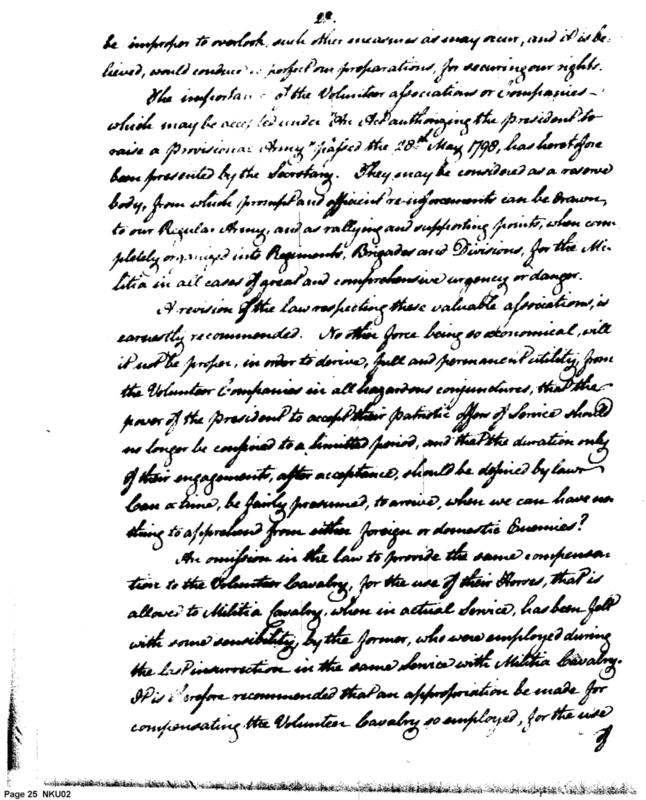
When the preceding propositions are respectfully submitted, as essential to the improvement of our military establishment, it would be
be improper to overlook such other measures as may occur, and it is believed, would conduce to perfect our preparations, for securing our rights.
The importance of the Volunteer associations or companies — which may be accepted under "the Act authorizing the president to raise a Provisional Army" passed the 28th May 1798, has heretofore been presented by the Secretary. They may be considered as a reserve body, from which prompt and efficient re-inforcements can be drawn, to our Regular Army, and as rallying and supporting points, when completely organized into Regiments, Brigades and Divisions, for the Militia in all cases of great and comprehensive urgency or danger.
A revision of the Law respecting these valuable associations, is earnestly recommended. No other force being so economical, will it not be proper, in order to derive, full and permanent utility, from the Volunteer Companies in all hazardous conjunctures, that the power of the president to accept their patriotic offers of Service should no longer be confined to a limited period, and that the duration only of their engagements, after acceptance, should be defined by law — Can a time, be fairly presumed, to arrive, when we can have no thing to apprehend from either foreign or domestic Enemies?
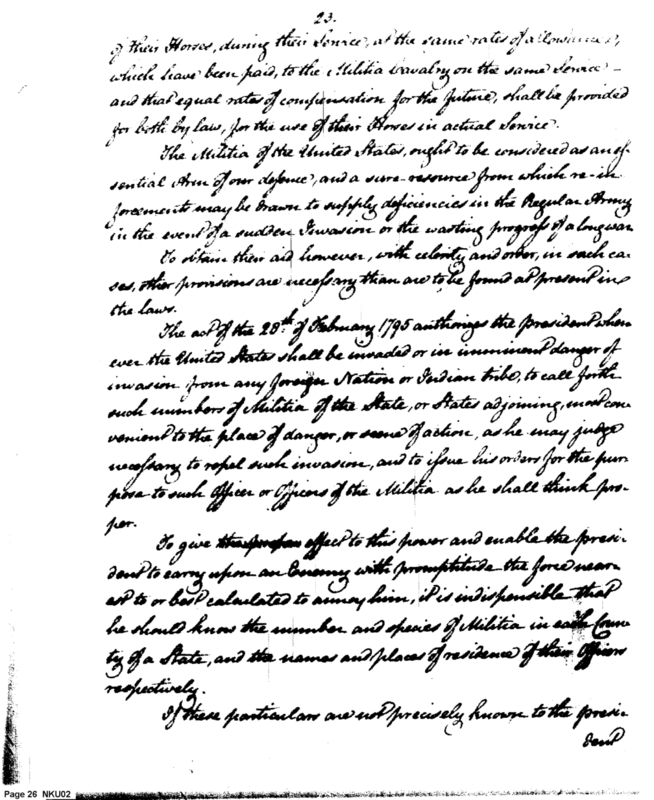
The omission in the law to provide the same compensation to the Volunteer Cavalry, for the use of their Horses, that is allowed to Militia Cavalry, when in actual Service, has been felt with some sensibility, by the former, who were employed during the last Insurrection in the same service with Militia Cavalry. It is therefore recommended that an appropriation be made for compensating the Volunteer Cavalry so employed, for the use
of their Horses, during their Service, at the same rates of allowance by which have been paid, to the Militia Cavalry on the same Service — and that equal rates of compensation for the future, shall be provided for both by law, for the use of their Horses in actual Service.
The Militia of the United States, ought to be considered as an essential Arm of our defence, and a sure resource from which re-inforcements may be drawn to supply deficiencies in the Regular Army in the event of a sudden Invasion or the wasting progress of a long war.
To obtain their aid however, with celerity and order, in such cases, other provisions are necessary than are to be found at present in the laws.
The act of the 28th of February 1795 authorizes the President whenever the United States shall be invaded or in imminent danger of invasion from any foreign Nation or Indian tribe, to call forth such numbers of Militia of the State, or States adjoining, most convenient to the place of danger, or scene of action, as he may judge necessary to repel such invasion, and to issue his orders for the purpose to such Officer or Officers of the Militia as he shall think proper.
To give the proper effect to this power and enable the president to carry upon an Enemy with promptitude the force nearest and best calculated to annoy him, it is indispensible that he should know the number and species of Militia in each County of a State, and the names and places of residence of their Officers respectively.
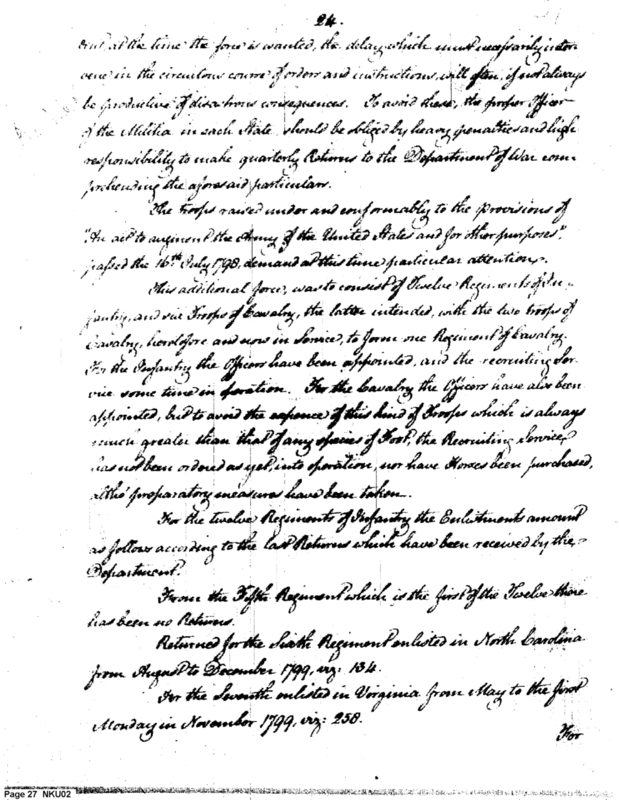
If these particulars are not precisely known to the president
dent at the time the force is wanted, the delay which must necessarily intervene in the circuitous course of orders and instructions, will often if not always be productive of disastrous consequences. To avoid these, the proper Officers of the Militia in each State should be obliged by heavy penalties and high responsibility to make quarterly Returns to the Department of War comprehending the aforesaid particulars.
The troops raised under and conformably to the provisions of "the act to augment the Army of the United States and for other purposes", passed the 16th July 1798, demand at this time particular attention.
This additional force, was to consist of Twelve Regiments of Infantry, and one Troop of Cavalry, the latter intended, with the two troops of Cavalry, heretofore and now in Service, to form one Regiment of Cavalry. For the Infantry the Officers have been appointed, and the recruiting Service some time in operation. For the Cavalry the Officers have also been appointed, but to avoid the expence of this kind of troops which is always much greater than that of any species of Foot, the Recruiting Service has not been ordered as yet into operation, nor have Horses been purchased, tho' the preparatory measures have been taken.
For the twelve Regiments of Infantry the Enlistments amount as follows according to the last Returns which have been received by the Department.
From the Fifth Regiment which is the first of the Twelve there has been no Returns.
Returned for the Sixth Regiment enlisted in North Carolina from August to December 1799, viz: 134.
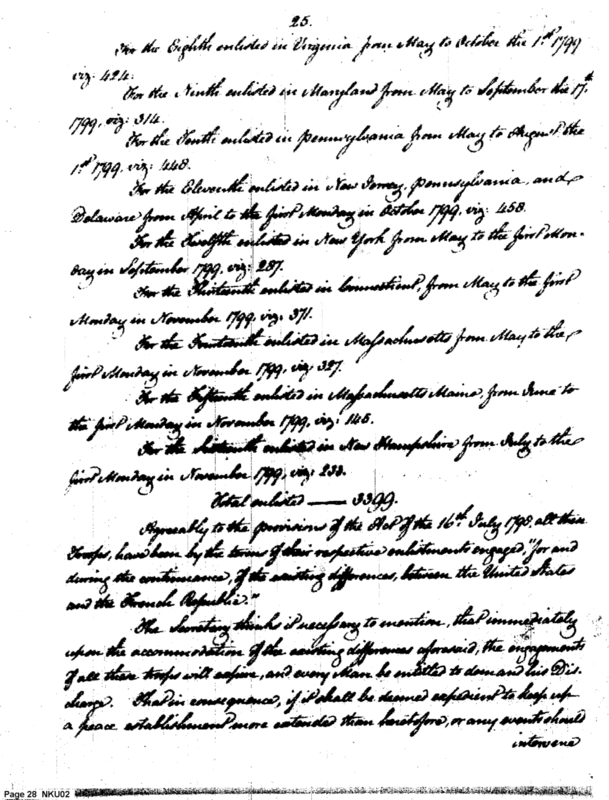
For the Seventh enlisted in Virginia from May to the first Monday in November 1799, viz: 258. For
For the Eighth enlisted in Virginia from May to October the 1st 1799 viz: 424.
For the Ninth enlisted in Maryland from May to September the 17th 1799, viz: 314.
For the Tenth enlisted in Pennsylvania from May to August the 1st 1799, viz: 448.
For the Eleventh enlisted in New Jersey, Pennsylvania, and Delaware from April to the first Monday in October 1799, viz: 458.
For the Twelfth enlisted in New York from May to the first Monday in September 1799, viz: 287.
For the Thirteenth enlisted in Connecticut, from May to the first Monday in November 1799, viz: 371.
For the Fourteenth enlisted in Massachusetts from May to the first Monday in November 1799, viz: 327.
For the Fifteenth enlisted in Massachusetts Maine, from June to the first Monday in November 1799, viz: 146.
For the Sixteenth enlisted in New Hampshire from July to the first Monday in November 1799, viz: 256.
Total enlisted — 3099.
Agreeably to the provisions of the Act of the 16th July 1798, all these Troops, have been by the terms of their respective enlistments engaged, "for and during the continuance, of the existing differences, between the United States and the French Republic."
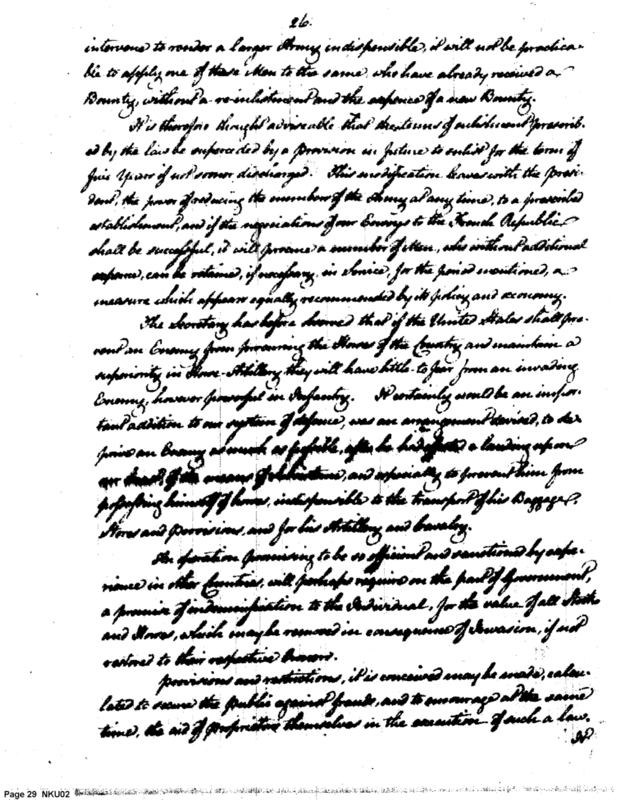
The Secretary thinks it necessary to mention, that immediately upon the accommodation of the existing differences aforesaid, the engagements of all these troops will expire, and every Man be entitled to demand his Discharge. That in consequence, if it shall be deemed expedient to keep up a peace establishment more extended than heretofore, or any events should intervene
intervene to render a longer Army indispensible, it will not be practicable to apply one of these Men to the same, who have already received a Bounty, without a re-enlistment and the expence of a new Bounty.
It is therefore thought adviseable that the terms of enlistment prescribed by the laws be superceded by a provision in future to enlist for the term of five Years if not sooner discharged. This modification leaves with the President, the power of reducing the number of the Army at any time, to a prescribed establishment; and if the negotiations of our Envoys to the French Republic shall be successful, it will preserve a number of them, who without additional expence, can be retained, if necessary, in service, for the period mentioned, a measure which appears equally recommended by its policy and economy.
The Secretary has before shewn that if the United States shall prevent an Enemy from possessing the Horses of the Country and maintain a superiority in Horse-Artillery they will have little to fear from an invading Enemy, however powerful in Infantry. It certainly would be an important addition to our system of defence, was an arrangement derived, to deprive an Enemy as much as possible, after he has effected a landing upon our Coast of the means of subsistance, and especially to prevent him from possessing himself of Horses, indispensable to the transport of his Baggage, Stores and Provisions, and for his Artillery and Cavalry.
The operation promising to be so efficient and sanctioned by experience in other Countries, will perhaps require on the part of Government, a promise of indemnification to the Individual, for the value of all Cattle and Horses, which may be removed in consequence of Invasion, if not restored to their respective Owners.
Provisions and restrictions, it is conceived may be made, calculated to secure the public against frauds, and to encourage at the same time, the aid of Proprietors themselves in the execution of such a law. —
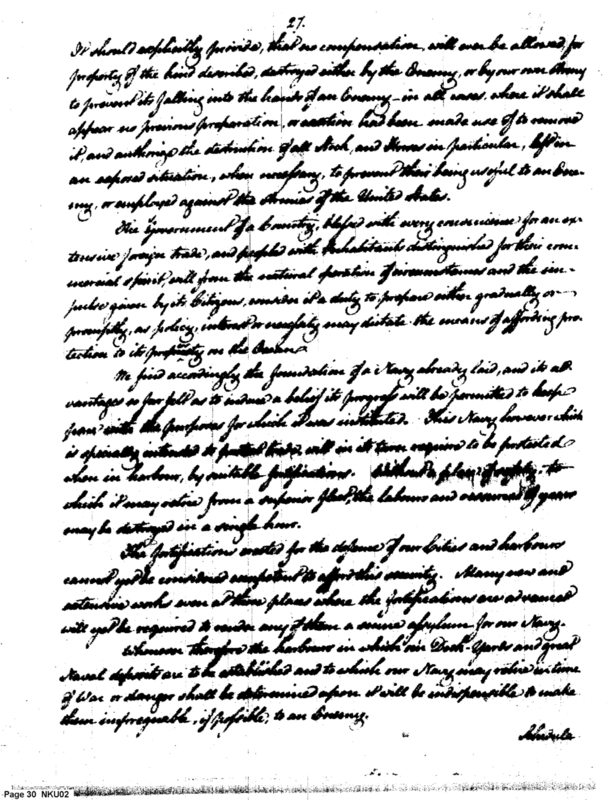
It should explicitly provide, that no compensation will ever be allowed for property of the kind described, destroyed either by the Enemy, or by our own Army to prevent its falling into the hands of an Enemy—in all cases, where it shall appear no previous preparation, or exertion had been made use of to remove it, and authorise the destruction of all Stock, and Horses in particular, by their own exerted exertion, when necessary, to prevent their being useful to an Enemy, or employed against the interests of the United States.
The Government of a Country, blessed with every convenience for an extensive foreign trade, and peopled with Inhabitants distinguished for their commercial spirit, will from the natural operation of circumstances and the impulse given by its Citizens, render it its duty to prepare either gradually or promptly, as policy, interest or necessity may dictate the means of affording protection to its property on the Oceans.
We find accordingly the foundations of a Navy already laid, and its advantages as far felt as to induce a belief its progress will be permitted to keep pace with the purposes for which it was instituted. This Navy however which is especially intended to protect trade, will in its turn require to be protected when in harbours, by suitable fortifications. Without it, a fleet of superior force from which it may retire, the labours and expenses of years may be destroyed in a single hour.
The fortifications erected for the defence of our Cities and harbours cannot yet be considered complete to afford this security. Many new and extensive works in other places where the fortifications are advanced will yet be required to render any of them a secure asylum for our Navy.
Whatever therefore the harbours in which our Dock-Yards and great Naval deposits are to be established and to which our Navy may retire in time of War or danger shall be determined upon, it will be indispensible to make them impregnable, if possible, to an Enemy. Schedule
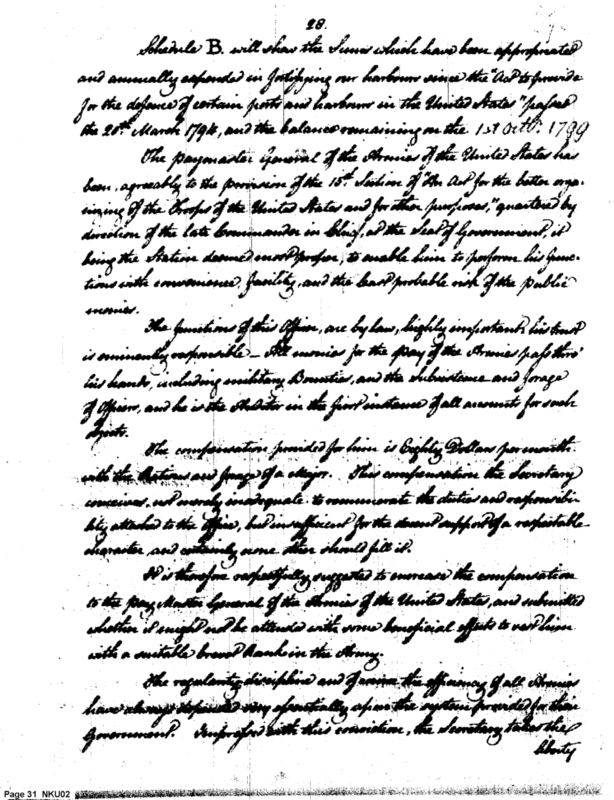
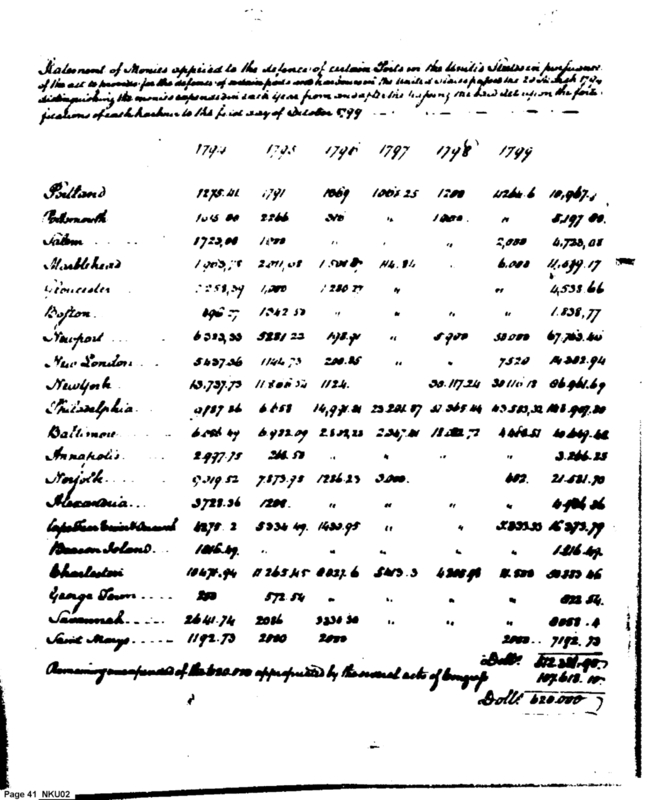
Schedule B. will show the Sums which have been appropriated and annually expended in fortifying our harbours since the "Act to provide for the defence of certain ports and harbours in the United States" passed the 20th March 1794, and the balance remaining on the 1st Octr. 1799.
The paymaster General of the Armies of the United States has been, agreeably to the provisions of the 15th Section of "the Act for the better organizing of the Troops of the United States and for other purposes," quartered by direction of the late Commander in Chief, at the Seat of Government, it being the Station deemed most proper, to enable him to perform his functions with convenience, facility, and the least probable risk of the public monies.
The functions of this Officer, are by law, highly important; his trust is eminently responsible — the monies for the pay of the Armies pass thro' his hands, including military Bounties, and the Subsistence and forage of Officers, and he is the Auditor in the first instance of all accounts for such objects.
The compensation provided for him is Eighty Dollars per month with the Rations and forage of a Major. The compensation the Secretary conceives, not merely inadequate to remunerate the duties and responsibility attached to the Officer, but insufficient for the decent support of a respectable character, and certainly none then should fill it.
It is therefore respectfully suggested to increase the compensation to the pay master General of the Armies of the United States, and submitted whether it might not be attended with some beneficial effects to vest him with a suitable brevet Rank in the Army.
The regularity, discipline and genius the efficiency of all Armies have always depended very essentially on the system provided for their Government. Impressed with this conviction, the Secretary takes the liberty
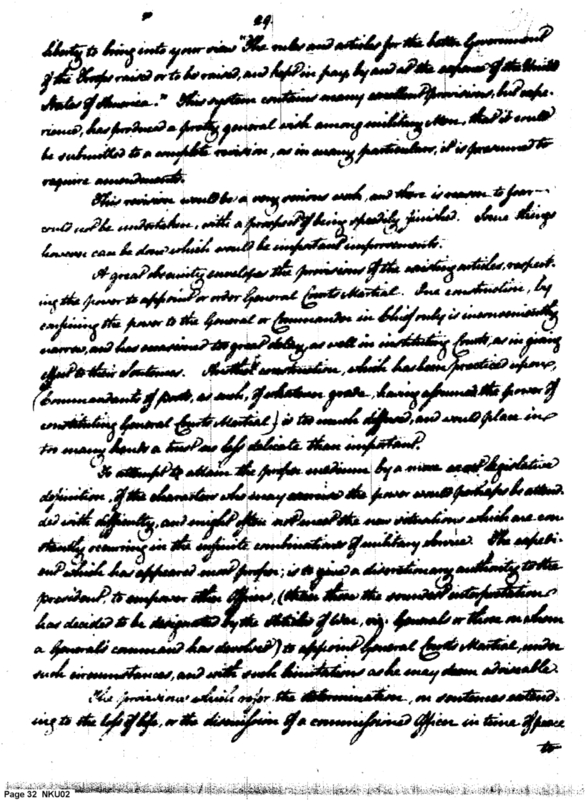
liberty to bring into your view "the rules and articles for the better Government of the Troops raised or to be raised, and kept in pay, by and at the expence of the United States of America." This system contains many excellent provisions, but experience, has produced a pretty general wish among military men, that it could be submitted to a complete revision, as in many particulars, it is presumed to require amendments.
This revision would be a very arduous work, and there is reason to fear—could not be undertaken, with a prospect of being speedily finished. Some things however can be done which would be important improvements.
A great obscurity envelops the provisions of the existing articles, respecting the power to appoint or order General Courts Martial. One construction, by confining the power to the General or Commander in Chief only is inconveniently narrow, and has occasioned too great delay, as well in instituting trials, as in giving effect to their Sentences. Another construction, which has been practised upon, (Commandants of posts, as such, of whatever grade, having assumed the power of constituting General Courts Martial,) is too much diffused, and would place in too many hands a trust no less delicate than important.
To attempt to attain the proper medium by a more exact legislative definition of the characters who may exercise the power would perhaps be attended with difficulty, and might often not embrace the new situations which are constantly occurring in the infinite combinations of military service. The expedient which has appeared most proper, is to give a discretionary authority to the president, to empower other Officers, (within those the soundest interpretations has decided to be designated by the articles of War, viz. Generals or those on whom a General's command has devolved) to appoint General Courts Martial, under such circumstances, and with such limitations as he may deem adviseable.
The provisions which refer to the determination, on sentences extending to the loss of life, or the dismission of a commissioned Officer in time of peace, to
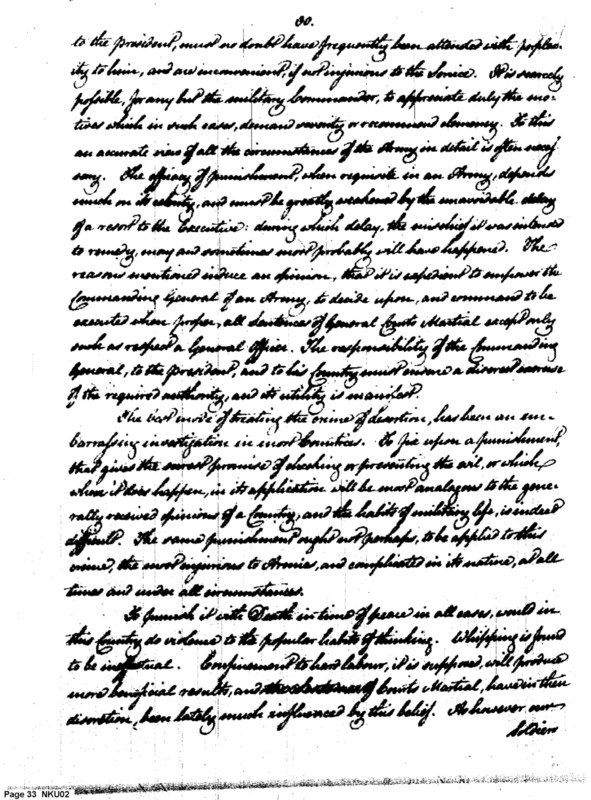
to the president, must no doubt have frequently been attended with perplexity to him, and are inconvenient, if not injurious to the Service. It is rarely possible, for any but the military Commander, to appreciate duly the motives which in such cases, demand severity or recommend clemency. It is this an accurate view of all the circumstances of the Army in detail is often necessary. The efficacy of punishment, when requisite in an Army, depends much on its celerity, and must be greatly weakened by the unavoidable delay of a resort to the Executive: during which delay, the mischief it was intended to remedy, may and sometimes most probably will have happened. The reasons mentioned induce an opinion, that it is expedient to empower the Commanding General of an Army, to decide upon, and command to be executed when proper, all sentences of General Courts Martial except only such as respect a General Officer. The responsibility of the Commanding General, to the president, and to his Country must ensure a discreet exercise of the required authority, and its utility is manifest.
The best mode of treating the crime of Desertion, has been an embarrassing investigation in most Countries. To fix upon a punishment, that gives the most promise of checking or preventing the evil, or which when it does happen, in its application will be most analogous to the generally received opinions of a Country, and the habits of military life, is indeed difficult. The same punishment ought not perhaps, to be applied to this crime, the most injurious to Armies, and complicated in its nature, at all times and under all circumstances.
To punish it with Death in time of peace in all cases, would in this Country do violence to the popular habits of thinking. Whipping is found to be ineffectual. Confinement to hard labour, it is supposed, will produce more beneficial results, and the Courts Martial, having in their discretion, been lately much influenced by this belief. As however Soldiers
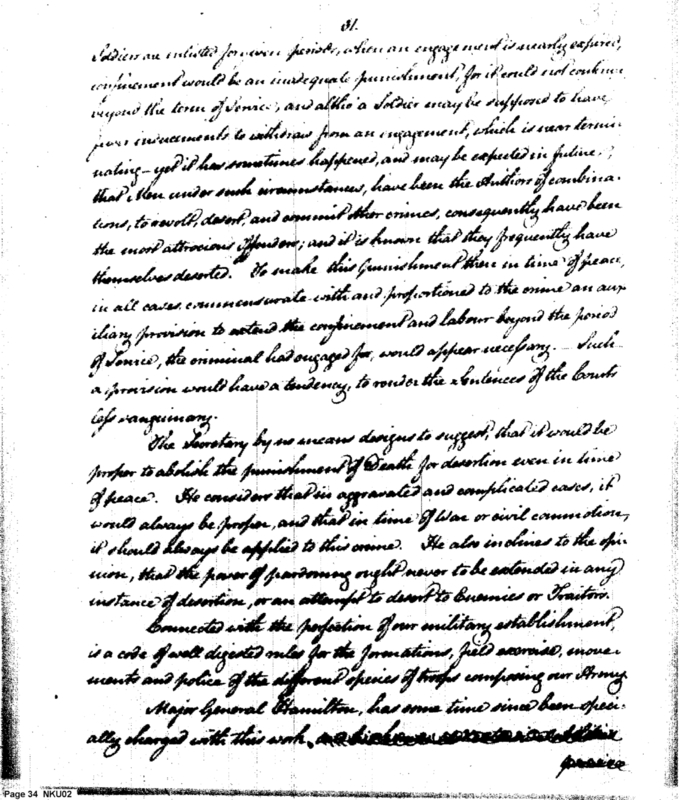
Soldiers are enlisted for certain periods, when an engagement is nearly expired, confinement would be an inadequate punishment, for it would not continue beyond the term of Service, and altho' a Soldier may be supposed to have some inducements to withdraw from an engagement, which is near terminating—yet it has sometimes happened, and may be expected in future, that there under such circumstances, have been the Authors of combinations, to revolt, desert, and commit other crimes, consequently have been the most atrocious offenders; and it is known that they frequently have themselves deserted. To make this punishment then in time of peace, in all cases commensurate with and proportioned to the crime an auxiliary provision to extend the confinement and Labour beyond the period of Service, the criminal had engaged for, would appear necessary. Such a provision would have a tendency, to render the sentences of the Courts less sanguinary.
The Secretary by no means designs to suggest, that it would be proper to abolish the punishment of Death for desertion even in time of peace. He considers that in aggravated and complicated cases, it would always be proper, and that in time of War or civil commotion, it should always be applied to this crime. He also inclines to the opinion, that the power of pardoning ought never to be extended in any instance of desertion, or an attempt to desert to Enemies or Traitors.
Connected with the perfection of our military establishment, is a code of well digested rules for the formations, field exercise, movements and police of the different species of troops composing our Army.
Major General Hamilton, has some time since been specially charged with this work, and which [undecipherable] passing
[underline: promise] to [undecipherable] excellence. As it was not however expected so extensive an undertaking could be completed without a subdivision of labour and the co-operation of various talents and experience, he informs that he has assigned to Major General Pinckney an important portion of the task. The execution, it is also understood will require the aid of other and subordinate Officers, for whose extra Service a special compensation is suggested as being agreeable to usage and essential to a cheerful and zealous performance of their duty. This, should it meet your approbation, demands no particular act of the Legislature.
There is another point relative to the Army, which he has made the subject of a recent communication to the Department of War, to which it may be proper to request attention.
The General observes, that the detaching Army Corps Soldiers as Servants to the various Officers of the General Staff is productive of material inconvenience, by withdrawing altogether, from military Service, a considerable number of persons, and occasioning dissatisfactions to the Commandants of Corps, who never see their Men removed without uneasiness, and are sometimes much disgusted by the selection of those whom they are anxious to retain. There is no doubt, he adds, that it would operate beneficially, if after fixing the number of Servants to which the several characters of the General Staff should be entitled they were to be allowed an equivalent in Money, regulated by the pay of a Soldier to the public, and were to be required to provide their own Servants."
Should this measure be adopted, which is agreeable to an obsolete
article regulation of the Congress, penalties may be devised to secure a faithful execution, which from the force of circumstances would be very little liable to abuse.
Before treating upon military subjects it may not be improper to give a general view of the positions of the existing regular force, composing the Armies of the United States conformably to a disposition of the same by your approbation and that of the late Commander in Chief.
The Four Regiments of Infantry and the two Companies of Cavalry on the permanent establishment are disposed of as follows.
One Regiment is assigned to the Frontiers of Tennessee and Georgia. There are also in that quarter, the two Companies of Cavalry.
The Three other Regiments are distributed along the Lakes from Niagara to Michilimackinae upon the Miami, Ohio, Mississippi and Tenobigbee.
There is also one Battalion of the Artillerists and Engineers distributed with the aforesaid Troops.
This entire force is manifestly inadequate to the purposes it is intended to answer on our Northern, Western, and Southern Frontiers.
The arrangement of our additional, twelve Regiments of Infantry now raising, have taken, or are to take, the following provisional positions, viz:
Three of the Twelve Regiments of Infantry in the vicinity of Providence River near Clabridge, Massachusetts.
Three Regiments in the vicinity of Brunswick New Jersey.
Three Regiments in the vicinity of Potomac near Harpers Ferry, Virginia.
Three Regiments in the vicinity of Augusta, above the Falls of Savannah. This
This disposition it is conceived combines considerations relative to the discipline and health of the Troops with the economical supply of their wants. It has also some military aspect, in the first instance, towards the security of Boston and Newport; in the second towards that of New York and Philadelphia; in the Third and fourth towards that of Baltimore, Charleston, Savannah and the Southern States generally, and in the third particularly towards the re-inforcement of the Western Army.
The residue of the two Regiments of Artillerists and Engineers except one Battalion stated to be on our Northern, Western, and Southern frontiers, are stationed in our Sea-board Fortifications, from Portland Massachusetts to the St. Mary's Georgia. From these are to be drawn two Battalions in succession for the Army when in the field, with a view to a course of regular instructions.
Schedule C. exhibits the actual force (according to the latest Returns) of the four Regiments of Infantry and two Companies of Cavalry on the old Establishment; and the two Regiments of Artillerists and Engineers.
All which is respectfully submitted.
War Department,
5th January 1800.
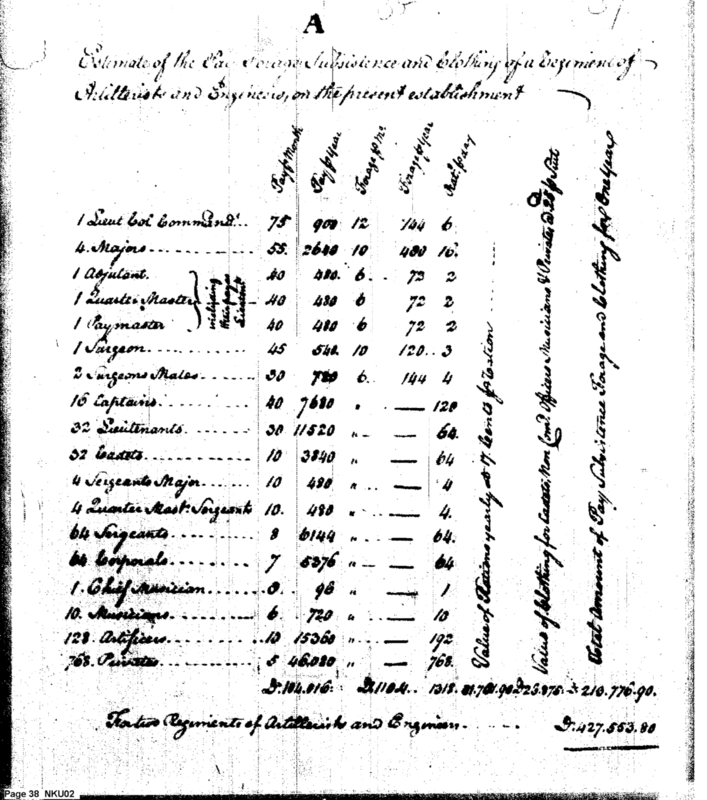
[Schedule A]
Estimate of the Pay Forage Subsistence and Clothing of a Regiment of Artillerists and Engineers, on the present establishment.
[table with columns: Pay/Month — Pay/Year — Forage/mo. — Forage/Year — Subs/year]
1 Lieut Col. Commandant.... 75 ... 900 ... 12 ... 144 ... 6
4 Majors .... 55. ... 2640 ... 10 ... 480 ... 16.
1 Adjutant. ... 40 ... 480. ... 6. .. 72 ... 2
1 Quarter Master } including ... 40 ... 480 ... 6 ... 72 ... 2
1 Paymaster } ... 40 ... 480 ... 6 ... 72 ... 2
1 Surgeon .... 45 ... 540. ... 10 ... 120.. 3
2 Surgeons Mates. .... 30 ... 720. ... 6. ... 144 ... 4
16 Captains .... 40 ... 7680 ... " ... — ... 120
32 Lieutenants. ... 30 ... 11520 ... " — ... 64.
32 Cadets .... 10 ... 3840 ... " ... — ... 64.
4 Sergeants Major. ... 10 ... 480 ... " ... — ... 4.
4 Quarter Mast. Sergeants ... 10. ... 480 ... " ... — ... 4.
64 Sergeants .... 8 ... 6144 ... " ... — ... 64.
64 Corporals .... 7 ... 5376 ... " — ... 64.
1. Chief Musician .... 0. ... 96 ... " ... — ... 1
10. Musicians .... 6. ... 720 ... " ... — ... 10
128 Artificers .... 10 ... 15360 ... " ... — ... 192
768. Privates. .... 5 ... 46,020 ... " ... — ... 768.
$.104.916. ... $.1104. ... 1318. ... 81.70 ... 80 ... 25.976. ... ÷ 210.776.90.
For two Regiments of Artillerists and Engineers .... $. 427.553.80
[Schedule A continued]
Estimate of the Pay, Forage Subsistence and Clothing of a Regiment of Artillery on the proposed peace establishment.
[table with columns: Pay/month — Pay/Year — Forage/mo. — Forage/Year — Subs/pay]
1 Lieut Col. Commandant ... 75 ... 900 ... 13 ... 144 ... 6
3 Majors .... 55 ... 1900 ... 10 ... 360 ... 12
1 Adjutant .... 40 ... 480. ... 6 ... 72 ... 2
1 Quarter Master } Lieuts. ... 40 ... 480 ... 6 ... 72 ... 2
1 Paymaster } ... 40 ... 480. ... 6 ... 72 ... 2
1 Surgeon .... 45 ... 540 ... 10 ... 120 ... 3
2 Surgeons Mates .... 30 ... 720 ... 6 ... 144 ... 4.
12 Captains .... 40 ... 5760 ... " ... — ... 36
24 Lieutenants .... 30 ... 8640 ... " ... — ... 48
24 Cadets .... 10 ... 2880 ... " ... — ... 48
3 Sergeant Majors ... 10 ... 360 ... " ... — ... *
3 Lieut. Mr. Sergeant ... 10 ... 360. ... — ... * ... 3
48 Sergeants .... 8 ... 4608 ... " ... — ... 48
48 Corporals .... 7 ... 4032 ... " ... — ... 48
One Chief Musician ... 6 ... 96 ... " ... — ... 1
12 Musicians .... 6 ... 864 ... " ... — ... 12
128 Artificers .... 10 ... 15360 ... " ... — ... 195
651 Privates .... 5 ... 39,000. ... " ... 651
For One Regiment: 87,780 ... 984. ... 1128. ... by 632.80 ... 22.975 ... 181.821.16.
For two Regiments: 362,842.36
[Schedule A continued]
Estimate of the Pay, Subsistence and Forage of the proposed Corps of Engineers, including the Clothing for the Cadets. —
[table with columns: Pay/month — Pay/Year — Forage/Month — Forage/Year — Rations/pay — Yearly Value of Cadets' Clothing at [undecipherable] — Value of Cadets' Clothing at [undecipherable] — Total]
2 Lieutenant Colonels. ... 75 ... 1800 ... 12 ... 288 ... 12
3 Majors .... 55 ... 1980 ... 10 ... 360 ... 12
12 Captains ... 40 ... 5760 ... " ... " ... 36
48 Lieutenants ... 30 ... 17280 ... " ... " ... 90
24. Cadets .... 10 ... 2880 ... — ... — ... 48
29,700 ... 648 ... 12,0350 ... 757 ... 43,756.20
[summary at bottom of Schedule A]
Of the two Regiments of Artillery on the present establishment for one year. ... 427,553.80.
[undecipherable] for two Regiments on the proposed establishment. ... 362,842.30
[undecipherable] expenses of the proposed Corps of Engineers. ... 43,756.20.
406,598.50
Saving in favour of the proposed establishment ... 20,955.30.
[Schedule B]
Statement of Monies applied to the defence of certain Ports on the United States in pursuance of the act to provide for the defence of certain ports and harbours in the United States passed the 20 March 1794, distinguishing the monies expended in each year from the adoption to the happening, the balance due upon the fortifications of each harbour to the first day of December 1799.
[table columns: 1794 — 1795 — 1796 — 1797 — 1798 — 1799]
Ballard ... 1275.41 ... 1,791 ... 1069 ... 1005.25 ... 1200 ... 4264.6 ... 10,967.
Falmouth ... 1046.00 ... 2566 ... 370. ... " ... 1000. ... " ... 8,197.00.
Salem ... 1723.00 ... 1070 ... " ... " ... " ... 2,050 ... 4,723.08
Marblehead ... 1303,35 ... 2,111.08 ... 1.500[?] ... 44.84 ... . ... 6,000 ... 11,639.17
Gloucester ... 2251.59 ... 1,200 ... 1280.77 ... " ... " ... " ... 4,533.66
Boston ... 860.77 ... 1,242.52 ... " ... " ... " ... " ... 1,838,77
Newport ... 6013.35 ... 5221.22 ... 498.94 ... " ... 5,900 ... 58,000 ... 67,703.80
New London ... 5407.56 ... 1144.75 ... 200.85 ... " ... " ... 7520 ... 84,303.94
New York ... 43,707.75 ... 11,808.54 ... 1124. ... 50.117.24 ... 30,116.13 ... 86941.69
Philadelphia ... 0/87.36 ... 6452 ... 14,94[?].06 ... 23,201.97 ... 51.564.44 ... 43,503.32 ... 108,999.20
Baltimore ... 6,046.44 ... 6,432.09 ... 2,502.22 ... 2,247.06 ... 18,022.72 ... 4,640.51 ... 60,649.68
Annapolis ... 2,997.75 ... 264.52 ... " ... " ... " ... " ... 3,266.25
Norfolk ... 9,319.52 ... 7,375.75 ... 1236.25 ... 3,000. ... ... 602. ... 21,521.70
Alexandria ... 3728.36 ... 1200. ... " ... " ... " ... " ... 4904.36
[Cape Fear] ... 6178.2 ... 5034.49. ... 1489.95 ... " ... " ... 580335 ... 15,273.79
Beacon Island ... 1016.69. ... " ... " ... " ... " ... " ... 1,016.69.
Charleston ... 10,671.94 ... 11,265.45 ... 0837.6 ... 5429.3 ... 4,300.91 ... 11,500 ... 50,337.66
George Town ... 250 ... 572.54 ... " ... " ... " ... " ... 622.54.
Savannah ... 2641.74 ... 2086 ... 5354.30 ... " ... " ... " ... 0053.4
Saint Marys ... 1192.73 ... 2000 ... 2000 ... ... ... 2000.. 7,192.73
Aggregate amount of the sums appropriated by the several acts of Congress ... Dolls ... 672,351.90
107,618.10
Dolls 620,000
C
Statement of the Number of Non Commissioned Officers Musicians and privates in the two Companies of Cavalry, two Regiments of Artillerists and Engineers, and four old Regiments of Infantry, taken from the last Returns.
Cavalry .... 116
Artillerists .... 1501.
Infantry .... 1012
Total — 3,429. —
Type
Copy of document
Description
Secretary McHenry requests action from President Adams respecting certain measures and assignments which he deems indispensable to the improvement of the military system. This report should also be submitted to the Congress. Discusses the Military Academy and schooling for members of the military (including studies of mathematics, geography, and natural philosophy).
Date
01/13/1800
Author
Document number
1800011390002
Page start
4
Note
Partially illegible.
Notable persons
James McHenry
Secretary of War
John Adams
President of the United States
Congress
troops
engineers
artillerists
cavalry
infantry
navy
professors
teachers
officers
architects
drawing master
riding master
fencing master
cadets
major
surgeon
quartermaster
paymaster
captain
lieutenant
sergeant major
corporal
musician
artificers
horse artillery
Austrian Army
Duportail
Narborne
French
Napoleon Bonaparte
General Moreau
Arch Duke Charles
volunteer associations
militia
Paymaster General
Major General Alexander Hamilton
servants
Notable locations
France
North Carolina
Virginia
Maryland
Pennsylvania
New Jersey
Delaware
New York
Connecticut
Massachusetts
Maine
New Hampshire
Tennessee
Georgia
Niagara
Michilimackinac
Miami River
Ohio River
Mississippi River
Tennessee River
frontiers
Providence River
Brunswick, New Jersey
Potomac
Harpers Ferry
Falls of Savannah
Augusta
Portland, Massachusetts
St. Mary's, Georgia
Portsmouth
Salem
Marblehead
Gloucester
Boston
Newport
New London
New York
Philadelphia
Baltimore
Annapolis
Norfolk
Alexandria
Beacon Island
Charleston
George Town
Savannah
Notable items
military system
discipline
organization
fortifications
military academy
mathematics
geography
philosophy
chemistry
drawing
construction
cannon
firearms
gun carriages
bridges
canals
navigation
certificates
apparatus
instruments
foundries
barracks
vacancies
commission
wagon
howitzers
expense
law
returns
baggage
stores
provisions
compensation
general courts martial
punishment
discipline
desertion
whipping
hard labor
pay
forage
rations
clothing
subsistence