

Unsigned Presidential Endorsement of Capital Punishment for Andrew Anderson
Document 1799States the particulars of the court martial and conviction of Andrew Anderson, and affirms his sentence to hang, in the name of "the beneficial influence of well-placed examples in Military Service." [Note: Adams signaled his intent to pardon Andrew Anderson at the last minute in his letter to McHenry of September 18, 1799].
No human transcription currently available for this document.
This transcription was generated by machine using Anthropic's Claude Code (model sonnet 4.6). It may contain errors or inaccuracies. Please verify against the document image. Learn more about our generative AI methodology.
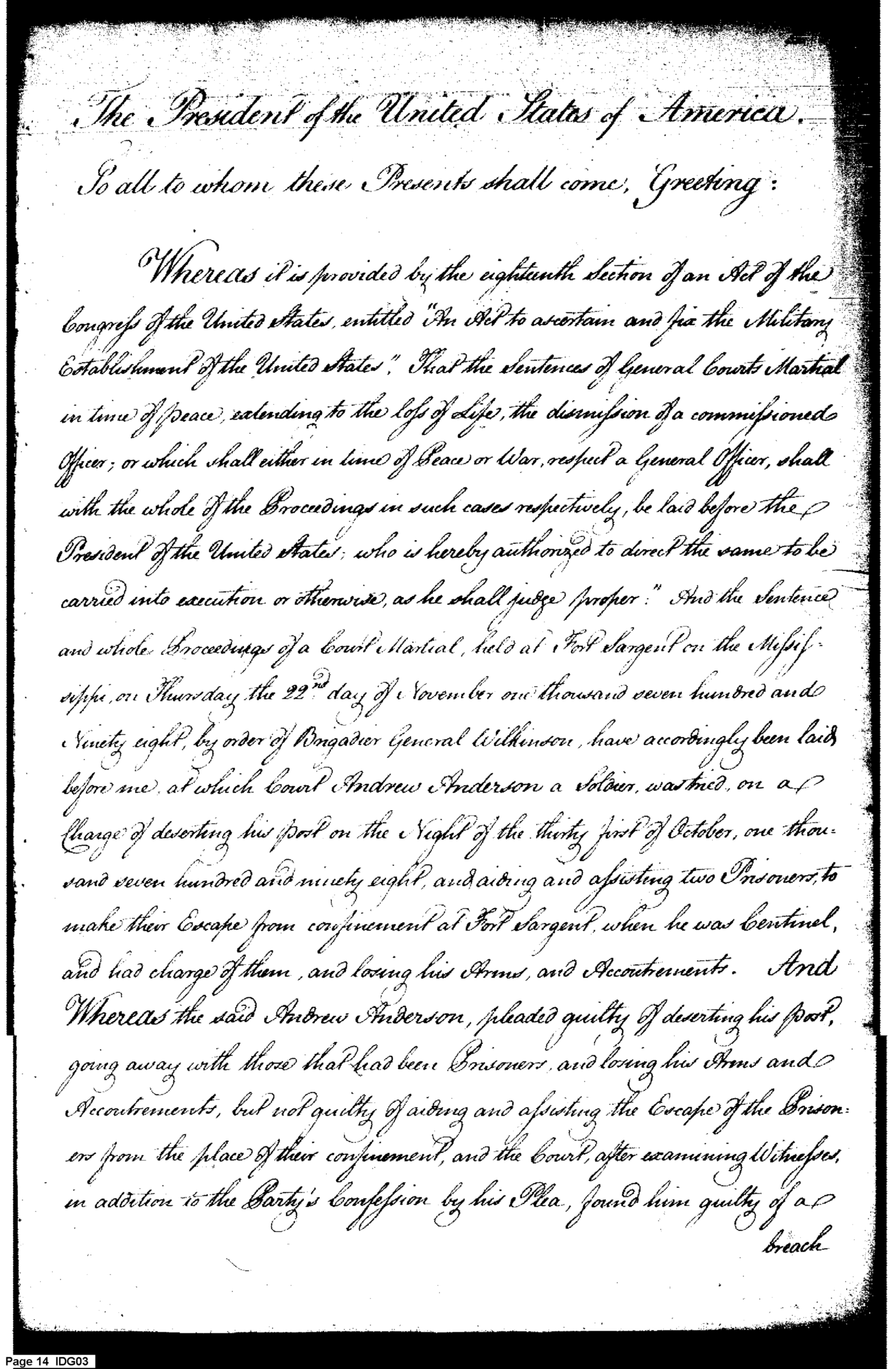
The President of the United States of America.
To all to whom these Presents shall come, Greeting:
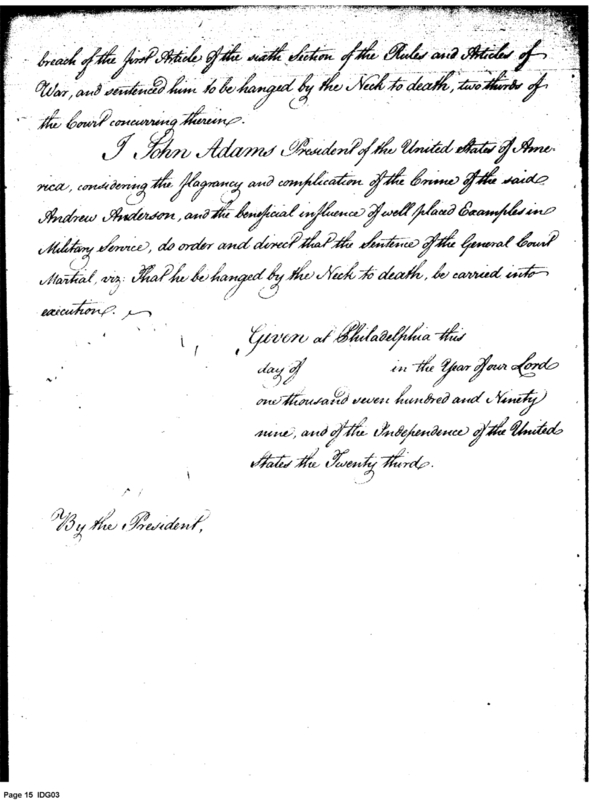
Whereas it is provided by the eighteenth Section of an Act of the Congress of the United States, entitled "An Act to ascertain and fix the Military Establishment of the United States," That the sentences of General Courts Martial in time of peace, extending to the loss of Life, the dismission of a commissioned Officer; or which shall either in time of Peace or War, respect a General Officer, shall with the whole of the Proceedings in such cases respectively, be laid before the President of the United States; who is hereby authorized to direct the same to be carried into execution or otherwise, as he shall judge proper." And the Sentence and whole Proceedings of a Court Martial, held at Fort Sargent on the Mississippi, on Thursday the 22nd day of November one thousand seven hundred and Ninety eight, by order of Brigadier General Wilkinson, have accordingly been laid before me; at which Court Andrew Anderson a Soldier, was tried, on a charge of deserting his post on the Night of the thirty first of October, one thousand seven hundred and ninety eight, and aiding and assisting two Prisoners, to make their Escape from confinement at Fort Sargent, when he was Centinel, and had charge of them, and losing his Arms, and Accoutrements. And Whereas the said Andrew Anderson, pleaded guilty of deserting his post, going away with those that had been Prisoners, and losing his Arms and Accoutrements, but not guilty of aiding and assisting the Escape of the Prisoners from the place of their confinement, and the Court, after examining Witnesses, in addition to the Party's Confession by his Plea, found him guilty of a breach of the first Article of the sixth Section of the Rules and Articles of War, and sentenced him to be hanged by the Neck to death, two thirds of the Court concurring therein.
I John Adams President of the United States of America, considering the flagrancy and complication of the Crime of the said Andrew Anderson, and the beneficial influence of well placed Examples in Military Service, do order and direct that the Sentence of the General Court Martial, viz: That he be hanged by the Neck to death, be carried into execution.
Given at Philadelphia this
day of in the Year of our Lord
one thousand seven hundred and Ninety
nine, and of the Independence of the United
States the Twenty third.
By the President,
Type
Document
Description
States the particulars of the court martial and conviction of Andrew Anderson, and affirms his sentence to hang, in the name of "the beneficial influence of well-placed examples in Military Service." [Note: Adams signaled his intent to pardon Andrew Anderson at the last minute in his letter to McHenry of September 18, 1799].
Date
1799
Author
Sent from
Philadelphia
Repository
Collection
Document number
1799999991701
Page start
14
Note
Enclosed in McHenry to Adams, 04/11/1799.
Notable persons
John Adams
Andrew Anderson
President of the United States
Congress
Brigadier General Wilkinson
prisoners
Notable locations
Philadelphia
Fort Sargent
Mississippi
Notable items
Act of Congress
sentence
courts martial
charge of deserting
escape
arms and accoutrements
confession
crime
hanged