

The President's Orders regarding the Death of George Washington
Document 1799McHenry forwards though Hamilton the President's orders regarding the funeral ceremonies that will commemorate the death of General George Washington.
No human transcription currently available for this document.
This transcription was generated by machine using Anthropic's Claude Code (model sonnet 4.6). It may contain errors or inaccuracies. Please verify against the document image. Learn more about our generative AI methodology.
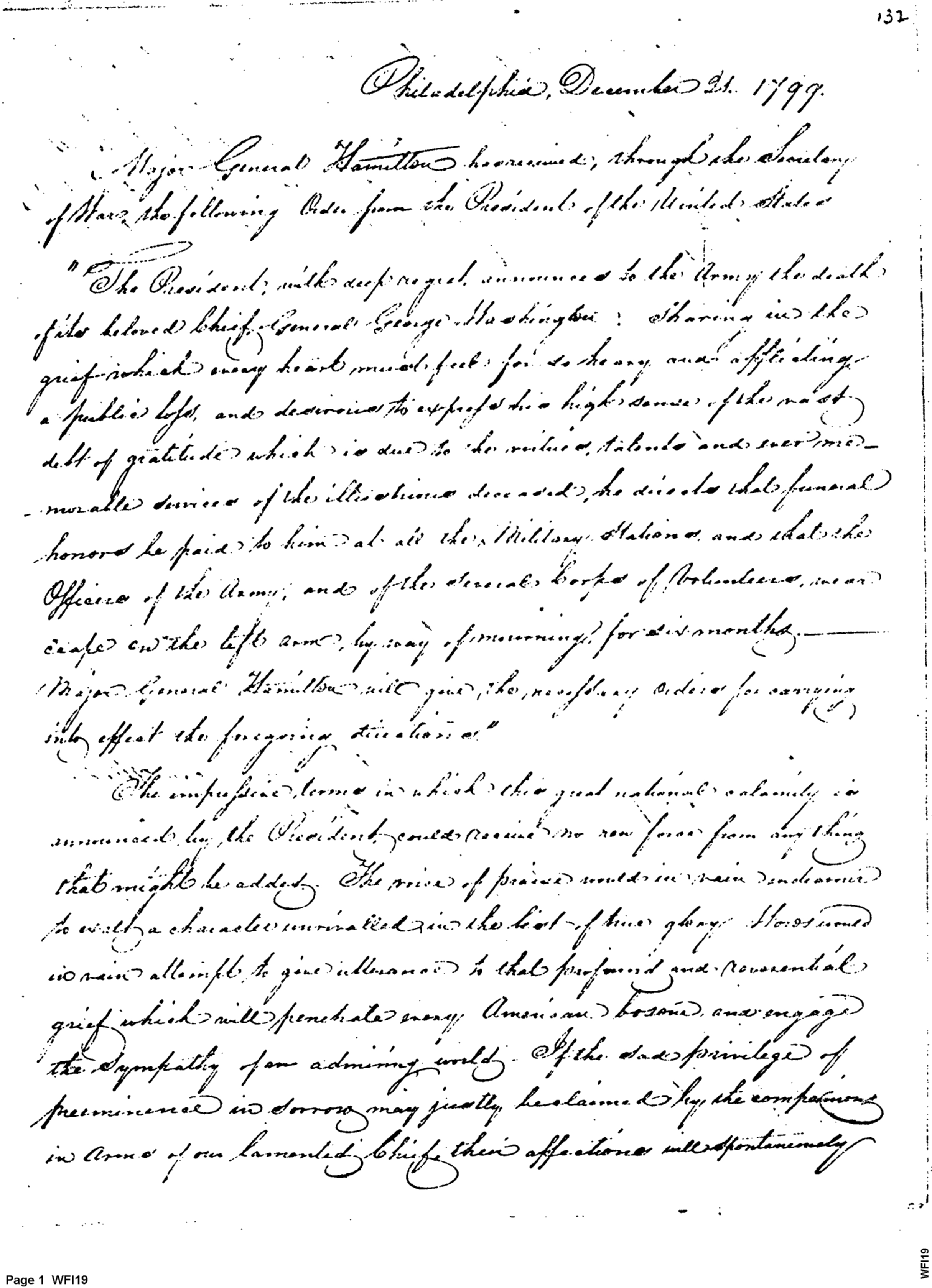
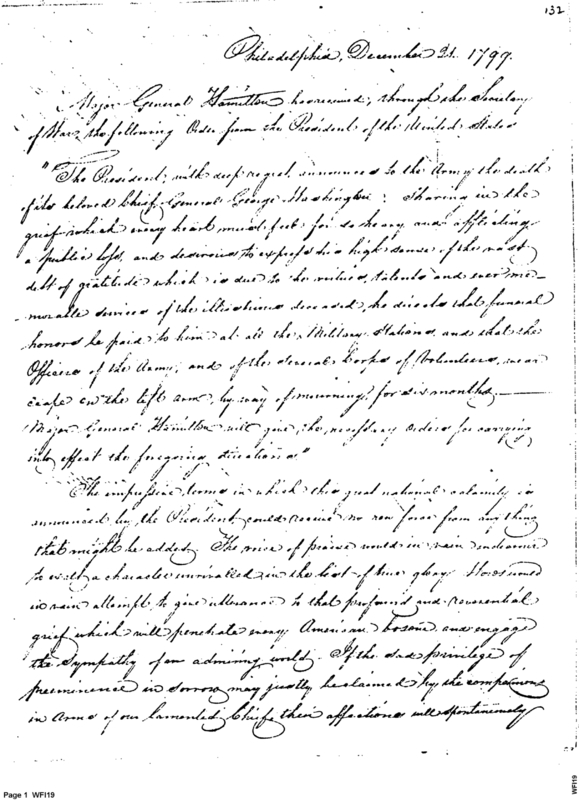
Philadelphia, December 21. 1799.
Major General Hamilton recommends, through the Secretary of War, the following Order from the President of the United States
"The President, with deep regret, announces to the Army the death of his beloved Chief, General George Washington; Sharing in the grief which every heart must feel for so heavy and afflicting a public loss, and desirous to express his high sense of the vast debt of gratitude which is due to the virtues, talents and ever memorable services of the illustrious deceased; he directs that funeral honors be paid to him at all the Military Stations, and that the Officers of the Army, and of the several Corps of Volunteers, wear crape on the left arm, by way of mourning, for six months. — Major General Hamilton will give the necessary orders for carrying into effect the foregoing direction."
The impressive terms in which this great national calamity is announced by the President could receive no new force from any thing that might be added. The voice of praise would in vain endeavour to with a character unrivalled in the last of human glory. No occasion to even attempt to give utterance to that profound and reverential grief which will penetrate many American bosoms, and engage the sympathy of an admiring world. If the sad privilege of preeminence in sorrow may justly be claimed by the companions in Arms of our lamented Chief, their affections will spontaneously
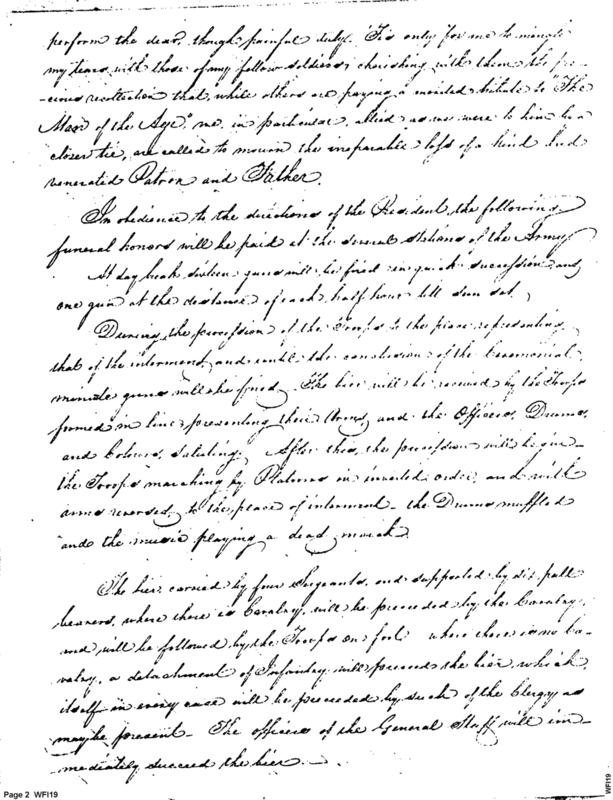
perform the dead, though painful duty. 'Tis only for me to mingle my tears with those of my fellow soldiers, cherishing with them the precious recollection that, while others are paying a merited tribute to "The Man of the Age"; we, in particular, allied as we were more to him by a closer tie, are called to mourn the inseparable loss of a kind and venerated Patron and Father.
In obedience to the directions of the President, the following funeral honors will be paid at the several Stations of the Army:
At day break, sixteen guns will be fired in quick succession, and one gun at the distance of each half hour till sun set.
During the procession of the Troops to the place representing that of the interment, and until the conclusion of the ceremonial, minute guns will be fired. The bier will be received by the Troops formed in line representing their flank, and the Officers Drums and colours Saluting. After this, the procession will begin — the Troops marching by Platoons in inverted order, and with arms reversed, to the place of interment, the Drums muffled and the music playing a dead march.
The bier carried by four Sargeants, and supported by six pall bearers, where there is Cavalry, will be preceded by the Cavalry, and will be followed by the Troops on foot. where there is no Cavalry, a detachment of Infantry will precede the bier, which itself in every case will be preceded by such of the Clergy as may be present. The Officers of the General Staff will immediately succeed the bier. —
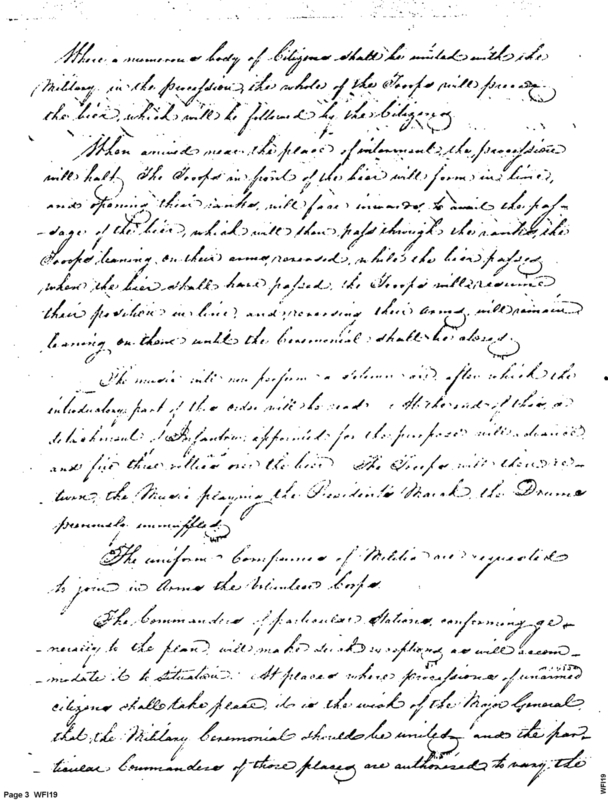
Where a numerous body of Citizens shall be united with the Military in the procession, the whole of the Troops will precede the bier, which will be followed by the Citizens.
When arrived near the place of interment, the procession will halt. The Troops in front of the bier will form in line, and opening their ranks, will face inwards to admit the passage of the bier, which will then pass through the ranks, the Troops leaning on their arms reversed, whilst the bier passes; when the bier shall have passed, the Troops will resume their position in line; and presenting their arms, will remain leaning on them until the ceremonial shall be closed.
The music will then perform a solemn ode, after which the introductory part of the order will be read. At the end of this, a detachment of Infantry appointed for the purpose will advance and fire three vollies over the bier. The Troops will then return, the Music playing the President's March, the Drums permeate unmuffled.
The uniform Corps of Militia are requested to join in Arms the blended body.
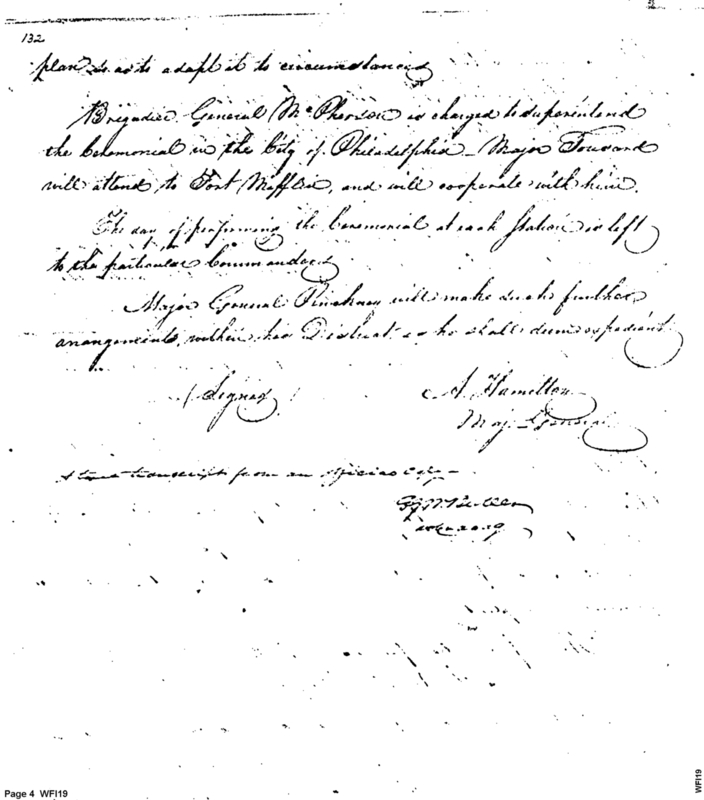
The Commanders of particular Stations, conforming generally to the plan, will make such adaptions as will accommodate to the Situation. At places where processions of unarmed citizens shall take place, it is the wish of the Major General that the Military Ceremonial should be united by, and the particular Commanders of those places are authorised to vary, the
plan so as to adapt it to circumstances.
Brigadier General McPherson is charged to superintend the Ceremonial in the City of Philadelphia. Major Toussard will attend to Fort Mifflin, and will cooperate with him.
The day of performing the Ceremonial at each Station is left to the particular Commanders.
Major General Pinckney will make such further arrangements within his District as he shall deem expedient.
(Signed) A. Hamilton
Maj. General.
A true transcript from an official copy —
[undecipherable]
[undecipherable]
Type
Autograph Document Signed
Description
McHenry forwards though Hamilton the President's orders regarding the funeral ceremonies that will commemorate the death of General George Washington.
Date
12/21/1799
Author
Recipient
Sent from
Philadelphia
Repository
Document number
1799122190001
Page start
1
Note
The announcement of George Washington's death. The copy of this document that Syrett published in The Papers of Alexander Hamilton was signed by Philip Church, Aid[e] de Camp. The copy found in the Andrew Jackson Papers was marked a true transcript from an official copy' which was apparently signed by Hamilton. Cited in Smith to Hamilton, 12/24/1799.
Notable persons
Alexander Hamilton
[John Adams]
Notable locations
Philadelphia