

Compensation of Doctor Brown
Document 1799Dr. Charles Brown complains to Secretary McHenry that he was promised compensation for his many services providing medical care for the Indian prisoners, including renting a house for their care, and has yet to be paid.
No human transcription currently available for this document.
This transcription was generated by machine using Anthropic's Claude Code (model sonnet 4.6). It may contain errors or inaccuracies. Please verify against the document image. Learn more about our generative AI methodology.
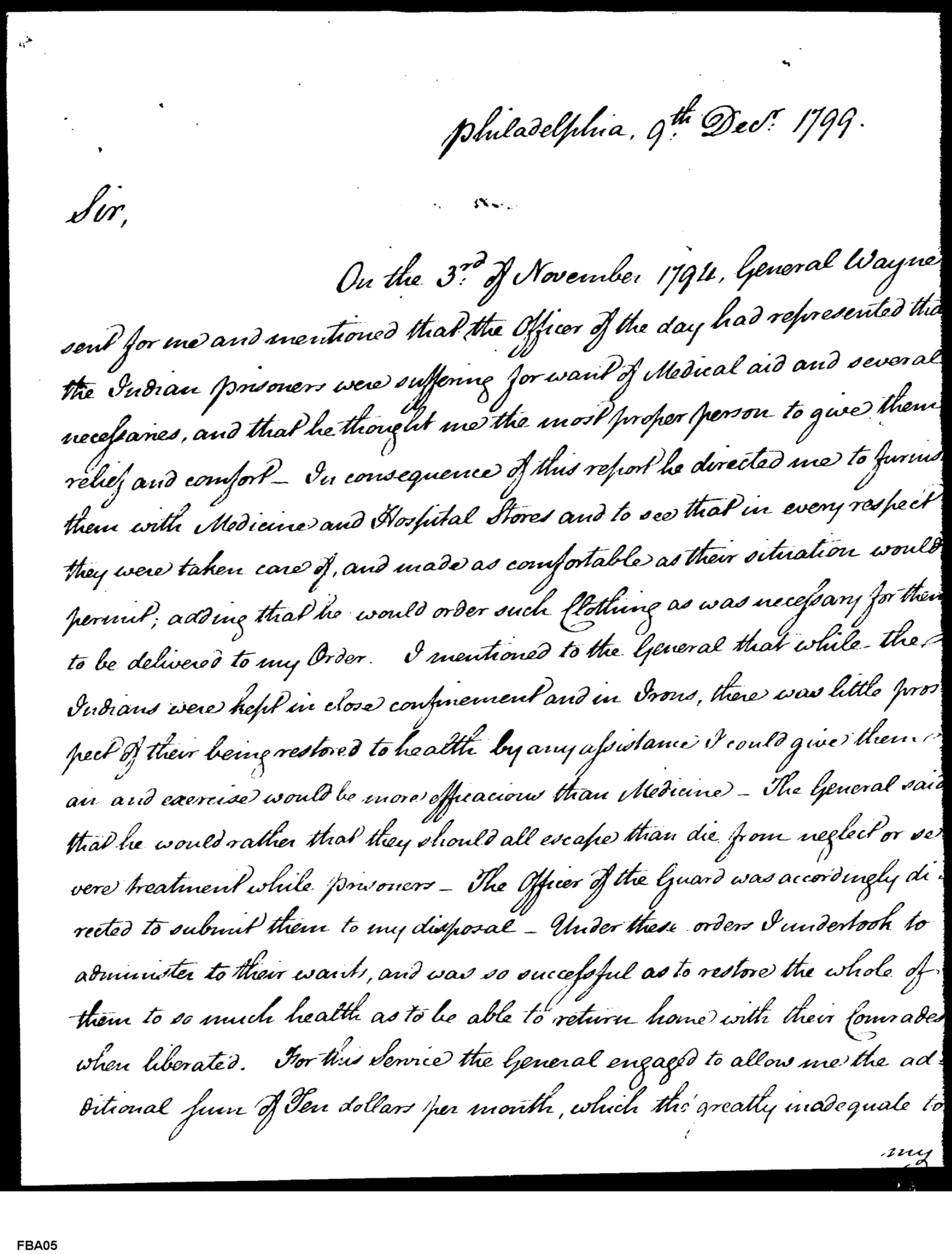
Philadelphia, 9th Dect. 1799.
Sir,
On the 3d of November 1794, General Wayne send for me and mentioned that the Officer of the day had represented that the Indian prisoners were suffering for want of Medical aid and several necessaries, and that he thought me the most proper person to give them relief and comfort. In consequence of this report he directed me to furnish them with Medicine and Hospital Stores and to see that in every respect they were taken care of, and made as comfortable as their situation would permit; adding that he would order such Clothing as was necessary for them to be delivered to my Order. I mentioned to the General that while the Indians were kept in close confinement and in Irons, there was little prospect of their being restored to health by any assistance I could give them, air and exercise would be more efficacious than Medicine. The General said that he would rather that they should all escape than die from neglect or severe treatment while prisoners. The Officer of the Guard was accordingly directed to submit them to my disposal. Under these orders I undertook to administer to their wants, and was so successful as to restore the whole of them to so much health as to be able to return home with their Comrades when liberated. For this Service the General engaged to allow me the additional sum of Ten dollars per month, which tho greatly inadequate to
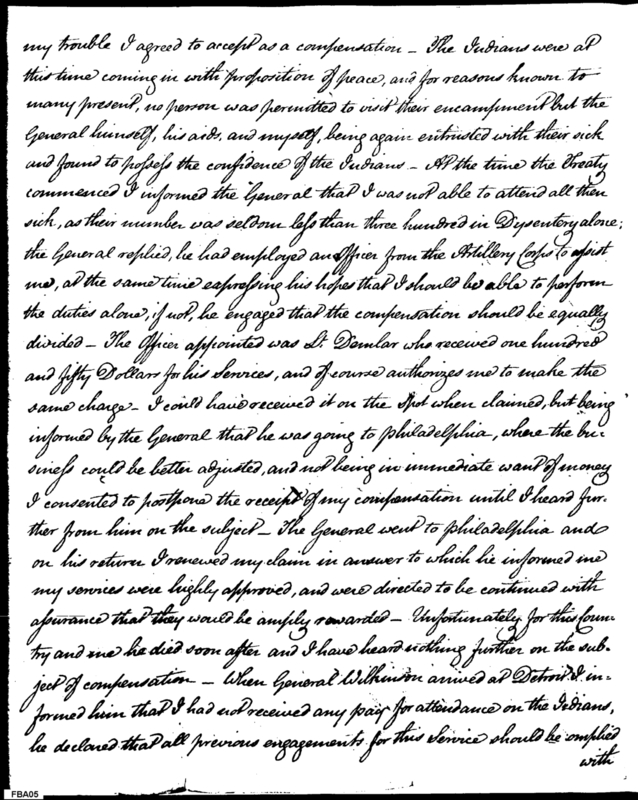
my trouble I agreed to accept as a compensation. The Indians were at this time coming in with proposition of peace, and for reasons known to many present, no person was permitted to visit their encampment but the General himself, his aids, and myself, being again entrusted with their sick and found to possess the confidence of the Indians. At the time the Treaty commenced I informed the General that I was not able to attend all their sick, as their number was seldom less than three hundred in Depending alone; the General replied, he had employed an Officer from the Artillery Corps to assist me, at the same time expressing his hopes that I should be able to perform the duties alone; if not, he engaged that the compensation should be equally divided. The Officer appointed was Lt Dunlap who received one hundred and fifty Dollars for his Services, and of course authorizes me to make the same charge. I could have received it on the Spot when claimed, but being informed by the General that he was going to Philadelphia, where the business could be better adjusted, and not being in immediate want of money I consented to postpone the receipt of my compensation until I heard further from him on the subject. The General went to Philadelphia and on his return I renewed my claim in answer to which he informed me my services were highly approved, and were directed to be continued with assurance that they would be amply rewarded. Unfortunately for this country and me he died soon after and I have heard nothing further on the subject of compensation. When General Wilkinson arrived at Detroit & informed him that I had not received any pay for attendance on the Indians, he declared that all previous engagements for this Service should be complied with,
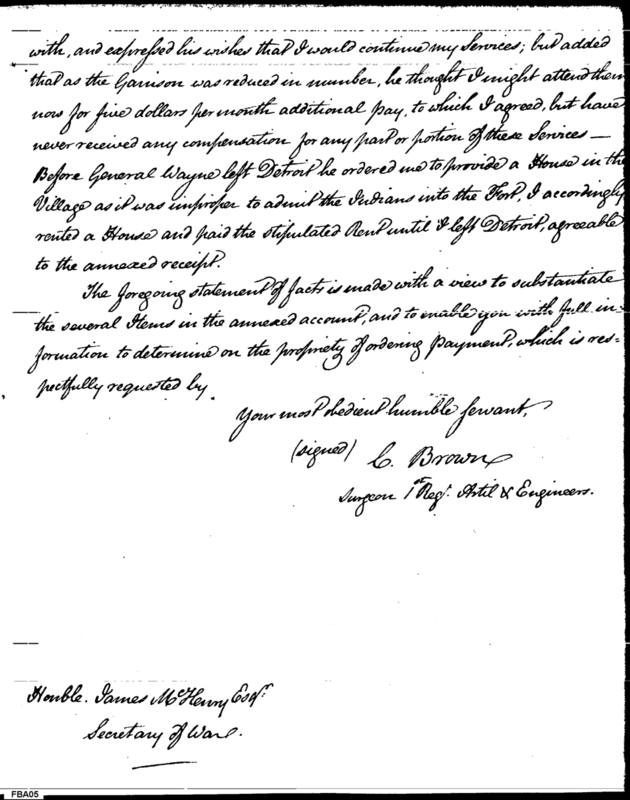
with, and expressed his wishes that I would continue my Services; but added that as the Garrison was reduced in number, he thought I might attend them now for five dollars per month additional pay, to which I agreed, but have never received any compensation for any part or portion of these Services.
Before General Wayne left Detroit he ordered me to provide a House in the Village as it was improper to admit the Indians into the Fort, I accordingly rented a House and paid the stipulated Rent until I left Detroit, agreeable to the annexed receipt.
The foregoing statement of facts is made with a view to substantiate the several Items in the annexed account, and to enable you with full information to determine on the propriety of ordering payment, which is respectfully requested by
Your most Obedient humble Servant,
(signed) C. Brown
Surgeon 1 Regt. Artil & Engineers.
Honble. James McHenry Esqr.
Secretary of War.
Type
Copy of Signed Document
Description
Dr. Charles Brown complains to Secretary McHenry that he was promised compensation for his many services providing medical care for the Indian prisoners, including renting a house for their care, and has yet to be paid.
Date
12/09/1799
Author
Recipient
Sent from
Philadelphia
Collection
Document number
1799120940001
Page start
1
Notable persons
Charles Brown
doctor James McHenry
Anthony Wayne
Indian prisoners
Officer of the Guard
officer from the artillery corps
Lieutenant Demlar
James Wilkinson
surgeon
artillerists
Engineers
Notable locations
Philadelphia
Detroit
Notable items
want of medical aid
relief and comfort
medicine and hospital stores
clothing
irons
health
air and exercise
additional sum of ten dollars per month
service
proposition of peace
encampment
their sick
confidence of the Indians
treaty
dysentary
my claim
want of money
pay for attendance on the Indians
garrison
five dollars per month additional pay
house in the village
fort
stipulated rent
annexed receipt
several items in the annexed account
foregoing statement of facts
propriety of ordering payment
medicine
dysentery