

Hamilton writes to McHenry regarding the establishment of a military academy
Document 1799Alexander Hamilton sends his ideas regarding the founding of a military academy to the Secretary at War, James McHenry.


No human transcription currently available for this document.
This transcription was generated by machine using Anthropic's Claude Code (model sonnet 4.6). It may contain errors or inaccuracies. Please verify against the document image. Learn more about our generative AI methodology.
[New York 23d Novr. 1799
[undecipherable]
Genl. A. Hamilton —
a [undecipherable] to the establishment of
a Military Academy —]
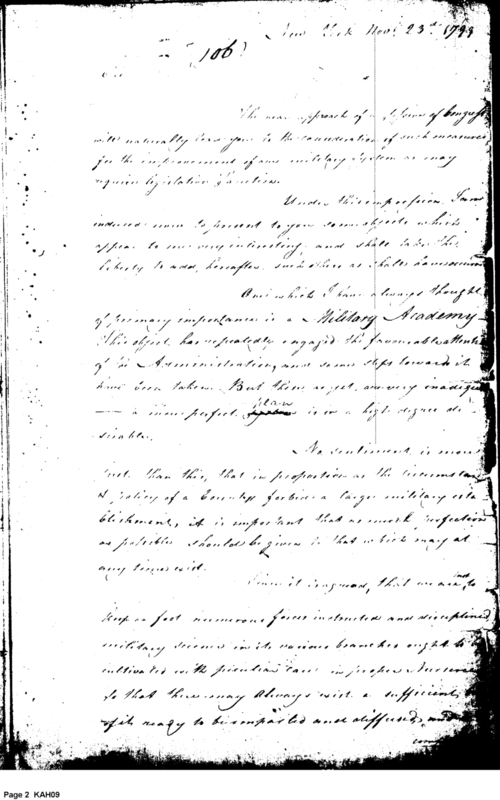
= (106) New York Nov. 23d 1799
Sir
The near approach of a [undecipherable] of Congress
will naturally draw you to the consideration of such measures
for the improvement of our military System as may
require legislative Sanction.
Under this impression I am
induced now to present to you some objects which
appear to me very interesting, and shall take the
liberty to add, hereafter, such others as shall have occasion.
One which I have always thought
of primary importance is a Military Academy.
This object has repeatedly engaged the favourable Attention
of the Administration, and some steps towards it
have been taken. But these as yet, are very inadequate
— a more perfect [strikethrough: plan] is in a high degree de-
sirable.
No sentiment is more
just than this, that in proportion as the [Government?]
& policy of a Country fosters a large military esta-
blishment, it is important that as much perfection
as possible should be given to that which may at
any times exist.
Since it is agreed, that we are to
keep [at?] [undecipherable] numerous forces instructed and disciplined
military Science in its various branches ought to
cultivate with particular care in proper Seminaries
to that there may always exist a sufficient
[undecipherable] of it ready to be imparted and diffused, and
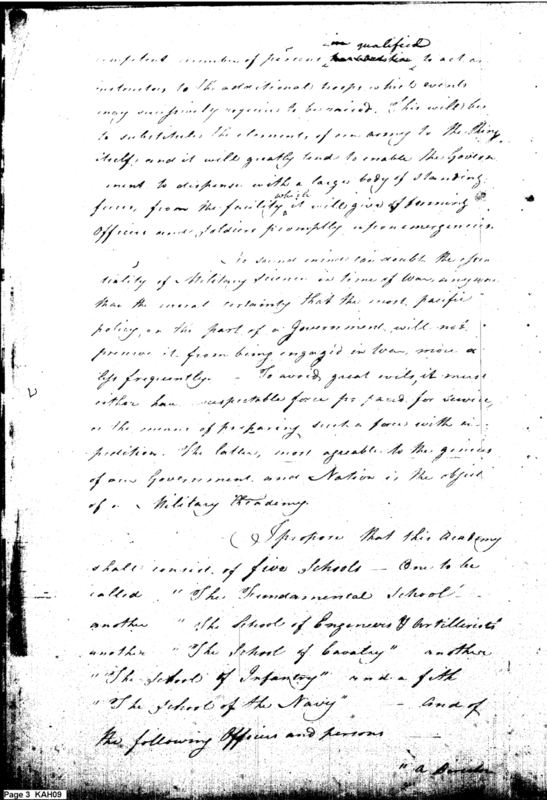
in qualified [undecipherable] [strikethrough: [undecipherable]] number of persons to act as
instructors to the additional troops which events
may constantly require to be raised. This will also be
to substitute the elements of our army to the thing
itself, and it will greatly tend to enable the Govern-
ment to dispense with a large body of Standing
forces, from the facility it will give of forming
Officers and Soldiers promptly upon emergencies.
No sound mind can doubt the appli-
cability of Military Science in time of War, any more
than the moral certainty that the most pacific
policy on the part of a Government will not
preserve it from being engaged in War, more or
less frequently. To avoid great evils, it must
either have respectable force prepared for Service,
or the means of preparing such a force with ex-
pedition. The latter, most agreeable to the genius
of our Government and Nation is the object
of a Military Academy.
(I propose that this Academy
shall consist of five Schools — One to be
called "The Fundamental School" —
another "The School of Engineers & Artillerists"
another "The School of Cavalry" another
"The School of Infantry" and a fifth
"The School of the Navy" — and of
the following Officers and persons —
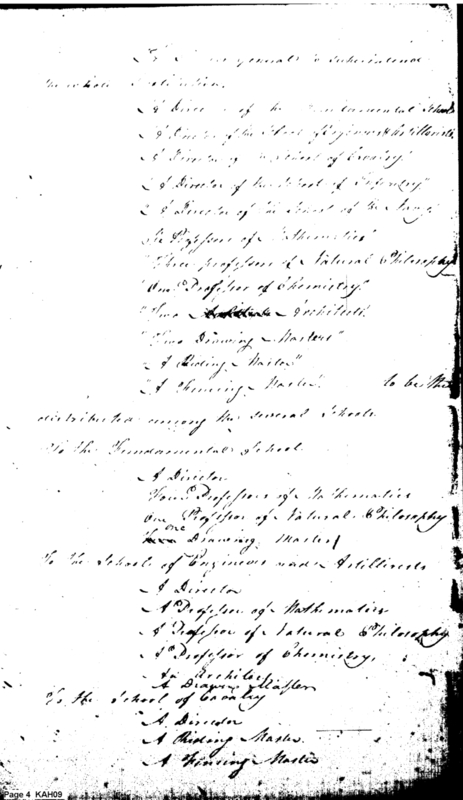
[To act] generally to superintend the whole Institution.
A Director of the Fundamental School
A Director of the School of Engineers & Artillerists
A Director of [the] School of Cavalry
A Director of the School of Infantry
A [Director of the School of the] Navy
[A] Professor of Mathematics
Three Professors of Natural Philosophy
One Professor of Chemistry
Two [strikethrough: [undecipherable]] Architects
Two Drawing Masters
A Riding Master
A Fencing Master to be thus
distributed among the several Schools
To the Fundamental School
A Director
Two Professors of Mathematics
One Professor of Natural Philosophy
[Two] Drawing Master[s]
To the School of Engineers and Artillerists
A Director
A Professor of Mathematics
A Professor of Natural Philosophy
A Professor of Chemistry,
A [Professor] of Architecture
A Drawing Master
To the School of Cavalry
A Director
A Riding Master.
A Fencing Master
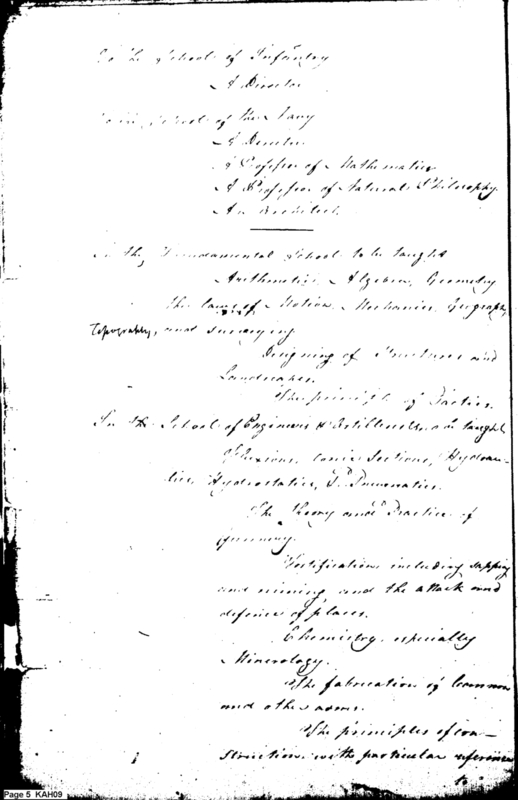
To the School of Infantry
A Director
[To the School of the] Navy
A Director
A Professor of Mathematics
A Professor of Natural Philosophy
An Architect
In the Fundamental School to be taught
Arithmetic Algebra Geometry
The laws of Motion, Mechanics, Geography
Topography, and Surveying
Drawing of Fortresses and
Landscapes.
The principles of Tactics.
In the School of Engineers & Artillerists, to be taught
Fluxions, Conic Sections, Hydro-
aulics, Hydrostatics, & Pneumatics.
The theory and practice of
Gunnery.
Fortification, including sapping
and mining, and the attack and
defence of places.
Chemistry, especially
Mineralogy.
The fabrication of Cannon
and other arms.
The principles of Con-
struction, with the particular reference
to aqueducts, Canals and Bridges.
[undecipherable] [undecipherable] [undecipherable]
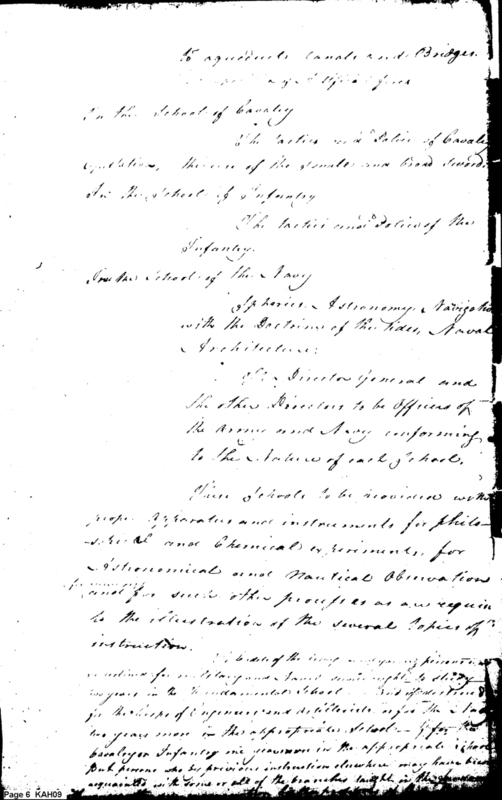
In the School of Cavalry
The tactics and duties of Cavalry.
Castrametation, the use of the Sabre and Broad Sword.
In the School of Infantry
The tactics and duties of the
Infantry.
In the School of the Navy
Spherics, Astronomy, Navigation
with the Doctrines of the Tides, Naval
Architecture.
The Director General and
the other Directors to be Officers of
the Army and Navy conforming
to the Nature of each Schools.
These Schools to be provided with
proper apparatus and instruments for Philo-
sophical and Chemical experiments, for
Astronomical and Nautical Observations
and for such other purposes as are requisite
to the illustration of the several topics of
instruction.
[The time of the young] [undecipherable] [persons] selected from Military and Naval service ought to study
[undecipherable] [years in the Fundamental School] and [undecipherable] for the [School]
of Engineers and Artillerists [undecipherable] for the [School]
[of Cavalry] [undecipherable] years more in the [appropriate School — if for the]
[School of] Infantry [undecipherable] those
[persons who by previous instruction elsewhere may have been]
acquainted with [some or all of the branches taught in this Academy]
be [admitted to] [undecipherable] [immediately commensurate]
[undecipherable] [undecipherable] [undecipherable] [undecipherable] [undecipherable] [undecipherable]
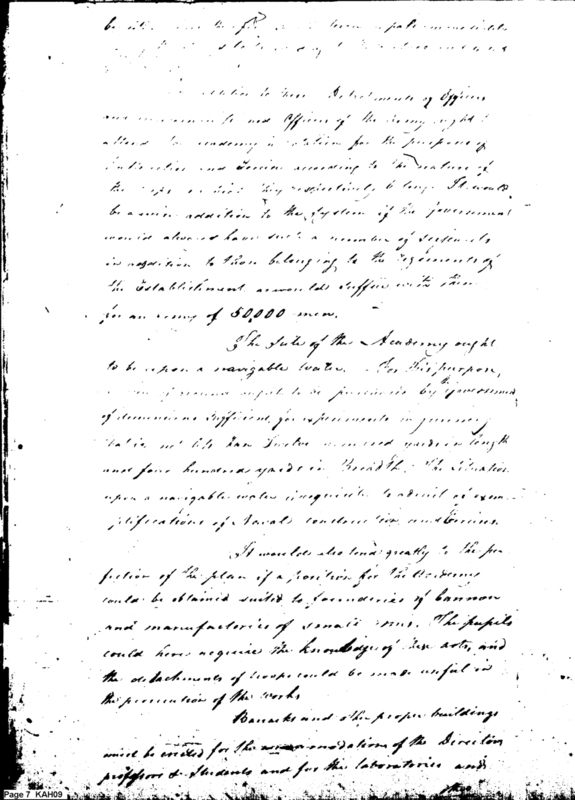
Addition to these, Detachments of Officers
and non-commissioned Officers of the Army ought to
attend in rotation for the purpose of
instruction and Exercise according to the dictates of
the corps in which they respectively belong. It would
be a useful addition to the system of the Government
to annex always [have?] such a number of Detachments
in proportion to those belonging to the Regiments of
the Establishment [undecipherable] accommodated to
[an army of] 50,000 men.
The Site of the Academy ought
to be upon a navigable water. For this purpose,
a [sum] of [ground] ought to be provided by Government
of dimensions sufficient for improvements in general,
taking not less than twelve hundred yards in length
and four hundred yards in breadth. The situation
upon a navigable water is requisite to admit of experiments,
[undecipherable] of Naval constructions and Exercises.
It would also tend greatly to the per-
fection of the plan if a position for the Academy
could be obtained suited to [furnishing?] of [Common]
and manufactories of small Arms. The pupils
could here acquire the knowledge of this Art, and
the detachments of troops could be made useful in
the prosecution of this Works.
Barracks and other proper buildings
must be erected for the accommodations of the Directors,
professors & Students and for the laboratories and
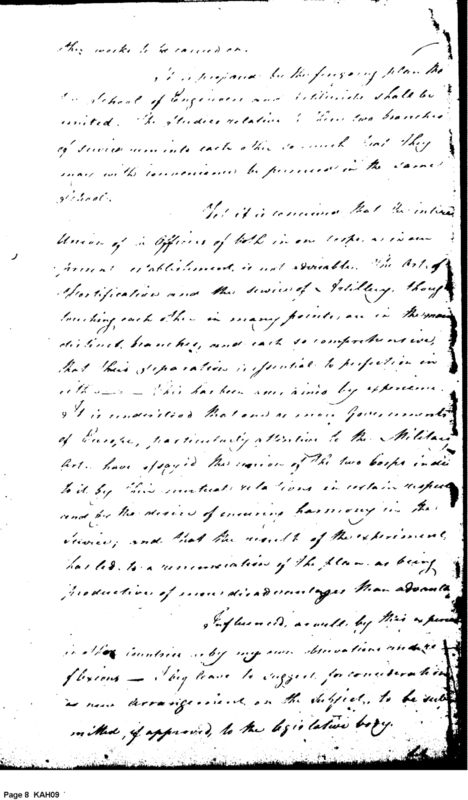
this works to be carried on.
It is proposed in the preparatory plan the
two Schools of Engineers and Artillerists shall be
united. The Studies relative to these two branches
of Service run into each other so much that they
may with convenience be pursued in the same
School.
Yet it is conceived that the intimate
Union of the Officers of both in one corps, as in one
general establishment, is not desirable. The Art of
Fortification and the Science of Artillery, though
touching each other in many points, are in their most
distinct branches, and each so comprehensive
that their separation is essential to perfection in
either — This has been ascertained by experience.
It is understood that all or many Governments
of Europe, particularly attentive to the Military
Art, have adopted this course of the two corps indicating
it by their [undecipherable] relations in certain respects
and by the desire of ensuring harmony in the
Service, and that the result of the experiment
has led to a reconsideration of the plan, as being
productive of more disadvantages than advantages.
Influenced, as well, by this experience
in other countries as by my own observations and
reflections — I beg leave to suggest for consideration
a new arrangement on the subject, to be sub-
mitted, if approved, to the legislative body.
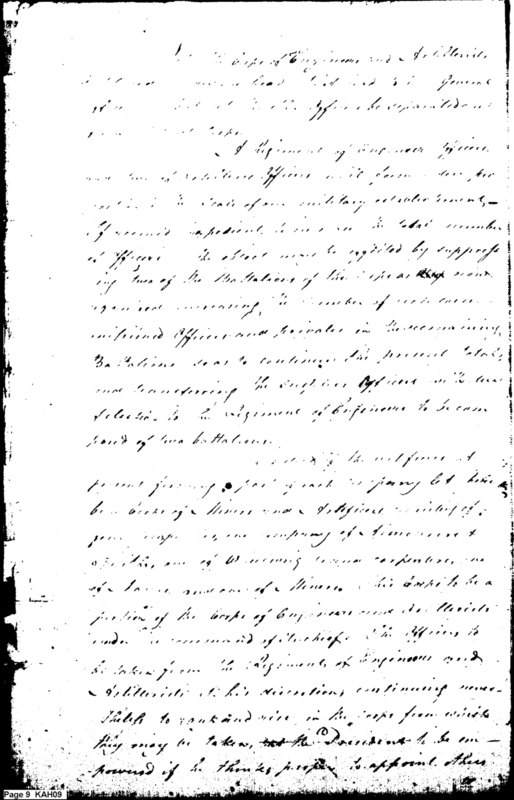
[The School] of Engineers and [Artillerist]s
[undecipherable] [undecipherable] [undecipherable] [undecipherable] [undecipherable]
[undecipherable] [undecipherable] [undecipherable] [undecipherable] [undecipherable] [undecipherable]
[undecipherable] [undecipherable] [undecipherable] [undecipherable] [undecipherable] [undecipherable] [undecipherable]
A Regiment of Engineer Officers,
and one of [Artillery] Officers [to form] two
[separate corps in the general military establishment —]
[undecipherable] [undecipherable] [undecipherable] [undecipherable] [undecipherable]
[undecipherable] [undecipherable] [undecipherable] [undecipherable] [undecipherable]
[undecipherable] [undecipherable] Officers and Privates in the [undecipherable]
[Battalions tends] to continue the [undecipherable] [undecipherable]
and [transmitting?] the Engineer Officers in the two
Selections to the Regiment of Engineers to be composed of two Battalions.
[undecipherable] the Officers to
be [put?] [undecipherable] [undecipherable] [undecipherable] [undecipherable]
be a [undecipherable] of Miners and Artisans [undecipherable]
[undecipherable] [undecipherable] [undecipherable] [undecipherable] [undecipherable] [undecipherable]
of a large number of Miners. This [corps?] to be a
[undecipherable] of the Corps of Engineers and Artillery
under a command of its [undecipherable]. The Officers to
be taken from the Regiment of Engineers and
Artillery at its directions continuing [undecipherable]
[undecipherable] to rank and rise in the Corps from which
they may be taken, and the President to be em-
powered if he thinks proper, to appoint them
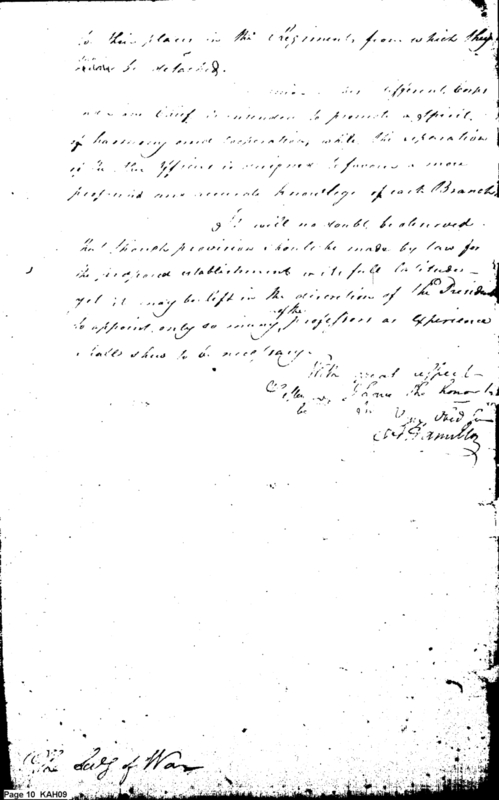
to their places in the Regiments from which they
[are] now to be detached.
[undecipherable] these different corps
[undecipherable] chief [incentives?] to promote a spirit
of harmony and cooperation, while the separation
of the Officers is designed to procure a more
profound and accurate knowledge of each Branch.
It will no doubt be allowed
that liberal provision should be made by law for
the proposed establishment, [undecipherable] [undecipherable] —
yet it may be left in the direction of the [President]
to appoint only so many professors as experience
shall shew to be necessary.
With great respect —
Col McHenry — I have the honor to be
[undecipherable] friend —
A. Hamilton
[The Secy of War]
Type
Autograph Letter Signed
Description
Alexander Hamilton sends his ideas regarding the founding of a military academy to the Secretary at War, James McHenry.
Date
11/23/1799
Author
Recipient
Sent from
New York
Repository
Collection
Document number
1799112340001
Page start
1
Notable persons
James McHenry
Alexander Hamilton
Notable locations
New York