

Army Supplies, Quarters, and Pay
Document 1799Routine instructions and correspondence concerning Army supplies, quarters, and pay.
No human transcription currently available for this document.
This transcription was generated by machine using Anthropic's Claude Code (model sonnet 4.6). It may contain errors or inaccuracies. Please verify against the document image. Learn more about our generative AI methodology.
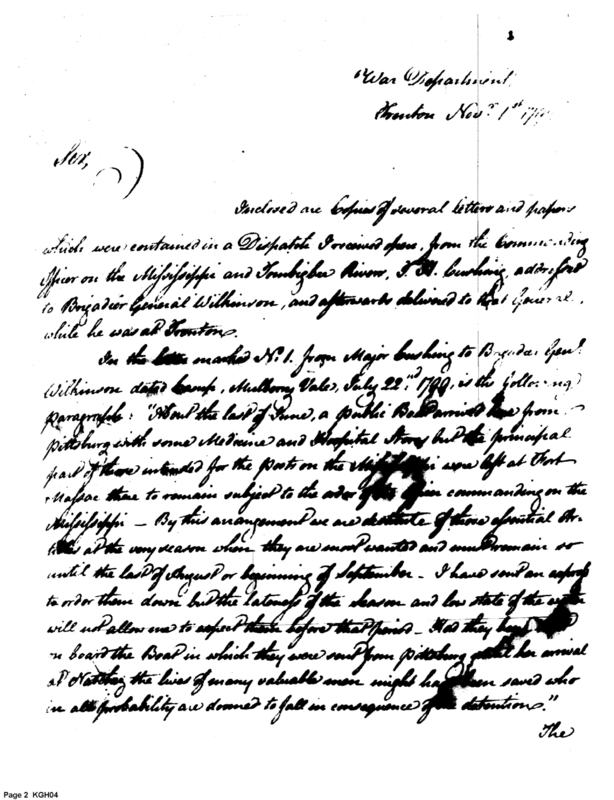
War Department
Trenton Nov.r 1st 179[9]
Sir,
Enclosed are Copies of several letters and papers which were contained in a Dispatch I received [here?], from the Commanding Officer on the Mississippi and Tombigbee Rivers, [undecipherable] Cushing, addressed to Brigadier General Wilkinson, and afterwards delivered to that General, while he was at Trenton.
In the letter marked N.o 1. from Major Cushing to Brigadier Gen.l Wilkinson dated Camp, [Shelbourn?] Vale, July 22.nd 1799, is the following paragraph: "About the last of June, a public Boat arrived here from Pittsburg with some Medicine and Hospital Stores but the principal part of those intended for the posts on the Mississippi were left at Fort Massac there to remain subject to the order of the officer commanding on the Mississippi — By this arrangement we are destitute of those essential Articles at the very season when they are most wanted and must remain so until the last of August or beginning of September — I have sent an express to order them down but the lateness of the season and low state of the river will not allow me to expect them before that period — Had they been on board the Boat in which they were sent from Pittsburg until her arrival at Natchez, the lives of many valuable men might have been saved who in all probability are doomed to fall in consequence of the detentions."
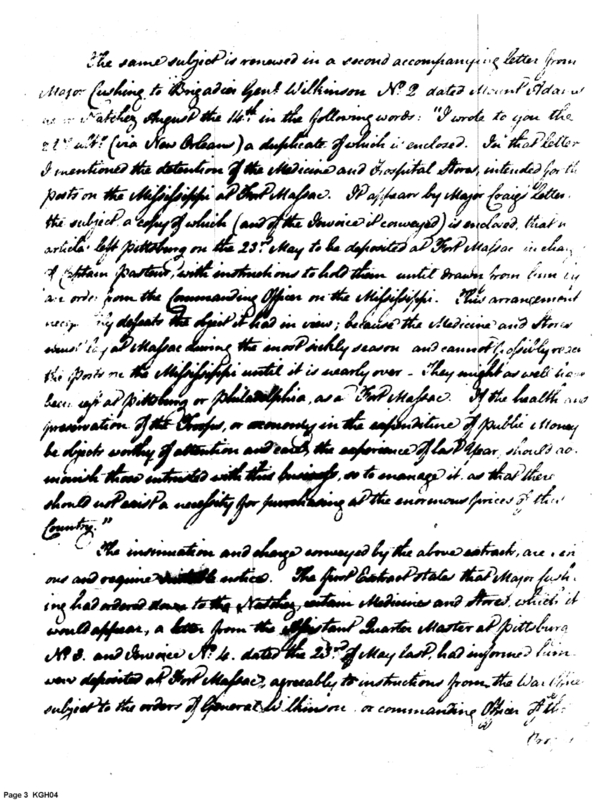
The same subject is renewed in a second accompanying letter from Major Cushing to Brigadier Gen.t Wilkinson N.o 2 dated [at] Mount Adams [near?] Natchez August the 14th in the following words: "I wrote to you the 21st ult.o (via New Orleans) a duplicate of which is enclosed. In that letter I mentioned the detention of the Medicine and Hospital Stores, intended for the posts on the Mississippi at Fort Massac. It appears by Major Craig's Letter the subject a copy of which (and of the Invoice it conveyed) is enclosed, that the articles left Pittsburg on the 23.d May to be deposited at Fort Massac in charge of Captain Pasteur, with instructions to hold them until drawn from him by an order from the Commanding Officer on the Mississippi. This arrangement necessarily defeats the object it had in view; because the Medicine and Stores were left at Massac during the most sickly season and cannot [undecipherable] reach the posts on the Mississippi until it is nearly over — They might as well have been kept at Pittsburg or Philadelphia, as at Fort Massac. If the health and preservation of the Troops, or economy in the expenditure of public Money be objects worthy of attention and care, the experience of last year, should admonish those entrusted with this business, so to manage it as that there should not exist a necessity for purchasing at the enormous prices of this Country."
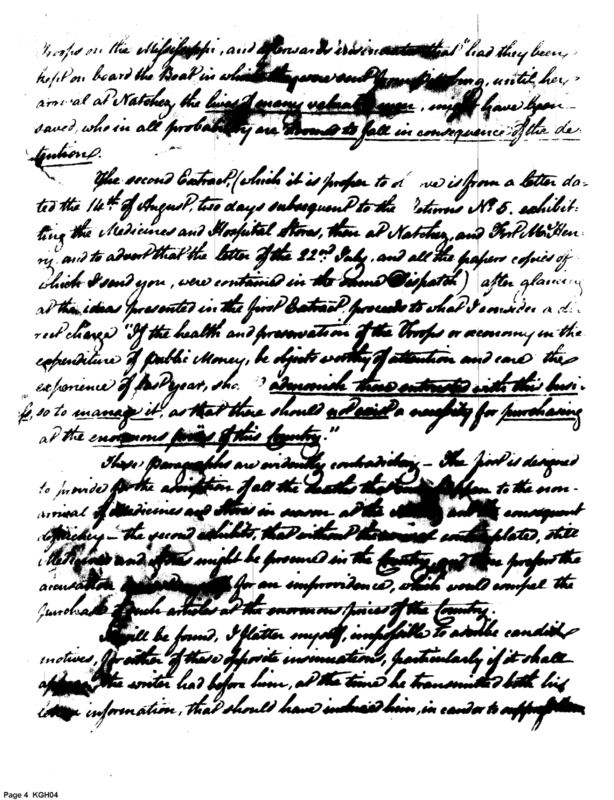
The insinuation and charge conveyed by the above extract, are serious and require [undecipherable] notice. The first Extract states that Major Cushing had ordered down to the Natchez, certain Medicines and Stores, which it would appear, a letter from the Assistant Quarter Master at Pittsburg N.o 3. and Invoice N.o 4. dated the 23.d of May last, had informed him were deposited at Fort Massac, agreeably to instructions from the War [Office] subject to the orders of General Wilkinson or commanding Officer of the troops on the Mississippi, and forwards [undecipherable] that "had they been kept on board the Boat in which they were sent from Pittsburg, until her arrival at Natchez, the lives of many valuable men, might have been saved, who in all probability are doomed to fall in consequence of the detentions.
The second Extract (which it is proper to observe) is from a letter dated the 14th of August, two days subsequent to the Returns N.o 5. exhibiting the Medicines and Hospital Stores, then at Natchez, and Fort McHenry, and to advert that the letter of the 22.d July, and all the papers copies of which I send you, were contained in the same Dispatch) after glancing at the ideas presented in the first Extract, proceeds to what I consider a direct charge "If the health and preservation of the Troops or economy in the expenditure of public Money, be objects worthy of attention and care the experience of last year, [undecipherable] admonish those entrusted with this business, so to manage it, as that there should not exist a necessity for purchasing at the enormous prices of this Country."
These paragraphs are evidently contradictory — The first is designed to provide for the admission of all the deaths that [undecipherable] to the non-arrival of Medicines and Stores in season at this [undecipherable] and the consequent deficiency — the second exhibits, that without the arrival contemplated, still Medicines and Stores might be procured in the [undecipherable] and thus prefers the accusation [undecipherable] for an improvidence, which would compel the purchase of such articles at the enormous prices of this Country.
It will be found, I flatter myself, impossible to ascribe candid motives, [to] either of these opposite insinuations, particularly if it shall appear the writer had before him, at the time he transmitted both his letters information, that should have induced him, in candor to suppress [undecipherable]
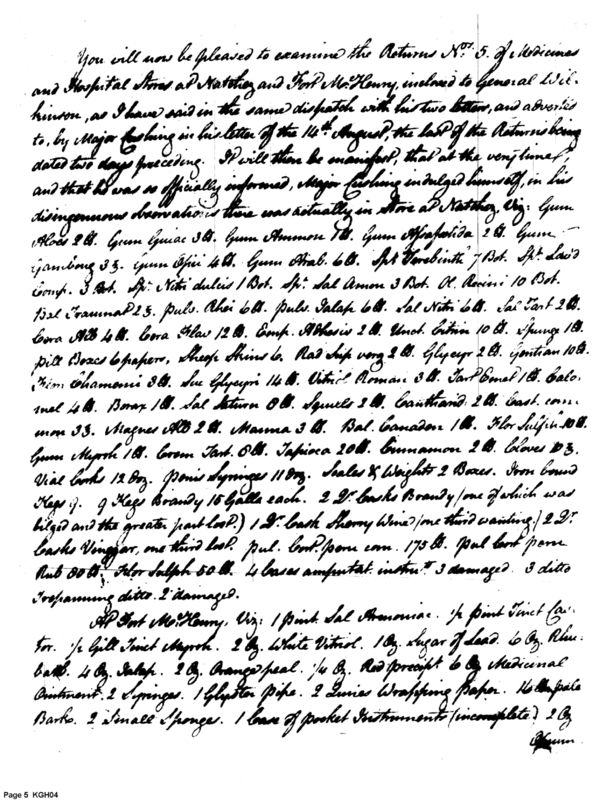
You will now be pleased to examine the Returns N.os 5. of Medicines and Hospital Stores at Natchez and Fort M.cHenry, enclosed to General Wilkinson, as I have said in the same dispatch with his two letters, and adverted to, by Major Cushing in his letter of the 14th August, the last of the Returns being dated two days preceding. It will then be manifest, that at the very time, and that he was so officially informed, Major Cushing indulged himself, in his disingenuous observations there was actually in Store at Natchez, Viz: Gum Aloes 2 lb. Gum Guiac 3 lb. Gum Ammon 1 lb. Gum Assafoetida 2 lb. Gum Gamboge 3 Z. Gum Opii 4 lb. Gum Arab. 6 lb. Spt Terebinthi 7 Bot. Spt. Lav.d Comp. 3 Bot. Spt. Nitri dulcis 1 Bot. Spt. Sal Amon 3 Bot. O. Ricini 10 Bot. Bal Traumat 2 Z. Pulv. Rhei 6 lb. Pulv. Jalapae 6 lb. Sal Nitri 6 lb. Sal Tart 2 lb. Cera AB 4 lb. Cera Flav 12 lb. Comp. Athesis 2 lb. Unct. Citrin 10 lb. Sponge 1 lb. pill Boxes 6 papers. Sheep Skins 6. Red Ship verg 2 lb. Glycyrp 2 lb. Gentian 10 lb. Fl.m Chamomili 3 lb. Suc Glycyrri 14 lb. Vitriol Roman 3 lb. Tart Emet 1 lb. Calomael 4 lb. Borax 1 lb. Sal Saturn 8 lb. Squills 2 lb. Cantharid. 2 lb. Cast. commune 3 Z. Magnes Alb 2 lb. Manna 3 lb. Bal Canad.on 1 lb. Flor Sulfis 10 lb. Gum Myrrh 1 lb. Cream Tart. 6 lb. Tapioca 20 lb. Cinnamon 2 lb. Cloves 10 Z. Vial Corks 12 Doz. Penis Syringes 11 Doz. Scales & Weights 2 Boxes. Iron bound Kegs 9. 9 Kegs Brandy 15 Galls each. 2 D.r Casks Brandy (one of which was bilged and the greater part lost.) 1 D.r Cask Sherry Wine (one third wanting.) 2 D.r Casks Vinegar, one third lost. Pul. Cont. Spom con. 175 lb. Pul Cont Spom Rub 80 lb. Flor Sulph 50 lb. 4 Cases amputat. Instrum.ts 3 damaged. 3 ditto Trepanning ditto. 2 damaged.
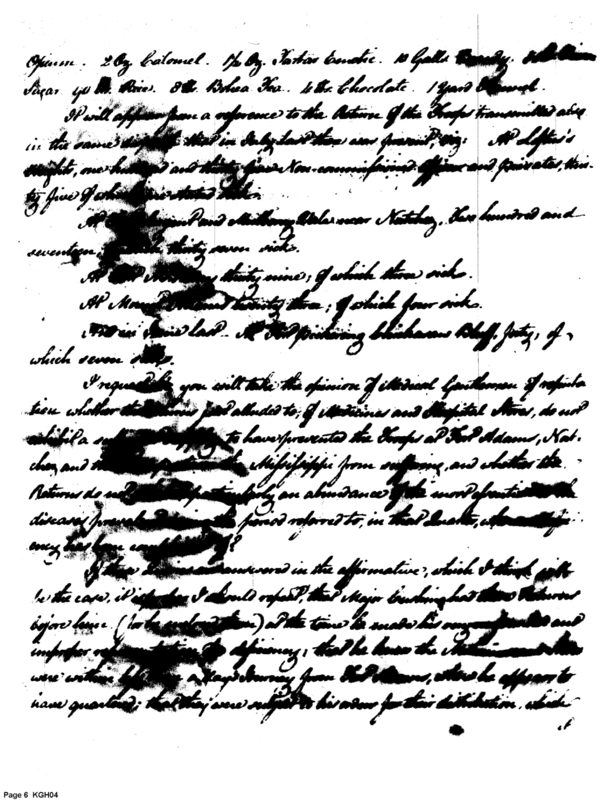
At Fort M.cHenry, Viz: 1 Pint Sal Ammoniac. ½ Pint Tinct [undecipherable]. ½ Gill Tinct Myrrh. 2 Oz. White Vitriol. 1 Oz. Sugar of Lead. 6 Oz. Rhubarb. 4 Oz. Jalap. 2 Oz. Orange peal. ¼ Oz. Red [undecipherable] 6 Oz. Medicinal Ointment. 2 Syringes. 1 Glister Pipe. 2 Quires Wrapping Paper. [undecipherable] Peruvian Barks. 2 Small Sponges. 1 Case of pocket Instruments (incomplete.) 2 Oz Alum
Opium. 2 Oz. Calomel. 1½ Oz. Tartar Emetic. 10 Galls Brandy. [undecipherable] Sugar [undecipherable] lb. Rice. 8 lb. Bohea Tea. 4 lb. Chocolate. 1 Yard [undecipherable].
It will appear from a reference to the Return of the Troops transmitted also in the same dispatch, that in July last there was present, Viz: [undecipherable], one hundred and thirty five Non-commissioned officers and privates, thirty five of whom were stated Sick.
At [undecipherable] and Artillery [undecipherable] near Natchez, Two hundred and seventeen and [undecipherable] thirty seven sick.
At [undecipherable] thirty nine; of which three sick.
At Mount [undecipherable] twenty three; of which four sick.
[undecipherable] — at [undecipherable] [undecipherable] [undecipherable], of which seven sick.
I request you will take the opinion of several Gentlemen of reputation whether the [undecipherable] just alluded to; of Medicines and Hospital Stores, do not exhibit a sufficiency to have prevented the Troops at Fort Adams, Natchez, and the posts on the Mississippi from suffering, and whether the Returns do not [undecipherable] an abundance of the most essential [undecipherable] diseases prevalent in the period referred to, in that quarter, [undecipherable].
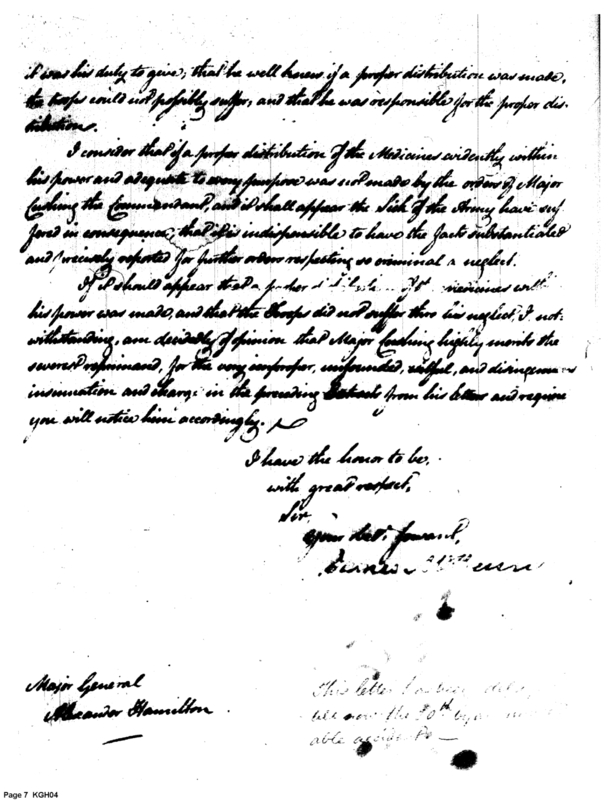
If these [undecipherable] are answered in the affirmative, which I think [undecipherable] be the case, it will then I should remark, that Major Cushing had these Returns before him (to be understood) at the time he made his [undecipherable] and improper [undecipherable] deficiency; that he knew the [undecipherable] were [undecipherable] days drawing from Fort Adams, where he appears to have quartered; that they were subject to his order for their distribution, which it was his duty to give; that he well knows if a proper distribution was made, the troops could not possibly suffer, and that he was responsible for the proper distribution.
I consider that if a proper distribution of the Medicines evidently within his power and adequate to every purpose was not made by the orders of Major Cushing the Commandant, and it shall appear the Sick of the Army have suffered in consequence; that it is indispensable to have the facts substantiated and officially reported for further orders respecting so criminal a neglect.
If it should appear that a proper distribution of the medicines within his power was made, and that the troops did not suffer thro' his neglect, I, notwithstanding, am decidedly of opinion that Major Cushing highly merits the severest reprimand, for the very improper, unfounded, wilful, and disingenuous insinuation and charge in the preceding Extracts from his letters and require you will notice him accordingly.
I have the honor to be,
with great respect,
Sir,
your Obt. Servant,
[undecipherable: James McHenry?]
Major General
Alexander Hamilton
[This letter having been [undecipherable] till now the 30th by [undecipherable] able [undecipherable] fo—]
Type
Letter Signed
Description
Routine instructions and correspondence concerning Army supplies, quarters, and pay.
Date
11/01/1799
Author
Recipient
Sent from
War Department
Repository
Collection
Document number
1799110100201
Page start
1
Note
Syrett listed this document in the Appendix to Vol. 24.
Notable persons
Alexander Hamilton
James McHenry
Notable locations
War Department