

Discusses State, Congressional, and Presidential Powers in Calling Invasion
Document 1799Refers to Constitutional article about Congressional approval for invasion. Mentions Presidential power. Discussion of law in Indian nations. Seeks private opinion.

No human transcription currently available for this document.
This transcription was generated by machine using Anthropic's Claude Code (model sonnet 4.6). It may contain errors or inaccuracies. Please verify against the document image. Learn more about our generative AI methodology.
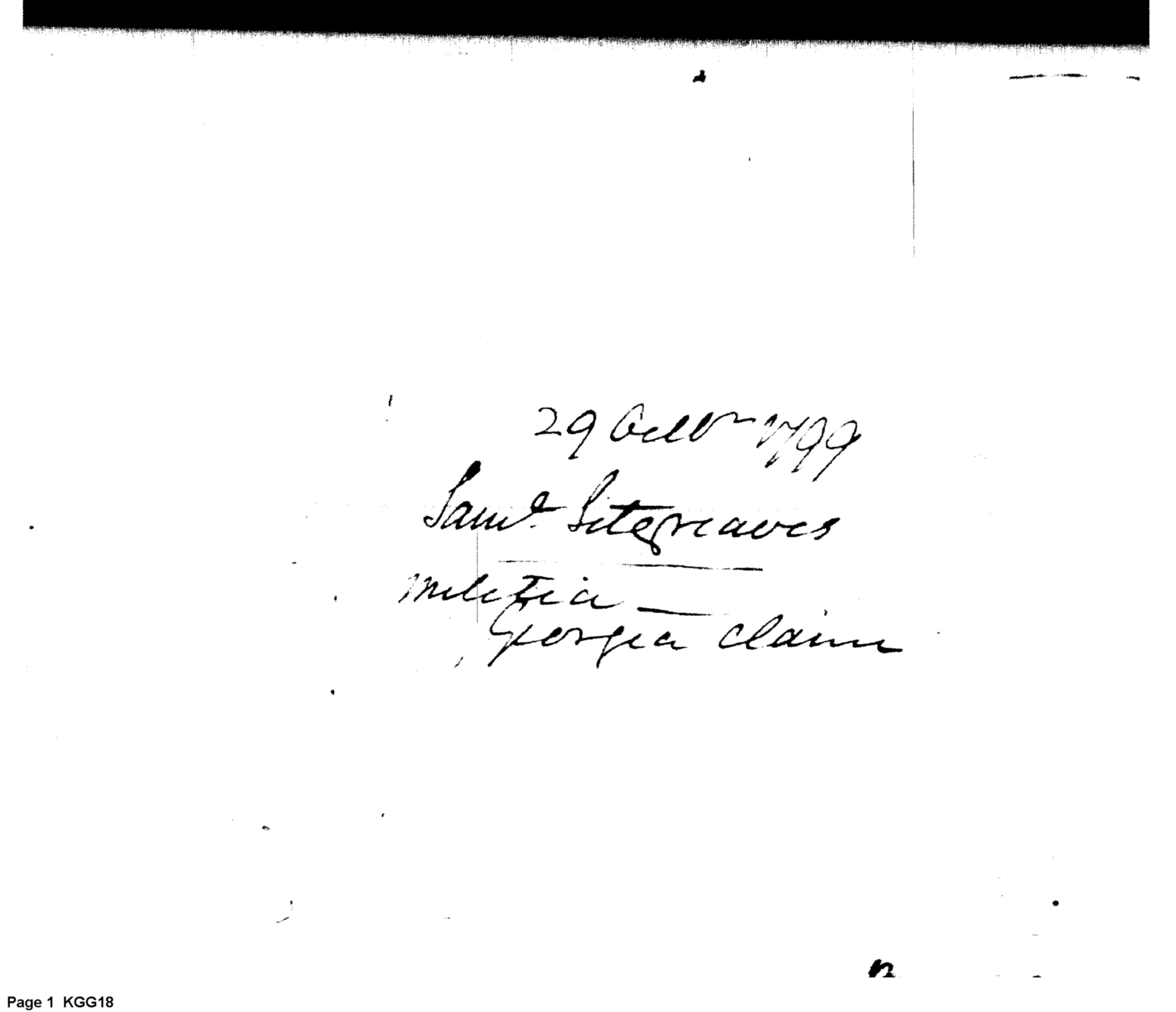
[29 Octr 1799
Samd Sitgreaves
militia
Georgia claim]
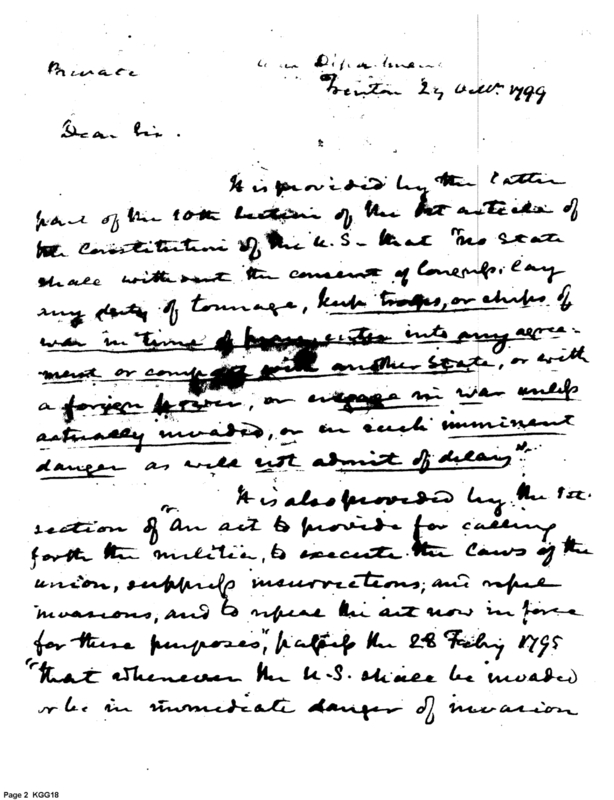
[Private] War Dept
Trenton 29 Oct. 1799
Dear Sir.
It is provided by the latter part of the 10th Section of the last article of the Constitution of the U.S. - that "No State shall without the consent of Congress, lay any duty of tonnage, keep [underline: troops], or [underline: ships] of war in time of [underline: peace], enter into any agreement or [underline: compact] with another State, or with a [underline: foreign power], or [underline: engage in war] unless [underline: actually invaded], or in such [underline: imminent danger] as will not admit of delay."
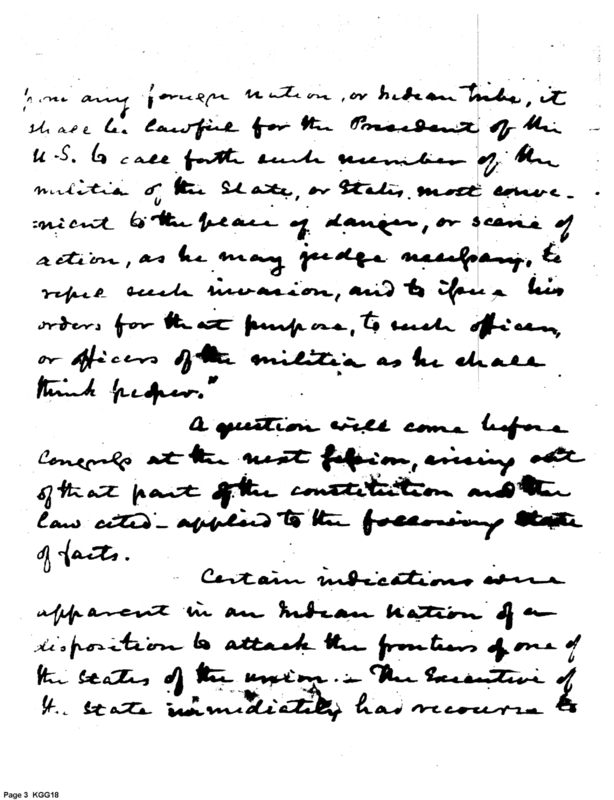
It is also provided by the 1st. section of An act to provide for calling forth the militia, to execute the laws of the union, suppress insurrections, and repel invasions, and to repeal the act now in force for these purposes, passed the 28 Feby 1795 "that whenever the U.S. shall be invaded or be in immediate danger of invasion from any foreign nation, or Indian Tribes, it shall be lawful for the President of the U.S. to call forth such number of the militia of the State, or States, most convenient to the place of danger, or scene of action, as he may judge necessary, to repel such invasion, and to issue his orders for that purpose, to such officers, or officers of the militia as he shall think proper."
A question will come before Congress at the next Session, arising out of that part of the constitution and the law cited - applied to the following State of facts.
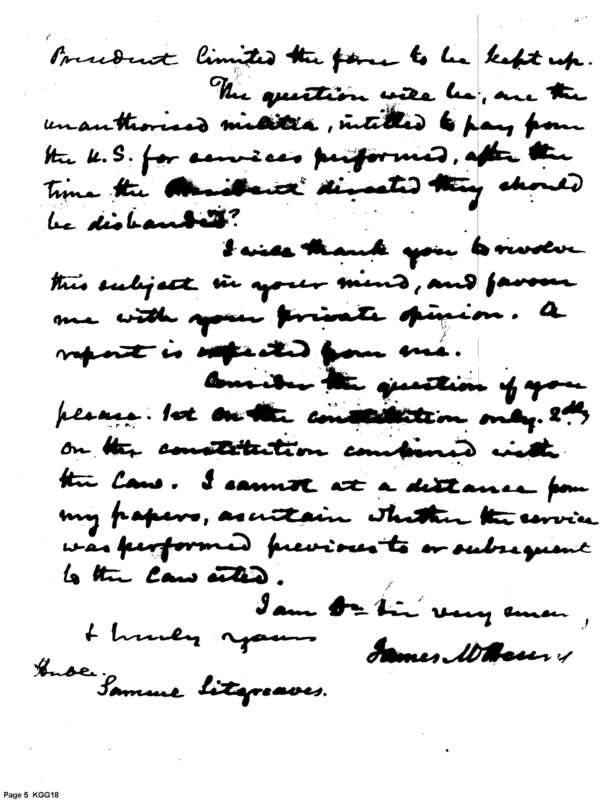
Certain indications were apparent in an Indian Nation of a disposition to attack the frontiers of one of the States of the union. - The Executive of the State immediately has recourse to calling out a large body of the militia and contemplated, as a measure of defence, the attack of the Indians in their own country. This attack was peremptorily forbidden, by orders of the President, and from circumstances which had come to his knowledge, he also thought proper to order a limitation of the force of the militia to be kept up, to a certain number, announcing that all beyond that number could not be paid by the U.S. The Executive of the State notwithstanding, kept in the field the whole number of militia. That part of the force which was authorised by the President to be kept up, and the whole called into service, 'till the time, their number was restricted, has been paid for their services. - The extra force remain unpaid from the time the President limited the force to be kept up.
The question will be, are the unauthorised militia, intitled to pay from the U.S. for services performed, after the time the President directed they should be disbanded?
I will thank you to revolve this subject in your mind, and favour me with your private opinion. A report is expected from me.
Consider the question if you please. 1st On the constitution only. 2dly on the constitution combined with the Laws. I cannot at a distance from my papers, ascertain whether the service was performed previous to or subsequent to the Law cited.
I am Dr Sir very sincer,
& truely yours
James McHenry
[undecipherable]
Samuel Sitgreaves.
Type
Autograph Letter Signed
Description
Refers to Constitutional article about Congressional approval for invasion. Mentions Presidential power. Discussion of law in Indian nations. Seeks private opinion.
Date
10/29/1799
Author
Recipient
Sent from
War Department, Trenton
Repository
Collection
Document number
1799102900001
Page start
1
Note
Private. Cited in Sulgreaves to McHenry, 11/10/1799.
Notable persons
Samuel Sitgreaves
James McHenry
John Adams
Indians
Notable locations
War Department, Trenton
Indian Nation