

Request for Ruling on Pay
Document 1799Discussion, with exceprts from letters between McHenry and Hamilton, of whether to compensate members of the military who serve on courts martial as judge advocates, and if so what expenses to allow. Other topics related to various instances of compensation follow, largely addressing claims and accounts which Simmons has rejected.


No human transcription currently available for this document.
This transcription was generated by machine using Anthropic's Claude Code (model sonnet 4.6). It may contain errors or inaccuracies. Please verify against the document image. Learn more about our generative AI methodology.
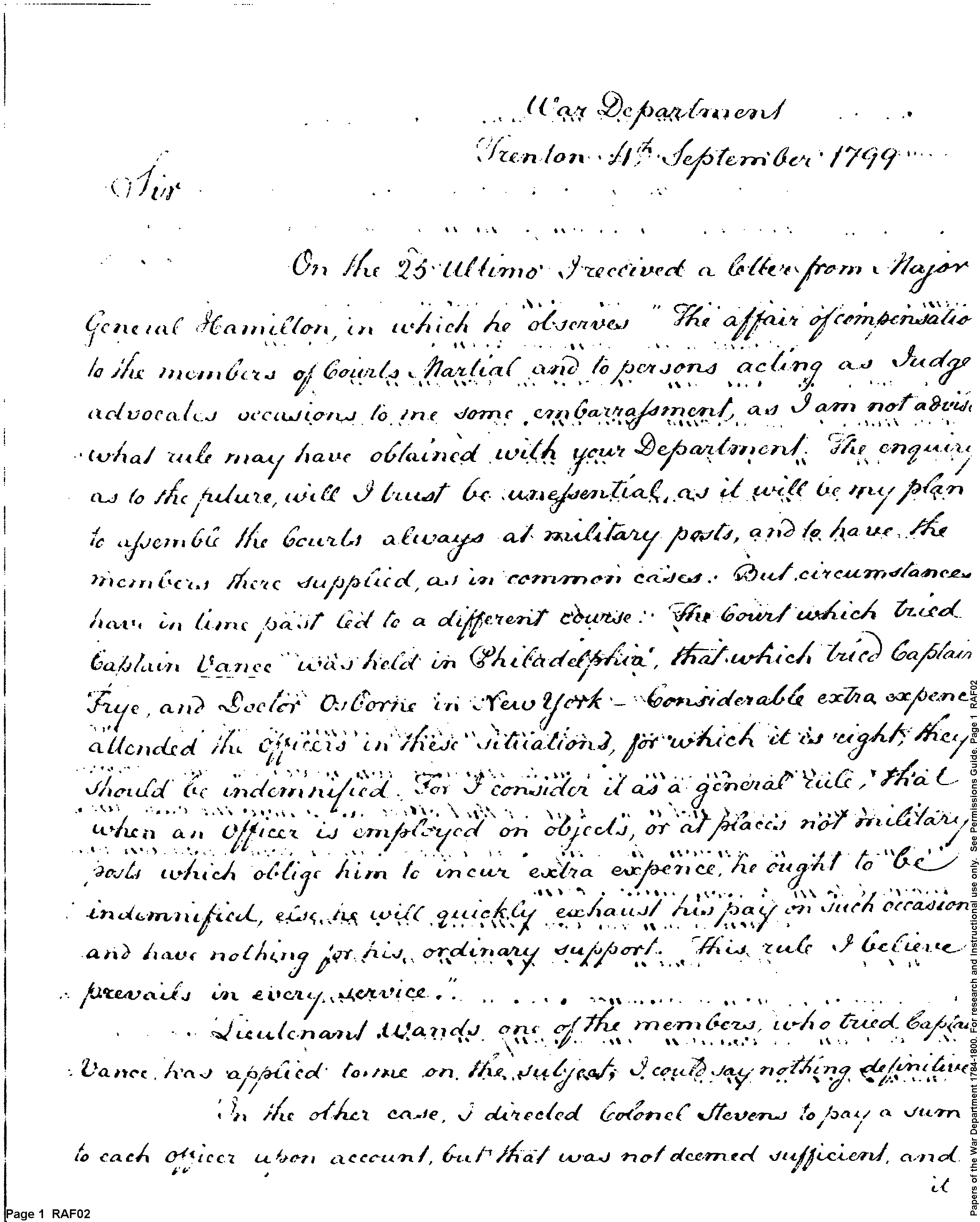
War Department
Trenton 11th September 1799
Sir
On the 23 Ultimo I received a letter from Major General Hamilton, in which he observes "The affair of compensatio to the members of Courts Martial and to persons acting as Judge advocates occasions to me some embarrassment, as I am not advis what rule may have obtained with your Department. The enquiry as to the future, will I trust be unessential, as it will be my plan to assemble the courts always at military posts, and to have the members there supplied, as in common cases. But circumstances have in time past led to a different course. The Court which tried Captain Vance was held in Philadelphia, that which tried Captain Frye, and Doctor Osborne in New York. Considerable extra expence attended the officers in these situations, for which it is right they should be indemnified. For I consider it as a general rule, that when an Officer is employed on objects, or at places not military, calls which oblige him to incur extra expence, he ought to be indemnified, else he will quickly exhaust his pay on such occasions and have nothing for his ordinary support. This rule I believe prevails in every service."
Lieutenant Wands one of the members who tried Captain Vance, has applied to me on the subject; I could say nothing definitive.
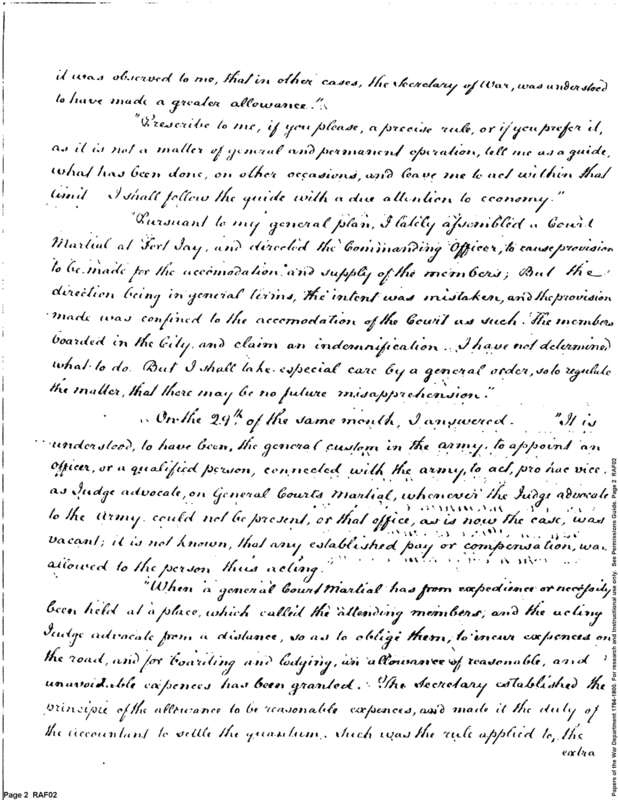
In the other case, I directed Colonel Stevens to pay a sum to each officer upon account, but that was not deemed sufficient, and it was observed to me, that in other cases, the Secretary of War, was understood to have made a greater allowance."
"Prescribe to me, if you please, a precise rule, or if you prefer it, as it is not a matter of general and permanent operation, tell me as a guide, what has been done, on other occasions, and leave me to act within that limit. I shall follow the guide with a due attention to economy."
"Pursuant to my general plan, I lately assembled a Court Martial at Fort Jay, and directed the Commanding Officer, to cause provision to be made for the accomodation and supply of the members; But the direction being in general terms, the intent was mistaken, and the provision made was confined to the accomodation of the Court as such. The members boarded in the City, and claim an indemnification. I have not determined what to do. But I shall take especial care by a general order, so to regulate the matter, that there may be no future misapprehension."
On the 29th of the same month, I answered. "It is understood, to have been, the general custom in the army, to appoint an Officer, or a qualified person, connected with the army, to act, pro hac vice, as Judge advocate, on General Courts Martial, whenever the Judge advocate to the army could not be present, or that office, as is now the case, was vacant; it is not known, that any established pay or compensation, was allowed to the person thus acting.
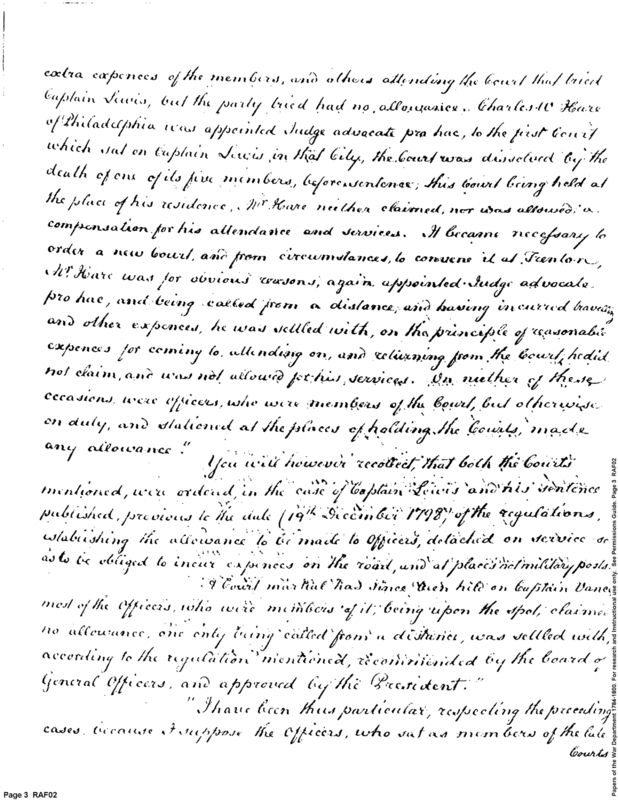
"When a general Court Martial has from expedience or necessity, been held at a place, which called the attending members, and the acting Judge advocate from a distance, so as to oblige them, to incur expences on the road, and for boarding and lodging, an allowance of reasonable, and unavoidable expences has been granted. The Secretary established the principle of the allowance to be reasonable expences, and made it the duty of the accountant to settle the quantum. Such was the rule applied to, the extra expences of the members, and others attending the court that tried Captain Lewis, but the party tried had no allowance. Charles W. Hare of Philadelphia was appointed Judge advocate pro hac, to the first Court which sat on Captain Lewis, in that City, the Court was dissolved by the death of one of its five members, before sentence; this Court being held at the place of his residence, Mr Hare neither claimed, nor was allowed, a compensation for his attendance and services. It became necessary to order a new court, and from circumstances, to convene it at Trenton. Mr Hare was for obvious reasons, again appointed Judge advocate pro hac, and being called from a distance, and having incurred travelg and other expences, he was settled with, on the principle of reasonable expences for coming to, attending on, and returning from the Court; he did not claim, and was not allowed for his services. On neither of these occasions were officers, who were members of the Court, but otherwise on duty, and stationed at the places of holding the Courts, made any allowance."
You will however recollect, that both the Courts mentioned, were ordered, in the case of Captain Lewis, and his sentence published, previous to the date (19th December 1798) of the regulations, establishing the allowance to Officers, detached on service so as to be obliged to incur expences on the road, and at places not military posts.
A Court martial had since been held on Captain Vance; most of the Officers, who were members of it, being upon the spot, claimed no allowance; one only being called from a distance, was settled with, according to the regulation mentioned, recommended by the Board of General Officers, and approved by the President.
"I have been thus particular, respecting the preceeding cases, because I suppose the Officers, who sat as members of the late Courts, ordered by you to convene at New York, think the allowance to the members, &c on Captain Lewis's trial at Trenton, should be a precedent for all future cases, and do not advert to the regulations of December 1798 The latter however preclude the idea of precedent, and supercede the former rule of reasonable expences, by expressing with precision what shall be the allowance."
"If Lieutenant Wands was a member of the Court which tried Captain Vance, and is entitled under the regulations, to an allowance, he will be settled with accordingly."
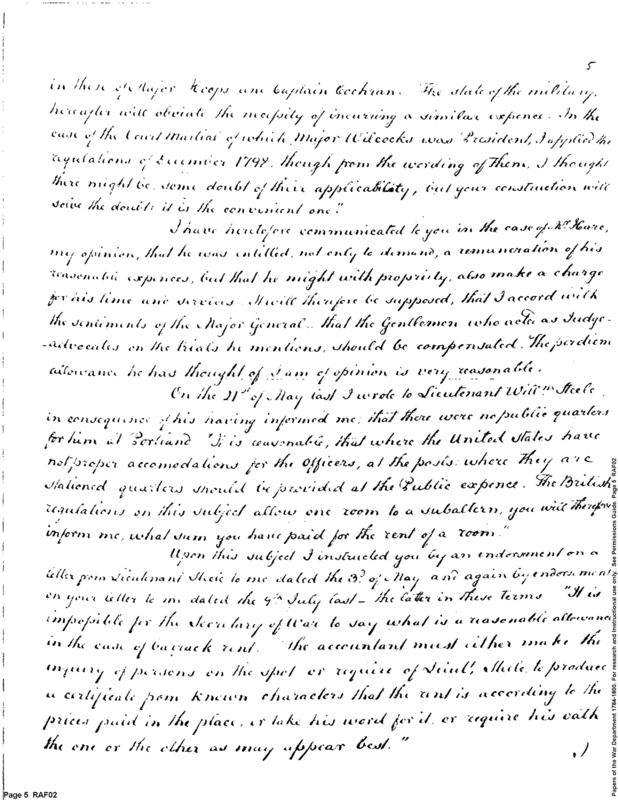
To my answer General Hamilton replied on the 3d ultimo. "Your letter of the 29th instant is received. I shall conform to what I understand to be, the spirit of the practice, of which it gives examples. It is right not to make an extra allowance to officers, for performing a military duty, at a place where they are stationed, or actually resident, or where there is a [underline: military post], at which they can be accomodated as usual, except for travelling from another place, to that post. But I submit that this is not applicable to a person not a member of the army, who may be specially designated to such a duty. Nor do I think that it consists with the dignity or policy of the Government, to desire the service of such a person gratis. A person not of the army, acting as Judge-advocate ought in my opinion to be compensated. Trials, in some instances, exhaust too large a portion of time, to be employed for a Public purpose without an equivalent. It will be agreeable to me, in the three instances, in which I have been the agent, to announce that an allowance is to be received. I have thought of three dollars per day. The Persons are Mr Hare in the trial of Captain Vance, Mr Morton in the trials of Captain Frye and Doctor Osborne, and Mr Malcolm in those of Major Hoops and Captain Cochran. The state of the military, hereafter will obviate the necessity of incurring a similar expence. In the case of the Court Martial of which Major Wilcocks was President, I applied the regulations of December 1797, though from the wording of them, I thought there might be some doubt of their applicability, but your construction will solve the doubt: it is the convenient one."
I have heretofore communicated to you in the case of Mr Hare, my opinion, that he was entitled, not only to demand, a remuneration of his reasonable expences, but that he might with propriety, also make a charge for his time and services. I will therefore be supposed, that I accord with the sentiments of the Major General. That the Gentlemen who act as Judge-advocates on the trials he mentions, should be compensated. The per diem allowance he has thought of, I am of opinion is very reasonable.
On the 11th of May last I wrote to Lieutenant Willm Steele, in consequence of his having informed me, that there were no public quarters for him at Portland. "It is reasonable, that where the United States have not proper accomodations for the Officers, at the posts where they are stationed, quarters should be provided at the Public expence. The British regulations on this subject allow one room to a subaltern, you will therefore inform me, what sum you have paid for the rent of a room."
Upon this subject I instructed you by an endorsement on a letter from Lieutenant Steele to me dated the 3d of May, and again by endorsement on your letter to me, dated the 4th July last - the latter in these terms. "It is impossible for the Secretary of War to say what is a reasonable allowance in the case of barrack rent. The accountant must either make the inquiry of persons on the spot, or require of Lieut. Steele to produce a certificate from known characters that the rent is according to the prices paid in the place, or take his word for it, or require his oath the one or the other as may appear best."
I have since received a letter from Lieutenant Steele dated Portland 18th August ultimo expressed as follows. "By a letter from Mr Simmons of the 7th instant, I am surprised with a rejection of my demand for room rent, altho' it had been previously sanctioned by you not only in your letter to me of the 21 of May, but also in your instructions to Mr Simmons on the subject enclesed me by him the 9 of July."
"the original ground of this demand was, that in consequence of being obliged to quarter in town, I was put to considerable extra expence. You were pleased to inform me "that where the United States have not proper accomodations for the Officers, quarters should be provided, at the public expence. You were afterwards pleased to direct Mr Simmons, to find the sum necessary to be allowed. either by enquiry of persons on the spot, or by certificate from known characters, or rely on my own word for it. By the direction of Mr Simmons, I procured a certificate from known characters, in this town of the price of Rent, and transmitted it to him, and he now rejects the amount, on the ground "that for this rent I never advanced a single cent."
"By what kind of Logic, a distinction is made, by Mr Simmons, between the actual payment of money for rent, & the actual payment of money for board, I am yet to learn. for the amount of the actual expence (extra) is the same. If quarters had been provided by the public, my rations would have supported me; but as I was obliged to procure them in Town, I was under the necessity of appropriating, no small proportion of my monthly pay, for the discharge of my Boarding Bill. Besides, in regular quarters my rations are sufficient to support me, at least for the supply of my table; but in private quarters, my Landlord will not receive them. For these rations therefore, I am under the necessity of receiving the money at the contract price, which is now a little more than eleven cents, a sum which is scarcely worth the attention of any one."
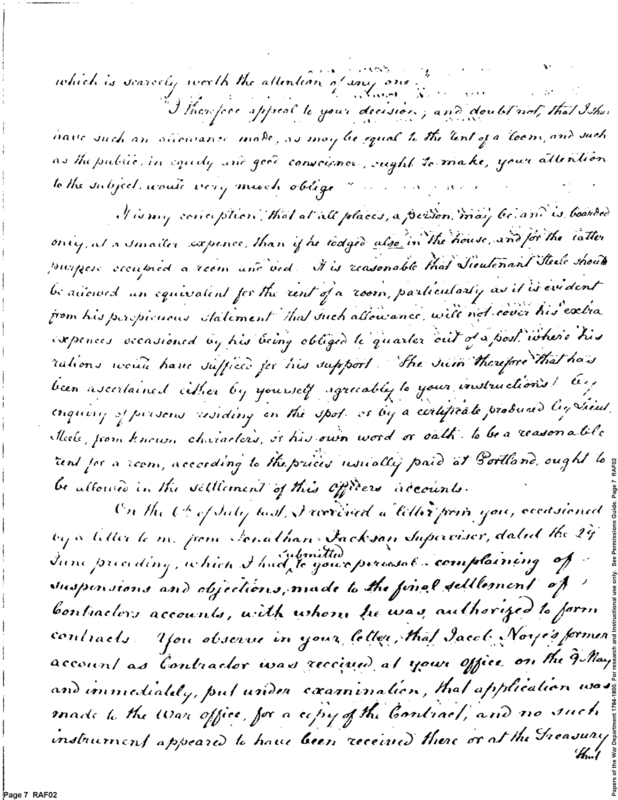
"I therefore appeal to your decision, and doubt not, that I shall have such an allowance made, as may be equal to the rent of a room, and such as the public, in equity and good conscience, ought to make, your attention to the subject, would very much oblige."
It is my conception, that at all places, a person may be, and is boarded only, at a smaller expence, than if he lodged [underline: also] in the house, and for the latter purpose occupied a room and &c'd. It is reasonable that Lieutenant Steele should be allowed an equivalent for the rent of a room, particularly as it is evident from his perspicuous statement, that such allowance will not cover his extra expences occasioned by his being obliged to quarter out of a post, where his rations would have sufficed for his support. The sum therefore that has been ascertained, either by yourself, agreeably to your instructions, by enquiry of persons residing on the spot, or by a certificate, produced by Lieut. Steele, from known characters, or his own word or oath, to be a reasonable rent for a room, according to the prices usually paid at Portland, ought to be allowed in the settlement of this Officers accounts.
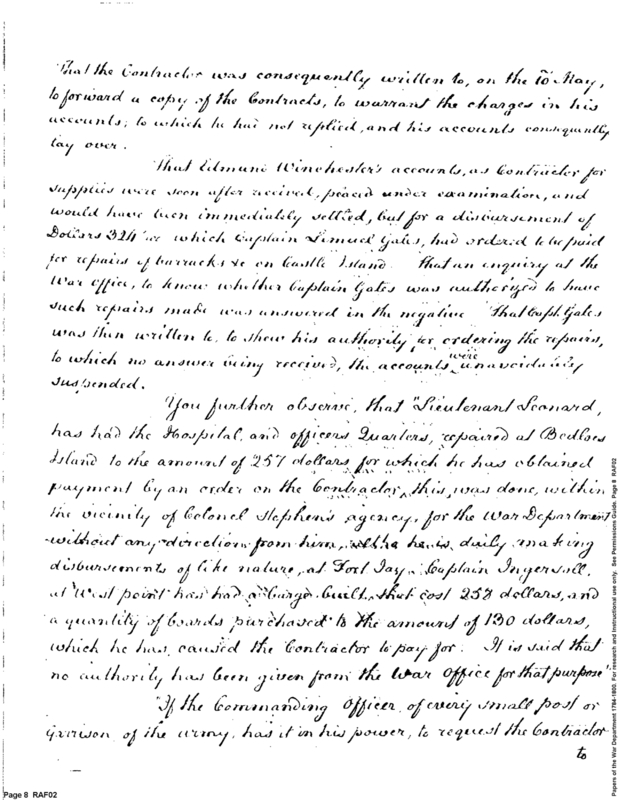
On the 4th of July last, I received a letter from you, occasioned by a letter to me, from Jonathan Jackson Supervisor, dated the 24 June preceiding, which I had, [strikethrough: submitted] to your perusal, complaining of suspensions and objections, made to the final settlement of Contractors accounts, with whom he was authorized to form contracts. You observe in your letter, that Jacob Noryes former account as Contractor was received at your Office on the 9 May and immediately, put under examination, that application was made to the War office, for a copy of the Contract, and no such instrument appeared to have been received there or at the Treasury That the Contractor was consequently written to, on the 10 May, to forward a copy of the Contracts, to warrant the charges in his accounts, to which he had not replied, and his accounts consequently lay over.
That Etmune Winchester's accounts, as Contractor for supplies were soon after received, placed under examination, and would have been immediately settled, but for a disbursement of Dollars 324 or which Captain Samuel Gates, had ordered to be paid for repairs of barracks &c on Castle Island. That an inquiry at the War office, to know whether Captain Gates was authorized to have such repairs made was answered in the negative. That Capt Gates was then written to, to show his authority, for ordering the repairs, to which no answer being received, the accounts were unavoidably suspended.
You further observe, that "Lieutenant Leonard, has had the Hospital, and officers Quarters, repaired at Bedlors Island to the amount of 257 dollars, for which he has obtained payment by an order on the Contractor, this was done, within the vicinity of Colonel Stephens agency, for the War Department, without any direction from him, with he has is daily making disbursements of like nature, at Fort Jay. Captain Ingersoll, at West point, has had a charge built, that cost 252 dollars, and a quantity of boards, purchased to the amount of 130 dollars, which he has caused the Contractor to pay for. It is said that no authority has been given from the War Office for that purpose.
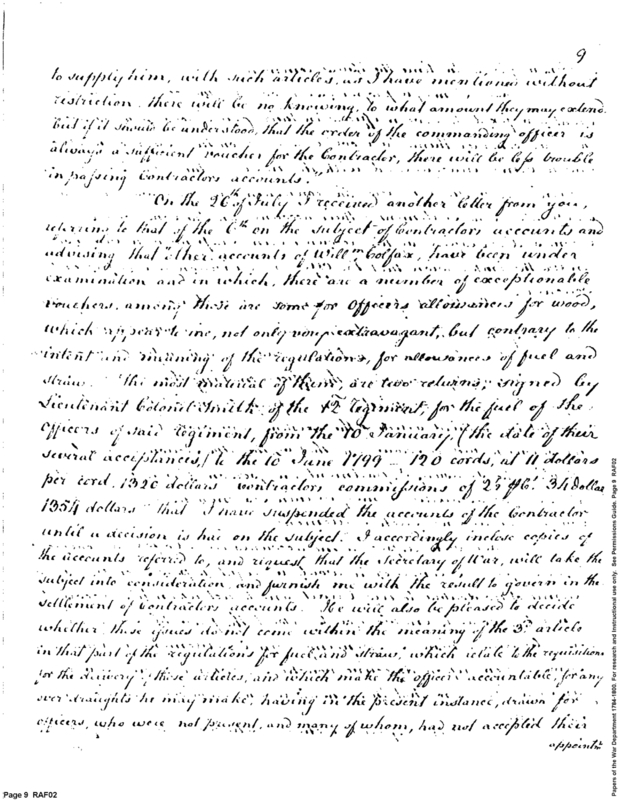
"If the Commanding Officer of every small post or Garrison of the army, had it in his power, to request the Contractor to supply them, with such articles, as they may mention, without restriction, there will be no knowing, to what amount they may extend; but if it should be understood, that the order of the commanding officer is always a sufficient voucher for the Contractor, there will be less trouble in passing Contractors accounts."
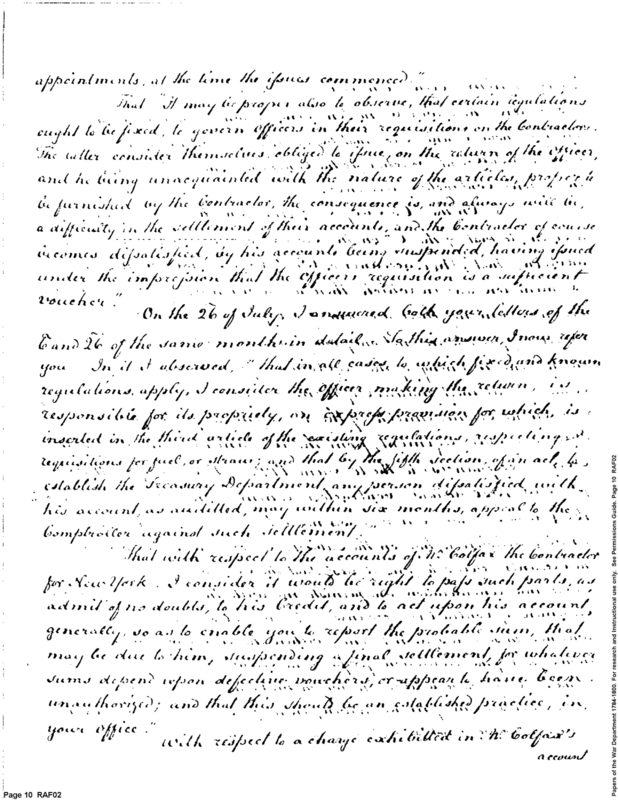
On the 26 of July, I received another letter from you, referring to that of the 6th on the subject of Contractors accounts, and advising, that their accounts of Willm Colfax, have been under examination, and in which, there are a number of exceptionable vouchers, among those are some for Officers allowances for wood, which appear to me, not only non extra vagant, but contrary to the intent and meaning of the regulations, for allowances of fuel and straw. The most material of them, are two returns, signed by Lieutenant Colonel Smith of the 4th Regiment, for the fuel of the Officers of said Regiment, from the 10 January, [the date of their several acceptances,] to the 10 June 1799. 190 cords, at 11 dollars per cord, 1990 dollars, Contractors commissions of 2½ pr ct. 34 Dollars 153/4 dollars. That I have suspended the accounts of the Contractor, until a decision is had on the subject. I accordingly inclose copies of the accounts referred to, and request, that the Secretary of War, will take the subject into consideration, and furnish me with the result to govern in the settlement of Contractors accounts. He will also be pleased to decide, whether those returns do not come within the meaning of the 8th article in that part of the regulations for fuel and straw, which relate to the regulations to the Suttlery; those articles, also which make the officers accountable for any over receipts he may make, having in the present instance, drawn for officers, who were not present, and many of whom, had not accepted their appointments, at the time the issues commenced.
That it may be proper also to observe, that certain regulations ought to be fixed, to govern officers in their requisitions on the Contractor. The latter consider themselves obliged to issue, on the return of the officer, and he being unacquainted with the nature of the articles, proper to be furnished, by the Contractor, the consequence is, and always will be, a difficulty, in the settlement of their accounts, and the Contractor of course becomes dissatisfied, by his accounts being suspended, having issued under the impression, that the Officers requisition is a sufficient voucher.
On the 26 of July, I answered both your letters of the 6 and 26 of the same month, in detail. In this answer, I now repeat you. In it I observed, "that in all cases to which fixed and known regulations apply, I consider the officer making the return, is responsible for its propriety, on express provision for which, is inserted in the third article of the existing regulations, respecting requisitions for fuel or straw; and that by the fifth section of an act to establish the Treasury Department, a person dissatisfied, with his account as audited, may within six months, appeal to the Comptroller against such settlement.
That with respect to the accounts of Mr Colfax the Contractor for New York, I consider it would be right to pass such parts, as admit of no doubt, to his Credit, and to act upon his account, generally, so as to enable you to report the probable sum, that may be due to him, suspending a final settlement, for whatever sums depend upon defective vouchers, or appear to have been unauthorized; and that this should be an established practice, in your office.
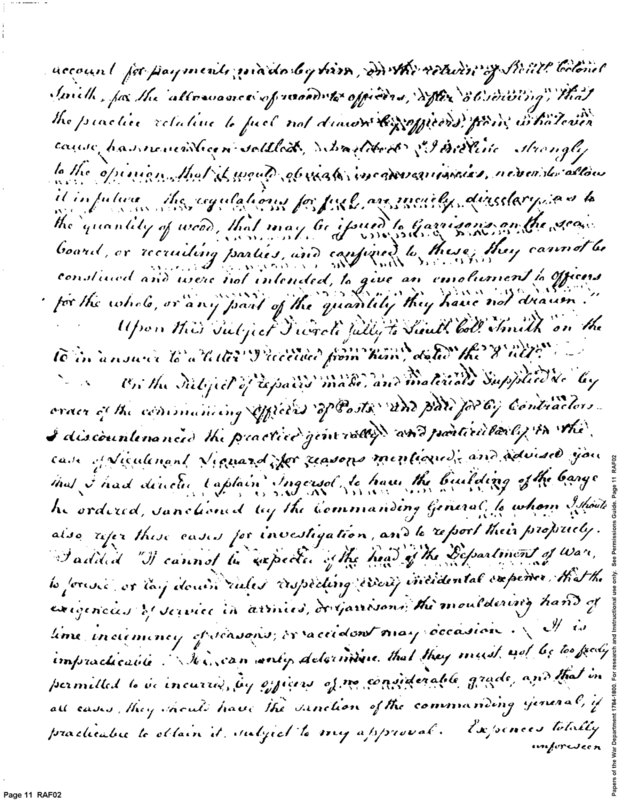
With respect to a charge exhibited in Mr Colfax's account for payments made by him, on the return of Brigt Colonel Smith, for the allowance of wood to officers, after abolishing, that the practice relative to fuel not drawn has received settlement, I am strongly to the opinion, that it would obtain inconveniences, never to allow it in future. The regulations for fuel, are merely directory, as to the quantity of wood, that may be issued to Garrisons, on the store board, or recruiting parties, and confined to these; they cannot be construed and were not intended, to give an emolument to officers for the whole, or any part of the quantity they have not drawn.
Upon this subject I wrote lately to Lieut. Col. Smith, on the 10, in answer to a letter I received from him, dated the 9 inst.
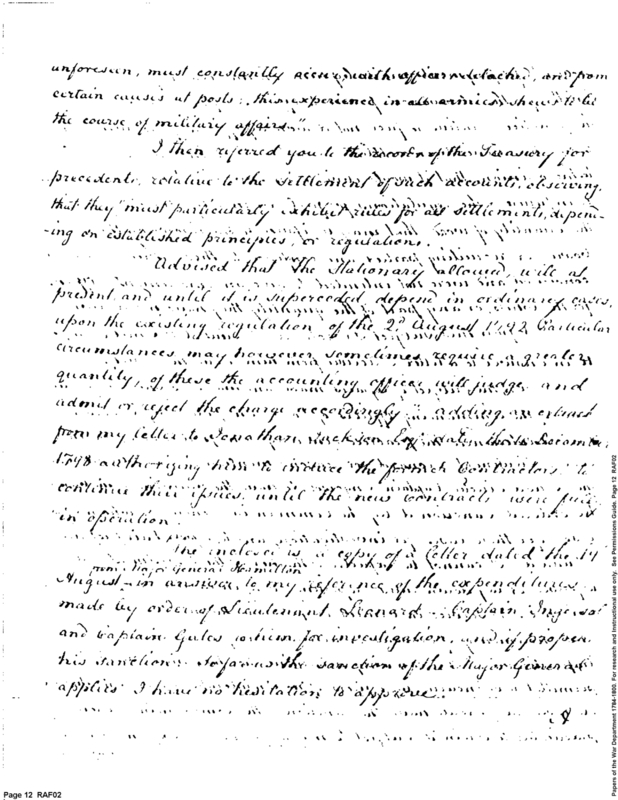
On the subject of repairs made, and materials supplied by order of the commanding officers at posts, and paid for by Contractors, I discountenanced the practice generally, and particularly in the case of Lieutenant Leonard, for reasons mentioned; and advised you, and I had directed, Captain Ingersoll to have the building of the charge he ordered, sanctioned by the commanding general, to whom I should also refer these cases for investigation, and to report their propriety. I added "It cannot be expected of the head of the Department of War, to prescibe or lay down rules respecting every incidental expence, that the exigencies of service in armies, or garrisons, the mouldering hand of time, inclemency of seasons, or accident may occasion. It is impracticable. We can only determine, that they must not be too freely permitted to be incurred, by officers of no considerable grade, and that in all cases, they must have the sanction of the commanding general, if practicable to obtain it, subject to my approval. Expences totally unforeseen, must constantly accumulate at places detached, and from certain causes at posts; this is experienced in all armies, it should be the course of military affairs."
I then referred you to the records of the Treasury for precedents, relative to the settlement of such accounts, observing, that they must particularly exhibit titles for all settlements, depending on established principles, or regulations.
"Advised that The Stationary allowance, will at present and until it is superceded depend in ordinary cases, upon the existing regulation of the 2d August 1792. Particular circumstances may however sometimes require a greater quantity, of these the accounting Officer will judge, and admit or reject the charge accordingly. I add, an extract from my letter to Jonathan Jackson Esqr, dated the 8 October 1798, authorizing him to instruct the former Contractors, to continue their issues, until the new contracts, were put in operation."
The inclosed is a copy of a letter dated the 14 from Major General Hamilton. in answer to my reference of the expenditures made by order of Lieutenant Leonard, Captain Ingersoll, and Captain Gates when, for investigation, and if proper his sanction; so far as the sanction of the Major General applies, I have no hesitation to approve.
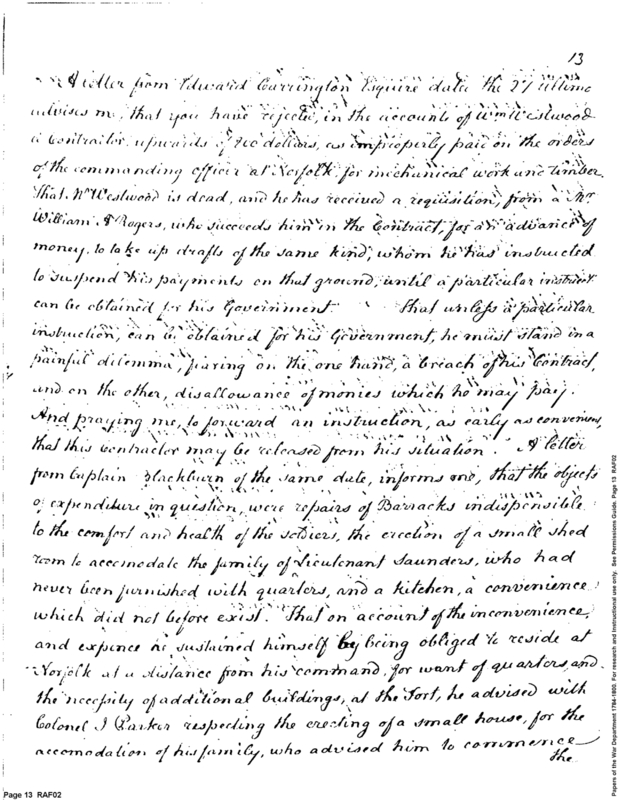
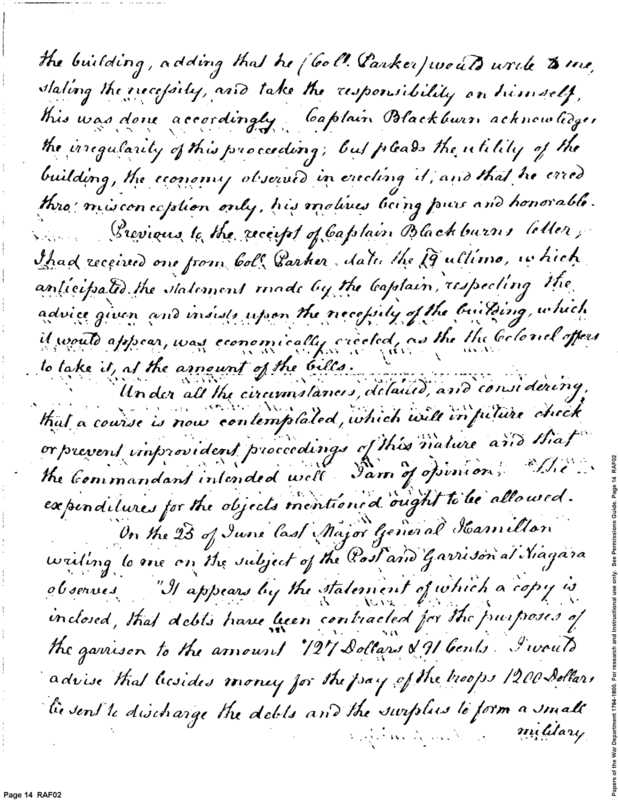
A letter from Edward Carrington Esquire, dated the 77 Ultimo, advises me, that you have rejected, in the accounts of Willm Westwood, a Contractor, upwards of 100 dollars, as improperly paid on the orders of the commanding officer at Norfolk, for mechanical work and timber. That Mr Westwood is dead, and he has received a requisition from Mr William At Rogers, who succeeds him in the Contract, for Mr Westwood's advance of money, to take up drafts of the same kind, whom he has instructed to suspend his payments, on that ground, until a particular instruction can be obtained for his Government. That unless a particular instruction, can be obtained for his Government, he must stand in a painful dilemma, fearing on the one hand, a breach of his Contract, and on the other, disallowance of monies which he may pay. And praying me, to forward an instruction, as early as convenient, that this contractor may be released from his situation. A letter from Captain Blackburn of the same date, informs me, that the objects of expenditure in question, were repairs of Barracks indispensible to the comfort and health of the soldiers, the erection of a small shed and room to accomodate the family of Lieutenant Saunders, who had never been furnished with quarters, and a kitchen, a convenience which did not before exist. That on account of the inconvenience, and expence as sustained himself, by being obliged to reside at Norfolk at a distance from his command, for want of quarters, and the necessity of additional buildings, at the fort, he advised with Colonel J. Parker, respecting the erecting of a small house, for the accomodation of his family, who advised him to commence the building, adding that he (Colo Parker) would write to me, stating the necessity, and take the responsibility on himself; this was done accordingly. Captain Blackburn acknowledges the irregularity of this proceeding; but pleads the utility of the building, the economy observed in erecting it, and that he erred thro' misconception only, his motives being pure and honorable.
Previous to the receipt of Captain Blackburn's letter, I had received one from Colo Parker, dated the 19 ultimo, in which it anticipated the statement made by the Captain, respecting the advice given and insists upon the necessity of the building, which it would appear, was economically erected, as the the Colonel offers to take it, at the amount of the bills.
Under all the circumstances, detailed, and considering, that a course is now contemplated, which will in future check or prevent improvident proceedings of this nature, and that the Commandant intended well. I am of opinion, "the expenditures for the objects mentioned ought to be allowed.
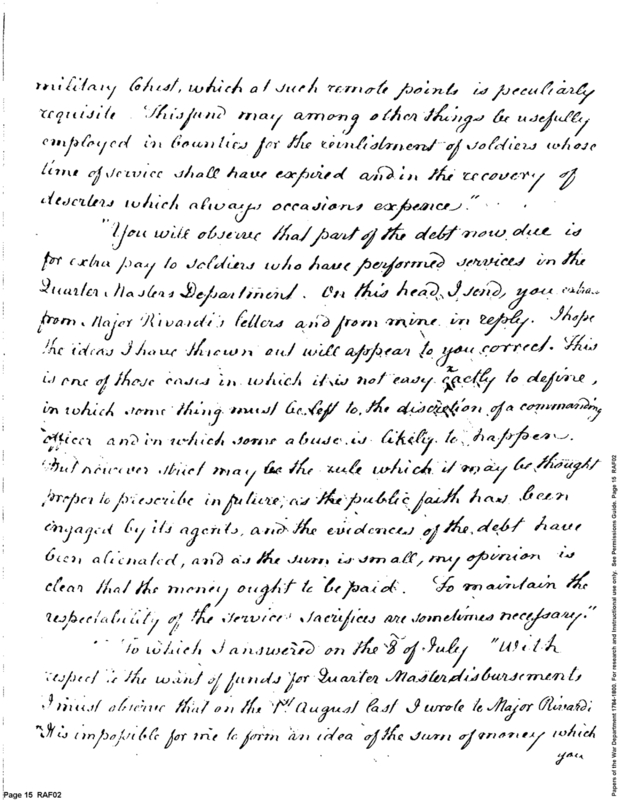
On the 23 of June last, Major General Hamilton, writing to me on the subject of the Post and Garrison at Niagara observes "It appears by the statement of which a copy is inclosed, that debts have been contracted for the purposes of the garrison to the amount 1127 Dollars & 91 Cents. I would advise that besides money for the pay of the troops 1200 Dollars be sent to discharge the debts and the surplus to form a small military Chest, which at such remote points is peculiarly requisite. This fund may among other things be usefully employed in bounties for the reinlistment of soldiers whose time of service shall have expired and in the recovery of deserters which always occasions expence."
"You will observe that part of the debt now due is for extra pay to soldiers who have performed services in the Quarter Masters Department. On this head I send you extracts from Major Rivardi's letters and from mine in reply. I hope the ideas I have thrown out will appear to you correct. This is one of those cases in which it is not easy exactly to define, in which some thing must be left to the discretion of a commanding officer and in which some abuse is likely to happen. But however strict may be the rule which it may be thought proper to prescribe in future, as the public faith has been engaged by its agents, and the evidences of the debt have been alienated, and as the sum is small, my opinion is clear that the money ought to be paid. To maintain the respectability of the service, Sacrifices are sometimes necessary."
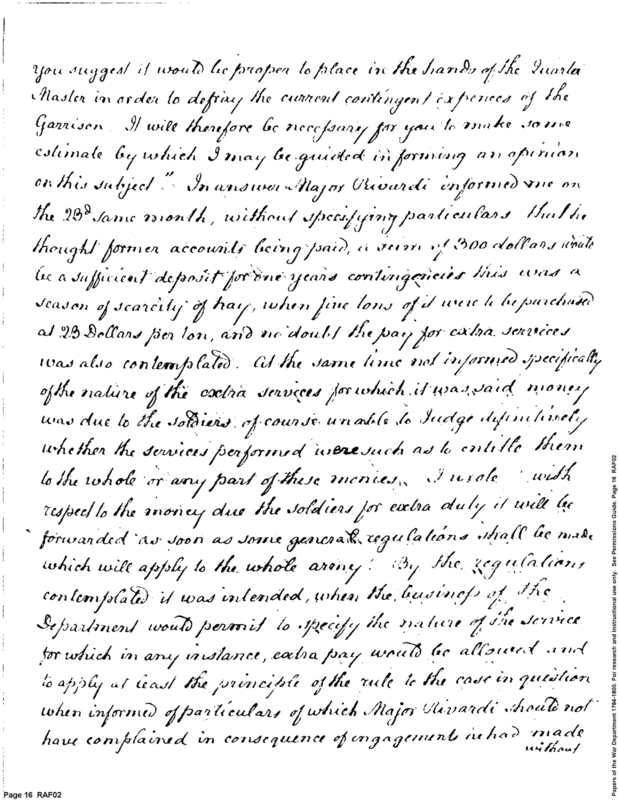
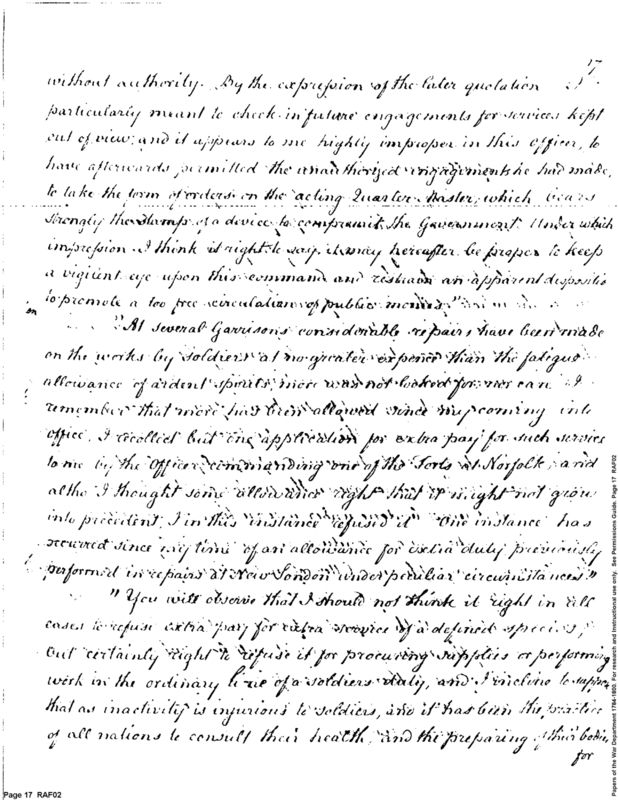
To which I answered on the 8 of July. "With respect to the want of funds for Quarter Master disbursements, I must observe that on the 1st August last I wrote to Major Rivardi, "It is impossible for me to form an idea of the sum of money which you suggest it would be proper to place in the hands of the Quarter Master in order to defray the current contingent expences of the Garrison. It will therefore be necessary for you to make some estimate by which I may be guided in forming an opinion on this subject." In answer Major Rivardi informed me on the 20th same month, without specifying particulars, that he thought former accounts being paid, a sum of 300 dollars would be a sufficient deposit for one years contingencies; this was a season of scarcity of hay, when five tons of it were to be purchased at 23 Dollars per ton, and no doubt the pay for extra services was also contemplated. At the same time not informed specifically, of the nature of the extra services for which it was said money was due to the soldiers, of course unable to judge definitively, whether the services performed were such as to entitle them to the whole or any part of these monies. I wrote "with respect to the money due the soldiers for extra duty, it will be forwarded as soon as some general regulations shall be made, which will apply to the whole army. By the regulations contemplated, it was intended, when the business of the Department would permit, to specify the nature of the service for which in any instance, extra pay would be allowed, and to apply at least the principle of the rule to the case in question, when informed of particulars of which Major Rivardi should not have complained in consequence of engagement he had made without authority. By the expression of the later quotation I particularly meant to check in future engagements for services kept out of view; and it appears to me highly improper in this Officer, to have afterwards permitted the unauthorized engagements he had made, to take the form of orders on the acting Quarter Master, which bears strongly the stamp of a device to compromise the Government. Under which impression, I think it right to say, it may hereafter be proper to keep a vigilant eye upon this command and restrain an apparent disposition to promote a too free circulation of public monies."
"At several Garrisons, considerable repairs have been made on the works by soldiers at no greater expence than the fatigue allowance of ardent spirits; none was not asked for, nor can I remember that more has been allowed since my coming into office. I recollect but one application for extra pay for such service to me by the Officer commanding one of the Forts at Norfolk, and altho' I thought some allowance right, that it might not grow into precedent, I in this instance refused it. One instance has occurred since my time, of an allowance for extra duty previously performed in repairs at New London under peculiar circumstances."
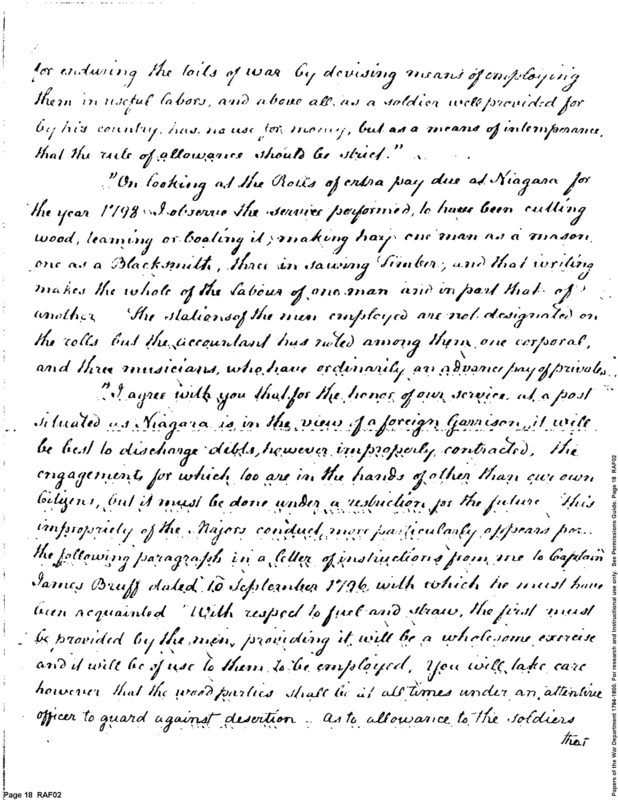
"You will observe that I should not think it right in all cases to refuse extra pay for extra service of a defined species, but certainly right to refuse it for procuring supplies, or performing work in the ordinary line of a soldiers duty, and I incline to suppose, that as inactivity is injurious to soldiers, and it has been the practice of all nations to consult their health, and the preparing their bodies, for enduring the toils of war, by devising means of employing them in useful labors, and above all, as a soldier well provided for by his country, has no use for money, but as a means of intemperance, that the rule of allowance should be strict."
"On looking at the Rolls of extra pay due at Niagara for the year 1798 I observe the services performed, to have been cutting wood, teaming or boating it, making hay, one man as a mason, one as a Blacksmith, three in sawing Timber, and that writing makes the whole of the labour of one man and in part that of another. The stations of the men employed are not designated on the rolls but the accountant has ruled among them, one corporal, and three musicians, who have ordinarily an advance pay of privates.
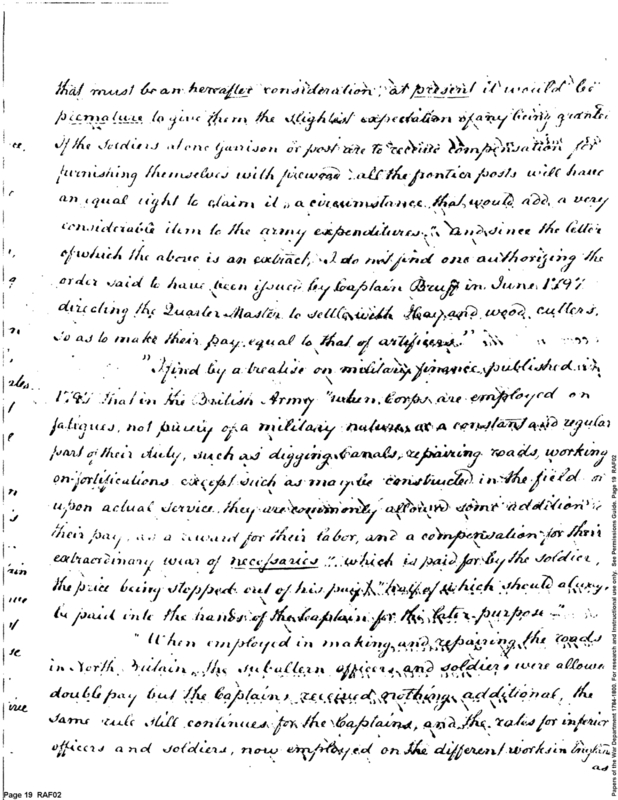
"I agree with you that for the honor of our service, at a post situated as Niagara is, in the view of a foreign Garrison, it will be best to discharge debts, however improperly contracted, the engagements for which too are in the hands of other than our own Citizens, but it must be done under a restriction for the future. This impropriety of the Major's conduct, more particularly appears from the following paragraph in a letter of instructions from me to Captain James Bruff dated 10 September 1796, with which he must have been acquainted. "With respect to fuel and straw, the first must be provided by the men, providing it will be a wholesome exercise and it will be of use to them to be employed. You will take care however that the wood parties shall be at all times under an attentive officer to guard against desertion. As to allowance to the soldiers that must be an hereafter consideration; at present it would be premature to give them the slightest expectation of any being granted. If the Soldiers alone, garrison or post, are to recieve compensation, for furnishing themselves with firewood, all the frontier posts will have an equal right to claim it, a circumstance that would add a very considerable item to the army expenditures. And since the letter of which the above is an extract, I do not find one authorizing the order said to have been issued by Captain Bruff, in June 1797 directing the Quarter Master to settle with the hay and wood cutters, so as to make their pay equal to that of artificers."
"I find by a treatise on military finance, published in 1783, that in the British Army "when Corps are employed on fatigues, not purely of a military nature, as a constant and regular part of their duty, such as digging canals, repairing roads, working on fortifications except such as may be constructed in the field or upon actual service, they are commonly allowed some addition to their pay, as a reward for their labor, and a compensation for their extraordinary wear of necessaries, which is paid for by the soldier, the price being stopped out of his pay, half of which should always be paid into the hands of the Captain for the latter purpose."
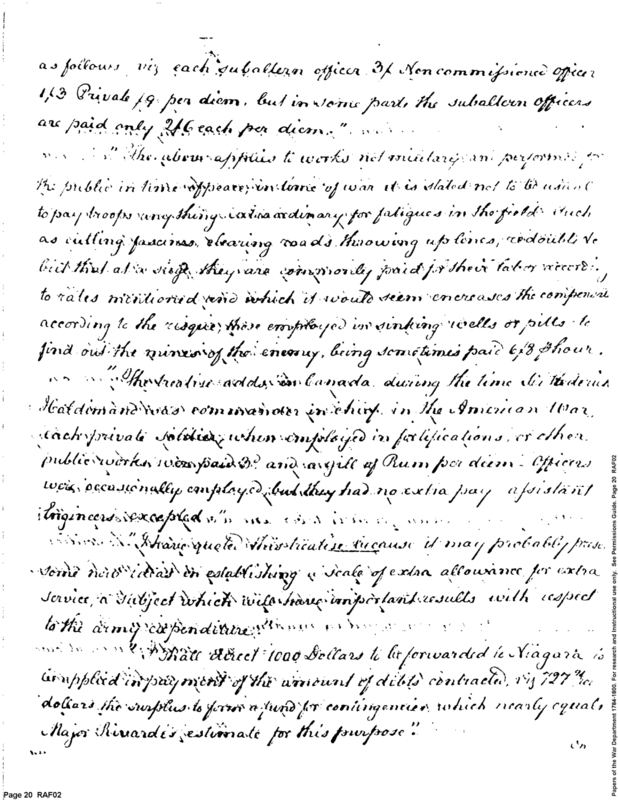
"When employed in making, and repairing the roads in North Britain, the subaltern officers and soldiers were allowed double pay but the Captains received nothing additional, the same rule still continues for the Captains, and the rates for inferior officers and soldiers, now employed on the different works in England as follows, viz each Subaltern officer 3/ Non commissioned Officer 1,6 Private 1/9 per diem; but in some parts, the subaltern officers are paid only 2/6 each per diem."
"The above applies to works not military, and performed for the public, in time of peace; in time of war, it is stated, not to be usual to pay troops any thing extraordinary for fatigues in the field, such as cutting fascines, clearing roads, throwing up lines, redoubts &c, but that at a siege, they are commonly paid for their labor according to rates mentioned, and which it would seem encreases the compensation, according to the risque; those employed in sinking wells or pits to find out the mines of the enemy, being sometimes paid 6/8 pr hour."
"The treatise adds, 'in Canada, during the time Sir Frederick Haldimand was commander in chief, in the American War, each private soldier, when employed in fortifications, or other public works, was paid 8d and a gill of Rum per diem. Officers were occasionally employed, but they had no extra pay; assistant Engineers excepted.'"
"I have quoted this treatise, because it may probably present some new ideas, in establishing a scale of extra allowance for extra service, a subject which will have important results with respect to the army expenditure."
"That direct 1000 Dollars to be forwarded to Niagara, to be applied in payment of the amount of debts contracted, as 727 ¾ dollars, the surplus to form a fund for contingencies which nearly equals Major Rivardi's estimate for this purpose."
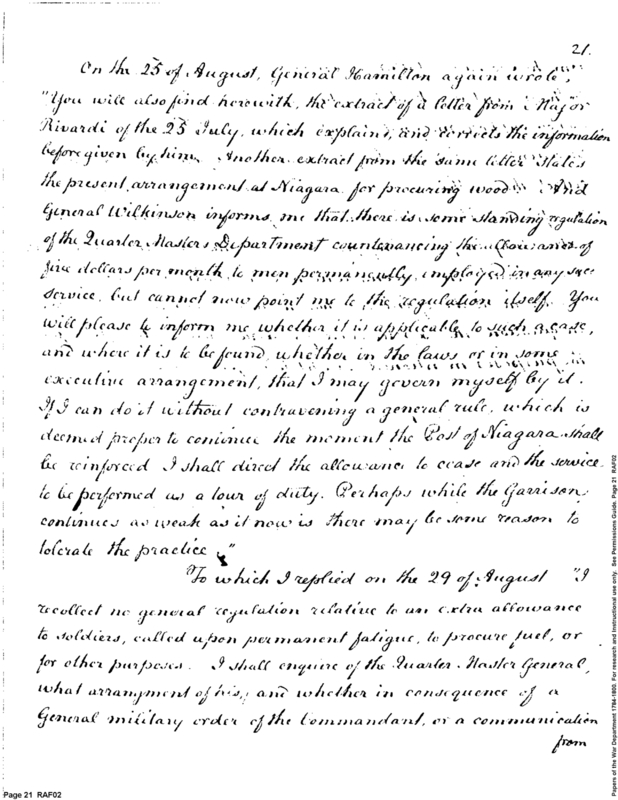
On the 25 of August, General Hamilton again wrote. "You will also find herewith, the extract of a letter from Major Rivardi of the 23 July, which explains, and corrects the information before given by him. Another extract from the same letter states the present arrangement at Niagara for procuring wood. And General Wilkinson informs me that there is some standing regulation of the Quarter Masters Department, countenancing the allowance of five dollars per month, to men permanently employed in any service, but cannot now point me to the regulation itself. You will please to inform me, whether it is applicable to such a case, and where it is to be found, whether in the laws, or in some executive arrangement, that I may govern myself by it. If I can do it without contravening a general rule, which is deemed proper to continue, the moment the Post of Niagara shall be reinorced, I shall direct the allowance to cease and the service to be performed as a tour of duty. Perhaps while the Garrison continues as weak as it now is, there may be some reason to tolerate the practice."
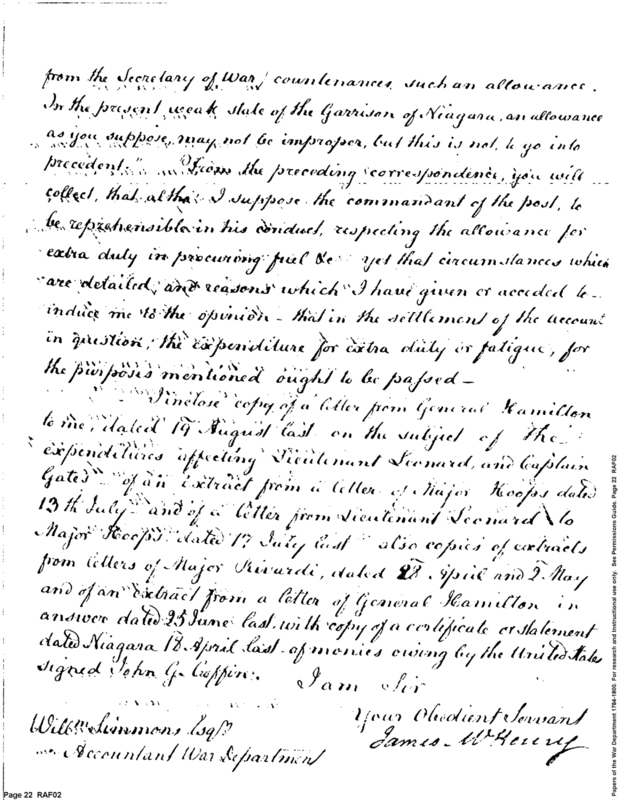
To which I replied on the 29 of August. "I recollect no general regulation relative to an extra allowance to soldiers, called upon permanent fatigue, to procure fuel, or for other purposes. I shall enquire of the Quarter Master General, what arrangement of his, and whether in consequence of a General military order of the commandant, or a communication from the Secretary of War, countenances such an allowance. In the present weak state of the Garrison of Niagara, an allowance as you suppose, may not be improper; but this is not to go into precedent. From the preceiding correspondence, you will collect, that altho' I suppose the commandant of the post, to be reprehensible in his conduct, respecting the allowance for extra duty in procuring fuel &c, yet that circumstances which are detailed, and reasons which I have given or acceded to, induce me to the opinion, that in the settlement of the account in question, the expenditure for extra duty or fatigue, for the purposes mentioned ought to be passed.
Inclose copy of a letter from General Hamilton to me, dated 19 August last, on the subject of the expenditures affecting Lieutenant Leonard, and Captain Gates; of an extract from a letter of Major Hoops, dated 13th July, and of a letter from Lieutenant Leonard to Major Hoops dated 17 July last; also copies of extracts from letters of Major Rivardi, dated 28 April and 2 May, and of an extract from a letter of General Hamilton in answer dated 23 June last, with copy of a certificate or statement dated Niagara 18 April last, of monies oweing by the United States, signed John G. Coppins. I am Sir
Wilkm Simmons Esqr
— Accountant War Department
Your Obedient Servant
James McHenry
Type
Autograph Letter Signed
Description
Discussion, with exceprts from letters between McHenry and Hamilton, of whether to compensate members of the military who serve on courts martial as judge advocates, and if so what expenses to allow. Other topics related to various instances of compensation follow, largely addressing claims and accounts which Simmons has rejected.
Date
09/04/1799
Author
Recipient
Sent from
War Department
Collection
Document number
1799090400001
Page start
1
Notable persons
William Simmons
James McHenry
Major General Alexander Hamilton
judge advocates
Captain Vance
Captain Frye
Doctor Osborn
Lieutenant Wands
Colonel Stevens
Secretary of War
Accountant
Captain Lewis
Charles W. Hare
Morton
Malcolm
Major Hoops
Captain Cochran
Major Wilcocks
Lieutenant William Steele
landlord
Jonathan Jackson
contractors
Jacob Noyes
Edmund Winchester
Captain Lemuel Gates
Lieutenant Leonard
Colonel Stephens
Captain Ingersoll
Ingersol
William Colfax
Lieutenant Colonel Smith
12 Regiment
Comptroller
Treasury Department
Edward Carrington
William Westwood
William Rogers
Captain Blackburn
family
Lieutenant Saunders
Colonel J. Parker
Major Rivardi
mason
blacksmith
Captain James Bruff
General Wilkinson
John G. Coffin
Notable locations
War Department
Philadelphia
New York
Fort Jay
Trenton
Portland
Castle Island
Bedloes Island
West Point
Norfolk
Niagara
North Britain
Canada
Notable items
courts martial
military posts
extra expense
compensation
pay
rule
accommodation
board
indemnification
lodging
claim
regulations
remuneration
public quarters
British regulations
rent
barrack rent
certificate
rations
monthly pay
contract price
suspension
final settlement
contract
supplies
repairs
hospital
barge
boards
voucher
wood
fuel
straw
stationery
stationary
mechanical work
shed room
kitchen
debts
military chest
extra pay
disbursement
garrison
public monies
ardent spirits
rolls
cutting wood
making hay
sawing timber
foreign garrison
desertion
fatigues
double pay
repairs of roads
American War
Revolutionary War
gill of rum