

Complaints About New System
Document 1799Swan notes that new regulations requiring him to reside in Philadelphia makes it impossible for him to carry out his duties which require daily contact with officers at a different location. Offers solution for solving problems with pay.




No human transcription currently available for this document.
This transcription was generated by machine using Anthropic's Claude Code (model sonnet 4.6). It may contain errors or inaccuracies. Please verify against the document image. Learn more about our generative AI methodology.
TREASURY DEPARTMENT,
Comptroller's Office,
February 22d, 1798.
SIR,
IT has been represented to me by Caleb Swan, Esquire, that Major General Anthony Wayne, late commander in chief of the army, had drawn sundry warrants on him as Pay-Master of the troops of the United States, in favor of Abraham Kirkpatrick, which were discharged by him out of the monies previously placed in his hands, for the pay, subsistence, and forage of the army.
As I am clearly of opinion that the powers of the commander in chief were competent to perform these acts, and of course that the Pay-Master of the troops was bound to obey them, it follows, that the latter is legally and equitably entitled to be exonerated from any further accountability for the monies which were thus drawn. You are therefore authorized, in liquidating Mr. Swan's accounts, in the capacity aforesaid, to admit the same to his credit, and to debit the said Abraham Kirkpatrick therewith.
It is however to be understood, that the authority hereby given, is only to extend to such monies as were drawn out of the hands of the Pay-Master of the troops, by the commander in chief, on warrants issued by the latter without any act of the former, on which such warrants might have been founded.
I am, Sir,
Very respectfully,
Your obedient servant,
JOHN STEELE,
Comptroller.
William Simmons, Esq.
Accountant War-Department.
[ornament]
PAY-OFFICE,
September 3d, 1799.
SIR,
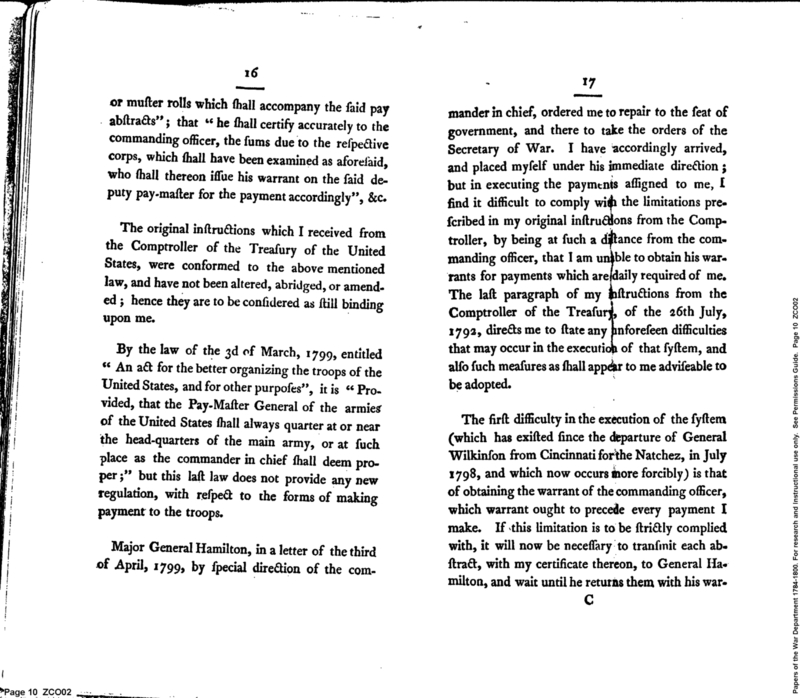
THE law of the 8th of May, 1792, entitled "An act making alterations in the treasury and war departments", requires that the Pay-Master shall "reside near the head-quarters of the troops of the United States"; that he "shall receive the pay abstracts of the Pay-masters of the several regiments and corps, and compare the same with the returns or muster rolls which shall accompany the said pay abstracts"; that "he shall certify accurately to the commanding officer, the sums due to the respective corps, which shall have been examined as aforesaid, who shall thereon issue his warrant on the said deputy pay-master for the payment accordingly", &c.
The original instructions which I received from the Comptroller of the Treasury of the United States, were conformed to the above mentioned law, and have not been altered, abridged, or amended; hence they are to be considered as still binding upon me.
By the law of the 3d of March, 1799, entitled "An act for the better organizing the troops of the United States, and for other purposes", it is "Provided, that the Pay-Master General of the armies of the United States shall always quarter at or near the head-quarters of the main army, or at such place as the commander in chief shall deem proper;" but this last law does not provide any new regulation, with respect to the forms of making payment to the troops.
Major General Hamilton, in a letter of the third of April, 1799, by special direction of the commander in chief, ordered me to repair to the seat of government, and there to take the orders of the Secretary of War. I have accordingly arrived, and placed myself under his immediate direction; but in executing the payments assigned to me, I find it difficult to comply with the limitations prescribed in my original instructions from the Comptroller, by being at such a distance from the commanding officer, that I am unable to obtain his warrants for payments which are daily required of me. The last paragraph of my instructions from the Comptroller of the Treasury, of the 26th July, 1792, directs me to state any unforeseen difficulties that may occur in the execution of that system, and also such measures as shall appear to me adviseable to be adopted.
The first difficulty in the execution of the system (which has existed since the departure of General Wilkinson from Cincinnati for the Natchez, in July 1798, and which now occurs more forcibly) is that of obtaining the warrant of the commanding officer, which warrant ought to precede every payment I make. If this limitation is to be strictly complied with, it will now be necessary to transmit each abstract, with my certificate thereon, to General Hamilton, and wait until he returns them with his warrants, before payment can be made; but the delays and inconveniences incident to this mode of proceeding, it is presumed are sufficiently obvious.
Instead of the usual course, it may perhaps be deemed sufficient that General Hamilton should grant a general warrant, authorising me to make payment whenever the muster and pay rolls presented, are conformable to my aforesaid instructions, and are certified by me according to law; or may not the power given to the commander in chief, by the 15th section of the law of the 3d March, 1799, of quartering the Pay-Master General [underline: at such place as he shall deem proper] (which power has been exercised in placing me at the seat of government) be considered as dispensing with the warrant required by the antecedent law of the 8th May 1792?
Another difficulty occurs from the present dispersed and unorganized state of the troops: they are scattered in detachments from Maine to Georgia, and have hitherto been in the habit of receiving advances on account from the Accountant's office; these advances have been made to colonels, majors, captains and subalterns, and in some few instances only to regularly appointed Pay-masters. It would be very desirable to avoid the perplexity which commonly attends the accounts of monies advanced in this way, by making them as seldom as can possibly be consistent with the good of the public service.
There are now pressing demands for further advances, as appears by the enclosed extract of a letter of the 13th August, 1799, from General Hamilton to the Secretary of War, and these advances must probably be made without the formalities prescribed in my instructions.
From the present state of things, it appears to me that the most eligible mode of discharging the arrears now due to the troops, would be to send two capable persons from this place, one to the district of Maine, and the other as far south as North Carolina; they could, as they went on, notify the several officers commanding detachments, to be prepared with the necessary muster and pay rolls, and on their return, make the payments required. This mode would be prompt in the execution, and the pay abstracts, by being examined by persons of experience, would be more correct than could be expected from officers young in service and inexperienced in paying troops;—and perhaps the extra travelling expences attending the business (which is all that is contemplated) would be found less than would accrue in any other way.
I have the honor to be,
Sir,
Your obedient servant,
C. SWAN,
Pay-Master General.
The Honorable
JOHN STEELE, Esq.
Comptroller of the Treasury of the United States.
[ornament]
TREASURY DEPARTMENT,
Comptroller's Office,
September 7, 1799.
SIR,
AFTER deliberately considering the contents of your letter of the 3d instant, I have concluded that it would not be proper to modify your instructions in such manner as to dispense with the warrant of the commanding officer in relation to the pay of the troops, required by the 3d section of the act of the 8th of May 1792.
The only inconvenience to be apprehended from an adherence to the established course, is the delay of a few days in transmitting and returning the papers, which is more than compensated by the information thus conveyed to the commanding officer, with respect to the business, and the security afforded thereby, that the troops will receive payment in proper season. If the commanding officer, with a view to obviate the inconveniences which you apprehend, should think fit to make a temporary arrangement with the Secretary of War, or any other officer at the seat of government to do his duty in this respect, no objection will be made to it in the settlement of your accompts. This assurance is as much as can be expected from me; it rests with others to agree to the arrangement or not, as it shall appear to be useful and necessary, or otherwise.
I concur with you in opinion, that advances on account, and individual settlements for pay, &c. should be made as seldom as possible. In practice they are irregular and troublesome; and frequently injurious to the service. On these points, however, the Secretary at War, as well from his general superintending authority, as from the principles established between the two departments, must be considered [underline: the exclusive judge]. When he thinks proper,
Type
Printed Document
Description
Swan notes that new regulations requiring him to reside in Philadelphia makes it impossible for him to carry out his duties which require daily contact with officers at a different location. Offers solution for solving problems with pay.
Date
09/03/1799
Author
Recipient
Sent from
Pay-Office
Document number
1799090315001
Page start
9
Note
Enclosed in Wolcott to Swan, 07/26/1792; Cited in Steele to Swan, 09/07/1799.
Notable persons
John Steele
Caleb Swan
Major General Alexander Hamilton
General James Wilkinson
troops
paymaster general
paymasters
Comptroller of the Treasury of the United States
James McHenry
Notable locations
headquarters
Philadelphia
Cincinnati
Natchez
Maine
Georgia
North Carolina
Treasury of the United States
Pay-Office
Notable items
pay abstracts
instructions
warrants
payments
delays
general warrant
authority
muster rolls
pay rolls
unorganized state of the troops
accounts
arrears
traveling expenses