

Regarding Conduct of Troops at Detroit Toward Civilians
Document 1799Addresses cannon sent to Detroit, and actions undertaken by the commandant of the garrison there, who has apparently acted outside his authority. References the "rules and articles for the better government of the troops of the United States." Addresses the limits of the authority of all soldiers, officers and enlisted, in relations with civilians.
No human transcription currently available for this document.
This transcription was generated by machine using Anthropic's Claude Code (model sonnet 4.6). It may contain errors or inaccuracies. Please verify against the document image. Learn more about our generative AI methodology.
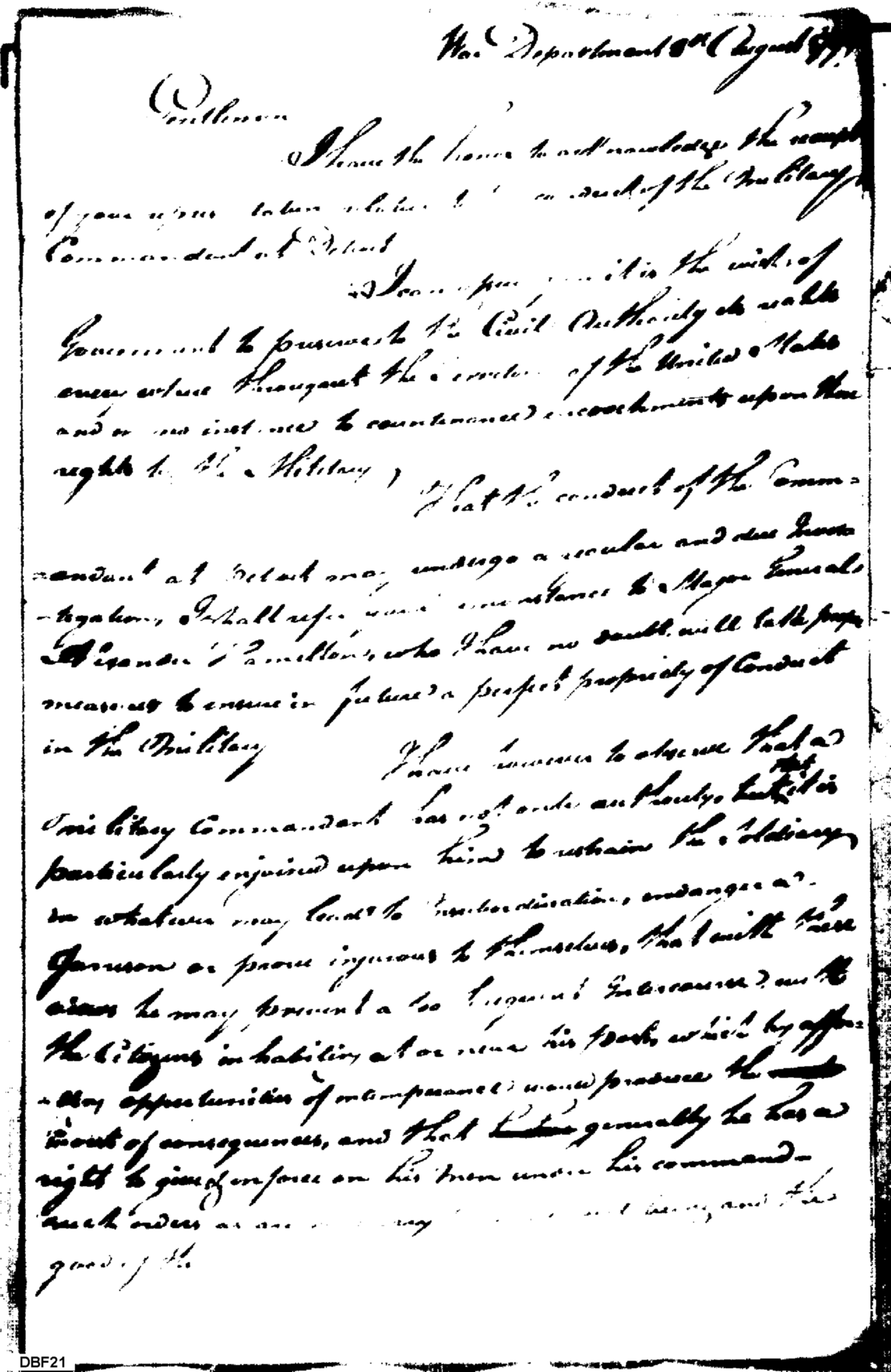
War Department 6th August [undecipherable]
Gentlemen,
I have the honor to acknowledge the receipt of your [undecipherable] [undecipherable] [undecipherable] on [undecipherable] of the [Military] Commandant at Detroit.
[Undecipherable] per[undecipherable] it is the wish of Government to preserve the Civil Authority as well as every virtue throughout the territory of the United States and on no instance to countenance encroachments upon the rights of the Military;
that the conduct of the Commandant at Detroit may undergo a regular and due investigation, I shall refer your [undecipherable] instances to Major General Alexander [undecipherable: probable reading "Hamilton"] who I have no doubt will take proper measures to ensure in future a proper propriety of conduct in the Military.
I have however to observe that a Military Commandant has not only the authority, but it is particularly enjoined upon him to restrain his Soldiers on whatever may lead to insubordination, endanger the Garrison or prove injurious to themselves, that [undecipherable] he may prevent a too frequent intercourse with the Citizens inhabiting at or near his Posts, which by affording opportunities of intemperance [undecipherable] produce the [undecipherable] of consequences, and that [undecipherable] generally he has a right to give[undecipherable] on his men under his command — such orders as an[undecipherable] [undecipherable] [undecipherable] and the good[undecipherable].
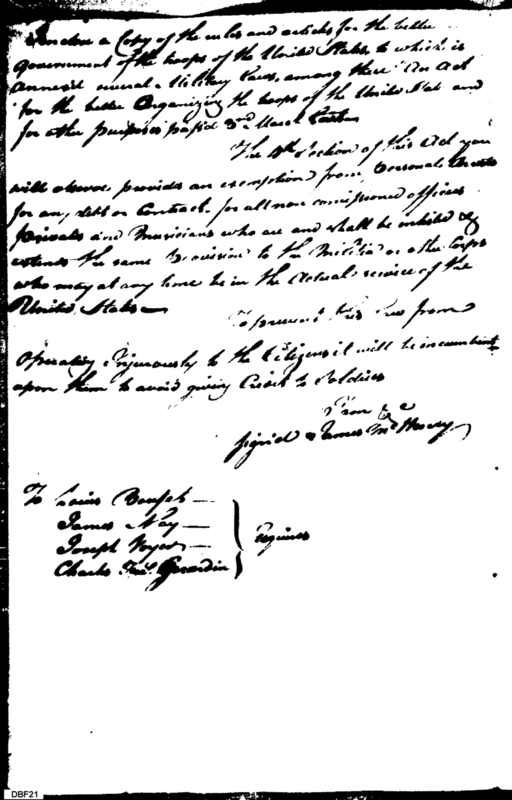
...direction a Copy of the rules and articles for the better Government of the troops of the United States, to which is annexed several Military Laws, among there "An Act for the better Organizing the troops of the United States and for other purposes passed 3d March [undecipherable]"
The 4th Section of this Act you will observe, provides an exemption from personal arrest for any debt or Contract, for all non-commissioned officers Privates and Musicians who are and shall be entitled to[undecipherable] extend the same provision to the Militia or the Corps who may at any time be in the Actual service of the United States —
To prevent this law from Operating Injuriously to the Citizens it will be incumbent upon them to avoid giving Credit to Soldiers
I am &c
Signed: James McHenry
To Lewis [Bousset?] —
James May — } Esquires
Joseph [Noyes?] —
Charles [St.?] [Guardin?]
Type
Autograph Letter Signed
Description
Addresses cannon sent to Detroit, and actions undertaken by the commandant of the garrison there, who has apparently acted outside his authority. References the "rules and articles for the better government of the troops of the United States." Addresses the limits of the authority of all soldiers, officers and enlisted, in relations with civilians.
Date
08/08/1799
Author
Sent from
War Department
Collection
Document number
1799080800401
Page start
1
Notable persons
James McHenry
Louis Bousses
Boufes
James Hay
May
Joseph Voyer
Charles Gardin
Commandant
Major General Alexander Hamilton
commissioned officers
privates
musicians
militia
Notable locations
War Department
Detroit
Notable items
civil authority
conduct
garrison
rules
military laws
contract
debt
credit