

Believes Court Martial of Sergeant Hunt was Illegal
Document 1799Mentions correspondence with heads of departments concerning the court martial death of Sergeant Hunt. Suggests role of Commission in such matters. Refers to General Hamilton and the president of the court, the judge advocate, on the wording of the commission and the sentence. Believes the whole process to be illegal.

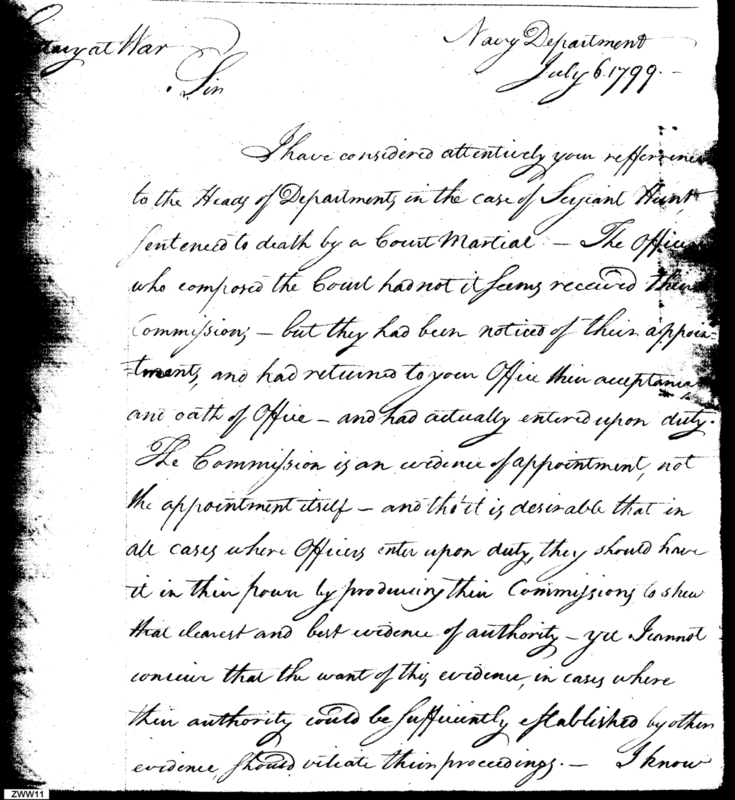
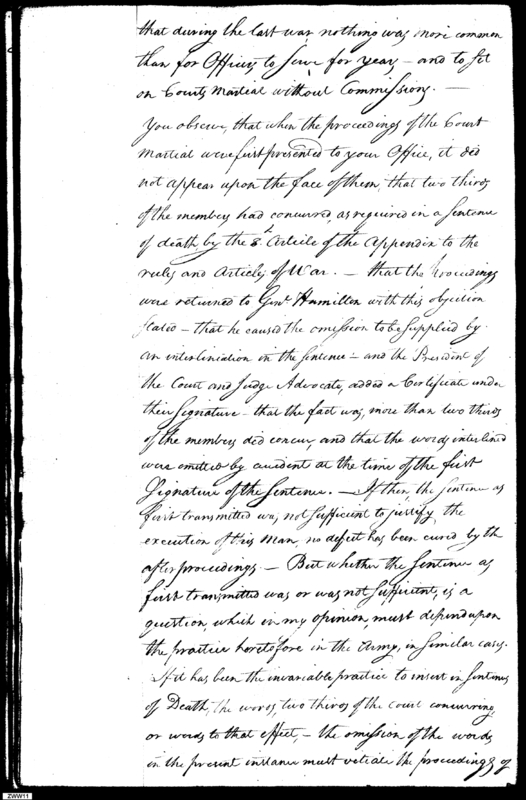
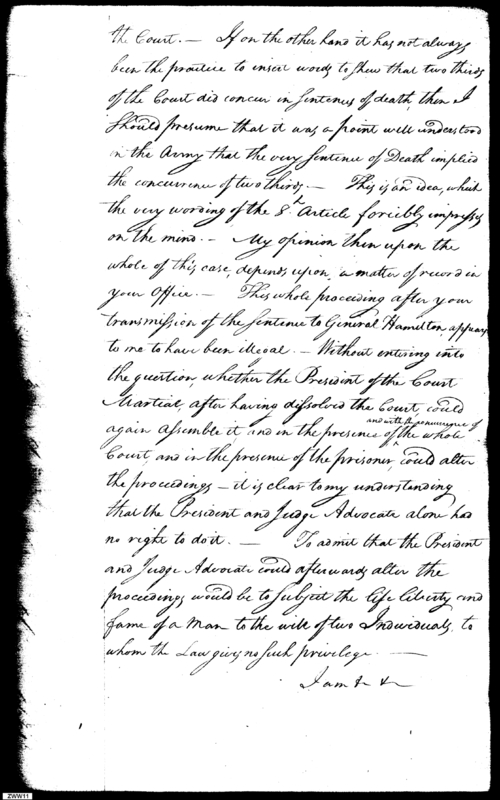
No human transcription currently available for this document.
This transcription was generated by machine using Anthropic's Claude Code (model sonnet 4.6). It may contain errors or inaccuracies. Please verify against the document image. Learn more about our generative AI methodology.
[Secy at War]
Navy Department
July 6 1799. -
Sir
I have considered attentively your reference to the Heads of Departments in the case of Serjeant Hunt sentenced to death by a Court Martial - The Officers who composed the Court had not it seems received their Commissions - but they had been noticed of their appointments, and had returned to your Office their acceptance and oath of Office - and had actually entered upon duty. The Commission is an evidence of appointment, not the appointment itself - and tho' it is desirable that in all cases where Officers enter upon duty, they should have it in their power by producing their Commissions to shew that clearest and best evidence of authority - yet I cannot concur that the want of this evidence, in cases where their authority could be sufficiently established by other evidence should vitiate their proceedings. - I know that during the last war nothing was more common than for Officers to serve for years - and to sit on Courts Martial without Commissions. -
You observe, that when the proceedings of the Court Martial were first presented to your Office, it did not appear upon the face of them, that two thirds of the members had concurred, as required in a sentence of death, by the 8th Article of the Appendix to the rules and Articles of War. - That the proceedings was returned to Genl Hamilton with this Objection stated - that he caused the omission to be supplied by an interlineation in the sentence - and the President of the Court and Judge Advocate, added a Certificate under their signature - that the fact was, more than two thirds of the members did concur, and that the words interlined was omitted by accident at the time of the first Signature of the Sentence. - If then the sentence as first transmitted was not sufficient to justify the execution of this Man, no defect has been cured by the after proceedings. - But whether the Sentence as first transmitted was or was not sufficient, is a question, which in my opinion must depend upon the practice heretofore in the Army, in similar cases. If it has been the invariable practice to insert in Sentences of Death, the words, two thirds of the court concurring, or words to that effect - the omission of the words in the present instance must vitiate the proceedings of the Court. - If on the other hand it has not always been the practice to insert words to shew that two thirds of the Court did concur in Sentences of death, then I should presume that it was a point well understood in the Army that the very Sentence of Death implied the concurrence of two thirds. - This is an idea, which the very wording of the 8th Article forcibly impresses on the mind. - My opinion then upon the whole of this case, depends upon a matter of record in your Office. - This whole proceeding after your transmission of the Sentence to General Hamilton appears to me to have been illegal. - Without entering into the question, whether the President of the Court Martial, after having dissolved the Court, could again assemble it and in the presence [interlined: and with the concurrence of] the whole Court, and in the presence of the prisoner, could alter the proceedings - it is clear to my understanding that the President and Judge Advocate alone has no right to do it. - To admit that the President and Judge Advocate could afterwards alter the proceedings, would be to subject the Life Liberty and fame of a Man to the will of two Individuals, to whom the Law gives no such privilege. -
I am &c &c
Type
Letterbook
Description
Mentions correspondence with heads of departments concerning the court martial death of Sergeant Hunt. Suggests role of Commission in such matters. Refers to General Hamilton and the president of the court, the judge advocate, on the wording of the commission and the sentence. Believes the whole process to be illegal.
Date
07/06/1799
Author
Recipient
Sent from
Navy Department
Document number
1799070640201
Page start
1
Notable persons
James McHenry
Benjamin Stoddert
Richard Hunt
Heads of Departments
Alexander Hamilton
John Adams
Secretary of War
army
Notable locations
Navy Department
War Department
Notable items
commission
court martial
articles of war