No human transcription currently available for this document.
War Department
[Janu?] [undecipherable], [179?]
Gentlemen,
I write to you, pursuant to the [direction?] of the President of the United States under his hand of the same instant, returned among its enclosures the proceedings of a General Court Martial, held at the City Hall of the City of New York, by order of Major General Hamilton, for the trial of [such persons?] as [were?] to be brought before it, on the 16th day of [April?] last.
The [prisoner?] who was brought before this Court, was Richard [Hunt?] a [Private?] in a Company of the second Regiment of Artillerists and Engineers, commanded by Captain [Kelly?], and [charged?] at [said?] [undecipherable] with having deserted from the said Company, on or about the 28th day of [February?] last, having been before that time duly enlisted in the [service?] of the United States, and at the time in the [service?] and [pay?], and with carrying away in violation of the trust reposed in him, [clothing?], to the amount of [two?] hundred Dollars and upwards, with which he had been entrusted by the [Men?] of the said company for their [use?], contrary to the Articles of [War?] in such case made, and provided. To this charge the prisoner, [undecipherable] and [desired?] such [bounty?] might be [shown?] to his character [which was?] complied with. The Court [afterwards?] [upon?] mature
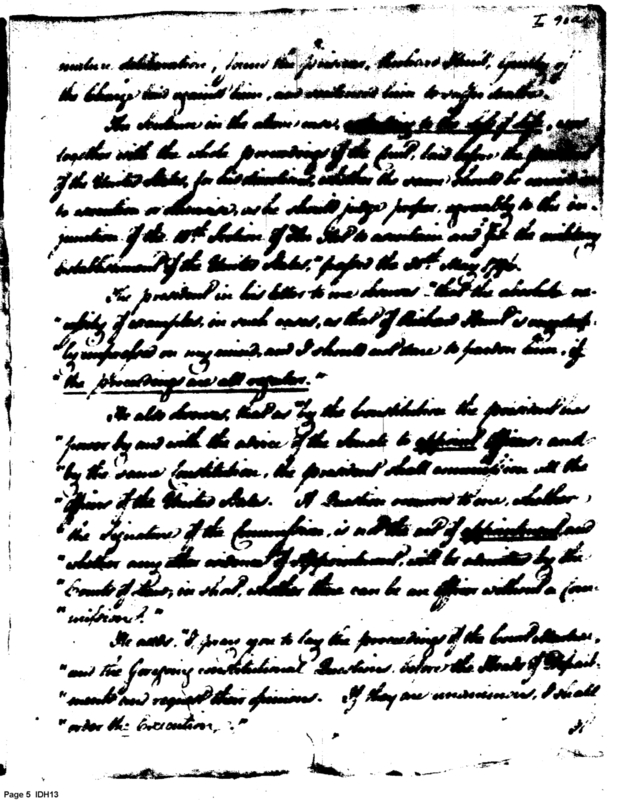
deliberations, [found?] the prisoner, Richard [Hunt?], guilty of the charges laid against him, and sentenced him to suffer death.
The decision in the above case, [underline: [agreeable?] to the [letter?] of the law], came together with the whole proceedings of the Court, laid before the President of the United States, for his [determination?], whether the [crime?] should be [commuted?] to execution or [dismissal?], as he should judge proper, agreeably to the [injunction?] of the 99th Section of the [Act?] to constitute and fix the military establishment of the United States, passed the [undecipherable] of [May?] [179?].
The President in his letter to me [declares?]: "that the absolute [undecipherable: probable reading inapplicability] of [accomplices?], in such cases, as that of Richard [Hunt?] is [emphatically?] "impressed on my mind, and I should not dare to [pardon?] him, if [underline: the proceedings are all regular.]"
He also [observes?], that as "by the Constitution the president has "power by and with the advice [of the Senate?] to appoint officers; and "by the same Constitution, the president shall commission all the "officers of the United States. A [question?] occurs to me, whether "the [signature?] of the Commission, is not the act of appointment; and "whether any the [evidence?] of appointment, will be [admitted?] by the "Courts of law, in short, whether there can be an officer without a Com- "mission?"
He adds: "I [pray?] you to lay the proceedings of the [Court Martial?], "and the foregoing constitutional [Questions?], before the [Heads?] of Depart- "ments and request their opinions. If they are unanimous, I shall "order the Execution,..."
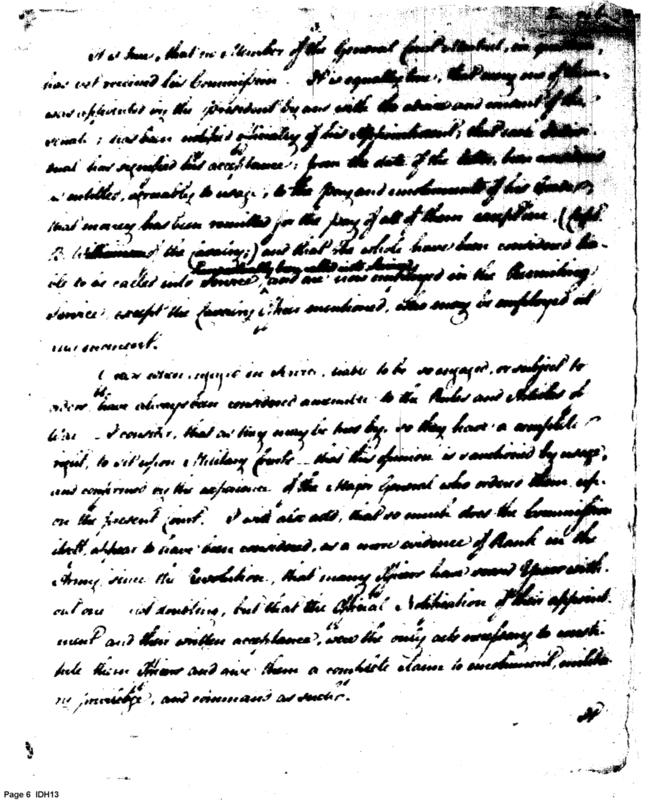
it is true, that not a Member of this General Court Martial in question has received his Commission. It is equally true, that [each?] were appointed by the president by and with the advice and consent of the Senate; [has?] been notified officially of his appointment; that each individual has signified his acceptance: from the date of his letter, has continued [a soldier?], agreeably to usage, to the pay and emoluments of his [station?]; that money has been remitted for the pay of all of them [excepting?] [([undecipherable] [B.?] [Williamson?] the [undecipherable])]; and that the whole have been considered [liable?] to be called into [service?], [Consistently?] they [called?] into [service?], and are now employed in the Recruiting [service?], except the [undecipherable] I have mentioned, [who?] is employed at [his?] [encampment?].
I can [cite?] [several?] in short, [liable?] to be so engaged, or subject to [their?] [undecipherable] always been considered amenable to the Rules and Articles of War. I [consider?], that as they may be [thus?] [undecipherable], do they have a complete [right?], to sit before a Military Court — that this opinion is [sanctioned?] by usage, and confirmed by the [experience?] of the Major General who orders these [to?] the present Court. I will also add, that so much does the Commission [shall?] appear to have been considered, as a mere evidence of Rank in the Army since the Revolution, that many officers have [served?] [therewith?] without any [doubts?], but that the [formal?] Notification of their appointment and their written acceptance, were the only acts necessary to constitute them Officers and give them a complete claim to [emolument?], [undecipherable] [privileges?], and [command?] as such.
It will be [shewed?] that the Commissions for the [officers?] appointed for [undecipherable] [Dearborn?] Regiment were missing, and for the additional Troops of [Cavalry?], to form a new Regiment, as provided for by law, have by the [advice?] of the Board of General Officers, convened at the head of Government last Fall, been delayed to await the final determination of relative Rank for the whole [which?] could not be [effected?], until the appointments were made for all the Regiments, and the [acceptances?] received — and that the whole of the Appointments have not yet been made.
As the President was intimated in his letter, a caution, respecting the regularity of the proceedings of the Court generally — I think it proper to observe, that when they were first presented to this office, it did not appear upon the face of them, that two thirds of the Members of the Court, had concurred in a sentence of Death, as it requires by the 8th [Article?] of the [Articles?] to [his?] Rules and Articles of [War?] — that the proceedings were returned to General Hamilton with this objection [stated?]; that he caused the omission to be supplied, by an interlineation in the sentence, which will be seen on inspection of the proceedings; and the [President?] and acting Judge Advocates of the Court, under their signatures, added a [certificate?] — that the fact was, more than two thirds of the Members did concur, and that the words interlined, were omitted by accident at the time of the first signature of the Sentence. The Major General then sent back the proceedings [endorsing?] them as perfect, and they were afterwards transmitted to the President.
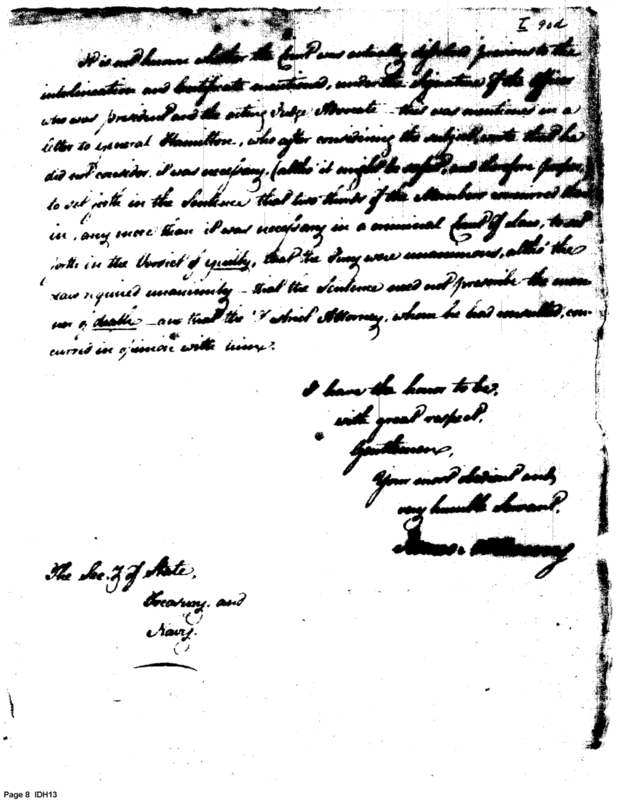
It is not known whether the Court was entirely [undecipherable] [to?] the intoxication and [undecipherable] mentioned, under the objections of the officer who was [presiding?] and the acting Judge Advocate — this was mentioned in a letter to General Hamilton, who after considering the subject, [wrote?] that he did not consider it was necessary, (altho' it might be [urged?], and [therefore?] [purpose?] to set forth in the Sentence that two thirds of the Members concurred [therein?], any more than it was necessary in a criminal Court of law, [to?] [write?] in the Verdict of [guilty?], that the Jury were unanimous, altho' the law required unanimity — that the Sentence need not prescribe the manner of [underline: death] — and that the [Judge?] Advocate, whom he had consulted, concurred in [opinions?] with him.
I have the honor to be,
with great respect,
Gentlemen,
Your most obedient and
my humble [servant?].
[James McHenry?]
The Sec.ys of State,
Treasury, and
Navy.