No human transcription currently available for this document.
Now I have all pages. Pages 1–4 are the primary document; pages 5–6 are collection separator cards; pages 7–10 are alternate copies that I used to assist with difficult readings. I will transcribe only the primary document (pages 1–4).
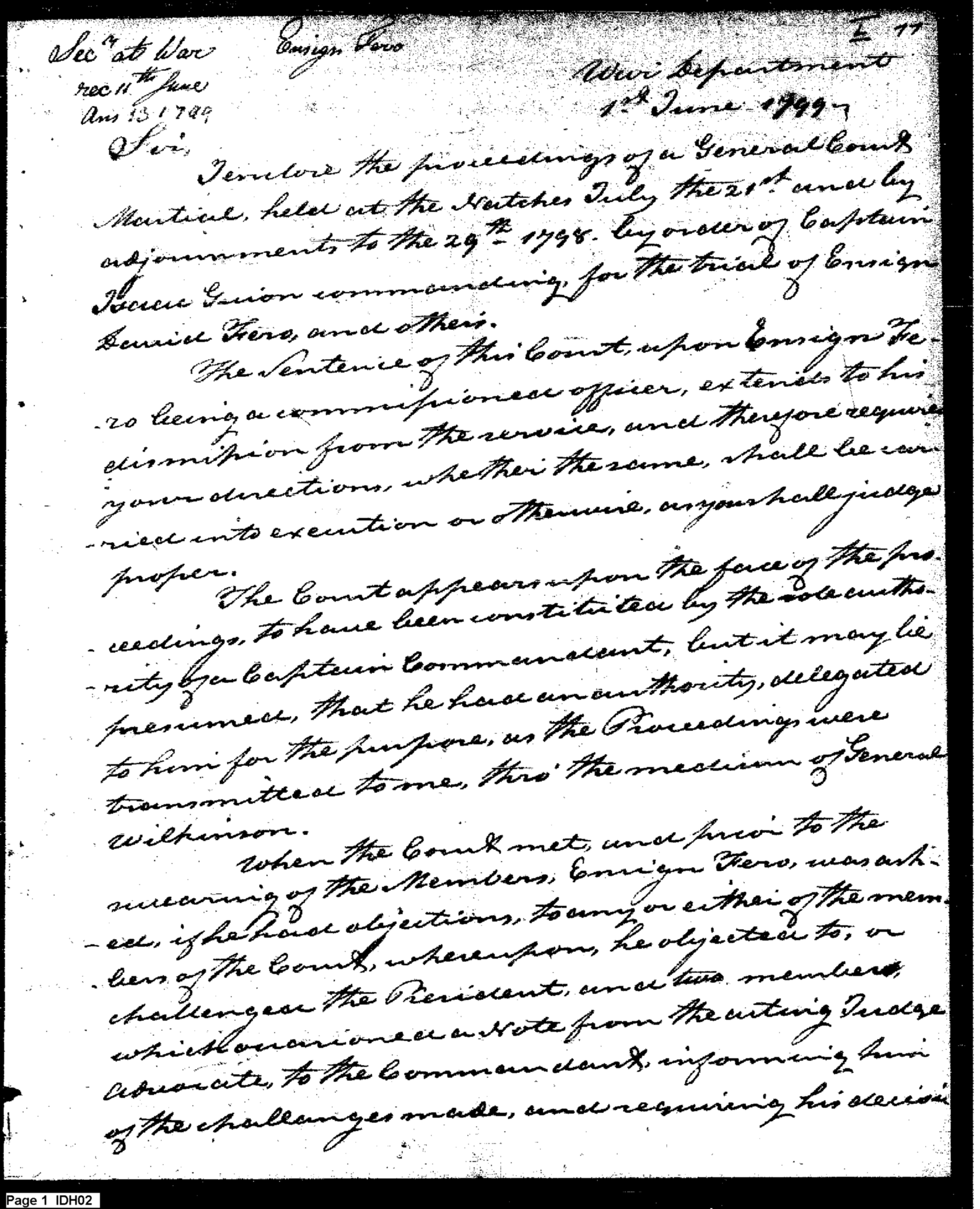
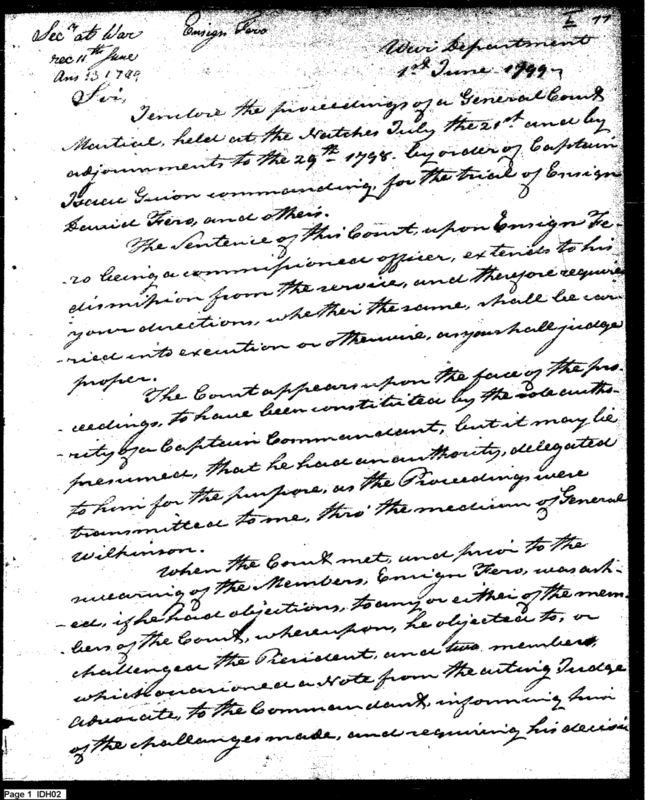
[Sect at War / rec 11th June / Ans 13 1799] [Ensign Fero]
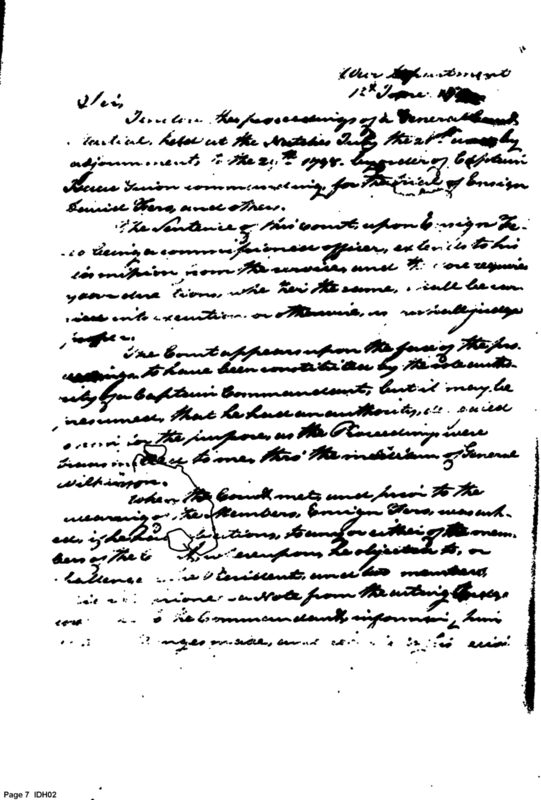
War Department
1st June 1799
Sir,
I enclose the proceedings of a General Court Martial, held at the Natches July the 21st and by adjournments to the 29th 1798. by order of Captain Isaac Guion commanding, for the trial of Ensign Dennise Fero, and others.
The Sentence of this Court, upon Ensign Fero being a commissioned officer, extends to his dismission from the service, and therefore requires your directions, whether the same, shall be carried into execution or otherwise, as you shall judge proper.
The Court appears upon the face of the proceedings, to have been constituted by the sole authority of a Captain Commandant, but it may be presumed, that he had an authority, delegated to him for the purpose, as the Proceedings were transmitted to me, thro' the medium of General Wilkinson.
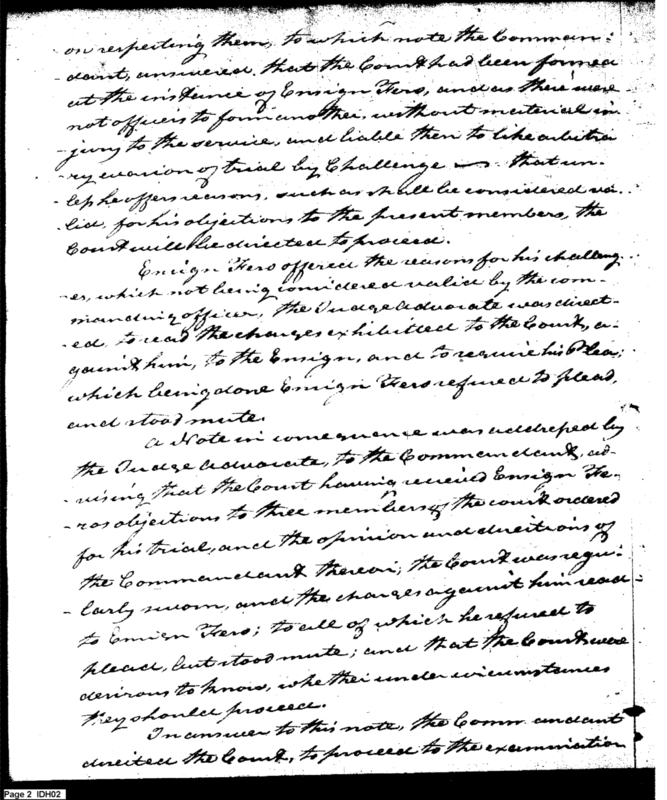
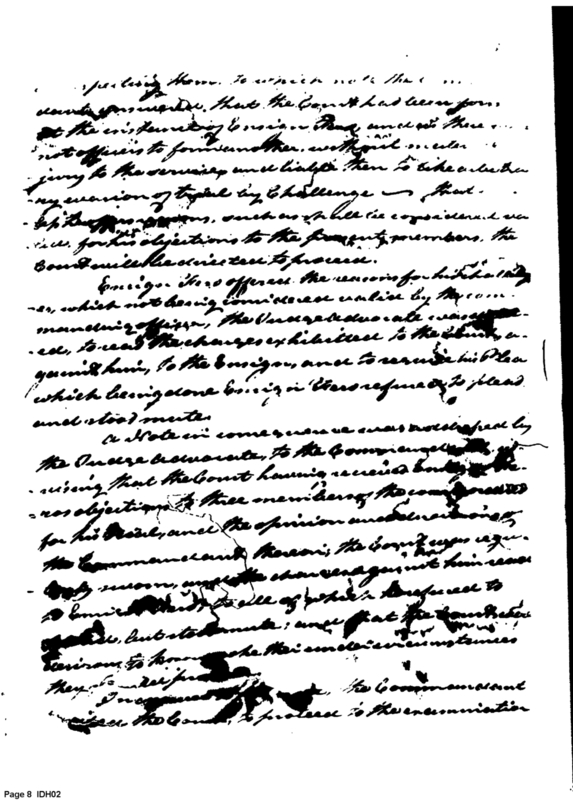
When the Court met, and prior to the swearing of the Members, Ensign Fero, was asked, if he had objections, to any or either of the members of the Court, whereupon, he objected to, or challenged the President, and two members, which occasioned a Note from the sitting Judge Advocate, to the Commandant, informing him of the challenges made, and requiring his decision on respecting them, to which note the Commandant, answered. that the Court had been formed at the instance of Ensign Fero, and as there were not officers to form another. without material injury to the service, and liable then to take arbitrary evasion of trial by Challenge — that unless he offers reasons, such as shall be considered valid, for his objections to the present members, the Court will be directed to proceed.
Ensign Fero offered the reasons for his challenges, which not being considered valid by the commanding officer, the Judge Advocate was directed to read the charges exhibited to the Court, against him, to the Ensign, and to require his Plea; which being done Ensign Fero refused to plead, and stood mute.
A Note in consequence was addressed by the Judge Advocate, to the Commandant, advising that the Court having received Ensign Fero's objections to three members of the court ordered for his trial, and the opinion and directions of the Commandant thereon; the Court was regularly sworn, and the charges against him read to Ensign Fero; to all of which he refused to plead, but stood mute; and that the Court were desirous to know, whether under circumstances they should proceed.
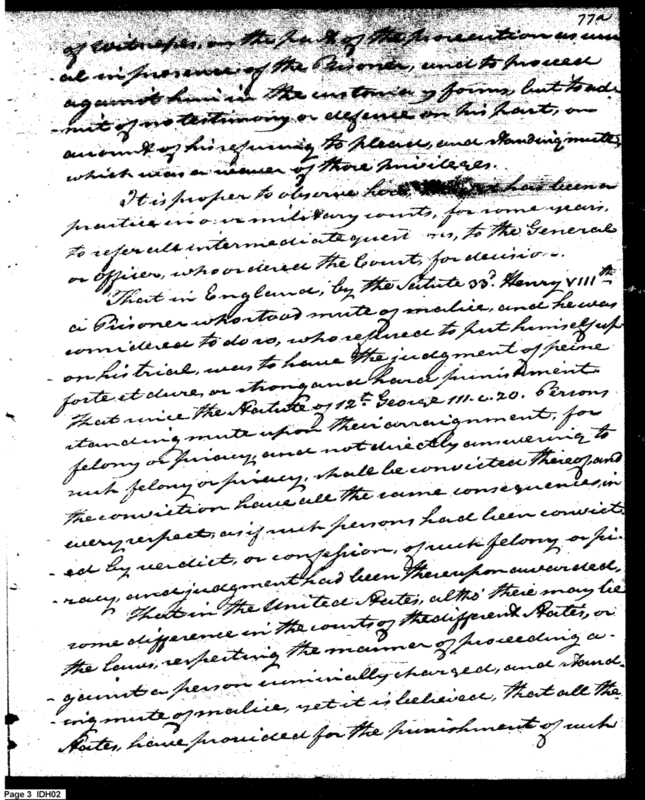
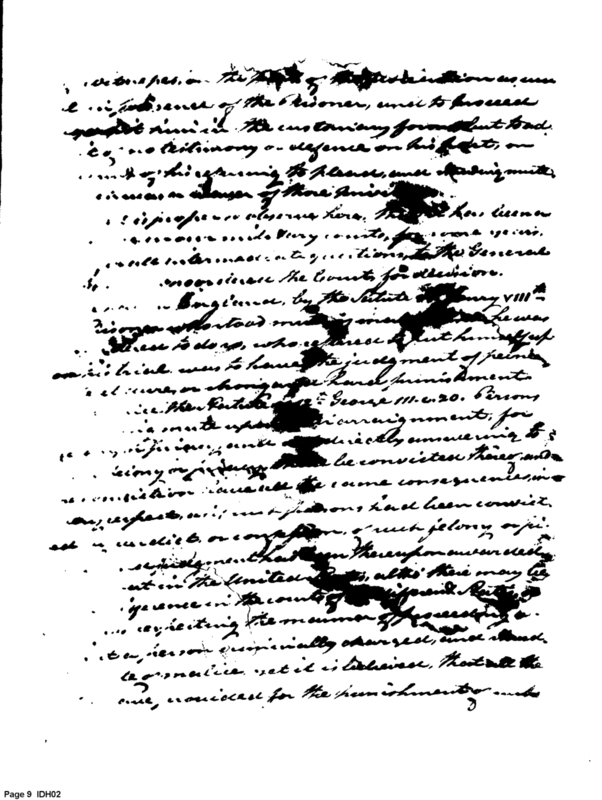
In answer to this note, the Commandant directed the Court, to proceed to the examination of witnesses, on the part of the prosecution as usual in presence of the Prisoner, and to proceed against him in the customary forms, but to admit of no testimony or defense on his part, on account of his refusing to plead, and standing mute, which was a waiver of those privileges.
It is proper to observe here, [undecipherable: that it has been a] practice in our military courts, for some years, to refer all intermediate questions, to the General or Officer, who ordered the Court, for decision.
That in England, by the Statute 33d Henry VIIIth a Prisoner who stood mute of malice, and he was considered to do so, who refused to put himself upon his trial, was to have the judgment of peine forte et dure, or strong and hard punishment.
That since the Statute of 12th George III. c.20. Persons standing mute upon their arraignment, for felony or piracy, and not directly answering to such felony or piracy, shall be convicted thereof, and the conviction have all the same consequences, in every respect, as if such persons had been convicted by verdict, or confession, of such felony, or piracy, and judgment had been thereupon awarded.
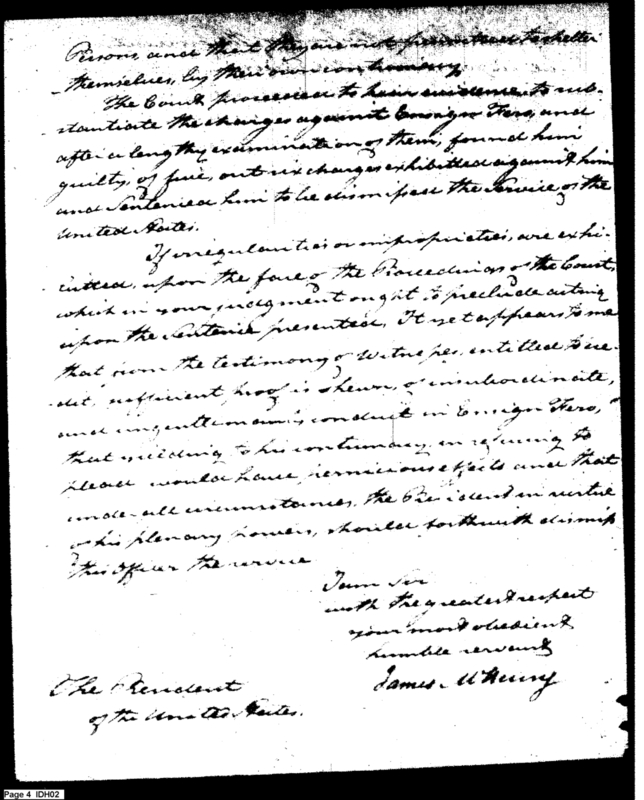
That in the United States, altho' there may be some difference in the courts of the different States, or the laws, respecting the manner of proceeding against a person criminally charged, and standing mute of malice, yet it is believed, that all the States, have provided for the punishment of such Persons and that they are not permitted to better themselves, by their own contumacy.
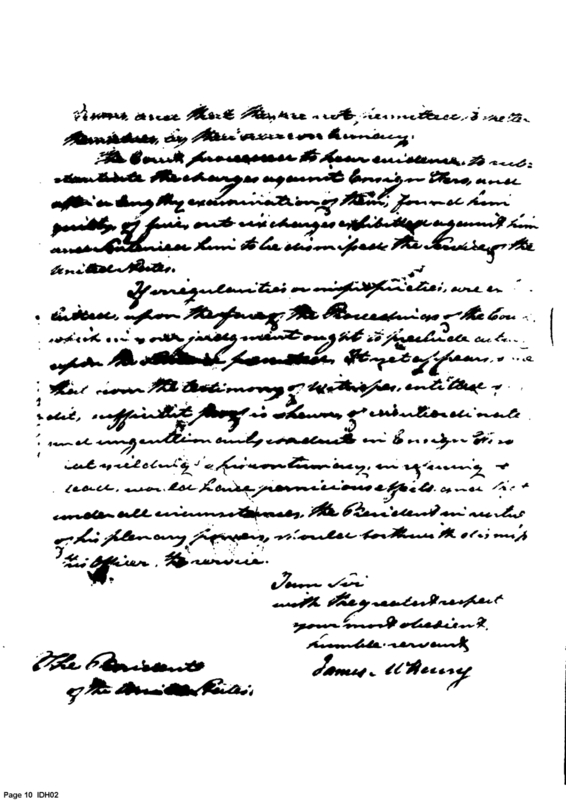
The Court proceeded to hear evidence to substantiate the charges against Ensign Fero, and after a lengthy examination of them, found him guilty, of five, out of six charges exhibited against him, and Sentenced him to be dismissed the Service of the United States.
If irregularities or improprieties, are exhibited, upon the face of the Proceedings of the Court, which in your judgment ought to preclude action upon the sentence presented, It yet appears to me that from the testimony of Witnesses, entitled [undecipherable], sufficient proof is shewn, of insubordinate, and ungentlemanly conduct in Ensign Fero, that [undecipherable] to his contumacy, in refusing to plead, would have pernicious effect, and that under all circumstances, the President in virtue of his plenary powers, should forthwith dismiss his Officer the service.
I am Sir
with the greatest respect
your most obedient
humble servant
James McHenry
The President
of the United States.