

Regarding the punishment for desertion
Document 1799States that it is expedient to empower the Commanding General of an army to decide and execute upon all sentences of the court martial, including any recommendations of clemency, for the crime of desertion. Discusses penalties for desertion and insists that no pardon ought to be extended to deserters or traitors to the enemy.
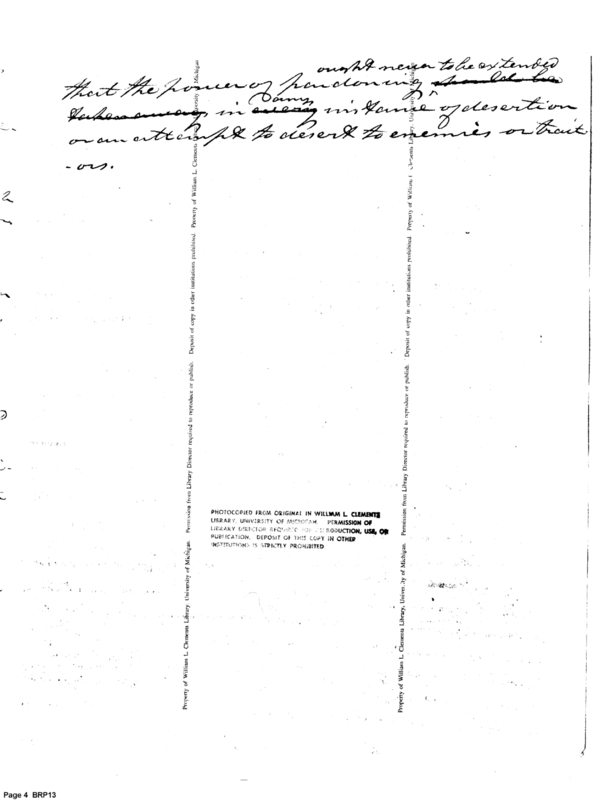
No human transcription currently available for this document.
This transcription was generated by machine using Anthropic's Claude Code (model sonnet 4.6). It may contain errors or inaccuracies. Please verify against the document image. Learn more about our generative AI methodology.
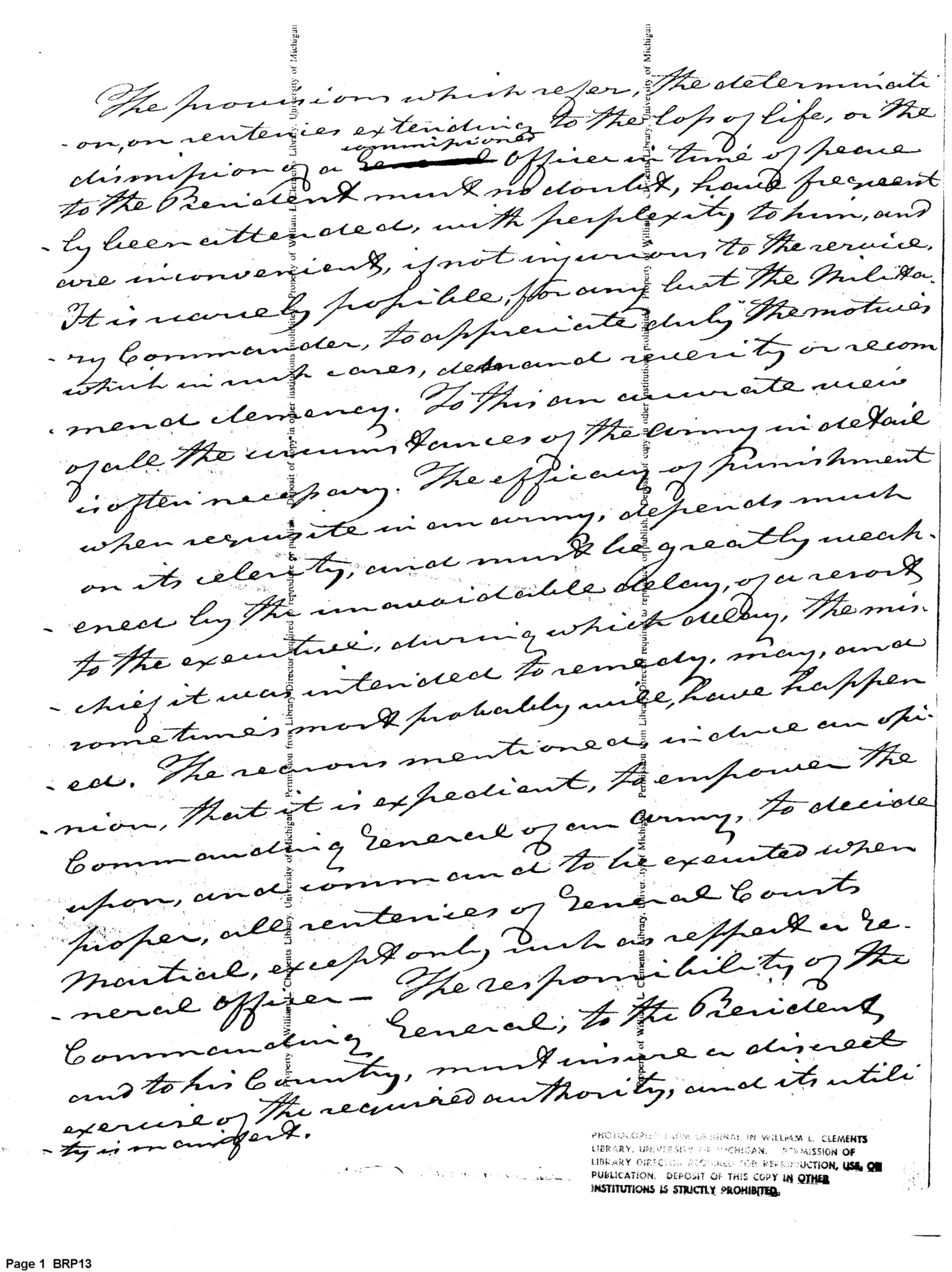
The provisions which refer to the determination, on sentences extending to the loss of life, or the dismission of a [strikethrough: commissioned] Officer in time of peace to the President must no doubt, have frequently been attended, with perplexity to him, and are inconvenient, if not injurious to the service. It is scarcely possible, for any but the Military Commander, to appreciate duly the motives which in such cases, demand severity or recommend clemency. To this an enumerate anew of all the circumstances of the army in detail is often necessary. The efficacy of punishment when requisite in an army, depends much on its celerity, and must be greatly weakened by the unavoidable delay, of a resort, to the executive, during which delay, the mischief it was intended to remedy, may, and sometimes most probably may, have happened. The reasons mentioned induce an opinion, that it is expedient, to empower the Commanding General of an army, to decide upon, and command to be executed when proper, all sentences of General Courts Martial, except only, such as respect a General Officer — The responsibility of the Commanding General; to the President, and to his Country, must insure a discreet exercise of the assumed authority, and its utility is manifest.
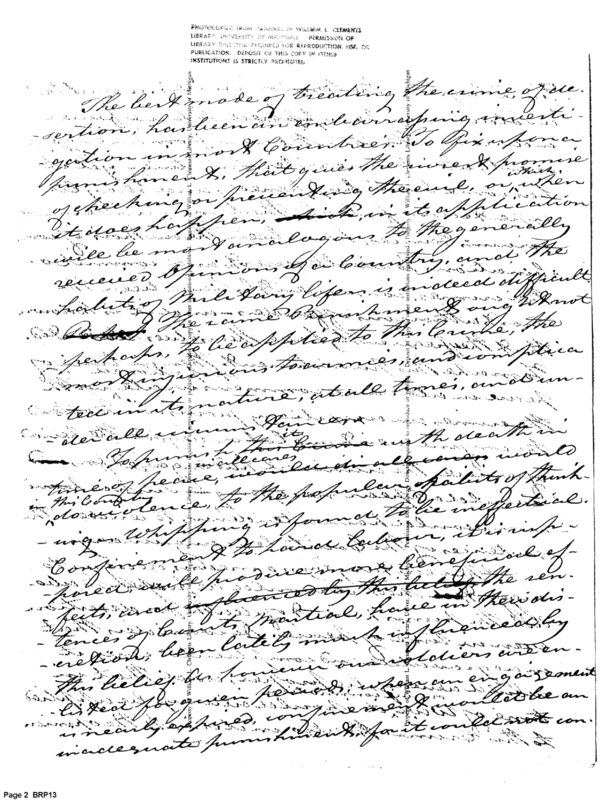
The best mode of treating the crime of desertion, has been an embarrassing investigation in most Countries. To fix upon a punishment, that gives the surest promise of checking or preventing the evil, or, when it does happen, [strikethrough: which] in its application will be most analogous to the generally received opinions of a Country, and the habits of Military life, is indeed difficult. [strikethrough: But] the same punishments ought not [strikethrough: perhaps,] be applied to this Crime, the most ignominious [undecipherable] and complicated in its nature, at all times, and under all circumstances.
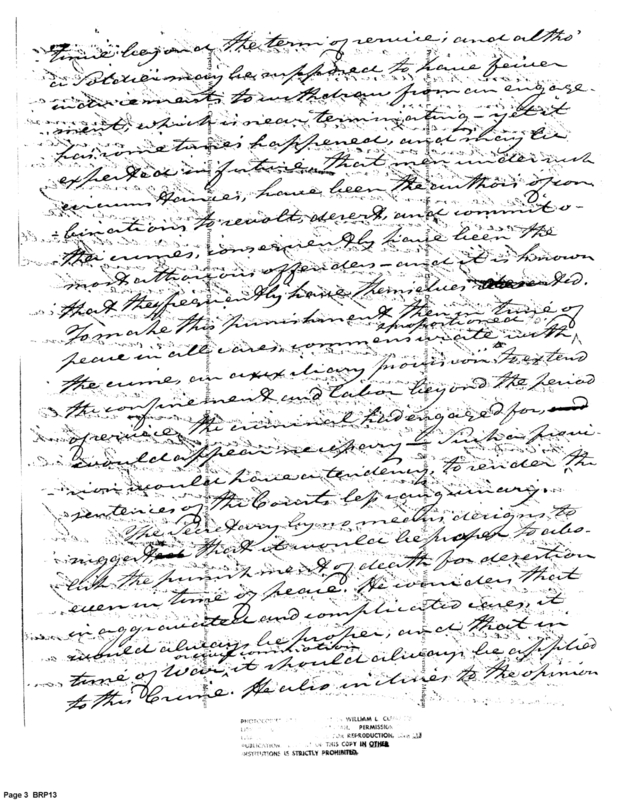
To punish this Crime with death in [undecipherable] of peace, in all cases would in this Country, to the popular habits of thinking, whipping is found to be ineffectual. Confinement, & to hard labour, it is imposed, will produce more beneficial effects, and influenced by this belief, the sentences of Courts Martial, have in their discretion, been lately much influenced by this belief. However our soldiers are enlisted for given periods, when an engaissement is nearly expired, confinement would not be an inadequate punishment for it could not continue beyond the term of service; and altho' a Soldier may be supposed to have fewer inducements to withdraw from an engagement, which is near terminating — yet it has sometimes happened, and men [undecipherable] [undecipherable] — That men under such circumstances, have been the authors of combinations to revolt, desert, and commit other crimes, consequently have been the most atrocious offenders — and it is known that they frequently have themselves [strikethrough: deserted].
To make the punishment therefore proportioned to the crime in all cases commensurable with the crime, an auxilliary provision to extend the confinement and labor beyond the period of service the criminal had engaged for, would appear necessary. Such a provision would have a tendency to render the sentences of the Courts less sanguinary.
The Secretary by no means designs to suggest that it would be proper to abolish the punishment of death for desertion even in time of peace. He considers that in aggravated and complicated cases, it would always be proper, and that in time of War, it should always be applied to this Crime. He also inclines to the opinion that the power of pardoning ought never to be extended [strikethrough: Defencouraging] in [strikethrough: cases] in case of desertion or an attempt to desert to enemies or traitors.
Type
Draft Document
Description
States that it is expedient to empower the Commanding General of an army to decide and execute upon all sentences of the court martial, including any recommendations of clemency, for the crime of desertion. Discusses penalties for desertion and insists that no pardon ought to be extended to deserters or traitors to the enemy.
Date
1799
Author
Repository
Collection
Document number
1799999900002
Page start
1
Note
This document was written in John Caldwell's hand.
Partially illegible.
Notable persons
James McHenry
officer
military
commander
army
general
courts martial
deserters
enemies
traitors
Notable items
Service
provisions
sentences
motives
clemency
authority
crime
desertion
interrogation
peace
punishment
labor
pardon