

Filling Vacancies During a Senate Recess
Document 1799Relays correspondence with Charles Lee, the Attorney General, on the question of a legislative act authorizing the President to fill vacancies in office while the Senate is not in session. Provides a list of recommendations for officer vacancies.



No human transcription currently available for this document.
This transcription was generated by machine using Anthropic's Claude Code (model sonnet 4.6). It may contain errors or inaccuracies. Please verify against the document image. Learn more about our generative AI methodology.
Now I have all pages. Let me compose the transcription from the primary copy (pages 3–7), using the cleaner secondary copy (pages 9–13) to fill in passages obscured by damage.
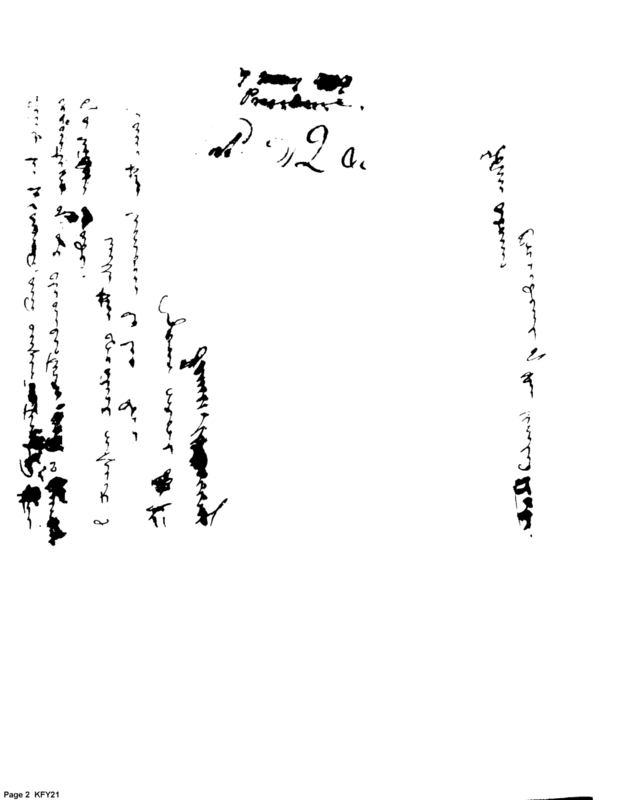
[Docket: 7 [undecipherable] [undecipherable] / Pres[iden]t. / d. 12 a. — remaining docket text undecipherable]
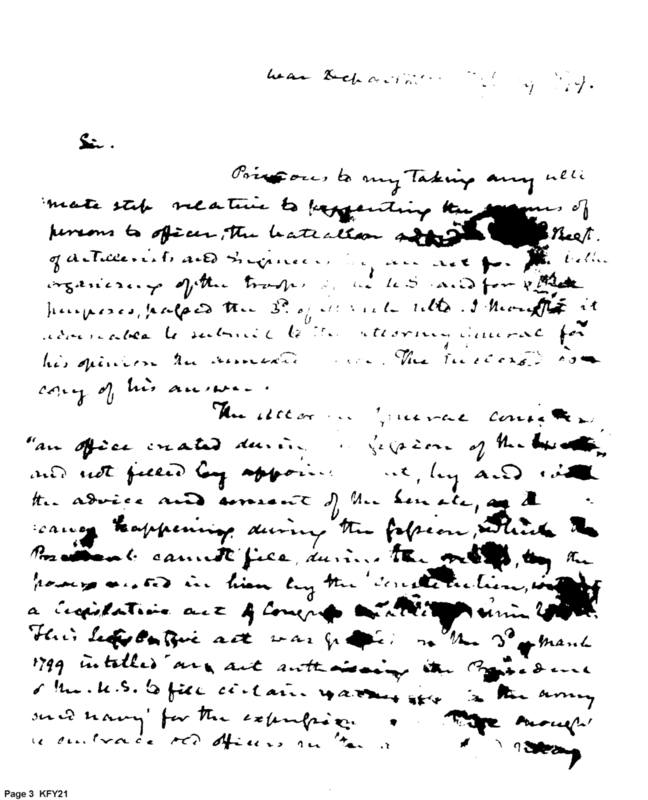
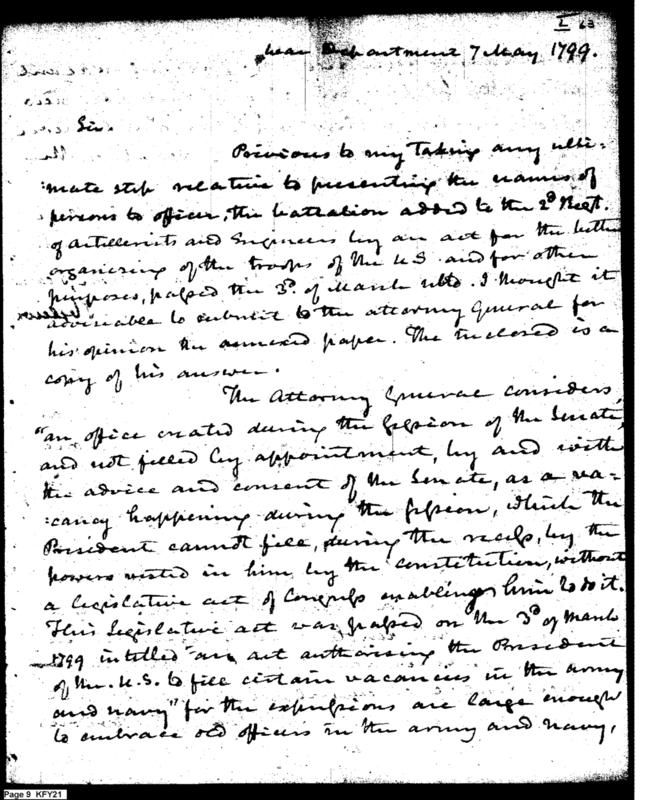
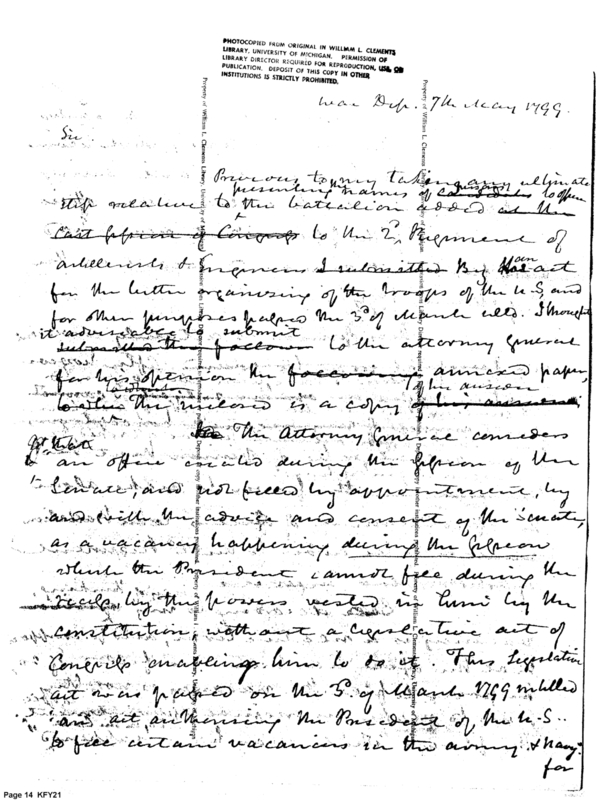
War Department 7 May 1799.
Sir.
Previous to my Taking any ultimate step relative to presenting the names of persons to officer, the battalion added to the 2d Regt. of Artillerists and Engineers by an act for the better organizing of the troops of the U.S. and for other purposes, passed the 3d of March ulto. I thought it adviseable to submit to the Attorney General for his opinion the annexed paper. The inclosed is a copy of his answer.
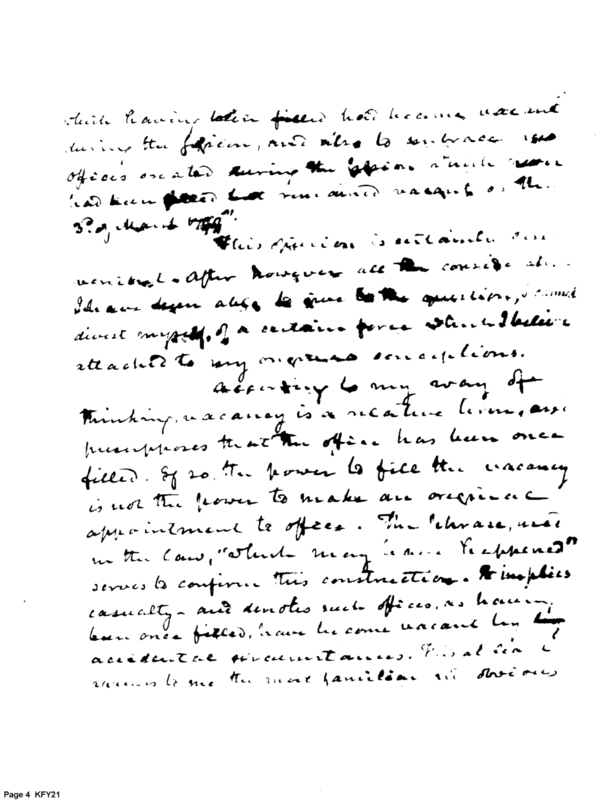
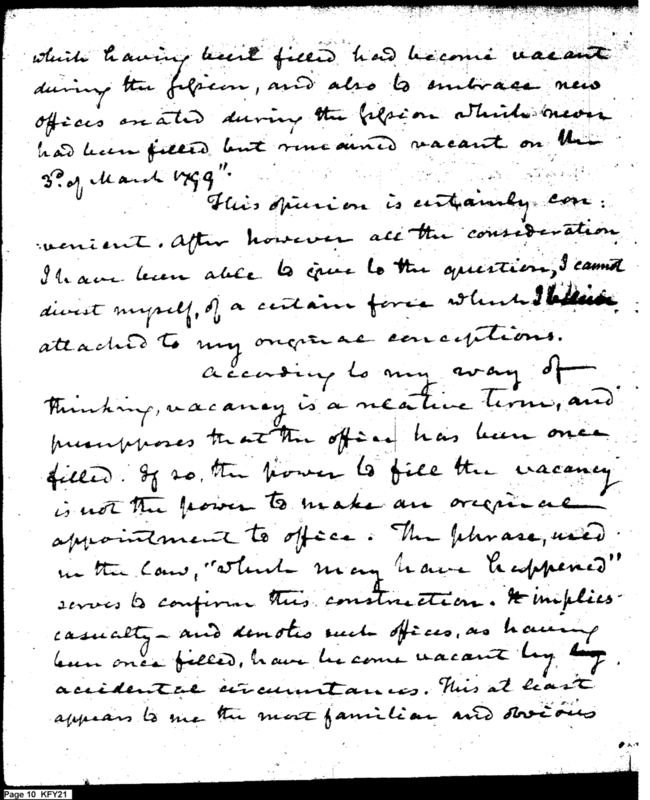
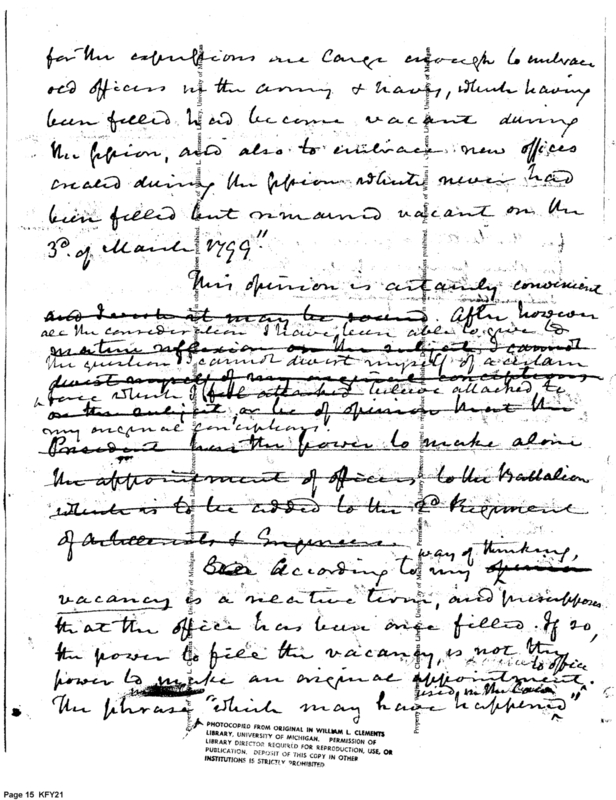
The Attorney General considers, "an office created during the Session of the Senate, and not filled by appointment, by and with the advice and consent of the Senate, as a vacancy happening during the Session, which the President cannot fill, during the recess, by the powers vested in him by the constitution, without a legislative act of Congress enabling him to do it. This legislative act was passed on the 3d of March 1799 intitled 'an act authorising the President of the U.S. to fill certain vacancies in the army and navy' for the expressions are large enough to embrace old Officers in the army and navy, while having been filled had become vacant during the Session, and also to embrace new offices created during the Session which never had been filled but remained vacant on the 3d of March 1799."
This opinion is certainly convenient. After however all the consideration I have been able to give to the question, I cannot divest myself, of a certain force which I believe attached to my original conceptions.
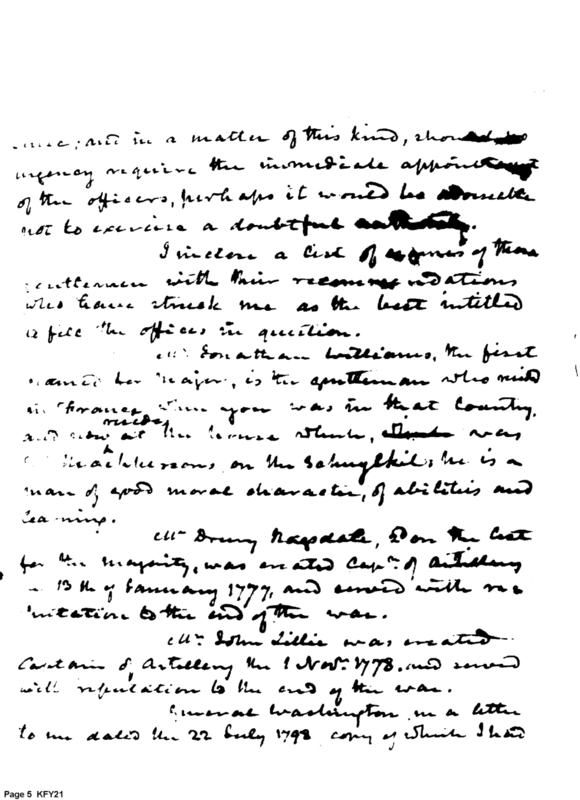
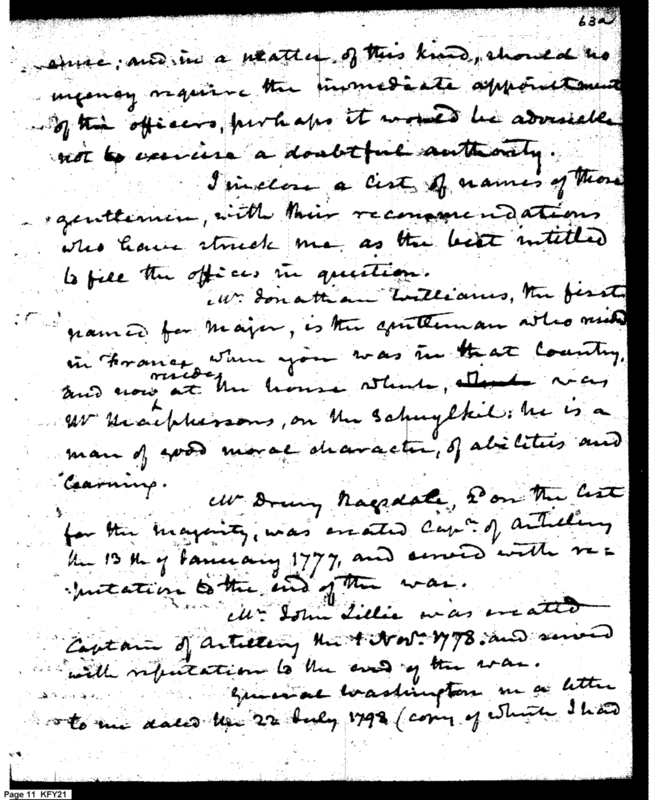
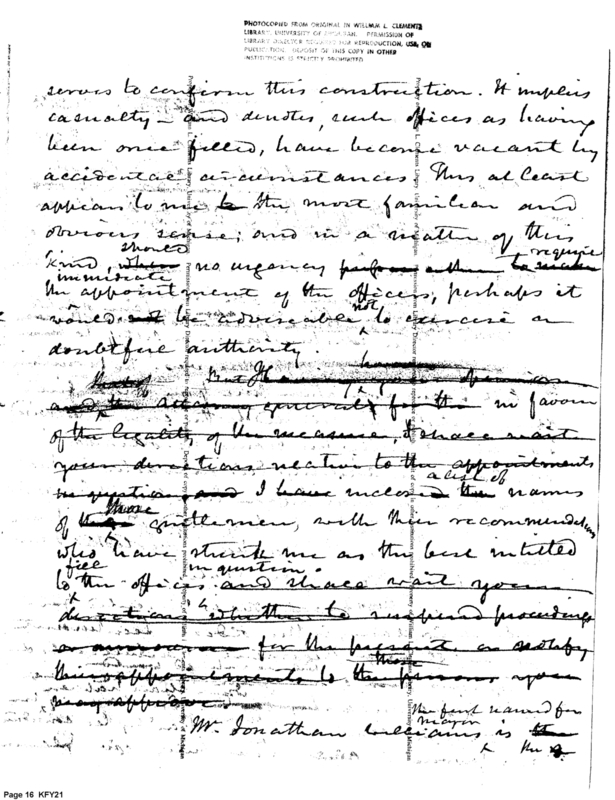
According to my way of thinking, vacancy is a negative term, and presupposes that the office has been once filled. If so, the power to fill the vacancy is not the power to make an original appointment to office. The phrase, used in the law, "which may have happened" serves to confirm this construction. It implies casualty— and denotes such offices, as having been once filled, have become vacant by accidental circumstances. This at least appears to me the most familiar and obvious sense; and in a matter of this kind, should no urgency require the immediate appointment of the officers, perhaps it would be adviseable not to exercise a doubtful authority.
I inclose a list of names of those gentlemen, with their recommendations who have struck me as the best intitled to fill the offices in question.
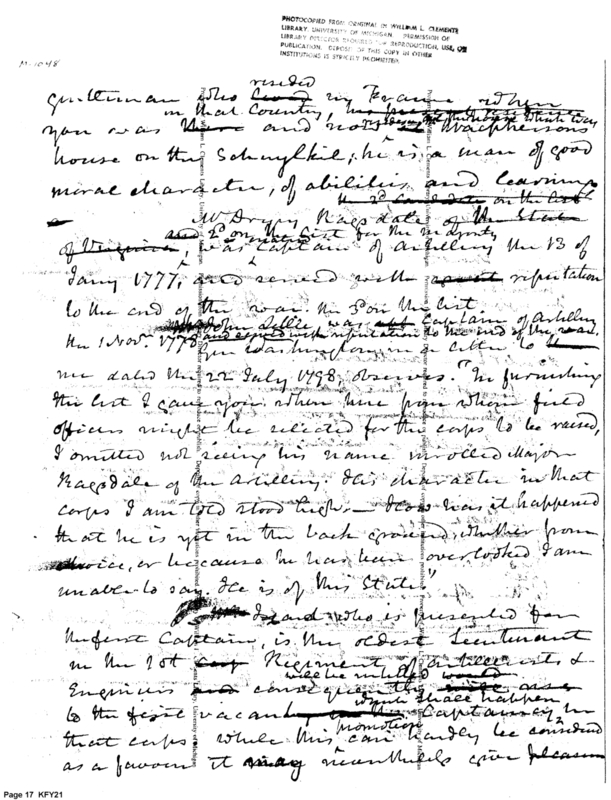
Mr Jonathan Williams, the first named for Major, is the gentleman who resided in France when you was in that Country, and now at the house which, once was Mr Macphersons, on the Schuylkil; he is a man of good moral character, of abilities and learning.
Mr Drury Ragsdale, 2d on the list for the majority, was created Capt. of Artillery the 13th of January 1779, and served with reputation to the end of the war.
Mr John Lillie was created— Captain of Artillery the 1 Novr. 1778, and served with reputation to the end of the war.
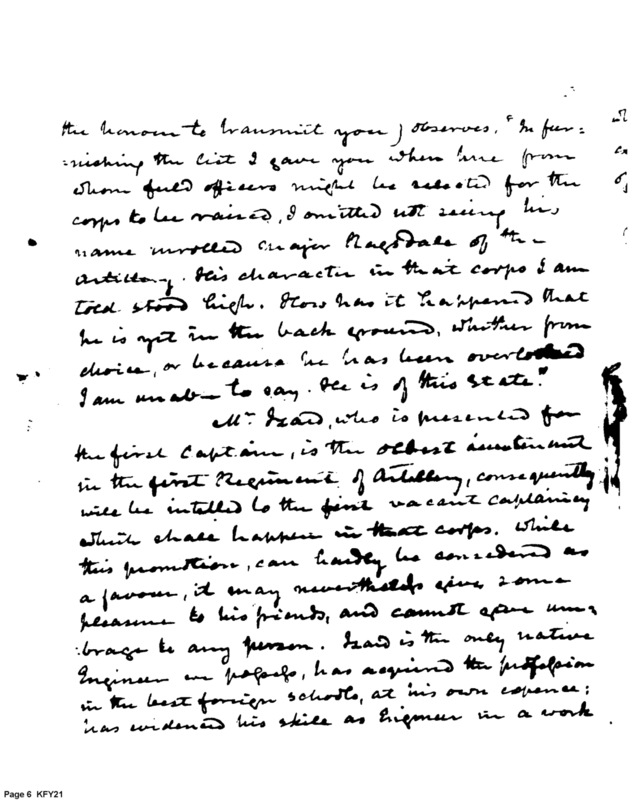
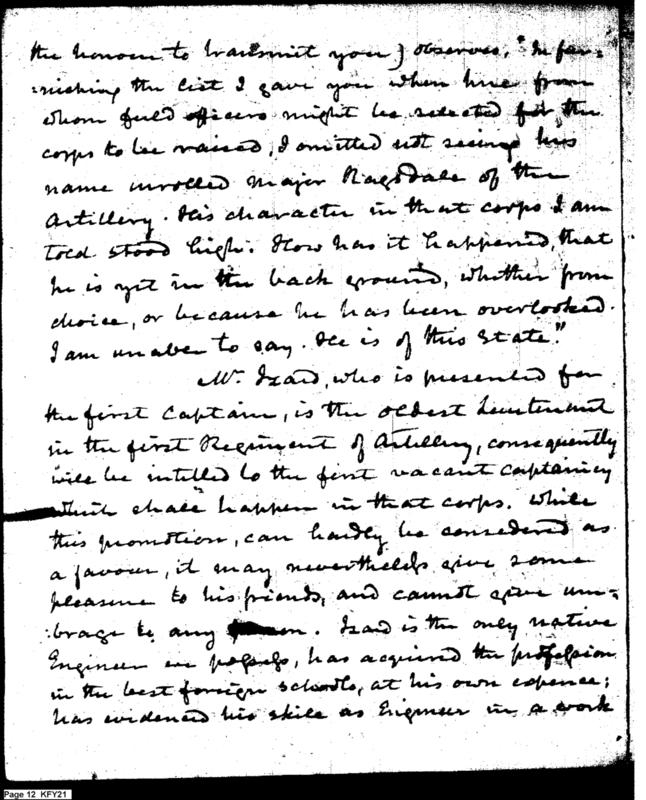
General Washington in a letter to me dated the 22 July 1798 copy of which I had the honour to transmit you, observes, "In furnishing the list I gave you when here from whom field officers might be selected for the corps to be raised, I omitted not seeing his name inrolled Major Ragsdale of the Artillery. His character in that corps I am told stood high. How has it happened that he is yet in the back ground, whether from choice, or because he has been overlooked. I am unable to say. He is of this State."
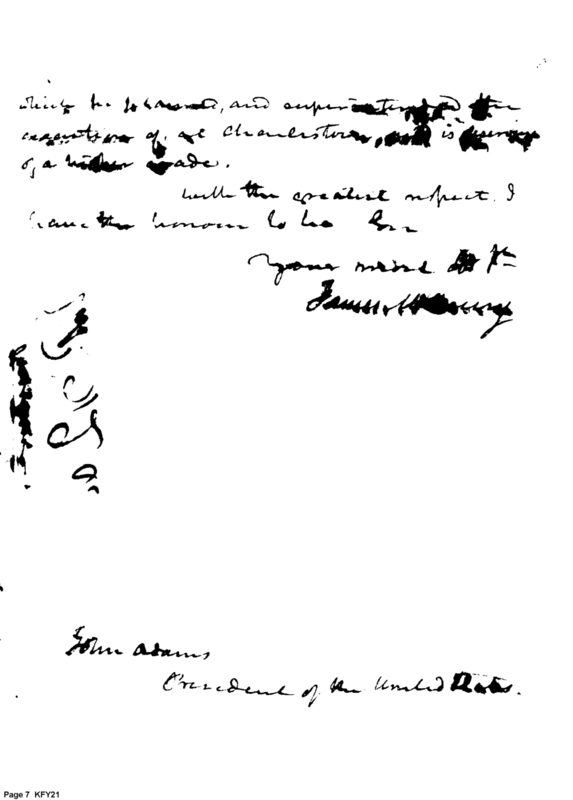
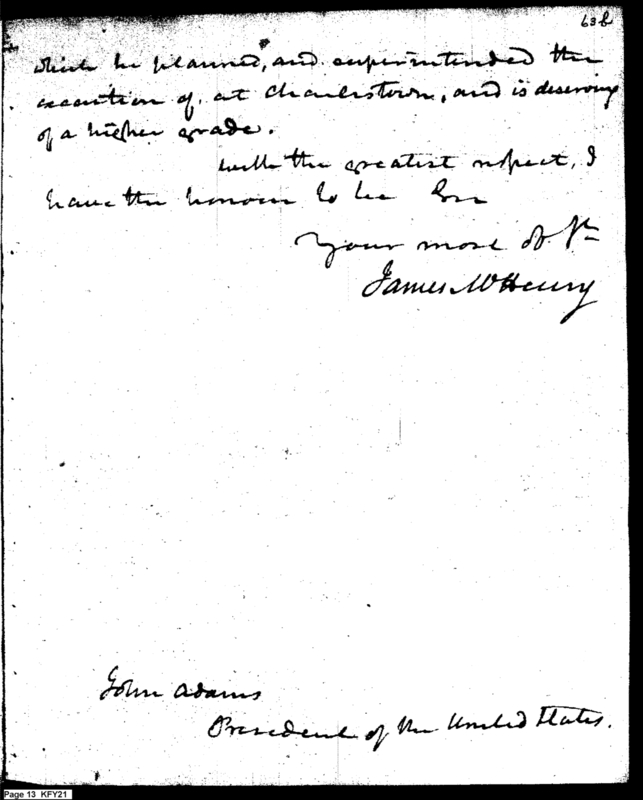
Mr Izzard, who is presented for the first Captain, is the oldest lieutenant in the first Regiment of Artillery, consequently will he intitled to the first vacant Captaincy which shall happen in that corps. While this promotion, can hardly be considered as a favour, it may nevertheless give some pleasure to his friends, and cannot give umbrage to any person. Izzard is the only native Engineer who perhaps, has acquired the profession in the best foreign schools, at his own expence; has evidenced his skill as Engineer in a work which he planned, and superintended the execution of, at Charlestown, and is deserving of a higher grade.
With the greatest respect, I have the honour to be
Your most obt. —
James McHenry
John Adams
President of the United States.
Type
Autograph Letter Signed
Description
Relays correspondence with Charles Lee, the Attorney General, on the question of a legislative act authorizing the President to fill vacancies in office while the Senate is not in session. Provides a list of recommendations for officer vacancies.
Date
05/07/1799
Author
Recipient
Sent from
War Department
Repository
Collection
Document number
1799050700001
Page start
1
Note
Cited in Adams to McHenry, 05/16/1799.
Notable persons
John Adams
James McHenry
officers
2nd Regiment of Artillerists and Engineers
Attorney General
Senate
President
Jonathan Williams
major
Macpherson
Drury Ragsdale
captain
John Lillie
John Lillis
General George Washington
Izard
lieutenant
First Regiment of Artillery
engineer
Notable locations
War Department
France
Schuylkill
Charlestown
Notable items
opinion
annexed paper
office
appointment
Constitution
act of Congress
recess
session
vacancy
list of names
recommendation
promotion
foreign schools
expense