No human transcription currently available for this document.
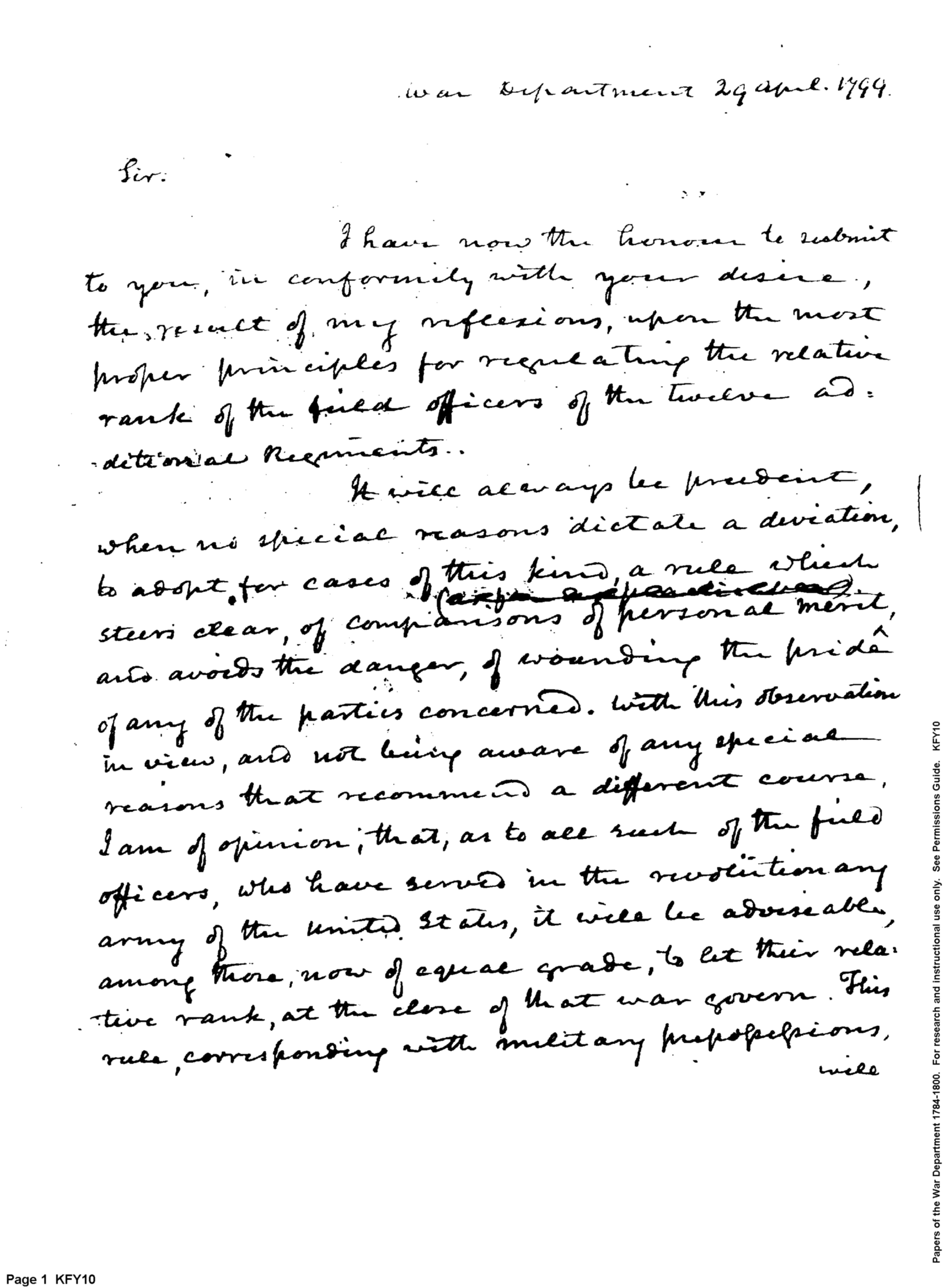
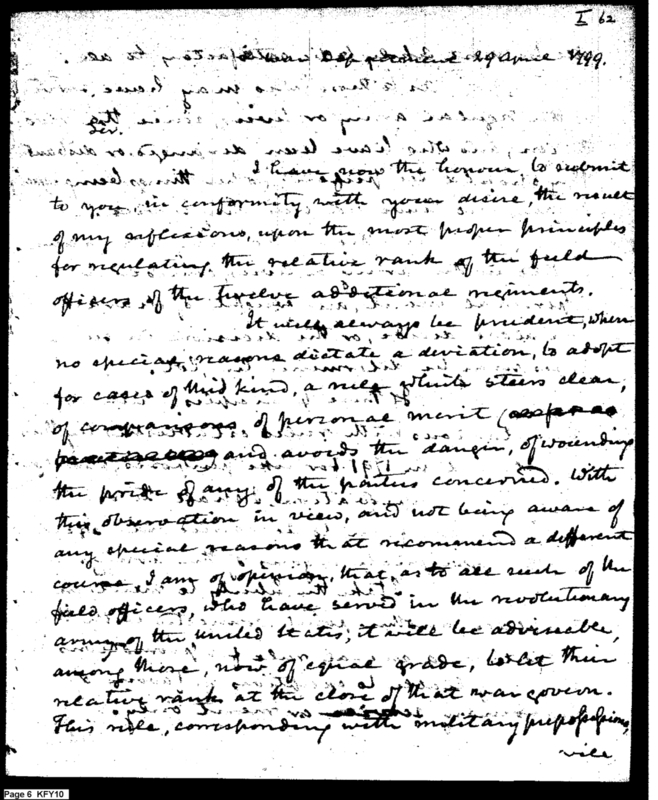
War Department 29 April. 1799.
Sir.
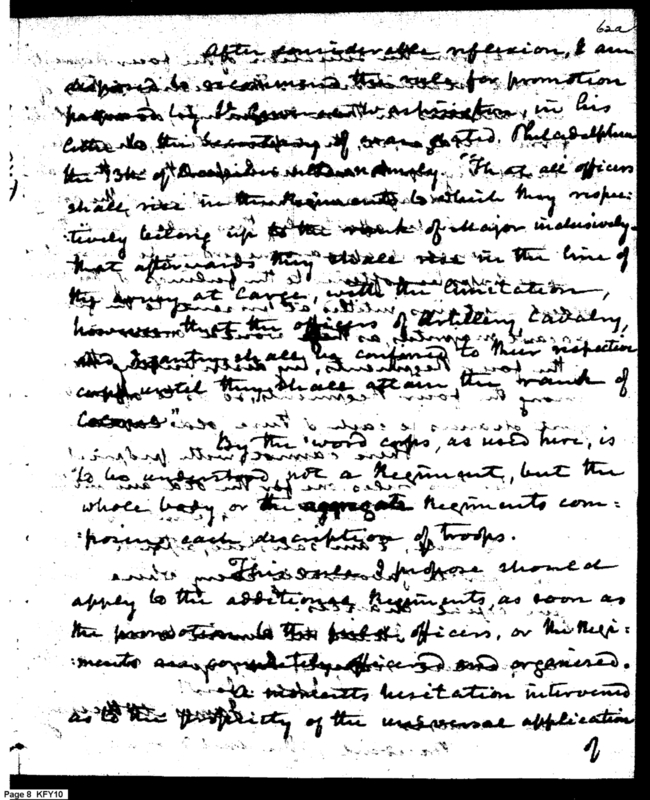
I have now the honour to submit to you, in conformity with your desire, the result of my reflexions, upon the most proper principles for regulating the relative rank of the field officers of the twelve additional Regiments..
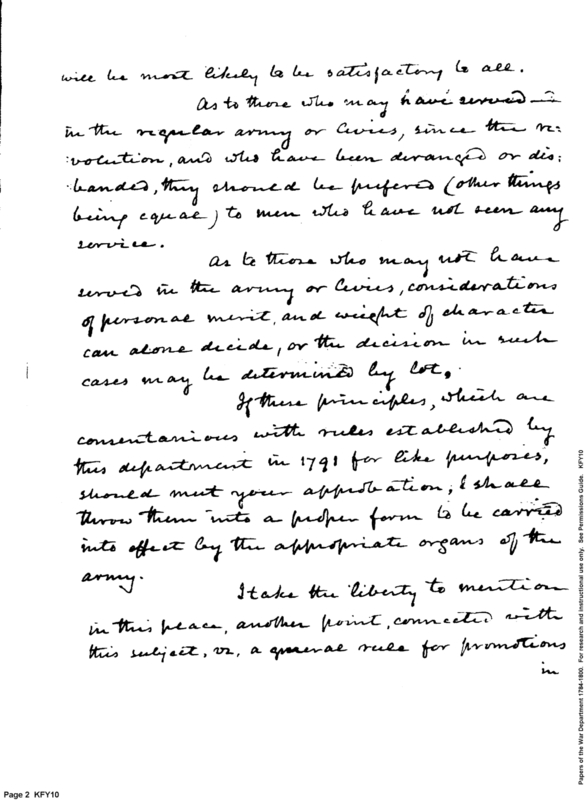
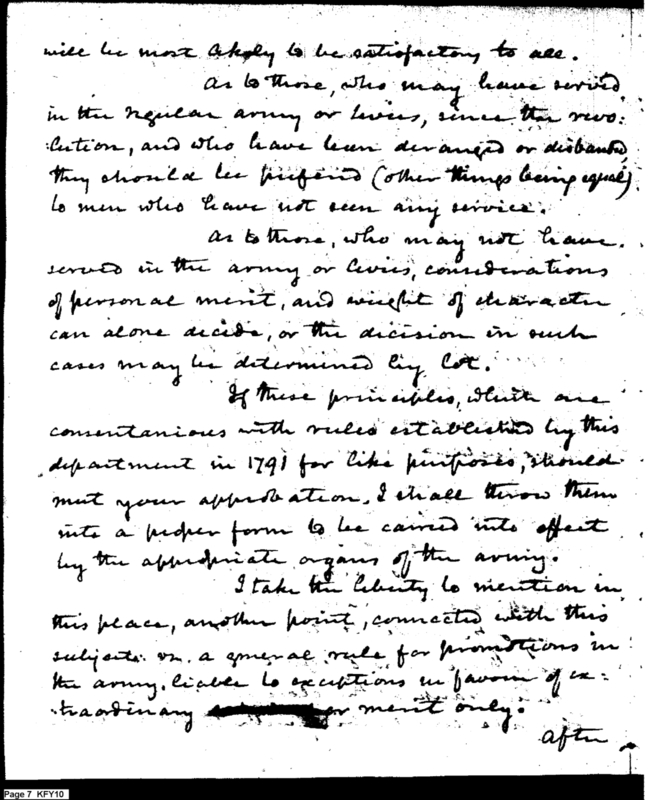
It will always be prudent, when no special reasons dictate a deviation, to adopt for cases of this kind, a rule which steers clear, of [strikethrough: undecipherable] comparisons of personal merit, and avoids the danger, of wounding the pride of any of the parties concerned. With this observation in view, and not being aware of any special reasons that recommend a different course, I am of opinion; that, as to all such of the field officers, who have served in the revolutionary army of the United States, it will be adviseable, among those, now of equal grade, to let their relative rank, at the close of that war govern. This rule, corresponding with military prepossessions, will be most likely to be satisfactory to all.
As to those who may have served in the regular army or levies, since the revolution, and who have been deranged or disbanded, they should be prefered (other things being equal) to men who have not seen any service.
As to those who may not have served in the army or levies, considerations of personal merit, and weight of character can alone decide, or the decision in such cases may be determined by lot.
If these principles, which are consentaneous with rules established by this department in 1791 for like purposes, should meet your approbation, I shall throw them into a proper form to be carried into effect by the appropriate organs of the army.
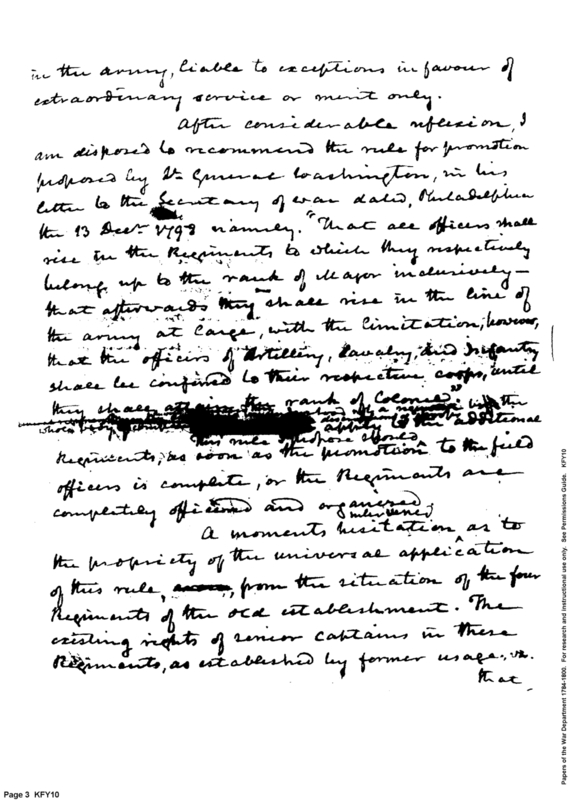
I take the liberty to mention in this place, another point, connected with this subject, viz, a general rule for promotions in the army, liable to exceptions in favour of extraordinary service or merit only.
After considerable reflexion, I am disposed to recommend the rule for promotion proposed by Gl Washington, in his letter to the Secretary of war dated, Philadelphia the 13 Decr 1799 namely. "That all officers shall rise in the Regiments to which they respectively belong, up to the rank of Major inclusively — that afterwards they shall rise in the line of the army at large, with the limitation, however, that the officers of Artillery, Cavalry, and Infantry shall be confined to their respective corps, until they shall attain the rank of Colonel." [undecipherable] This rule I propose [undecipherable: interlined addition] to the additional Regiments, as soon as the promotions to the field officers is complete, or the Regiments are completely officered and organized [undecipherable: interlined addition].
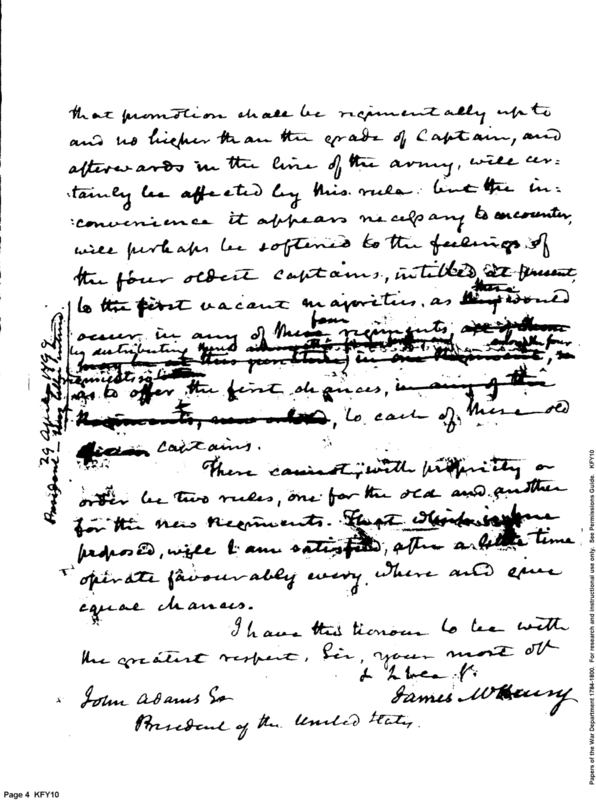
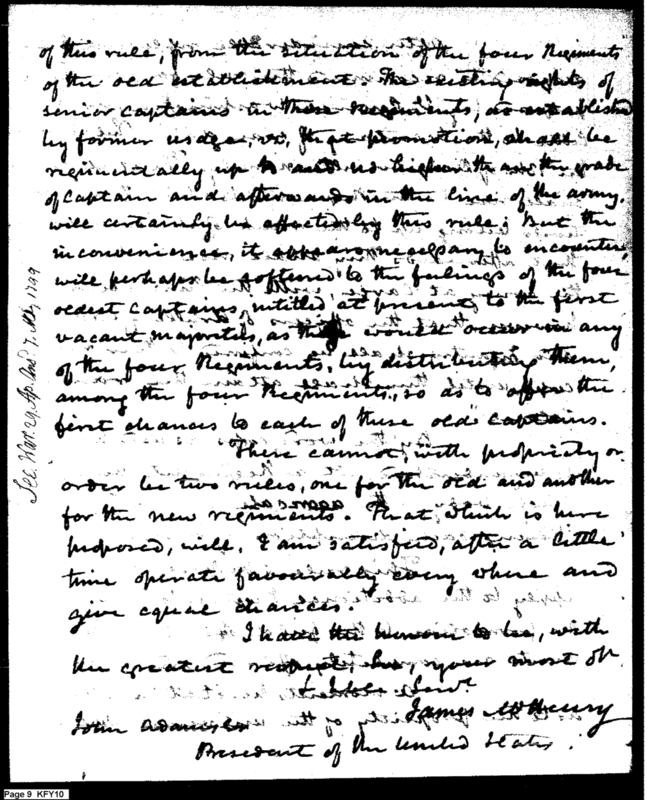
A moments hesitation as to the propriety of the universal application of this rule, [strikethrough: arises], from the situation of the four Regiments of the old establishment. The existing rights of senior captains in these Regiments, as established by former usage, viz. that promotion shall be regimentally up to and no higher than the grade of Captain, and afterwards in the line of the army, will certainly be affected by this rule. but the inconvenience it appears necessary to encounter, will perhaps be softened to the feelings of the four oldest captains, intitled [strikethrough: at present] to the first vacant majorites, as [strikethrough: they would] [strikethrough: occur] [undecipherable: interlined] occur in any of the [undecipherable: interlined] regiments, [strikethrough: and them] by distributing [strikethrough: them] [undecipherable: interlined] among [strikethrough: the positions] in one [undecipherable] [undecipherable: interlined] Regiments [strikethrough: new order], to each of these old [strikethrough: oldest] captains.
There cannot, with propriety or order be two rules, one for the old and another for the new Regiments. That [strikethrough: which is here] proposed, will I am satisfi'd, after a little time operate favourably every where and give equal chances.
I have the honour to be with the greatest respect, Sir, your most obt & hble St
James McHenry
John Adams So
President of the United States.
[Marginal note left side: Propos[al?] 29 April 1799]