No human transcription currently available for this document.
War Department 22 April 1799
Sir.
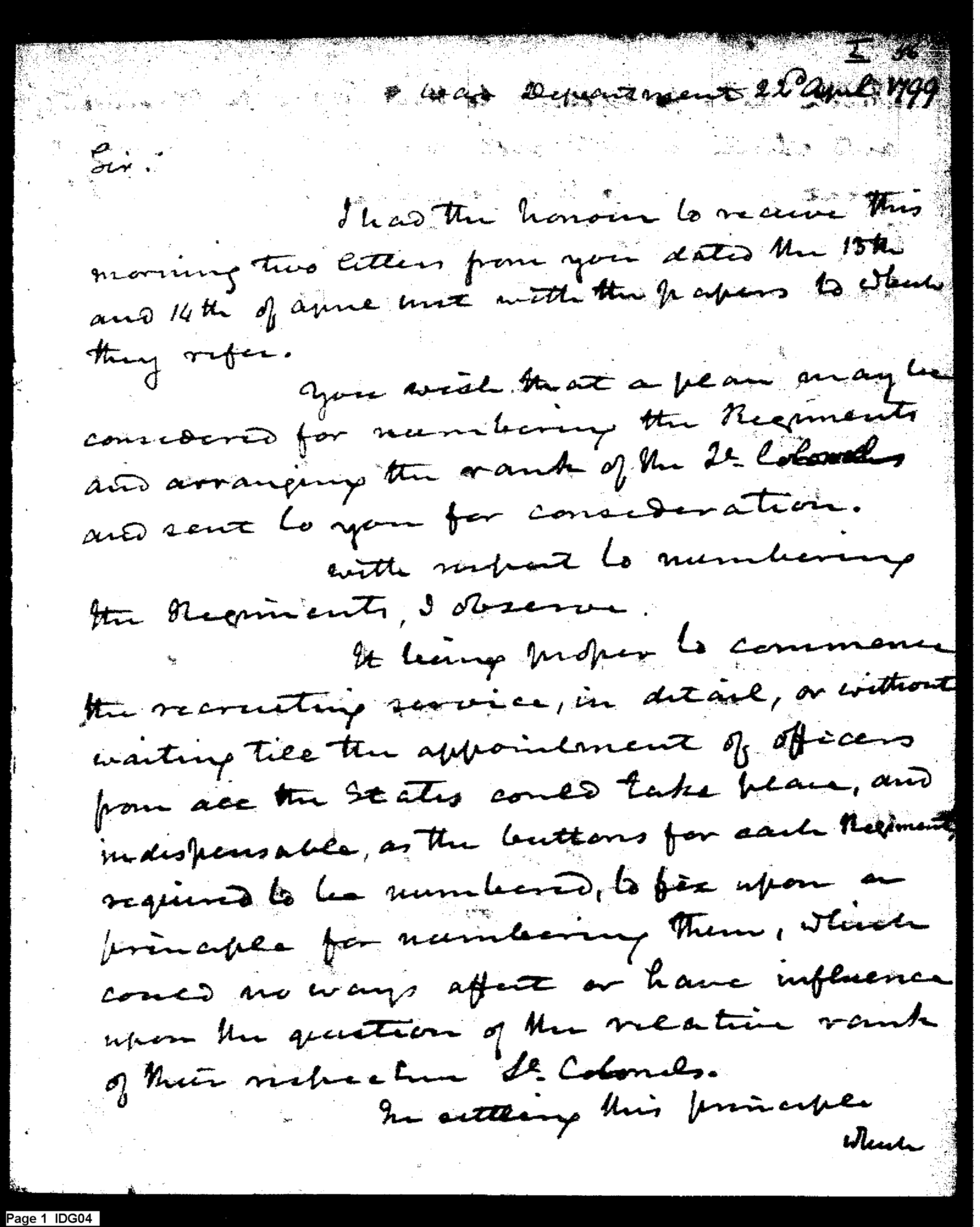
I had the honour to receive this morning two letters from you dated the 13th and 14th of April with the papers to which they refer.
You wish that a plan may be considered for numbering the Regiments and arranging the rank of the Lt. Colonels and sent to you for consideration.
With respect to numbering the Regiments, I observe.
It being proper to commence the recruiting service, in detail, or without waiting till the appointment of officers from all the States could take place, and indispensable, as the buttons for each Regiment required to be numbered, to fix upon a principle for numbering them, which could no ways affect or have influence upon the question of the relative rank of their respective Lt. Colonels.
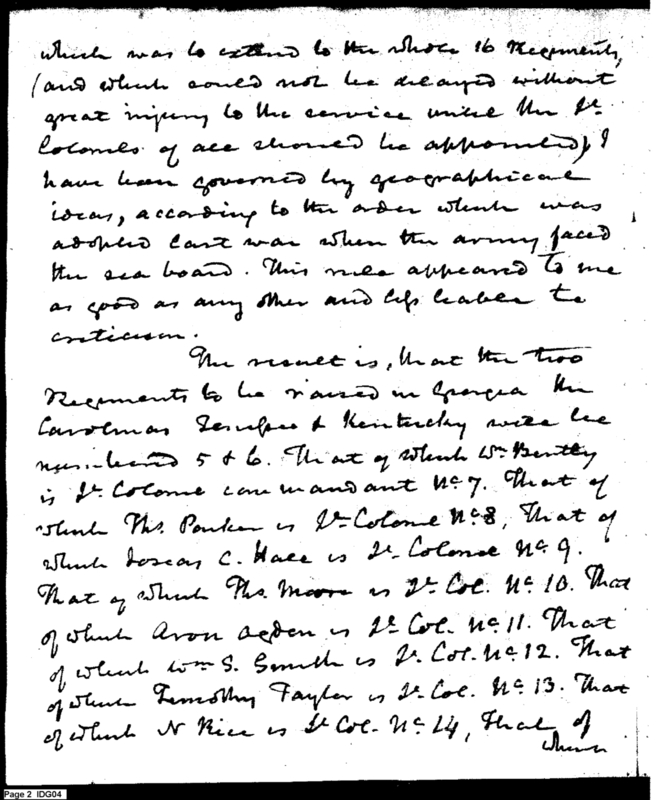
In settling this principle which was to extend to the whole 16 Regiments, (and which could not be delayed without great injury to the service until the Lt. Colonels of all should be appointed) I have been governed by geographical ideas, according to the order which was adopted last war when the army faced the sea board. This rule appeared to me as good as any other and less liable to criticism.
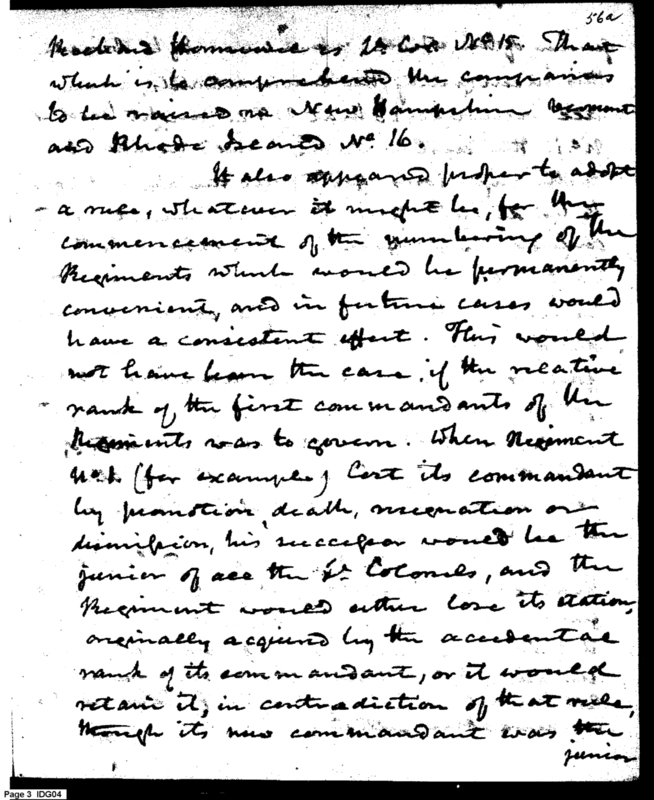
The result is, that the two Regiments to be raised in Georgia the Carolinas [undecipherable] & Kentucky were numbered 5 & 6. That of which W. Bentley is Lt. Colonel commandant N° 7. That of which Th. Parker is Lt. Colonel N° 8. That of which Josias C. Hall is Lt. Colonel N° 9. That of which Th. Moore is Lt. Col. N° 10. That of which Aron Ogden is Lt. Col. N° 11. That of which Wm S. Smith is Lt. Col. N° 12. That of which Timothy Tayler is Lt. Col. N° 13. That of which N. Rice is Lt. Col. N° 14. That of [undecipherable] is Lt. Col. N° 15. That which is to comprehend the companies to be raised on New Hampshire Regiment and Rhode Island N° 16.
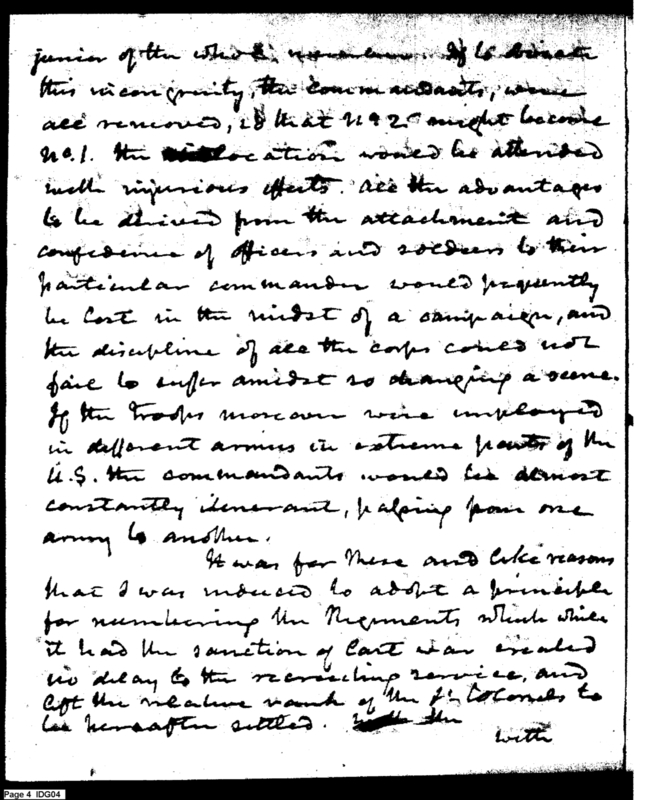
It also appeared proper to adopt a rule, whatever it might be, for the commencement of the numbering of the Regiments which would be permanently convenient, and in future cases would have a consistent effect. This would not have been the case if the relative rank of the first commandants of the Regiments was to govern. When Regiment N° 8 (for example) lost its commandant by promotion, death, resignation or dismission, his successor would be the junior of all the Lt. Colonels, and the Regiment would either lose its station originally acquired by the accidental rank of its commandant, or it would retain it, in contradiction of that rule, though its new commandant was the junior of the whole number. To obviate this incongruity, the commandants were all removed, so that N° 2 might become N° 1. The [undecipherable] would be attended with injurious effects. All the advantages to be derived from the attachment and confidence of officers and soldiers to their particular commander would frequently be lost in the midst of a campaign, and the discipline of all the corps could not fail to suffer amidst so changing a scene. If the troops moreover were employed in different armies in extreme parts of the U.S. the commandants would be almost constantly itinerant, passing from one army to another.
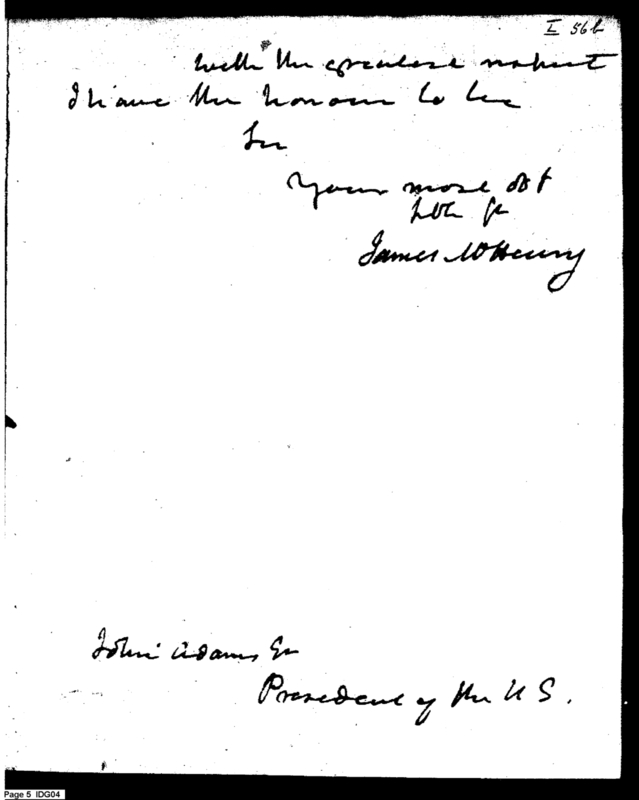
It was for these and like reasons that I was induced to adopt a principle for numbering the Regiments which while it had the sanction of last war, created no delay to the recruiting service, and left the relative rank of the Lt. Colonels to be hereafter settled. [strikethrough: [undecipherable]] with the greatest respect I have the honour to be
Sir
your most obt
hble Se
James McHenry
John Adams Esq
President of the U.S.