

Rules and Regulations Respecting the Recruting Service
Document 1799These are the thirty seven rules and regulations for the recruiting service including the prohibition of recruiting individuals who are intoxicated or who are Negroes, Mulattoes, or Indians. Included is a sample of an enlistment document.



No human transcription currently available for this document.
This transcription was generated by machine using Anthropic's Claude Code (model sonnet 4.6). It may contain errors or inaccuracies. Please verify against the document image. Learn more about our generative AI methodology.
[undecipherable — page wholly illegible]
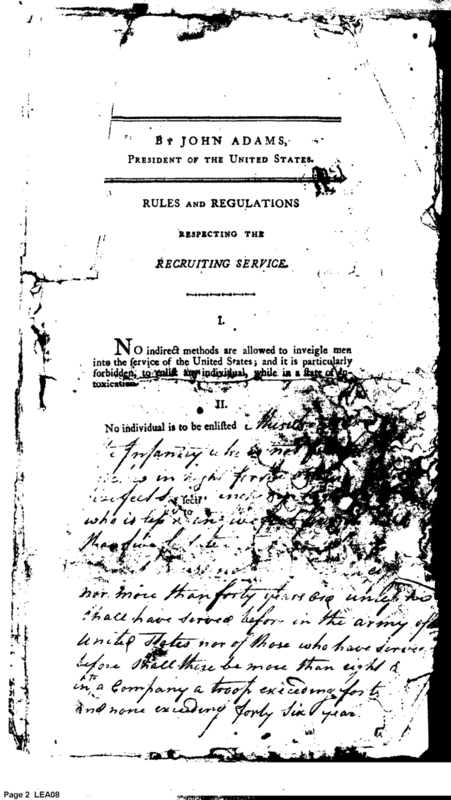
By JOHN ADAMS,
PRESIDENT OF THE UNITED STATES.
RULES AND REGULATIONS
RESPECTING THE
RECRUITING SERVICE.
I.
No indirect methods are allowed to inveigle men into the fervice of the United States; and it is particularly forbidden, to enlifl any individual, while in a ftate of intoxication [undecipherable]
II.
No individual is to be enlifted [undecipherable]
[undecipherable: Infantry] who is not [undecipherable]
[undecipherable] in [undecipherable] fervice [undecipherable]
[undecipherable] feet [undecipherable] erect [undecipherable]
who is [undecipherable] [undecipherable] [undecipherable]
[undecipherable]
nor more than forty years old un[undecipherable] no
fhall have ferved before in the army of
United States nor of thofe who have ferved
before fhall there be more than eight [undecipherable]
in a Company a troop exceeding for[undecipherable]
and none exceeding forty Six years.
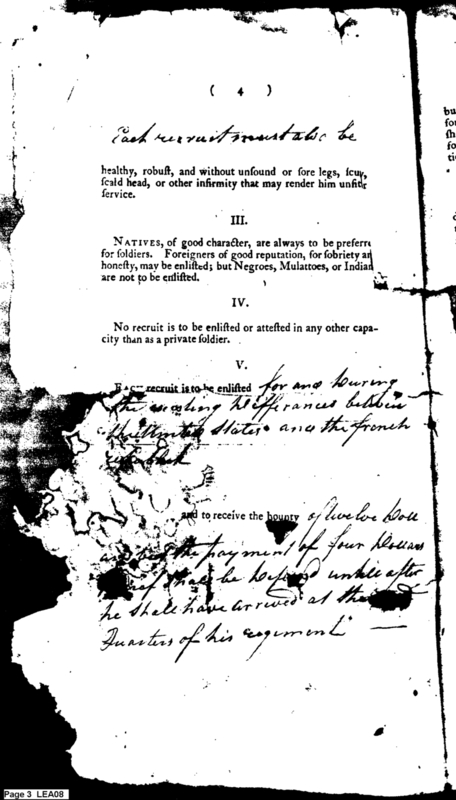
Each recruit muft alfo be
healthy, robuft, and without unfound or fore legs, fcuy, fcald head, or other infirmity that may render him unfit for fervice.
III.
NATIVES, of good character, are always to be preferred for foldiers. Foreigners of good reputation, for fobriety and honefty, may be enlifted; but Negroes, Mulattoes, or Indians are not to be enlifted.
IV.
No recruit is to be enlifted or attefted in any other capacity than as a private foldier.
V.
Each recruit is to be enlifted for and during [undecipherable]
the [undecipherable] differences between
[undecipherable] States, and the French
[undecipherable]
and to receive the bounty of twelve Doll[undecipherable]
and [undecipherable] the payment of four Dollars
[undecipherable] fhall be kept [undecipherable] until after
he fhall have arrived at the [undecipherable]
Quarters of his regiment —
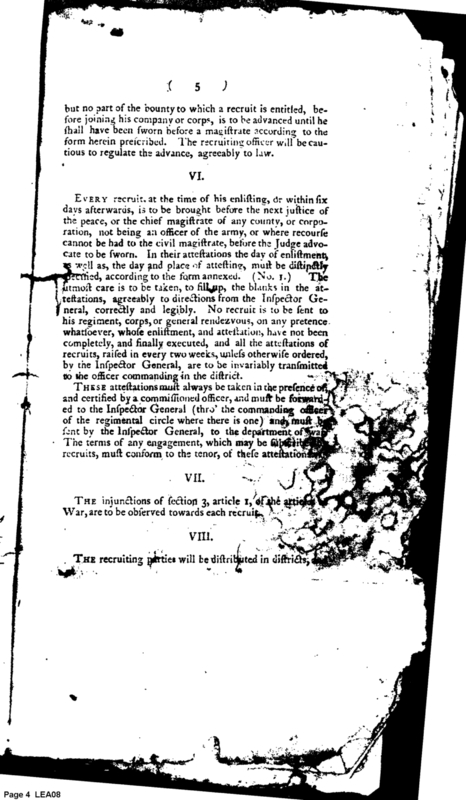
but no part of the bounty to which a recruit is entitled, before joining his company or corps, is to be advanced until he fhall have been fworn before a magiftrate according to the form herein prefcribed. The recruiting officer will be cautious to regulate the advance, agreeably to law.
VI.
EVERY recruit, at the time of his enlifting, or within fix days afterwards, is to be brought before the next juftice of the peace, or the chief magiftrate of any county, or corporation, not being an officer of the army, or where recourfe cannot be had to the civil magiftrate, before the Judge advocate to be fworn. In their atteflations the day of enlifment, as well as, the day and place of attefting, muft be diftinctly certified, according to the form annexed. (No. 1.) The utmoft care is to be taken, to fill up, the blanks in the atteftations, agreeably to directions from the Infpector General, correctly and legibly. No recruit is to be fent to his regiment, corps, or general rendezvous, on any pretence whatfoever, whofe enliflment, and atteftation, have not been completely, and finally executed, and all the atteftations of recruits, raifed in every two weeks, unlefs otherwife ordered, by the Infpector General, are to be invariably tranfmitted to the officer commanding in the diftrict.
THESE atteftations muft always be taken in the prefence of, and certified by a commiffioned officer, and muft be forwarded to the Infpector General (thro' the commanding officer of the regimental circle where there is one) and muft be fent by the Infpector General, to the department of War. The terms of any engagement, which may be fubftituted for recruits, muft conform to the tenor, of thefe atteftations.
VII.
THE injunctions of fection 3, article 1, of the articles of War, are to be obferved towards each recruit.
VIII.
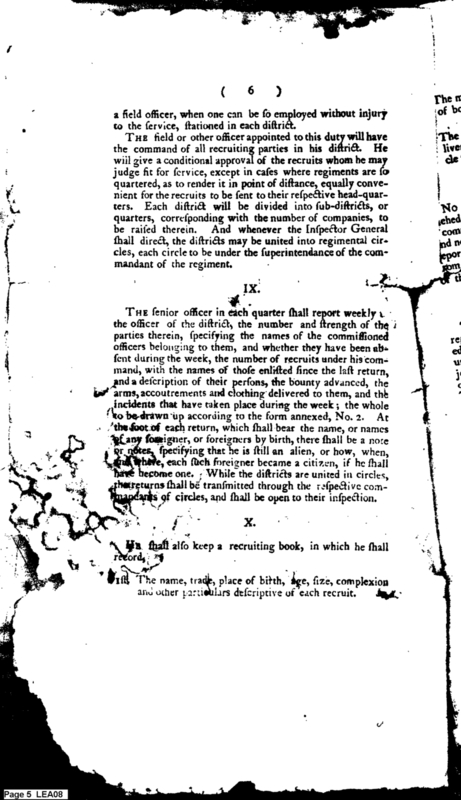
THE recruiting parties will be diftributed in diftricts, a field officer, when one can be fo employed without injury to the fervice, ftationed in each diftrict.
THE field or other officer appointed to this duty will have the command of all recruiting parties in his diftrict. He will give a conditional approval of the recruits whom he may judge fit for fervice, except in cafes where regiments are fo quartered, as to render it in point of diftance, equally convenient for the recruits to be fent to their refpective head-quarters. Each diftrict will be divided into fub-diftricts, or quarters, correfponding with the number of companies, to be raifed therein. And whenever the Infpector General fhall direct, the diftricts may be united into regimental circles, each circle to be under the fuperintendance of the commandant of the regiment.
IX.
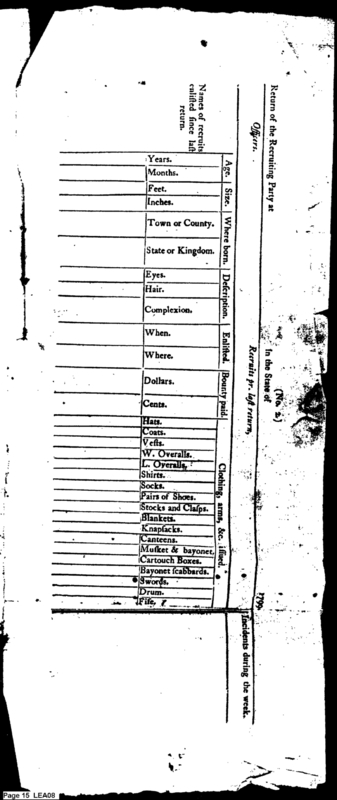
THE fenior officer in each quarter fhall report weekly to the officer of the diftrict, the number and ftrength of the parties therein, fpecifying the names of the commiffioned officers belonging to them, and whether they have been abfent during the week, the number of recruits under his command, with the names of thofe enlifted fince the laft return, and a defcription of their perfons, the bounty advanced, the arms, accoutrements and clothing delivered to them, and the incidents that have taken place during the week; the whole to be drawn up according to the form annexed, No. 2. At the foot of each return, which fhall bear the name, or names of any foreigner, or foreigners by birth, there fhall be a note or notes, fpecifying that he is ftill an alien, or how, when, and where, each fuch foreigner became a citizen, if he fhall have become one. While the diftricts are united in circles, the returns fhall be tranfmitted through the refpective commandants of circles, and fhall be open to their infpection.
X.
He fhall alfo keep a recruiting book, in which he fhall record,
1ft The name, trade, place of birth, age, fize, complexion and other particulars defcriptive of each recruit.
The money advanced every recruit whether on account of bounty or pay.
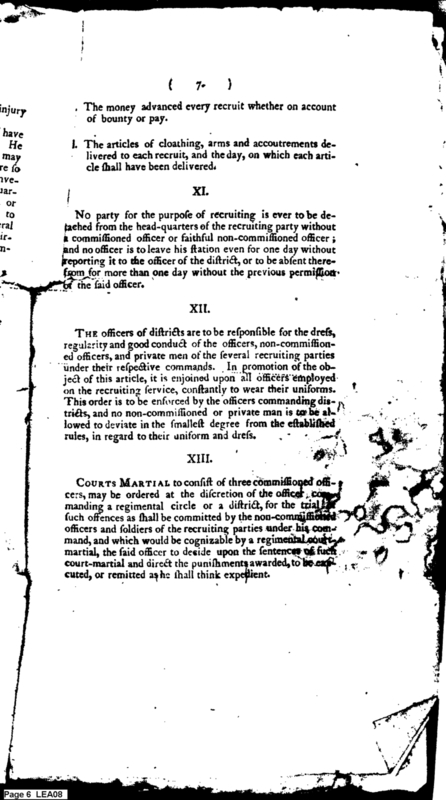
l. The articles of cloathing, arms and accoutrements delivered to each recruit, and the day, on which each article fhall have been delivered.
XI.
No party for the purpofe of recruiting is ever to be detached from the head-quarters of the recruiting party without a commiffioned officer or faithful non-commiffioned officer; and no officer is to leave his ftation even for one day without reporting it to the officer of the diftrict, or to be abfent therefrom for more than one day without the previous permiffion of the faid officer.
XII.
THE officers of diftricts are to be refponfible for the drefs, regularity and good conduct of the officers, non-commiffioned officers, and private men of the feveral recruiting parties under their refpective commands. In promotion of the object of this article, it is enjoined upon all officers employed on the recruiting fervice, conftantly to wear their uniforms. This order is to be enforced by the officers commanding diftricts, and no non-commiffioned or private man is to be allowed to deviate in the fmalleft degree from the eftablifhed rules, in regard to their uniform and drefs.
XIII.
COURTS MARTIAL to confift of three commiffioned officers, may be ordered at the difcretion of the officer commanding a regimental circle or a diftrict, for the trial of fuch offences as fhall be committed by the non-commiffioned officers and foldiers of the recruiting parties under his command, and which would be cognizable by a regimental court-martial, the faid officer to decide upon the fentences of fuch court-martial and direct the punifhments awarded, to be executed, or remitted as he fhall think expedient.
XIV.
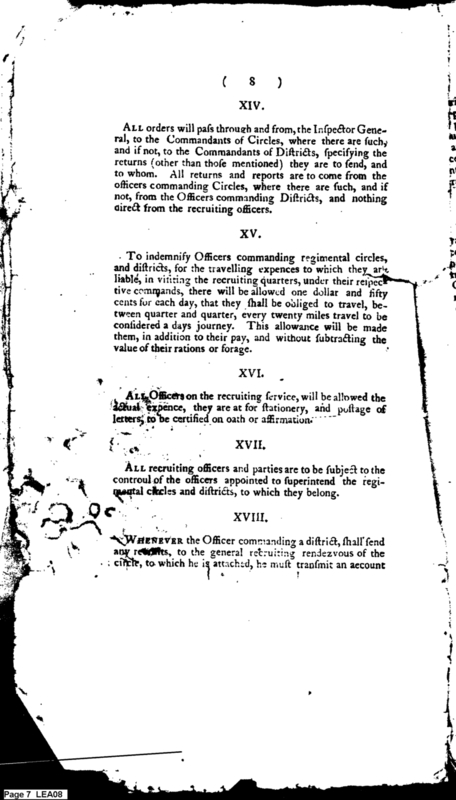
ALL orders will pafs through and from, the Infpector General, to the Commandants of Circles, where there are fuch, and if not, to the Commandants of Diftricts, fpecifying the returns (other than thofe mentioned) they are to fend, and to whom. All returns and reports are to come from the officers commanding Circles, where there are fuch, and if not, from the Officers commanding Diftricts, and nothing direct from the recruiting officers.
XV.
To indemnify Officers commanding regimental circles, and diftricts, for the travelling expences to which they are liable, in vifiting the recruiting quarters, under their refpective commands, there will be allowed one dollar and fifty cents for each day, that they fhall be obliged to travel, between quarter and quarter, every twenty miles travel to be confidered a days journey. This allowance will be made them, in addition to their pay, and without fubtracting the value of their rations or forage.
XVI.
ALL Officers on the recruiting fervice, will be allowed the actual expence, they are at for ftationery, and poftage of letters, to be certified on oath or affirmation.
XVII.
ALL recruiting officers and parties are to be fubject to the controul of the officers appointed to fuperintend the regimental circles and diftricts, to which they belong.
XVIII.
WHENEVER the Officer commanding a diftrict, fhall fend any recruits, to the general recruiting rendezvous of the circle, to which he is attached, he muft tranfmit an account writing to the proper officer, ftating, what bounty has been paid, and to what period fuch recruits have received pay, and fubfiftence, and alfo the cloathing, arms, and accoutrements, that have been delivered to them refpectively, at what times. Like returns muft be tranfmitted by the officer appointed to recruit for a regiment, or corps, on the frontiers, or at a diftance to the proper officer when he fends his recruits, to their refpective regiments, corps, or companies.
XIX.
WHEN recruits abfcond or refufe to go before a magiftrate to be attefted within the time prefcribed, an attefted certificate of that fact is to be immediately fent to the officer commanding in the diftrict, in order to its being tranfmitted to the Infpector-General and alfo to the Head-Quarters of the regiment or corps, and the Paymafter of the regiment. No allowance will be made to the recruiting officer for recruits fo abfconding or refufing to go before a magiftrate, and afterwards returned as deferters, although they fhould be fent under an efcort to their regiments, corps, or general rendezvous, unlefs fuch certificate fhall have been previoufly received.
XX.
THE officer that enlifts a recruit who, on joining his regiment or corps, or upon infpection by the proper officer, fhall be found to labor under any difability which, exifted, and might have been known before his enliflment, and incapacitates him from performing the duties of a foldier, fhall reimburfe to the United States all bounty-money or advances he may have paid to fuch recruit. And the proof that the difability accrued after the enliflment, fhall lie upon the officer.
XXI.
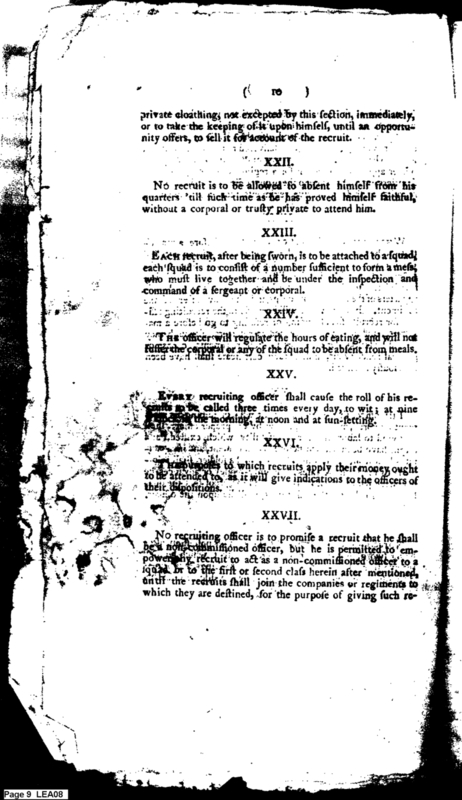
No recruit is to be permitted to keep in his poffeffion, after being fworn, any other cloathing, but that which he may receive from the public, except fhirts, ftockings, and fhoes. The officer is therefore, to oblige him, to difpofe of all his private cloathing, not excepted by this fection, immediately, or to take the keeping of it upon himfelf, until an opportunity offers, to fell it for account of the recruit.
XXII.
No recruit is to be allowed to abfent himfelf from his quarters 'till fuch time as he has proved himfelf faithful, without a corporal or trufty private to attend him.
XXIII.
EACH recruit, after being fworn, is to be attached to a fquad; each fquad is to confift of a number fufficient to form a mefs; who muft live together and be under the infpection and command of a fergeant or corporal.
XXIV.
[undecipherable]
THE officer will regulate the hours of eating, and will not fuffer the corporal or any of the fquad to be abfent from meals.
[undecipherable]
XXV.
EVERY recruiting officer fhall caufe the roll of his recruits to be called three times every day, to wit: at nine o'clock in the morning, at noon and at fun-fetting.
[undecipherable]
XXVI.
The houfes to which recruits apply their money ought to be attended to, as it will give indications to the officers of their difpofitions.
[undecipherable]
XXVII.
No recruiting officer is to promife a recruit that he fhall be a non-commiffioned officer, but he is permitted to empower the recruit to act as a non-commiffioned officer to a fquad, or to the firft or fecond clafs herein after mentioned, until the recruits fhall join the companies or regiments to which they are deftined, for the purpofe of giving fuch recruit an opportunity to fhew by his conduct, whether he is qualified for promotion when it can make place in the courfe of fervice.
XXVIII.
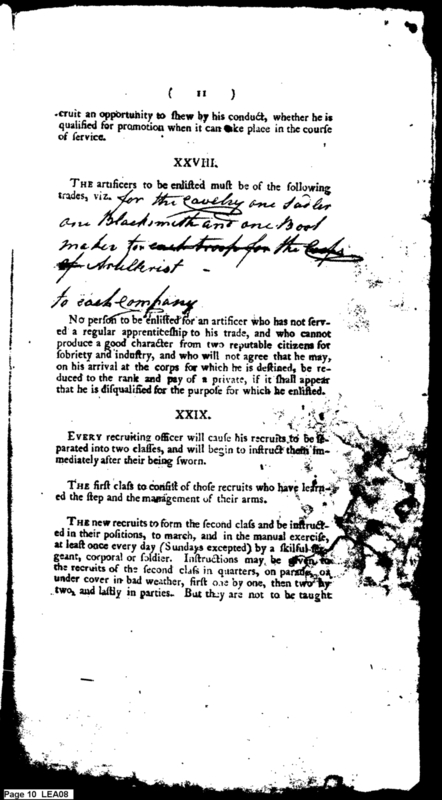
THE artificers to be enlifted muft be of the following trades, viz. for the cavalry one fadler and one Blackfmith and one Boot maker for each troop for the corps of Artillerift —
to each company
No perfon to be enlifted for an artificer who has not ferved a regular apprenticefhip to his trade, and who cannot produce a good character from two reputable citizens for fobriety and induftry, and who will not agree that he may, on his arrival at the corps for which he is deftined, be reduced to the rank and pay of a private, if it fhall appear that he is difqualified for the purpofe for which he enlifted.
XXIX.
EVERY recruiting officer will caufe his recruits to be feparated into two claffes, and will begin to inftruct them immediately after their being fworn.
THE firft clafs to confift of thofe recruits who have learned the ftep and the management of their arms.
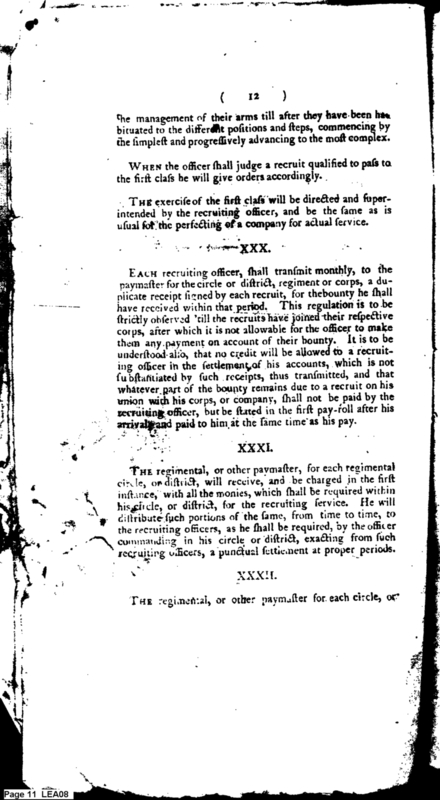
THE new recruits to form the fecond clafs and be inftructed in their pofitions, to march, and in the manual exercife, at leaft once every day (Sundays excepted) by a fkilful fergeant, corporal or foldier. Inftructions may be given to the recruits of the fecond clafs in quarters, on parades, or under cover in bad weather, firft one by one, then two by two, and laftly in parties. But they are not to be taught the management of their arms till after they have been habituated to the different pofitions and fteps, commencing by the fimpleft and progreffively advancing to the moft complex.
WHEN the officer fhall judge a recruit qualified to pafs to the firft clafs he will give orders accordingly.
THE exercife of the firft clafs will be directed and fuperintended by the recruiting officer, and be the fame as is ufual for the perfecting of a company for actual fervice.
XXX.
EACH recruiting officer, fhall tranfmit monthly, to the paymafter for the circle or diftrict, regiment or corps, a duplicate receipt figned by each recruit, for the bounty he fhall have received within that period. This regulation is to be ftrictly obferved 'till the recruits have joined their refpective corps, after which it is not allowable for the officer to make them any payment on account of their bounty. It is to be underftood alfo, that no credit will be allowed to a recruiting officer in the fettlement of his accounts, which is not fubftantiated by fuch receipts, thus tranfmitted, and that whatever part of the bounty remains due to a recruit on his union with his corps, or company, fhall not be paid by the recruiting officer, but be ftated in the firft pay-roll after his arrival, and paid to him at the fame time as his pay.
XXXI.
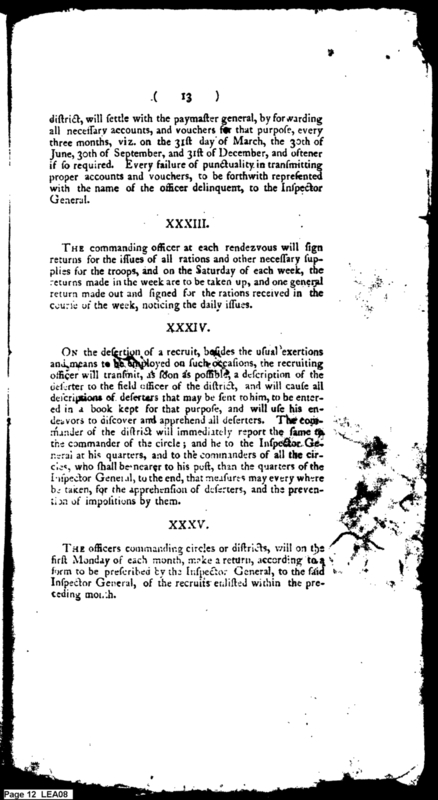
THE regimental, or other paymafter, for each regimental circle, or diftrict, will receive, and be charged in the firft inftance, with all the monies, which fhall be required within his circle, or diftrict, for the recruiting fervice. He will diftribute fuch portions of the fame, from time to time, to the recruiting officers, as he fhall be required, by the officer commanding in his circle or diftrict, exacting from fuch recruiting officers, a punctual fettlement at proper periods.
XXXII.
THE regimental, or other paymafter for each circle, or diftrict, will fettle with the paymafter general, by forwarding all neceffary accounts, and vouchers for that purpofe, every three months, viz. on the 31ft day of March, the 30th of June, 30th of September, and 31ft of December, and oftener if fo required. Every failure of punctuality in tranfmitting proper accounts and vouchers, to be forthwith reprefented with the name of the officer delinquent, to the Infpector General.
XXXIII.
THE commanding officer at each rendezvous will fign returns for the iffues of all rations and other neceffary fupplies for the troops, and on the Saturday of each week, the returns made in the week are to be taken up, and one general return made out and figned for the rations received in the courfe of the week, noticing the daily iffues.
XXXIV.
ON the defertion of a recruit, befides the ufual exertions and means to be employed on fuch occafions, the recruiting officer will tranfmit, as foon as poffible, a defcription of the deferter to the field officer of the diftrict, and will caufe all defcriptions of deferters that may be fent to him, to be entered in a book kept for that purpofe, and will ufe his endeavors to difcover and apprehend all deferters. The commander of the diftrict will immediately report the fame to the commander of the circle; and he to the Infpector General at his quarters, and to the commanders of all the circles, who fhall be nearer to his poft, than the quarters of the Infpector General, to the end, that meafures may every where be taken, for the apprehenfion of deferters, and the prevention of impofitions by them.
XXXV.
THE officers commanding circles or diftricts, will on the firft Monday of each month, make a return, according to a form to be prefcribed by the Infpector General, to the faid Infpector General, of the recruits enlifted within the preceding month.
XXXVI.
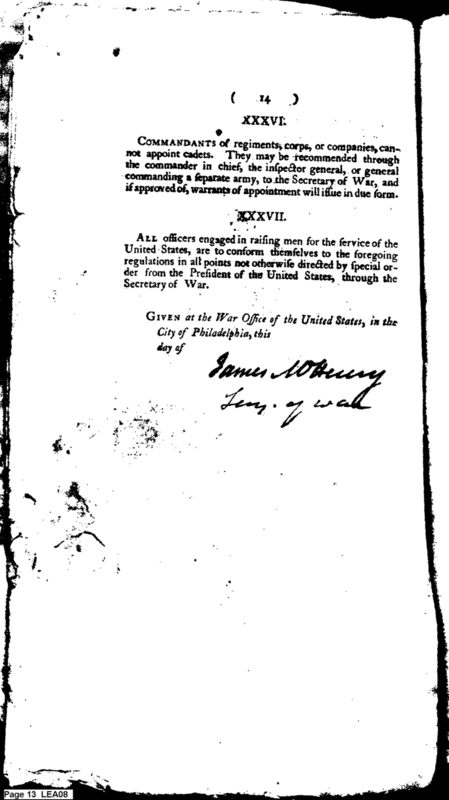
COMMANDANTS of regiments, corps, or companies, cannot appoint cadets. They may be recommended through the commander in chief, the infpector general, or general commanding a feparate army, to the Secretary of War, and if approved of, warrants of appointment will iffue in due form.
XXXVII.
ALL officers engaged in raifing men for the fervice of the United States, are to conform themfelves to the foregoing regulations in all points not otherwife directed by fpecial order from the Prefident of the United States, through the Secretary of War.
GIVEN at the War Office of the United States, in the City of Philadelphia, this day of
James McHenry
Secy. of war
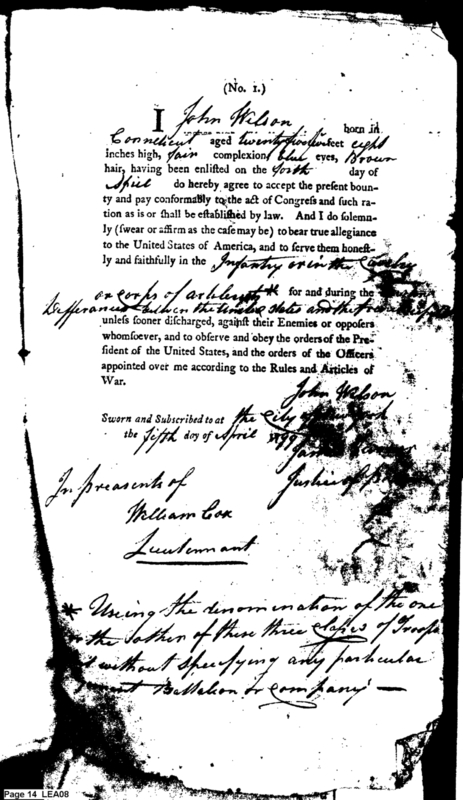
(No. 1.)
I John Wilfon born in
Connecticut aged twenty [undecipherable] feet eight
inches high, fair complexion, blue eyes, Brown
hair, having been enlifted on the fourth day of
April do hereby agree to accept the prefent bounty and pay conformably to the act of Congrefs and fuch ration as is or fhall be eftablifhed by law. And I do folemnly (fwear or affirm as the cafe may be) to bear true allegiance to the United States of America, and to ferve them honeftly and faithfully in the Infantry or in the Cavalry
or corps of Artillerift* for and during the [undecipherable]
differences between the United States and the French [undecipherable]
unlefs fooner difcharged, againft their Enemies or oppoffers whomfoever, and to obferve and obey the orders of the Prefident of the United States, and the orders of the Officers appointed over me according to the Rules and Articles of War.
John Wilfon
Sworn and Subfcribed to at the City [undecipherable]
the fifth day of April 1799
[undecipherable] Juftice of [undecipherable]
In prefents of
William Cox
Lieutenant
* Ufeing the denomination of the one or the lother of thefe three claffes of Troops, without fpecifying any particular regiment Battalion or company —
(No. 2.)
[illustration of a blank Return of the Recruiting Party form]
Return of the Recruiting Party at
Officers.
In the State of
Names of recruits enlifted fince laft return.
Age. Years. Months.
Size. Feet. Inches.
Where born. Town or County. State or Kingdom.
Defcription. Eyes. Hair. Complexion.
Enlifted. When. Where.
Bounty paid. Dollars. Cents.
Clothing, arms, &c. iffued. Hats. Coats. Vefts. W. Overalls. L. Overalls. Shirts. Socks. Pairs of Shoes. Stocks and Clafps. Blankets. Knaplacks. Canteens. Mufket & bayonet. Cartouch Boxes. Bayonet fcabbards. Swords. Drum. Fife.
Recruits pr. laft return.
1799.
Incidents during the week.
Type
Contemporary Printed Copy of Letter/Document (other than PL/PD)
Description
These are the thirty seven rules and regulations for the recruiting service including the prohibition of recruiting individuals who are intoxicated or who are Negroes, Mulattoes, or Indians. Included is a sample of an enlistment document.
Date
04/05/1799
Author
Collection
Document number
1799040590001
Page start
1
Notable persons
John Adams
natives
foreigners
Negroes
Mulattoes
Indians
recruiting officer
chief magistrate
commissioned officer
non-commissioned officer
Inspector General
Commandants
cavalry
artificers
blacksmith
deserters
James McHenry
John Wilson
William Cox
Notable locations
districts
Philadelphia
Connecticut
New York
Notable items
rules and regulations
recruiting service
recruit
enlistment
differences between the United States and the French Republic
sworn
bounty or pay
clothing
arms and accoutrements
dress, regularity, and good conduct
courts martial
orders
returns and reports
traveling expenses
allowance
stationery
postage
abscond
disability
shirts
stockings
shoes
hours of eating
roll
money
apprenticeship
good character
pay roll
detention
height
complexion