

COPY: Unauthorized Military Actions
Document 1799E. Telfair, governor of Georgia, used militia troops and materials for unauthorized offensive expedition into Creek Country on the pretext that he was protecting Georgia's frontier.

No human transcription currently available for this document.
This transcription was generated by machine using Anthropic's Claude Code (model sonnet 4.6). It may contain errors or inaccuracies. Please verify against the document image. Learn more about our generative AI methodology.
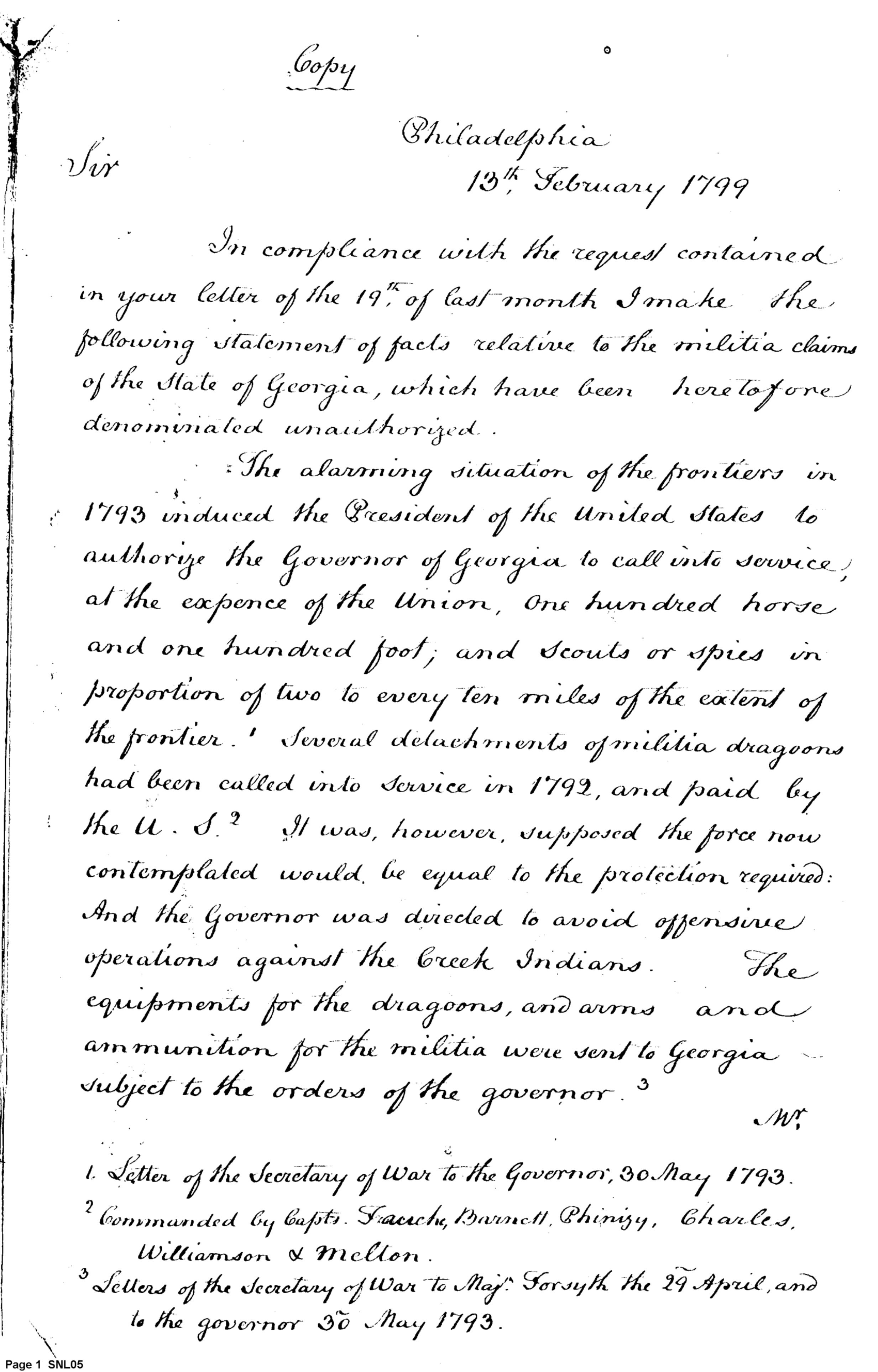
[Copy]
Philadelphia
Sir 13th February 1799
In compliance with the request contained in your letter of the 19th of last month I make the following statement of facts relative to the militia claims of the State of Georgia, which have been heretofore denominated unauthorized.
The alarming situation of the frontiers in 1793 induced the President of the United States to authorize the Governor of Georgia to call into service, at the expence of the Union, One hundred horse and one hundred foot; and Scouts or spies in proportion of two to every ten miles of the extent of the frontier.1 Several detachments of militia dragoons had been called into Service in 1792, and paid by the U. S.2 It was, however, supposed the force now contemplated would be equal to the protection required: And the Governor was directed to avoid offensive operations against the Creek Indians. The equipments for the dragoons, and arms and ammunition for the militia were sent to Georgia subject to the orders of the governor.3
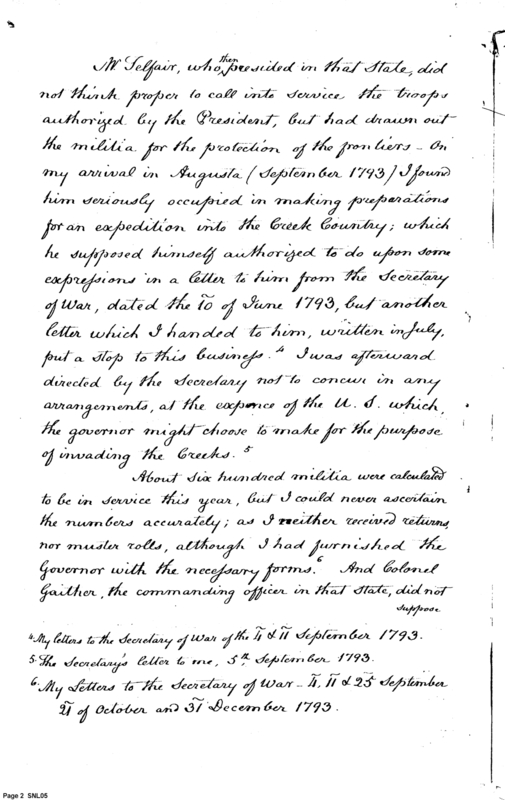
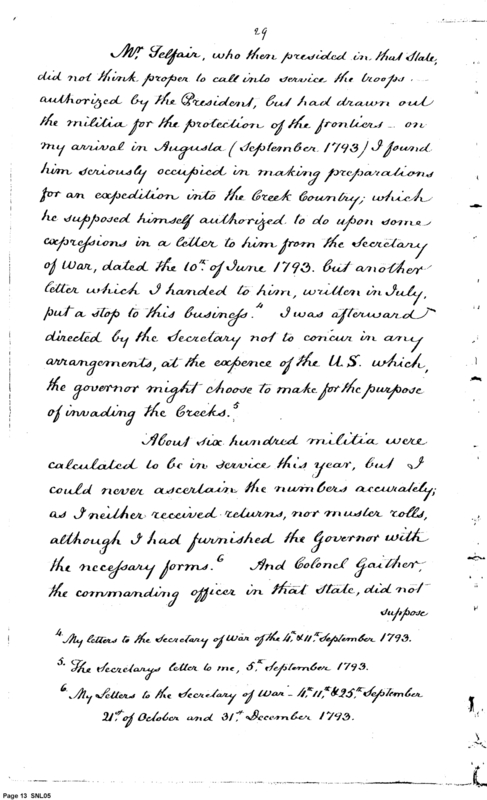
Mr Selfair, who then presided in that State, did not think proper to call into service the troops authorized by the President, but had drawn out the militia for the protection of the frontiers. On my arrival in Augusta (September 1793) I found him seriously occupied in making preparations for an expedition into the Creek Country; which he supposed himself authorized to do upon some expressions in a letter to him from the Secretary of War, dated the 10 of June 1793, but another letter which I handed to him, written in July, put a stop to this business.4 I was afterward directed by the Secretary not to concur in any arrangements, at the expence of the U. S. which the governor might choose to make for the purpose of invading the Creeks.5
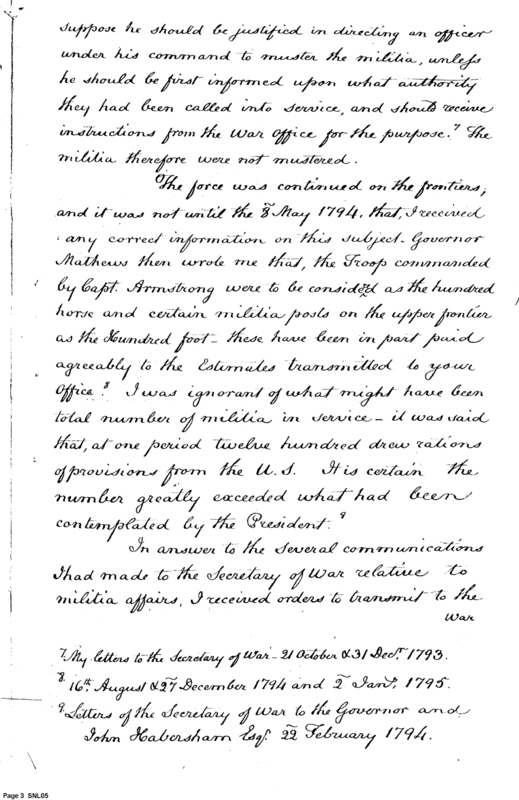
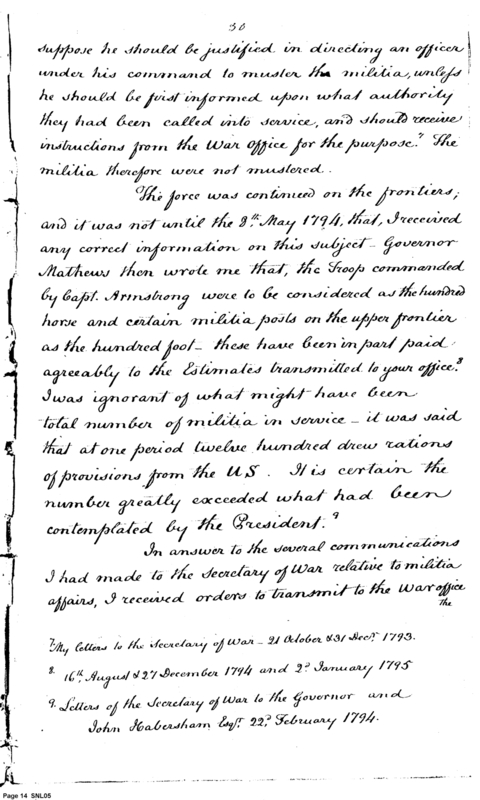
About six hundred militia were calculated to be in service this year, but I could never ascertain the numbers accurately; as I neither received returns nor muster rolls, although I had furnished the Governor with the necessary forms.6 And Colonel Gaither, the commanding officer in that State, did not suppose he should be justified in directing an officer under his command to muster the militia, unless he should be first informed upon what authority they had been called into service, and should receive instructions from the War Office for the purpose.7 The militia therefore were not mustered.
The force was continued on the frontiers; and it was not until the 8 May 1794, that, I received any correct information on this subject. Governor Mathews then wrote me that, the Troop commanded by Capt. Armstrong were to be considered as the hundred horse and certain militia posts on the upper frontier as the Hundred foot — these have been in part paid agreeably to the Estimates transmitted to your Office.8 I was ignorant of what might have been total number of militia in service — it was said that, at one period twelve hundred drew rations of provisions from the U. S. It is certain the number greatly exceeded what had been contemplated by the President.9
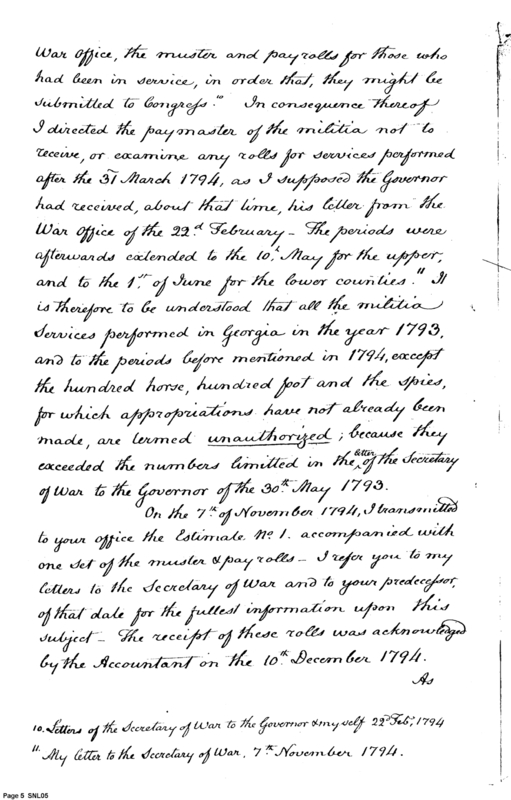
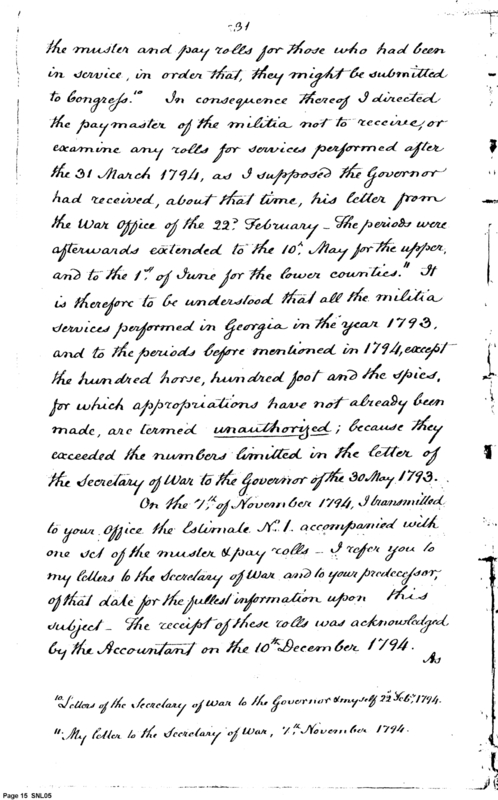
In answer to the several communications I had made to the Secretary of War relative to militia affairs, I received orders to transmit to the War Office, the muster and pay rolls for those who had been in service, in order that, they might be submitted to Congress.10 In consequence thereof I directed the paymaster of the militia not to receive, or examine any rolls for services performed after the 31 March 1794, as I supposed the Governor had received, about that time, his letter from the War Office of the 22.d February. The periods were afterwards extended to the 10.th May for the upper, and to the 1.st of June for the lower counties.11 It is therefore to be understood that all the militia Services performed in Georgia in the year 1793, and to the periods before mentioned in 1794, except the hundred horse, hundred foot and the spies, for which appropriations have not already been made, are termed [underline: unauthorized]; because they exceeded the numbers limitted in the letter of the Secretary of War to the Governor of the 30th May 1793.
On the 7th of November 1794, I transmitted to your office the Estimate No 1. accompanied with one set of the muster & pay rolls. I refer you to my letters to the Secretary of War and to your predecessor, of that date for the fullest information upon this subject. The receipt of these rolls was acknowledged by the Accountant on the 10th December 1794.
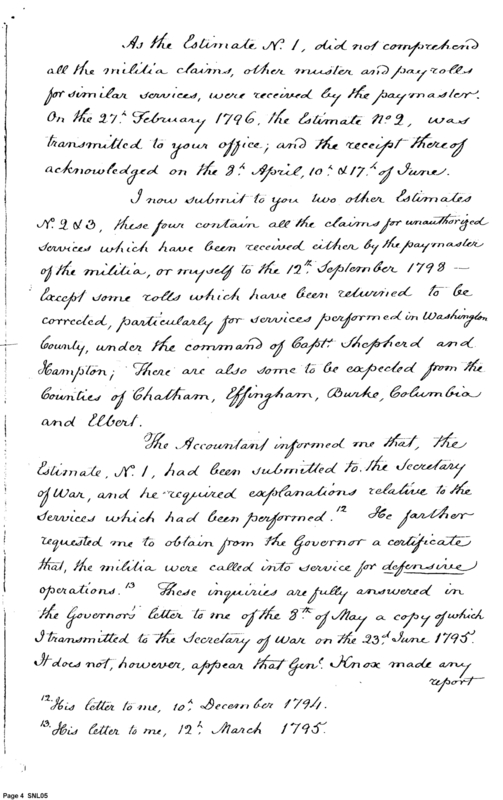
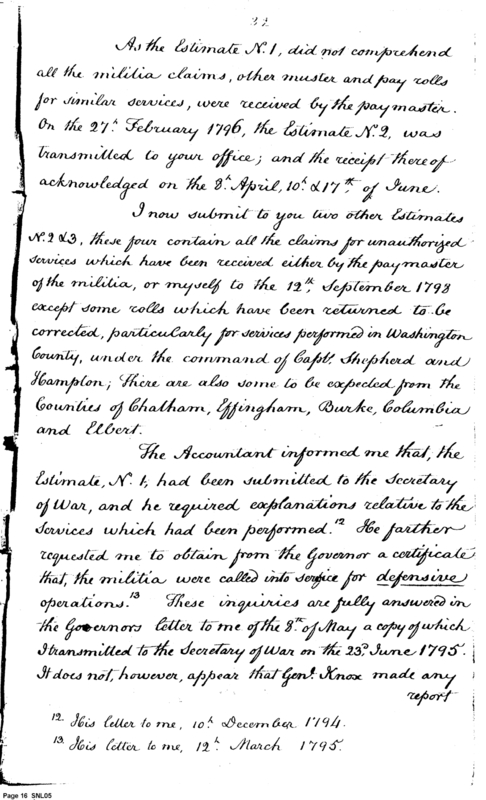
As the Estimate No 1, did not comprehend all the militia claims, other muster and pay rolls for similar services, were received by the paymaster. On the 27.th February 1796, the Estimate No 2, was transmitted to your office; and the receipt thereof acknowledged on the 3.th April, 10.th & 17.th of June.
I now submit to you two other Estimates No 2 & 3, these four contain all the claims for unauthorized services which have been received either by the paymaster of the militia, or myself to the 12th September 1798 — Except some rolls which have been returned to be corrected, particularly for services performed in Washington County, under the command of Capts Shepherd and Hampton; There are also some to be expected from the Counties of Chatham, Effingham, Burke, Columbia and Elbert.
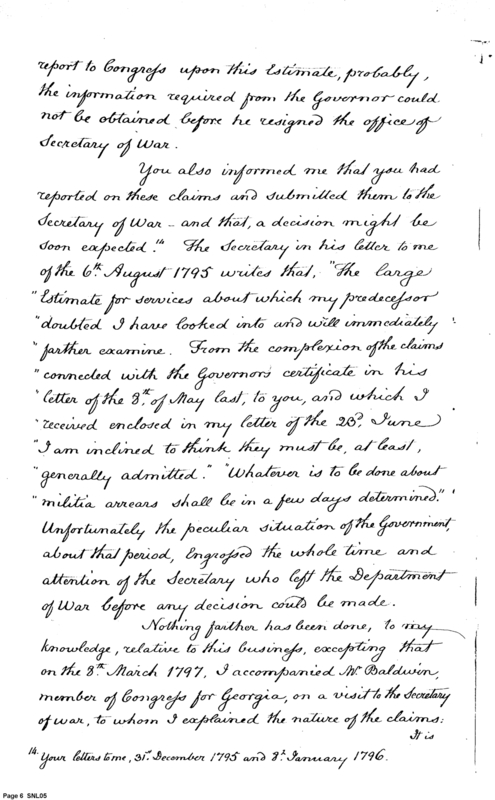
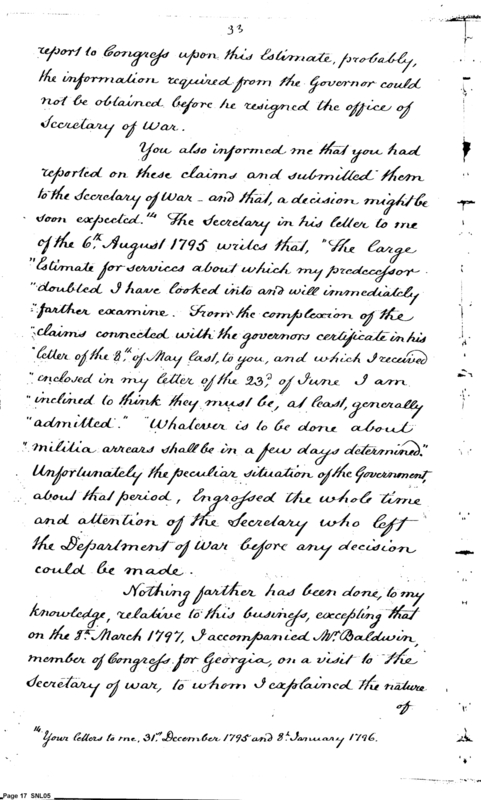
The Accountant informed me that, the Estimate, No 1, had been submitted to the Secretary of War, and he required explanations relative to the Services which had been performed.12 He farther requested me to obtain from the Governor a certificate that, the militia were called into service for [underline: defensive] operations.13 These inquiries are fully answered in the Governors letter to me of the 8th of May a copy of which I transmitted to the Secretary of War on the 23.d June 1795. It does not, however, appear that Genl Knox made any report to Congress upon this Estimate, probably, the information required from the Governor could not be obtained before he resigned the office of Secretary of War.
You also informed me that you had reported on these claims and submitted them to the Secretary of War. and that, a decision might be soon expected.14 The Secretary in his letter to me of the 6th August 1795 writes that, "The large "Estimate for services about which my predecessor "doubted I have looked into and will immediately "farther examine. From the complexion of the claims "connected with the Governors certificate in his "letter of the 8.th of May last, to you, and which I "received enclosed in my letter of the 23.o June "I am inclined to think they must be, at least, "generally admitted." "Whatever is to be done about "militia arrears shall be in a few days determined." Unfortunately the peculiar situation of the Government, about that period, Engrosed the whole time and attention of the Secretary who left the Department of War before any decision could be made.
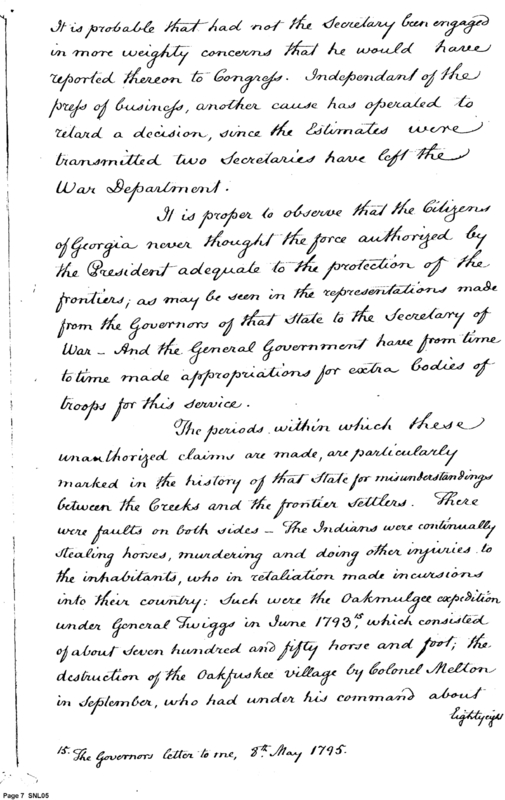
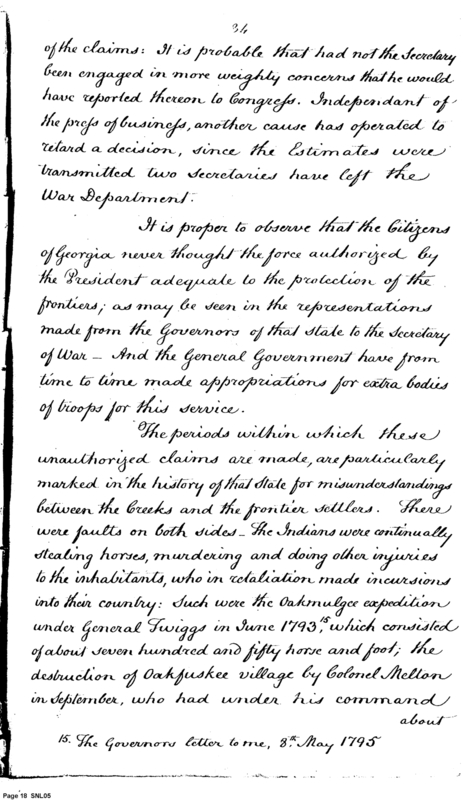
Nothing farther has been done, to my knowledge, relative to this business, excepting that on the 8th March 1797, I accompanied Mr Baldwin, member of Congress for Georgia, on a visit to the Secretary of war, to whom I explained the nature of the claims. It is probable that had not the Secretary been engaged in more weighty concerns that he would have reported thereon to Congress. Independant of the press of business, another cause has operated to retard a decision, since the Estimates were transmitted two Secretaries have left the War Department.
It is proper to observe that the Citizens of Georgia never thought the force authorized by the President adequate to the protection of the frontiers; as may be seen in the representations made from the Governors of that State to the Secretary of War. And the General Government have from time to time made appropriations for extra bodies of troops for this service.
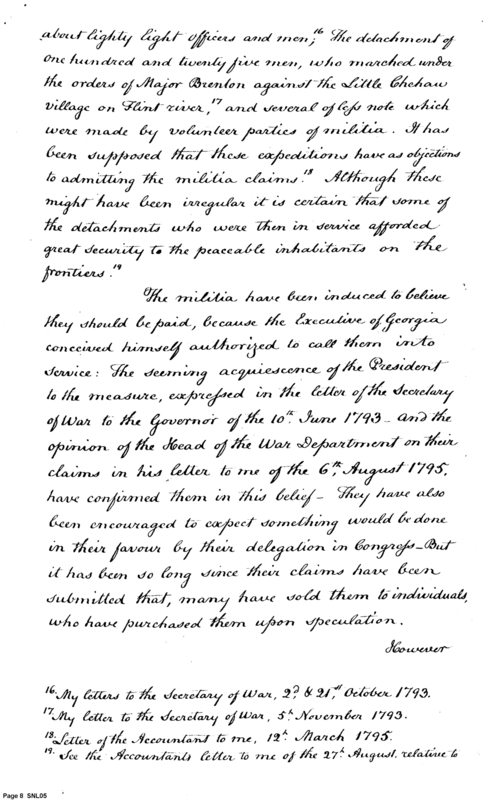
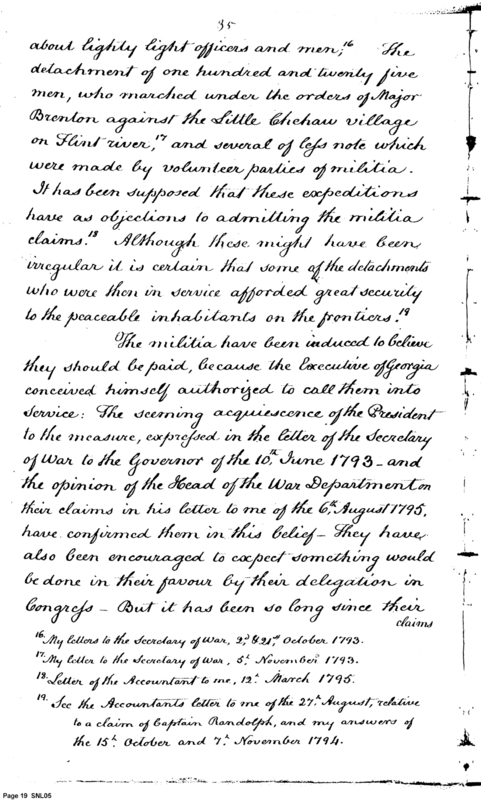
The periods within which these unauthorized claims are made, are particularly marked in the history of that State for misunderstandings between the Creeks and the frontier settlers. There were faults on both sides. The Indians were continually stealing horses, murdering and doing other injuries to the inhabitants, who in retaliation made incursions into their country: Such were the Oakmulgee expedition under General Twiggs in June 1793,15 which consisted of about seven hundred and fifty horse and foot; the destruction of the Oakfuskee village by Colonel Melton in September, who had under his command about lightly light officers and men;16 The detachment of one hundred and twenty five men, who marched under the orders of Major Brenton against the Little Chehaw village on Flint river,17 and several of less note which were made by volunteer parties of militia. It has been supposed that these expeditions have as objections to admitting the militia claims.18 Although these might have been irregular it is certain that some of the detachments who were then in service afforded great security to the peaceable inhabitants on the frontiers.19
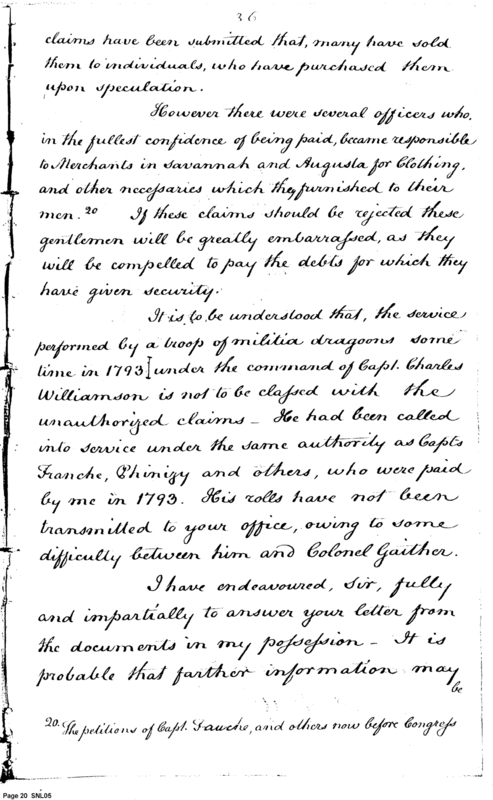
The militia have been induced to believe they should be paid, because the Executive of Georgia conceived himself authorized to call them into Service: The seeming acquiescence of the President to the measure, expressed in the letter of the Secretary of War to the Governor of the 10th June 1793. and the opinion of the Head of the War Department on their claims in his letter to me of the 6th August 1795, have confirmed them in this belief. They have also been encouraged to expect something would be done in their favour by their delegation in Congress. But it has been so long since their claims have been submitted that, many have sold them to individuals, who have purchased them upon speculation.
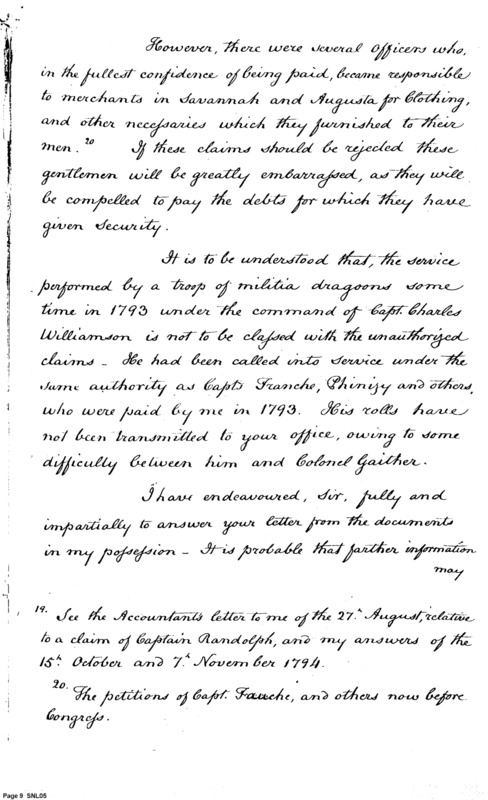
However, there were several Officers who, in the fullest confidence of being paid, became responsible to merchants in Savannah and Augusta for Clothing, and other necesaries which they furnished to their men.20 If these claims should be rejected these gentlemen will be greatly embarrassed, as they will be compelled to pay the debts for which they have given Security.
It is to be understood that, the service performed by a troop of militia dragoons some time in 1793 under the command of Capt. Charles Williamson is not to be classed with the unauthorized claims. He had been called into service under the same authority as Capts Franche, Phinizy and others, who were paid by me in 1793. His rolls have not been transmitted to your office, owing to some difficulty between him and Colonel Gaither.
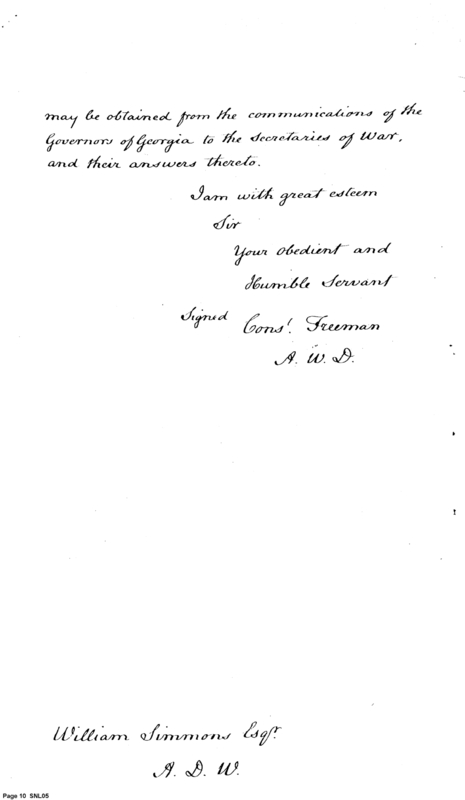
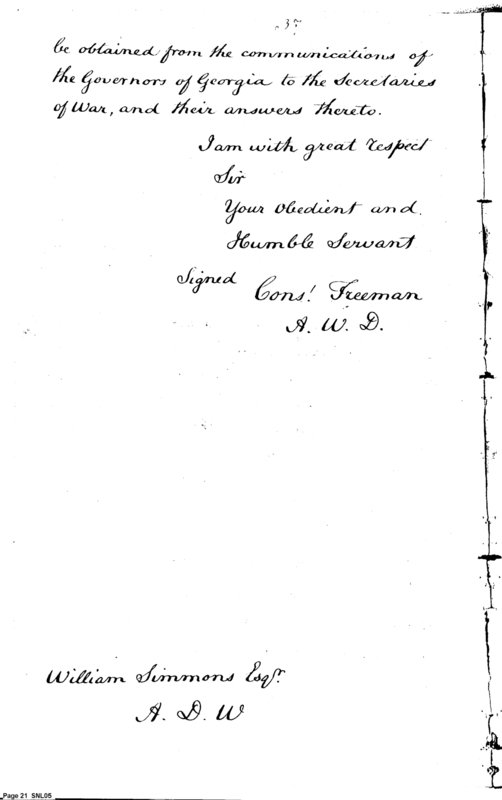
I have endeavoured, Sir, fully and impartially to answer your letter from the documents in my possesion. It is probable that farther information may be obtained from the communications of the Governors of Georgia to the Secretaries of War, and their answers thereto.
I am with great esteem
Sir
Your obedient and
Humble Servant
Signed Const Freeman
A. W. D.
William Simmons Esqr
A. D. W.
---
1. Letter of the Secretary of War to the Governor, 30 May 1793.
2. Commanded by Capts. Frauche, Barnett, Phinizy, Charles Williamson & Melton.
3. Letters of the Secretary of War to Majr Forsyth the 29 April, and to the governor 30th May 1793.
4. My letters to the Secretary of War of the 4th & 11th September 1793.
5. The Secretary's letter to me, 5th September 1793.
6. My Letters to the Secretary of War. 4th, 11th & 25th September 21st of October and 31st December 1793.
7. My letters to the Secretary of War. 21 October & 31 Decr 1793.
8. 16th August & 27 December 1794 and 2 Jany, 1795.
9. Letters of the Secretary of War to the Governor and John Habersham Esqr 22 February 1794.
10. Letters of the Secretary of War to the Governor & my self 22d Feby, 1794.
11. My letter to the Secretary of War, 7th November 1794.
12. His letter to me, 10th December 1794.
13. His letter to me, 12th March 1795.
14. Your letters to me, 31st December 1795 and 3d January 1796.
15. The Governors letter to me, 8th May 1795.
16. My letters to the Secretary of War, 2d & 21st October 1793.
17. My letter to the Secretary of War, 5th November 1793.
18. Letter of the Accountant to me, 12th March 1795.
19. See the Accountants letter to me of the 27th August, relative to a claim of Captain Randolph, and my answers of the 15th October and 7th November 1794.
20. The petitions of Capt. Frauche, and others now before Congress.
Type
Copy of Signed Document
Description
E. Telfair, governor of Georgia, used militia troops and materials for unauthorized offensive expedition into Creek Country on the pretext that he was protecting Georgia's frontier.
Date
02/13/1799
Author
Recipient
Sent from
Philadelphia
Document number
1799021370001
Page start
1
Notable persons
William Simmons
Constant Freeman
Edward Telfair
Creek Nation
Indian Nation
Indians
hostiles
President
troops
dragoons
foot soldiers
militia
Colonel Gaither
Governor Mathews
Captain Armstrong
Notable locations
Philadelphia
Georgia
Creek Country
territory
frontier
Indian territory
Notable items
horses
materials
supplies
ammunition