

Sedgwicks's Many Concerns
Document 1799In addition to a reference to an attempt to repeal the Alien and Sedition Acts, Sedgwick discusses the difficulties in supplying sufficient clothing to the troops in the widely dispersed Army. He mentions an encounter with John Adams in which Adams expressed his suspicion that some were attempting to diminish his authority by expanding the powers of General Washington.






No human transcription currently available for this document.
This transcription was generated by machine using Anthropic's Claude Code (model sonnet 4.6). It may contain errors or inaccuracies. Please verify against the document image. Learn more about our generative AI methodology.
Now I have all the images. Let me produce the full transcription.
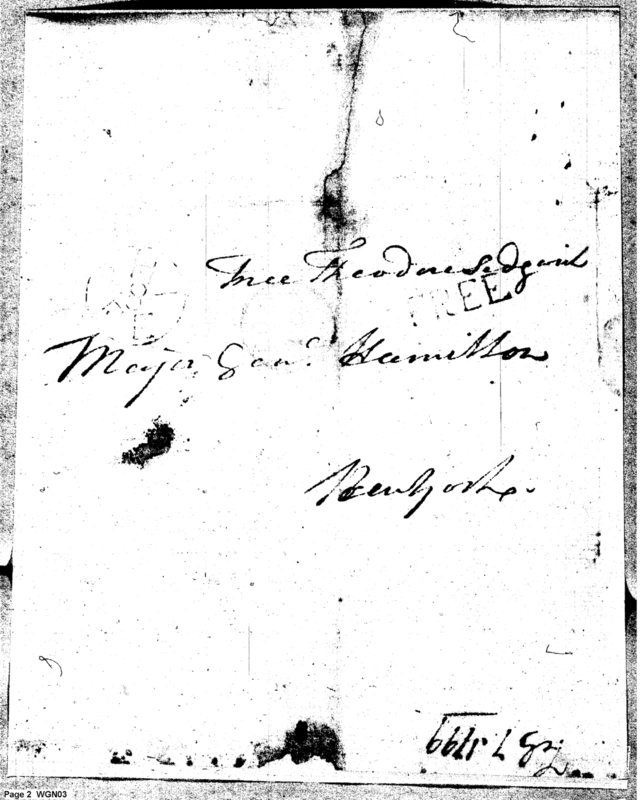
[free Theod Sedgwick] [FREE]
Major Genl Hamilton
New York.
[212] [403. See 7th page]
Philadelphia 7th Feby 1799
I had the pleasure, my dear Sir, the day before yesterday to receive your favor of the 2d.
With regard to the conduct of Virginia & Kentucky — The moment I came into town I applied to the apparent leaders in the house of Representatives, & stated to them my opinion of the measures which to me [undecipherable] to be [undecipherable]. That there [was reason?] to pre-occupy the ground — That, for this purpose it would be expedient to appoint an abl[e] committee, to pre[pare] the addresses on the subject, with an intention of making a report, which should have all the properties of an address. I had two reasons for preferring this being done by the house — because [it?] had before the Senate no address on the [sub]ject and because, for obvious reasons, the conduct of the house would excite more attention and make a deeper impression — I spoke to no Gentle[man] who
who did not explicitly concur with me in opinion but Nothing has been done, because, as I understand, the Gentleman cannot agree on the precise mode in which it is to be done. They still say and [undecipherable], [undecipherable: thursday?] had [did?] conversation with them on the subject, that the bu[si]ness will yet be done. Had it not been believed that the house would have before this time [expedited?] this importa[nt] object, it would have been [re]ferred in progress[ion] to the Senate. It is not yet, perhaps too late. [undecipherable] as much as any one can the delay —
You have seen, I presume, the address of the minority of the [House?] of Representatives, to their constituents. It is said to have been drawn by Marshall. It is able, [undecipherable] and eloquent, but the eloquence is of a kind not to make a deep impression on the gross mass to which it[s address?]. It shows that its authors believe their situation critical & the danger [--] imminent. It [was?], perhaps, incompatible with the relation of the address [of] a minority, to employ the instrument of denunciation and yet, I am persuaded, no prudence of this kind can be effectual, without it.
Under the present circumstances it is expedient that this subject should be undertake[n] by the Senate.
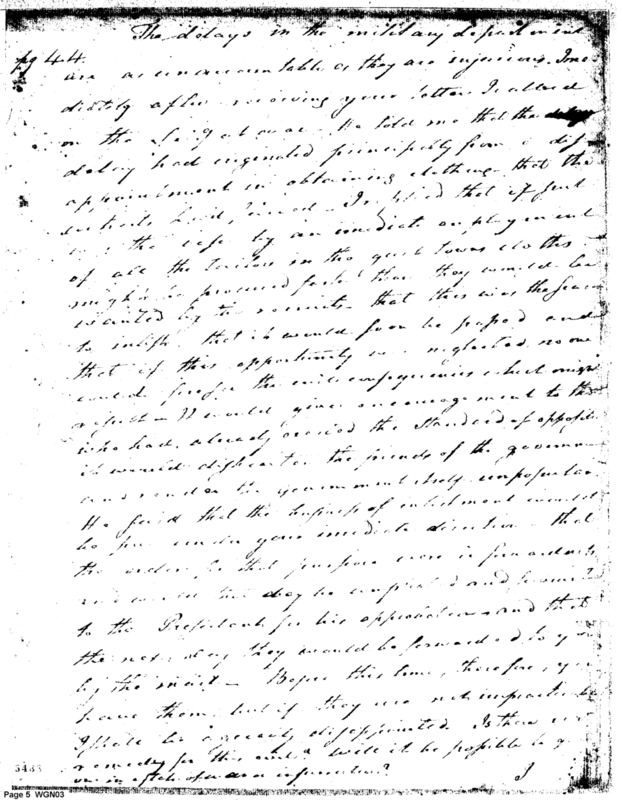
The delays in the military department are as unaccountable as they are injurious. Imme[diately] after receiving your letter I attended on the [Secretary?] of War. He told me that the [great?] delay had originated principally from a dif[ficulty in the] appointment in obtaining clothing. That the [undecipherable] had [undecipherable]. I urged that it [must?] be [the?] case by an immediate employment of all the tailors in the great towns, clothes might be procured faster than they would be wanted by the recruits. That this was the [sea]son to enlist. That it would soon be passed and that if this opportunity was neglected, no one could [foresee] the embarrassments which might attend it. It would give encouragement to those who had already roused the Standard of opposition. It would dishearten the friends of the government and render the government truly unpopular.
He said that the business of enlistment would be put under your immediate direction. That the orders to that purpose were in [preparation?], and would this day be [re]spected and [sent?] to the President for his approbation, and that the next day they would be forwarded to you by the mail. Before this time, therefore, you must have them, but if they are not, impractica[ble?] [it?] shall be greatly disappointing. Is there [no] remedy for this [evil?]? Will it be possible to g[ive?] [on?] in after [a?] [--] inspection?
[undecipherable] [I shall?] [report?] to you on the [sum?] of [my?] [undecipherable] confidence. Last evening called to pay [re]spects to the President. He was [alone and?] [undecipherable] introducing the subject of [our army?] [gave?] him my views of the subject. I [somewhat?] also [re]ferred nearly in the following words. 'As to the [resolutions?] Sir, it is not for me to apprehend any thing from them, but if you must leave an Army [undecipherable] [give?] it to you that [our?] country [should?] [be?] [the?] government was no [more?] popular than all [those?] others [?]. They have submitted to it [more?] [con]stant[ly?] [?] [the?] people [have?] done [?] the burden of taxes [which?] have been [underline: liberally laid on] their pol[ic]ies [?].'" This was the task on which [undecipherable]. I cannot say that I was after [the?] [latter?] [remark?] [?] sentiment [which?] he has [seemed?] to have towards the [part?] to [--]. During the time that I was [ill?] the [--] before the Senate, [?] the reorganization of the army was mentioned. He also asked [me?] [of?] [undecipherable] offered to give [undecipherable] [a?] additional authority [to?] [--] proposed to give [undecipherable] [Command?] on [?] [undecipherable]. He proposed [undecipherable] [?] preferred [?] giving him a new title [To?] "[General?]" [undecipherable] said [he was?] [undecipherable] [to appoint?] him General [under?] the President. He "[I have?] not been [prevented?] [?] [undecipherable] combined [?] qualities [undecipherable] [?] themselves the friends of government [now?] [?] the [effective?] powers given by the [President?] [?]."
[undecipherable]
[--] praising his virtues?" my understanding has [undecipherable] and my heart felt. After an expression of surprise and a declaration of belief that he was mistaken, with [underline: all humility] I prayed him to mention [the] facts from which he had made this inference. He [a]llowed that if I had not [seen?] it, it was [improper?] [for?] him to go into the details.
This proves that we are afflicted with an evil for which certainly no [comprehending?] can be applied, but it might be perhaps [undecipherable] bringing into the administration a man of talents [?] of that, peculiar kind whose genius in [abiding?] [until?] it being perceived. This [?] [were?] in [any?] [only?] more important. Not of the [?] character [can?] be furnished with an [objective?] [undecipherable]. With all his good qualities however, one [friend?] [undecipherable] not the [same?]. The official details [of?] [description?] [further?] [has?] no superior, but in the other and more essential characteristics to my mind he is [widely?] deficient. But can a vacancy be made [--?]? I have been [to?] [?] writing [?] old [?] the [abstract?] of [Senate?] [--] debate the most [relevant?]. Will you permit me to stop without [reason?]? I have written I know not [what?] and I hope it is [un]intelligible. This [?] [also?] knows that I am your friend
J. S. —
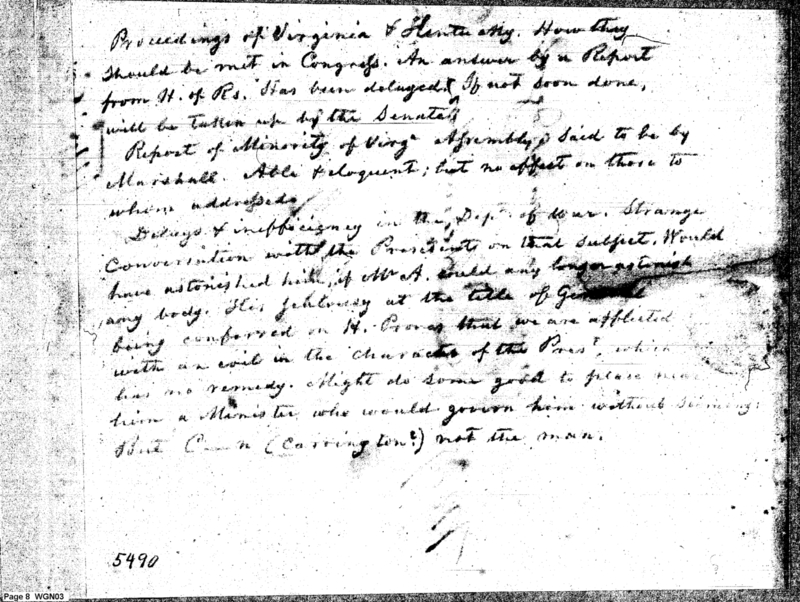
Proceedings of Virginia & [Kentucky?]. How they should be met in Congress. An answer by a Report from H. of Rs. Has been delayed. If not soon done, will be taken up by the Senate.
Report of Minority of Virg[inia] Assembly; said to be by Marshall. Able & eloquent; but no effect on those to whom addressed.
Delays & inefficiency in the Dep[artmen]t of War. Strange conversation with the President on that subject. Would have astonished him, if M[r]. A. could any longer astonish any body. His jealousy at the title of Gen[eral?] being conferred on H. [--] that we are afflicted with an evil in the character of the Pres[iden]t which has no remedy. Might do some good to place near him a Minister, who would govern him without [him?] [undecipherable] (Carrington?) not the man.
Type
Autograph Letter Signed
Description
In addition to a reference to an attempt to repeal the Alien and Sedition Acts, Sedgwick discusses the difficulties in supplying sufficient clothing to the troops in the widely dispersed Army. He mentions an encounter with John Adams in which Adams expressed his suspicion that some were attempting to diminish his authority by expanding the powers of General Washington.
Date
02/07/1799
Author
Recipient
Sent from
Philadelphia
Repository
Collection
Document number
1799020760001
Notable persons
Alexander Hamilton
Theodore Sedgwick
apparent leaders in the House of Representatives
the Senate
constituents
[John] Marshall
Secretary of War [McHenry]
tailors in the great towns
recruits
friends of the government
the President [John Adams]
the Virginians
Commander in Chief [Washington]
our friend [Edward Carrington]
Notable locations
New York
Philadelphia
Virginia
Kentucky
Notable items
[Alien and Sedition Acts]
able comittee
address of the minority of the House of Representatives of Virginia to their constituents
eloquence
instrument of denunciation
military department
clothing
contracts
evil consequences
standard of opposition
business of enlistment
state of war or insurrection
burden of taxes
patience
astonishment
bill before the Senate
new organization of the Army
vacancy
chit-chat of senatorial debate