

Appointing Friends of the Government to Military Stations, Etc.
Document 1799Along with a discussion of the distrubtion of the States into recruiting districts, Hamilton makes the point that political considerations should not always overrule military aptitude in the appointment of officers, especially those in the inferior grades.
No human transcription currently available for this document.
This transcription was generated by machine using Anthropic's Claude Code (model sonnet 4.6). It may contain errors or inaccuracies. Please verify against the document image. Learn more about our generative AI methodology.
[Illegible Text: Some or all of the pages of this file are wholly or in part illegible. We have not been able either to locate a better copy of the document, or to enhance its legibility electronically.]
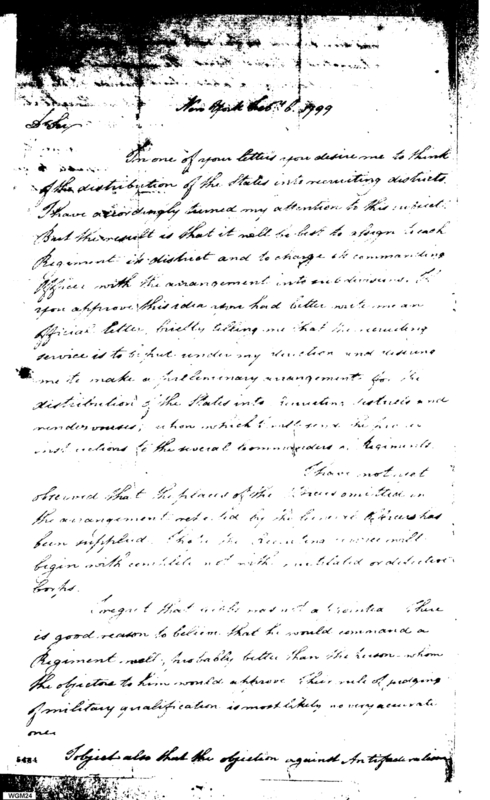
New York Decr 6. 1799
Sir
In one of your letters you desire me to think of the distribution of the States into recruiting districts. I have accordingly turned my attention to this subject. But the result is that it will be best to assign to each Regiment its district and to charge its commanding Officer with the arrangement into subdivisions. If you approve this idea you had better write me an Official letter, briefly telling me that the recruiting service is to be put under my direction and desiring me to make a preliminary arrangement for the distribution of the States into Rendezvous Districts and Rendezvous, upon which I will send the [undecipherable] instructions to the several commanders of Regiments.
I have not yet observed that the places of the [undecipherable] omitted in the arrangement return'd by the General [undecipherable] has been supplied. I hope the Recruiting service will begin with complete not with mutilated or defective Books.
I regret that [undecipherable] was not a [undecipherable]. There is good reason to believe that he would command a Regiment well, probably better than the person whom the objectors to him would approve. Their rule of judging of military qualification is most likely no very accurate one.
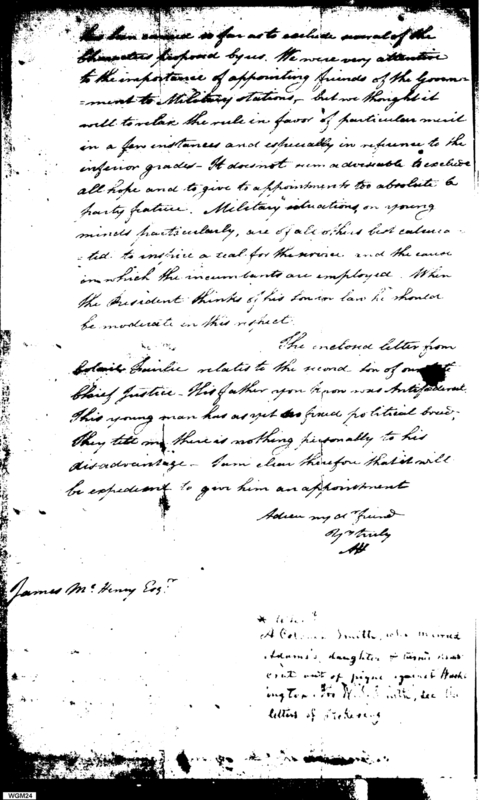
I object also that the objection against Antifederalism has been carried so far as to exclude several of the characters proposed by us. We were very attentive to the importance of appointing friends of the Government to Military stations, but we thought it well to relax the rule in favor of particular merit in a few instances and especially in reference to the inferior grades. It does not seem advisable to exclude all hope and to give to appointments too absolute a party feature. Military educations on young minds particularly, are of all others best calculated to inspire a zeal for the service and the cause in which the incumbants are employed. When the President thinks of his son in law he should be moderate in this respect.
The enclosed letter from Colonel Fairlie relates to the second son of our [undecipherable] Chief Justice. His father upon [undecipherable] was Antifederal. This young man has as yet [undecipherable] formed political [undecipherable: creed]; they tell me there is nothing personally to his disadvantage. I am clear therefore that it will be expedient to give him an appointment
Adieu my dr friend
Yrs truly
AH
James Mc Henry Esqr
[* A Col[onel] Smith who married Adams's daughter & turns [undecipherable] out of [undecipherable] against Washington. For [undecipherable] Smith, see the letters of Pickering.]
Type
Autograph Letter Signed
Description
Along with a discussion of the distrubtion of the States into recruiting districts, Hamilton makes the point that political considerations should not always overrule military aptitude in the appointment of officers, especially those in the inferior grades.
Date
02/06/1799
Author
Recipient
Sent from
New York
Repository
Collection
Document number
1799020640301
Note
Cited in McHenry to Hamilton, 02/08/1799.
Notable persons
James McHenry
Alexander Hamilton
Commanders of Regiments
General Officers
[Caleb] Gibbs
friends of the government
the President [John Adams]
the president's son-in-law [William S. Smith]
Colonel [James] Fairlie
second son of our late Chief Justice [William Yates]
Notable locations
New York
Notable items
distribution of the States into recruiting districts
regiment
arrangement into subdivisions
rendezvouses
military qualification
objection against Anti-Federalism
no fixed political creed