

Questions Affecting the Legality of the General Court Martial
Document 1799McHenry has two questions bearing on the legality of the General Court Martial: Can the Commandant of a Port or Garrison , where there a sufficient number of officers, order a General Court Martial? Do the Articles of War make the Judge Advocate, or some person properly appointed, essential to a Court Martial?
No human transcription currently available for this document.
This transcription was generated by machine using Anthropic's Claude Code (model sonnet 4.6). It may contain errors or inaccuracies. Please verify against the document image. Learn more about our generative AI methodology.
Now I have all 11 pages. Let me transcribe the complete document.
[James Mc Henry
21 Jany 1799
Ansd 26. 1799]
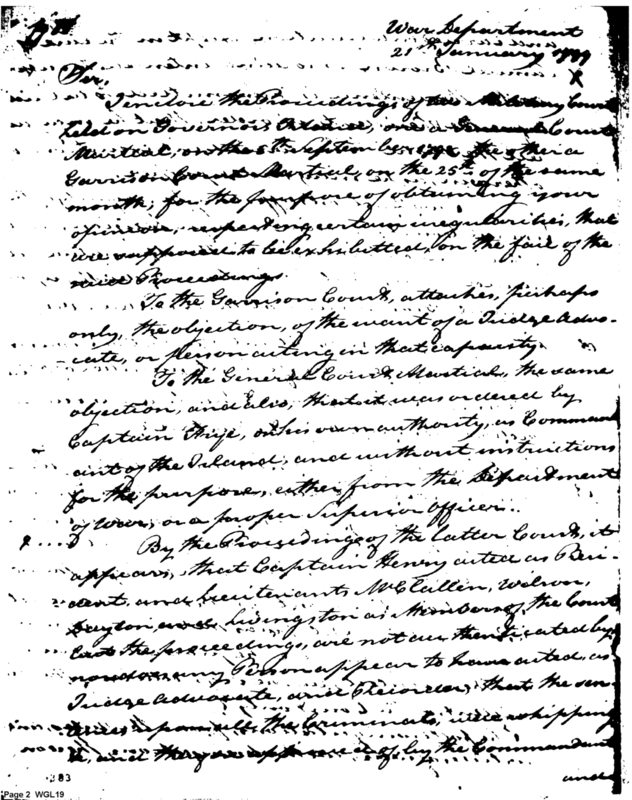
War Department
21st January 1799
Sir,
I enclose the proceedings of two Military Courts held on Governor's Island, one a General Court Martial, on the 8th September 1798, the other a Garrison Court Martial, on the 25th of the same month; for the purpose of obtaining your opinion, respecting certain irregularities, that were supposed to be exhibited, on the face of the said Proceedings.
To the Garrison Court, attaches, perhaps only, the objection, of the want of a Judge Advocate, or person acting in that capacity.
To the General Court Martial, the same objection, and also, that it was ordered by Captain Price, on his own authority, as Commandant of the Island, and without instructions for the purpose, either from the Department of War, or a proper Superior Officer.
By the Proceedings of the latter Court, it appears, that Captain Henry acted as President, and Lieutenants McCullen, Wilson, Peyton and Livingston as Members of the Court; but the proceedings, are not authenticated by, nor do any Person appear to have acted as Judge Advocate, and their sentence, that the [undecipherable] be punished with whipping, and they are [undecipherable] by the Commanding
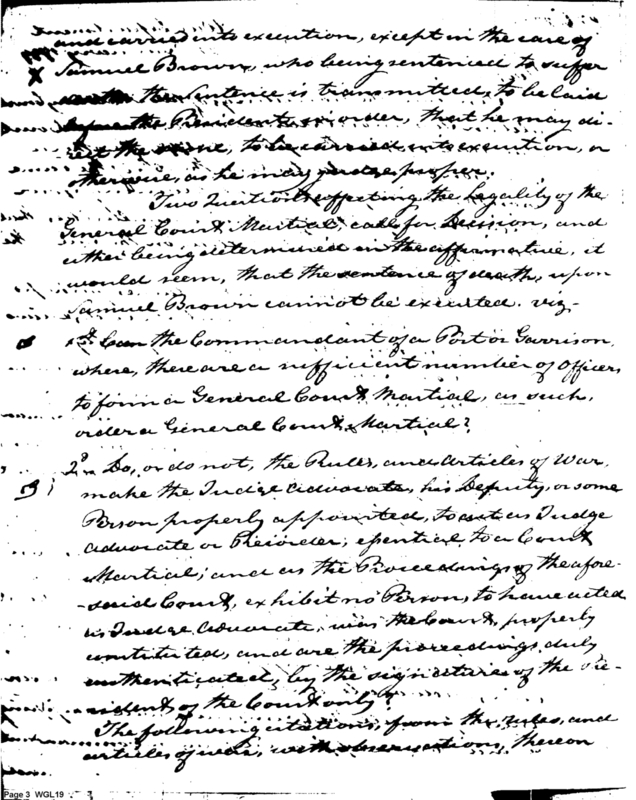
and carried into execution, except in the case of Samuel Brown, who being sentenced to suffer death, the sentence is transmitted, to be laid before the President to order, that he may direct the same, to be carried into execution, or reprieve, as he may judge proper.
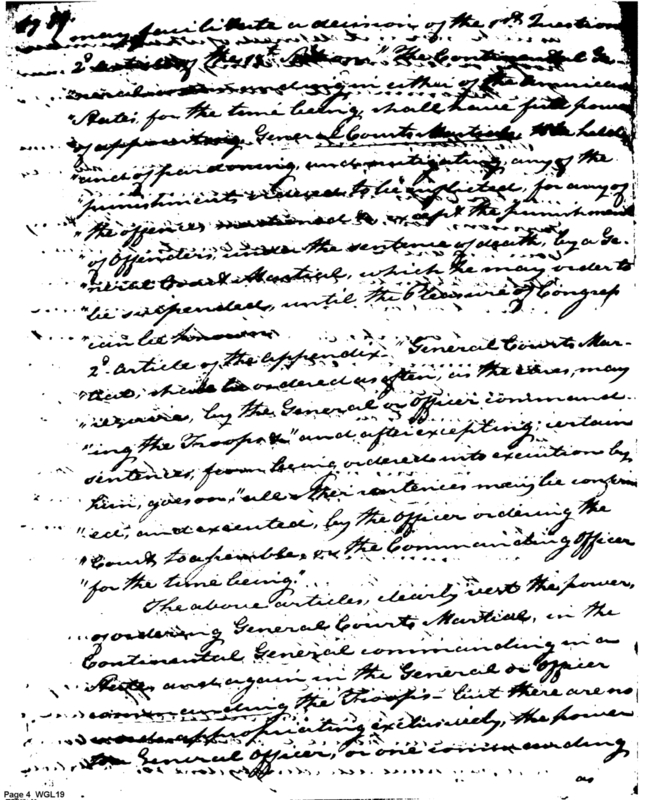
Two Questions affecting the legality of the General Court Martial, call for decision, and either being determined in the affirmative, it would seem, that the sentence of death, upon Samuel Brown cannot be executed. viz.
1st Can the Commandant of a Port or Garrison, where, there are a sufficient number of Officers to form a General Court Martial, as such, order a General Court Martial?
2d Do, or do not, the Rules and Articles of War, make the Judge Advocate, his Deputy, or some Person properly appointed, to act as Judge Advocate or Recorder, essential to a Court Martial; and as the Proceedings of the aforesaid Court, exhibit no Person, to have acted as Judge Advocate, were the Court properly constituted, and are the proceedings, duly authenticated, by the signatories of the President of the Court only?
The following citations, from the Rules, and Articles of War, with observations thereon
may facilitate a decision of the 1st Question
2d Article 18th Section. "The Continental [undecipherable] in either of the American States, for the time being, shall have full power of appointing General Courts Martial, to be held for conducting, and investigating, any of the punishments to be inflicted, for any of the offences mentioned to, except the punishment of offenders, under the sentence of death, by a General Court Martial, which he may order to be suspended, until the pleasure of Congress can be known."
2d Article of the Appendix. General Courts Martial, should be ordered as often, as the times, may require, by the General or Officer commanding the Troops &c., and after excepting certain sentences, from being ordered into execution by him, goes on, "all other sentences may be confirmed, and executed, by the officer ordering the Court, to assemble, or the Commanding Officer for the time being."
The above articles, clearly vest the power of ordering General Courts Martial, in the Continental General commanding in a State, and again in the General or Officer commanding the Troops — but there are no [undecipherable] appropriating exclusively, the power [undecipherable] to the General Officer, or one commanding
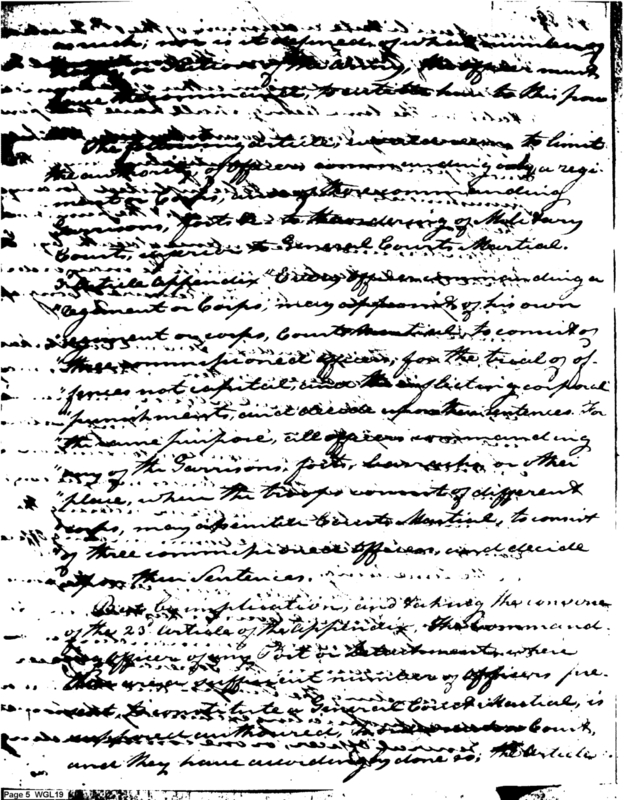
[undecipherable], nor is it [undecipherable] [undecipherable] [undecipherable] to this [undecipherable]
The [undecipherable] Article, [undecipherable] seems to limit the [undecipherable] of officers commanding only a regiment, [undecipherable] or the commanding of Garrisons, forts &c. to the ordering of Military Courts, [undecipherable] General Courts Martial.
3 Article Appendix. "Every Officer commanding a Regiment or Corps, may appoint of his own [undecipherable] or corps, Courts Martial, to consist of three commissioned Officers, for the trial of offences not capital, and to inflict any military corporal punishments, and decide upon their sentences. For the same purpose, all Officers commanding any of the Garrisons, forts, barracks, or other places, where the troops consist of different Corps, may appoint Courts Martial, to consist of three commissioned Officers, and decide upon their sentences."
But by implication, and taking the converse of the 23 Article of the Appendix, the Commandant [undecipherable] of any Post or Detachment, where there are not a sufficient number of Officers present, to constitute a General Court Martial, is [undecipherable] empowered, to [undecipherable] Court, and they have accordingly done so; the Article
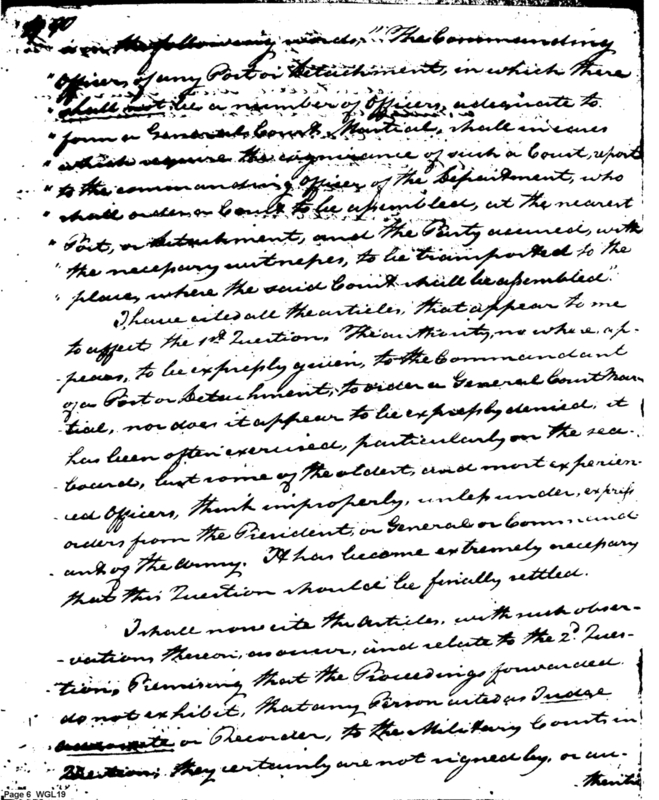
in the following words. "The Commanding Officer of any Post or Detachment, in which there shall not be a number of Officers adequate to form a General Court Martial, shall in cases which require the cognisance of such a Court, report to the commanding Officer of the Department, who shall order a Court to be assembled, at the nearest Post, or Detachment, and the Party accused, with the necessary witnesses, to be transported to the places where the said Court shall be assembled."
I have cited all the articles, that appear to me to affect the 1st question. The authority, no where appears, to be expressly given, to the Commandant of a Post or Detachment, to order a General Court Martial, nor does it appear to be expressly denied, it has been often exercised, particularly on the sea-board, but some of the oldest, and most experienced Officers, think improperly, unless under, express orders from the President, or General or Commanding officer of the Army. It has become extremely necessary that this question should be finally settled.
I shall now cite the articles, with such observations thereon, as occur, and relate to the 2d question, Premising that the Proceedings before us do not exhibit, that any Person acted as Judge Advocate or Recorder, to the Military Courts in question; they certainly are not signed by, or [undecipherable]
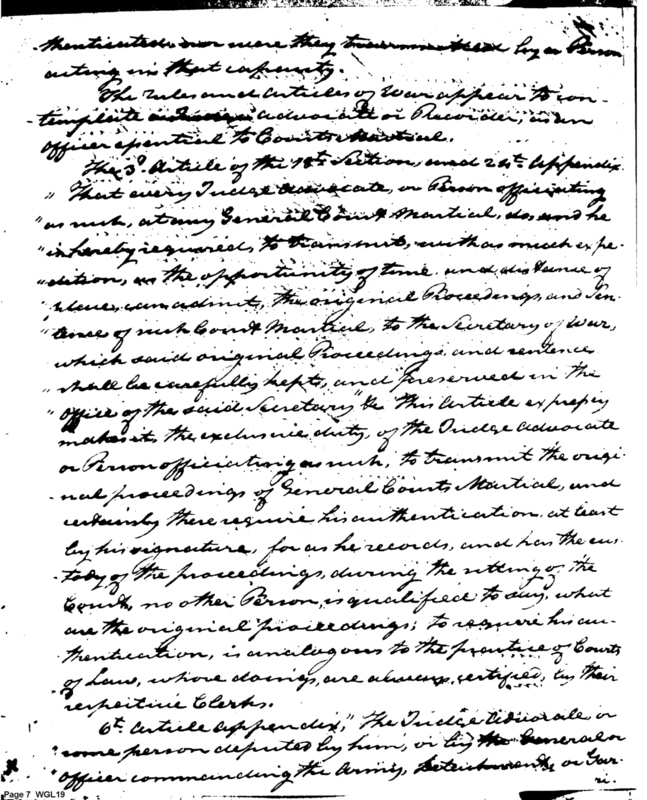
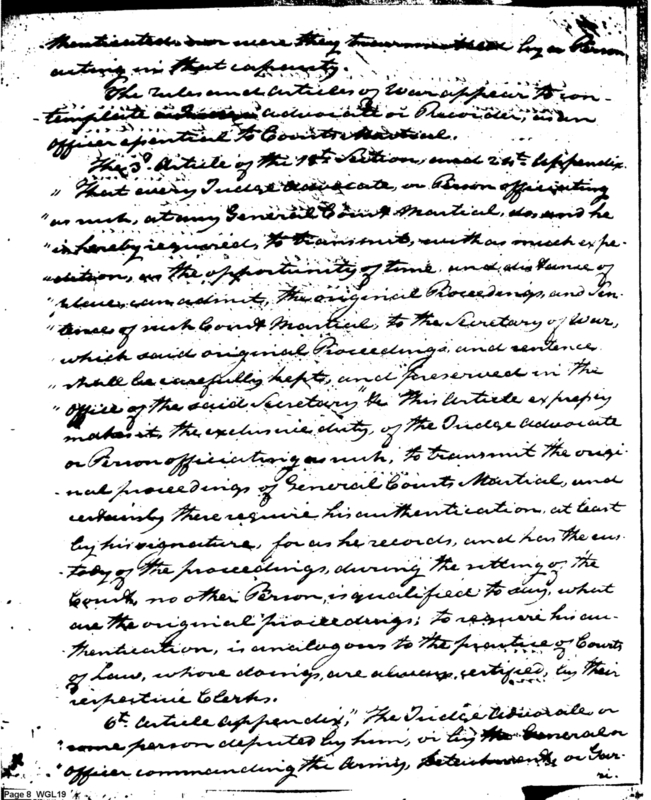
[undecipherable], nor were they transmitted by a Person acting in that capacity.
The Rules and Articles of War appear to contemplate a Judge Advocate or Recorder, as an officer essential to Courts Martial.
The 3d Article of the 18th Section, and 24th Appendix. "That every Judge Advocate, or Person officiating as such, at any General Court Martial, do, and he is hereby required, to transmit, with as much expedition, as the opportunity of time, and distance of places, can admit, the original Proceedings, and Sentences of such Courts Martial, to the Secretary of War, which said original Proceedings, and sentence shall be carefully kept, and preserved in the office of the said Secretary." This Article expressly makes it the exclusive duty, of the Judge Advocate or Person officiating as such, to transmit the original proceedings of General Courts Martial, and certainly there require his authentication, at least by his signature, for as he records, and has the custody of the proceedings, during the sitting of the Court, no other Person, is qualified to say, what are the original proceedings; to require his authentication, is analogous to the practice of Courts of law, whose doings, are always certified, by their respective Clerks.
6th Article Appendix. "The Judge Advocate or some person deputed by him, or by the General or Officer commencing the Army, Detachments, or Garrison
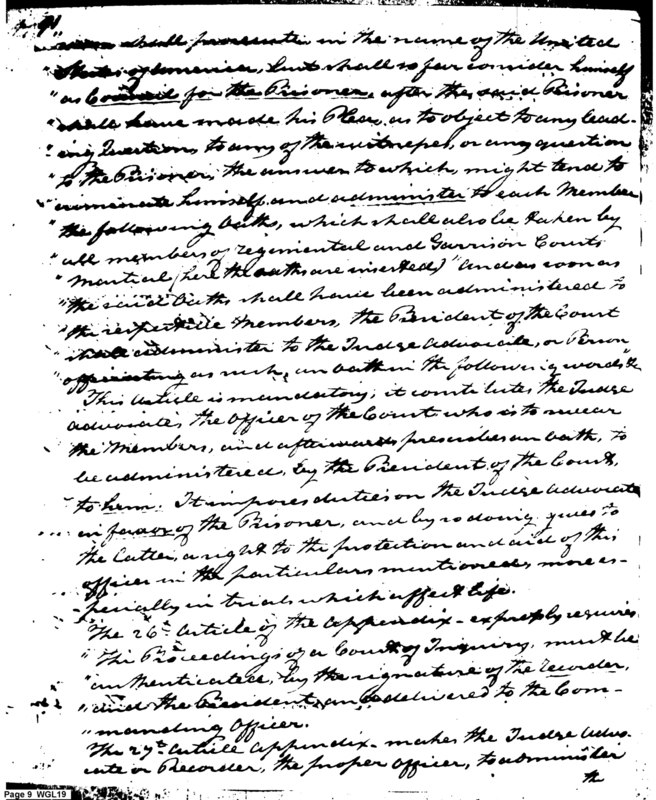
[undecipherable] shall prosecute in the name of the United States of America, but shall so far consider himself as Counsel for the Prisoner, after the said Prisoner shall have made his Plea, as to object to any leading Questions to any of the witnesses, or any question of the Prisoner, the answer to which, might tend to criminate himself, and administer to each Member the following oath, which shall also be taken by all members of regimental and Garrison Courts Martial (here the oaths are inserted) 'And as soon as the said oaths shall have been administered to the respective Members, the President of the Court shall administer to the Judge Advocate, or Person officiating as such, an oath in the following words: &c'"
This Article is mandatory; it constitutes the Judge Advocate, the officer of the Court who is to swear the Members, and afterwards presides in oath, to be administered, by the President of the Court, to him. It imposes duties on the Judge Advocate in favour of the Prisoner, and by so doing, gives to the latter, a right to the protection and aid of this officer, in the particulars mentioned, more especially in trials which affect life.
The 26th Article of the Appendix — expressly requires the Proceedings of a Court of Enquiry, must be "authenticated, by the signature of the Recorder, and the President and be delivered to the commanding Officer."
The 27th Article Appendix, makes the Judge Advocate, or Recorder, the proper officer, to administer the
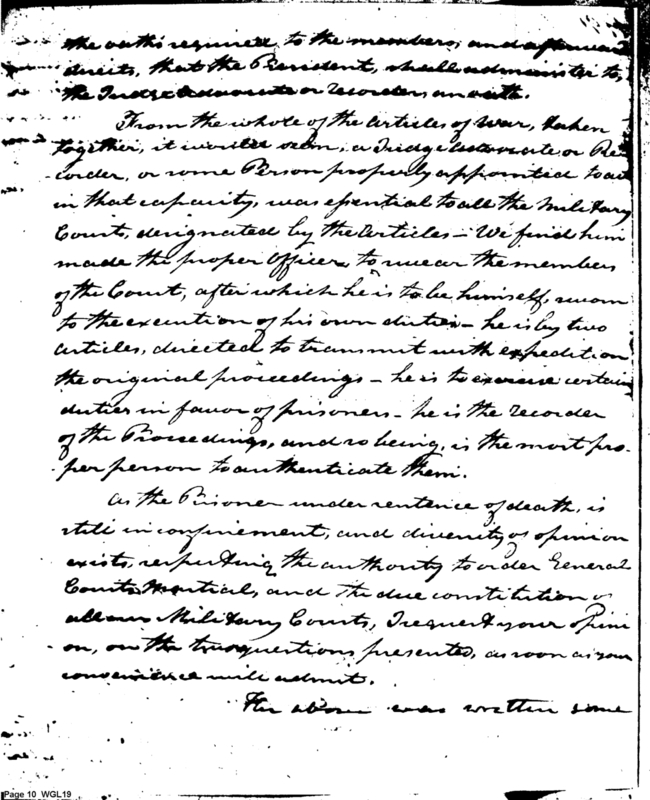
oaths required to the members, and afterwards it states, that the President, shall administer to, the Judge Advocate or Recorder, an oath.
From the whole of the Articles of War, taken together, it would seem, a Judge Advocate or Recorder, or some Person properly appointed to act in that capacity, was essential to all the Military Courts, designated by the Articles — We find him made the proper Officer, to swear the members of the Court, after which he is to be himself, sworn to the execution of his own duties — he is by two articles, directed to transmit with expedition the original proceedings — he is to exercise certain duties in favour of prisoners — he is the Recorder of the Proceedings, and as being, is the most proper person to authenticate them.
As the Prisoner under sentence of death, is still in confinement, and diversity of opinion exists, respecting the authority to order General Courts Martial, and the due constitution of all our Military Courts, I request your Opinion, on the two questions presented, as soon as your convenience will admit.
The above was written some
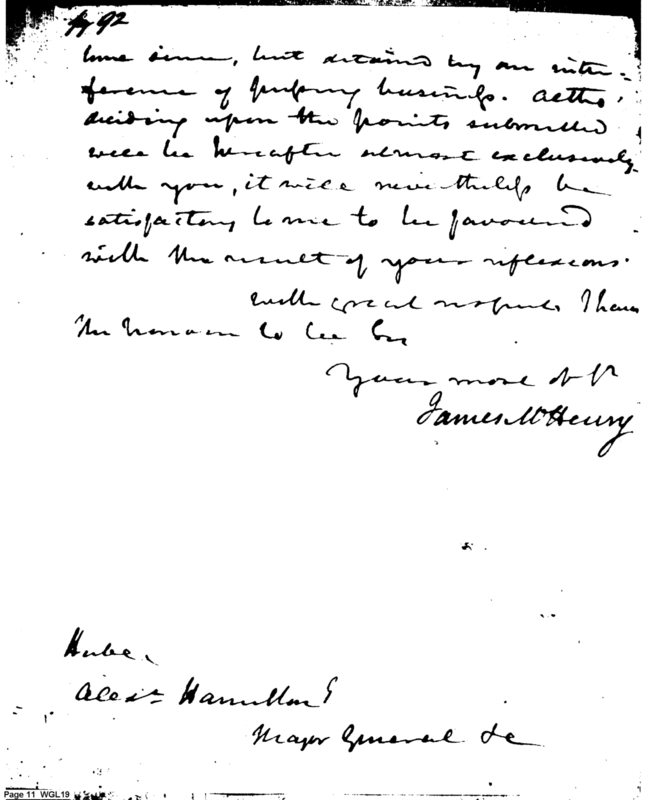
time since, but detained by an interference of pressing business. As the [undecipherable] acting upon the points submitted will hereafter almost exclusively be with you, it will nevertheless be satisfactory to me to be favoured with the result of your reflections.
with great respect I have the honour to be Sir
Your most obt servt
James McHenry
[hube.
Alexr Hamilton
Major General &c]
Type
Letter Signed
Description
McHenry has two questions bearing on the legality of the General Court Martial: Can the Commandant of a Port or Garrison , where there a sufficient number of officers, order a General Court Martial? Do the Articles of War make the Judge Advocate, or some person properly appointed, essential to a Court Martial?
Date
01/21/1799
Author
Recipient
Sent from
War Department
Repository
Collection
Document number
1799012100001
Note
Eleven page document.
Notable persons
Alexander Hamilton
James McHenry
Commandant of a Port of Garrison
Judge Advocate
Recorder
President of the Court
Notable locations
War Department
Governors Island
Governeurs Island
New York
Notable items
Proceedings of Two Military Courts
General Court Martial
Garrison Court Martial
Questions affecting the legality of the General Court Martial
rules and Articles of War
proceedings of the aforesaid Court