

Relative Rank of Captains in the Navy
Document 1799Talbot complains to Hamilton about his placement in the relative rank of Captains of the Navy. He is particulaly displeased with the placement of Capt. Truxton above him .He argues that when an officer of the Navy is out of command his pay ceases but not his rank which should remain the same when his service recommences.


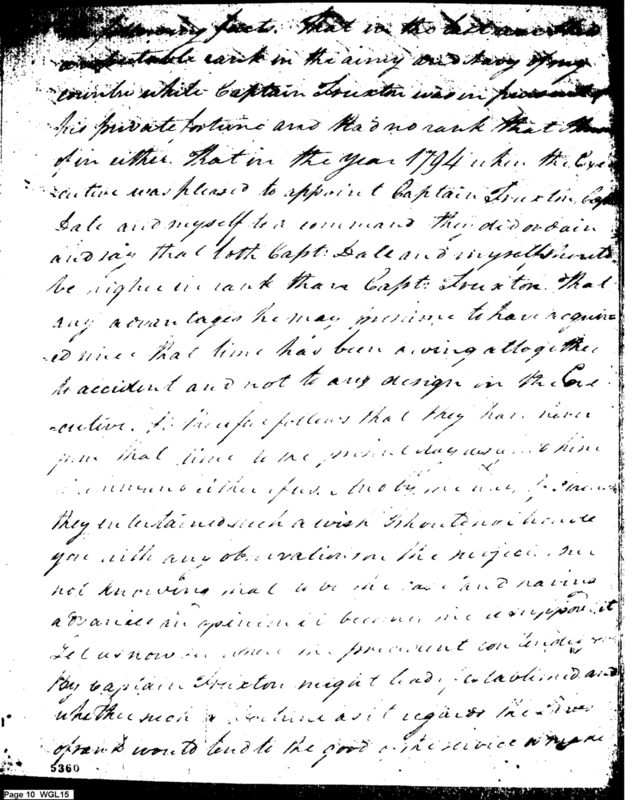
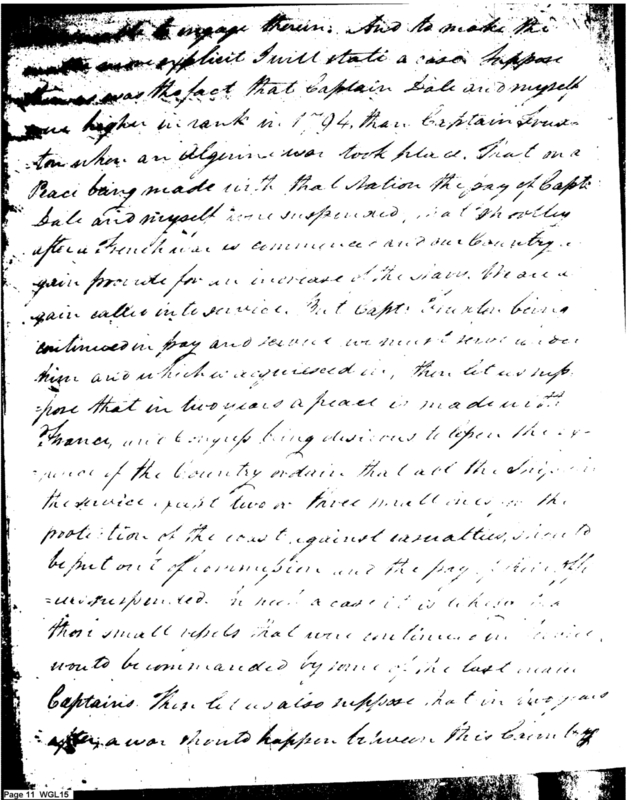
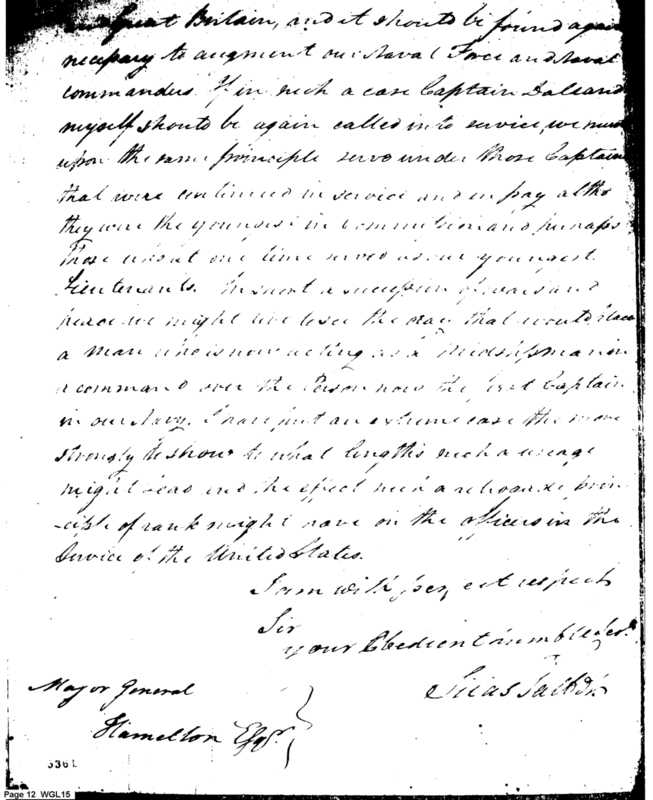
No human transcription currently available for this document.
This transcription was generated by machine using Anthropic's Claude Code (model sonnet 4.6). It may contain errors or inaccuracies. Please verify against the document image. Learn more about our generative AI methodology.
Now I have all the pages. Let me compile the full transcription.
[undecipherable]
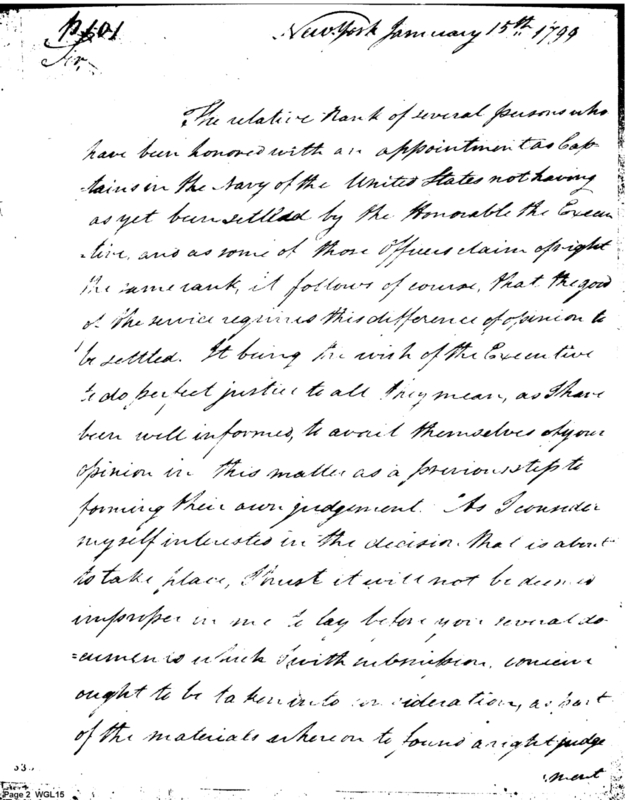
New-York January 15th 1799
[p.501]
Sir,
The relative Rank of several persons who have been honored with an appointment as Cap-tains in the Navy of the United States not having as yet been settled by the Honorable the Execu-tive, and as some of those Officers claim of right the same rank, it follows of course, that the good of the service requires this difference of opinion to be settled. It being the wish of the Executive to do perfect justice to all they mean, as I have been well informed, to avail themselves of your Opinion in this matter as a previous step to forming their own judgement. As I consider myself interested in the decision that is about to take place, I trust it will not be deemed improper in me to lay before you several do-=cuments which [strikethrough: I] with submission, conceive ought to be taken into consideration, as part of the materials whereon to found a right judge-ment
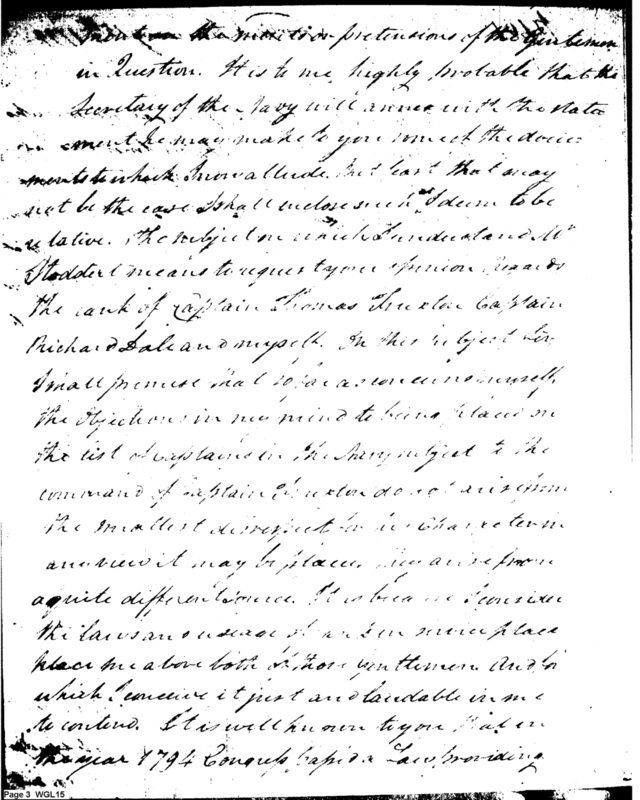
[and to present] the merits and pretensions of the Gentlemen in Question. It is to me highly probable that the Secretary of the Navy will annex with the state-ment he may make to you some of the docu-ments to which I now allude. But lest that may not be the case I shall enclose such I deem to be relative. The subject on which I understand Mr Stoddert means to request your Opinion regards the rank of Captain Thomas Truxtun Captain Richard Dale and myself. On this subject Sir I shall premise that I have no concern with the Objections in my mind to being placed on the list of captains in the Navy subject to the command of Captain Truxtun does not arise from the smallest disrespect for his Character terms and views it may be placed in a more or quite different source. It has been I consider the law and usage of our service to have placed me above both of those Gentlemen. And to which I conceive it just and laudable in me to contend. It is well known to you Sir in the year 1794 Congress passed a law providing
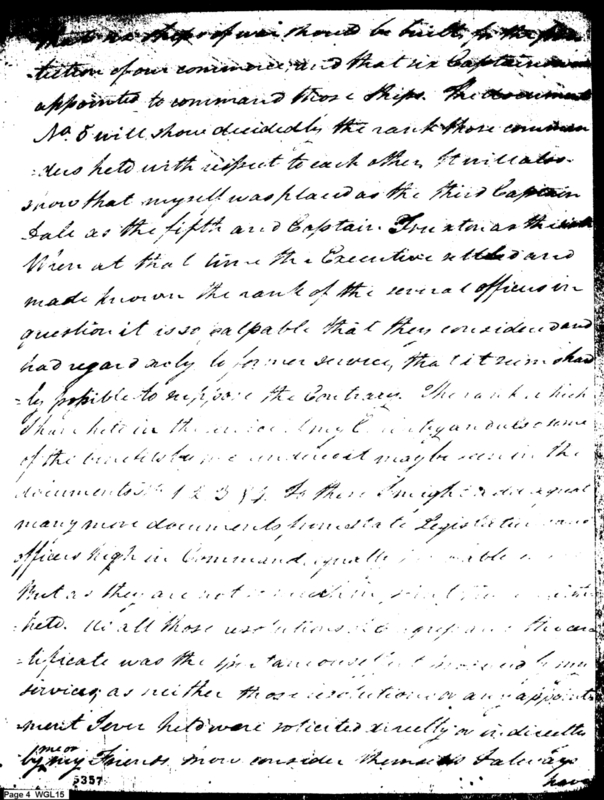
[that six ships of war should be built, for the con]stitution of our commerce, and that six Captains be appointed to command those Ships. The document No 6 will show decidedly the rank those command-ers held with respect to each other. It will also show that myself was placed as the third Captain, Dale as the fifth and Captain Truxtun as the [undecipherable: sixth?]. When at that time the Executive settled and made known the rank of the several Officers in question it is so palpable that they considered and had regard only to former service, that it must [be] as possible to suppose the Contrary. The rank which [they] held in the service [they] previously and also some of the credentials are indicated may be seen in the documents [No] 1 2 3 [&] 4. To these I might add a great many more documents from State to Legislature and officers high in Command, equally [undecipherable] but as they are not [undecipherable] here deleted. As all those resolutions so [undecipherable] the certificate was the spontaneous [undecipherable] from services, as neither those resolutions or any appointment [I ever] held were solicited directly or indirectly by my friends, more consider themselves [undecipherable]
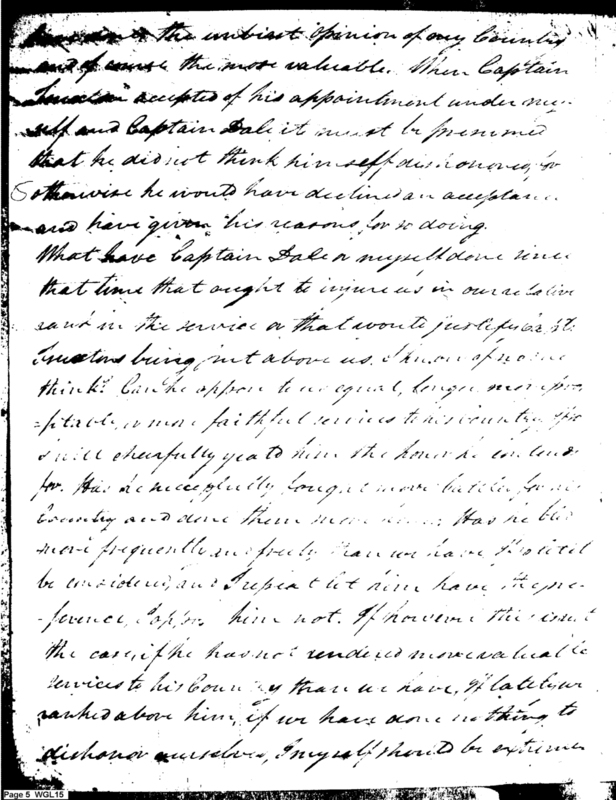
[Justly?] as the unbiased Opinion of my Country and of course the more valuable. When Captain Truxtun accepted of his appointment under my-self and Captain Dale it must be presumed that he did not think himself dishonored, for otherwise he would have declined an acceptance, and have given his reasons for so doing.
What have Captain Dale & myself done since that time that ought to injure us in our relative rank in the service or that would justify placing Truxtun being put above us. I know of no one think[s] can the oppose to our equal, longer more [re]spectable, a more faithful services to his country, the [which] I will cheerfully yet to him the honor he is entitled to. Has he successfully fought more battles for his Country and done them more [honor?] Has he been more frequently and freely than we have. I hold it be considered and I repeat let him have the pre-ference, for him not. If however this is not the case, if he has not rendered more valuable services to his country than we have, If late been ranked above him, if we have done nothing to dishonor ourselves, I myself should be extreme
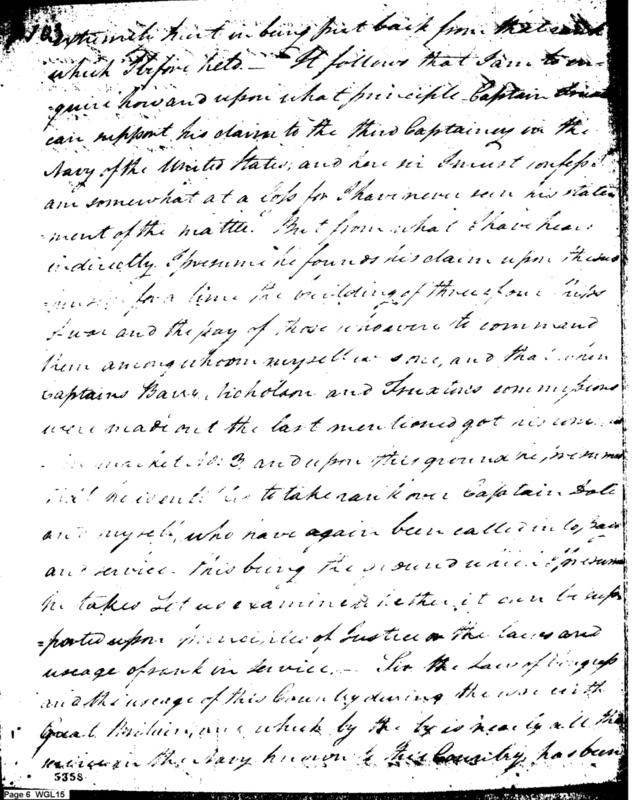
[to?] put [himself?] hurt in being put back from that rank which before held. — It follows that I am to enquire how and upon what principle Captain Truxtun can support his claim to the third Captaincy in the Navy of the United States, and here Sir I must confess I am somewhat at a loss for I have never seen his state-ment of the matter. But from what I have heard indirectly I presume he founds his claim upon the [undecipherable] for a time the [building?] of three [or] four [ships?] was and the pay of those who were to command them among whom myself was one, and that [even?] captains Barry, Nicholson and Truxtun commissions were made out the last mentioned got his commission. [The] marked No 3 and upon this ground he presumes that it entitles him to take rank over Captain Dale and myself, who have again been called into active service. This being the ground upon which he takes Let us examine whether it can be sup-ported upon principles of justice or the laws and usage of rank in service. — For the law of Congress and the usage of this country during the war with Great Britain, and which by the by is nearly all the warriors in the Navy known to their country, has been
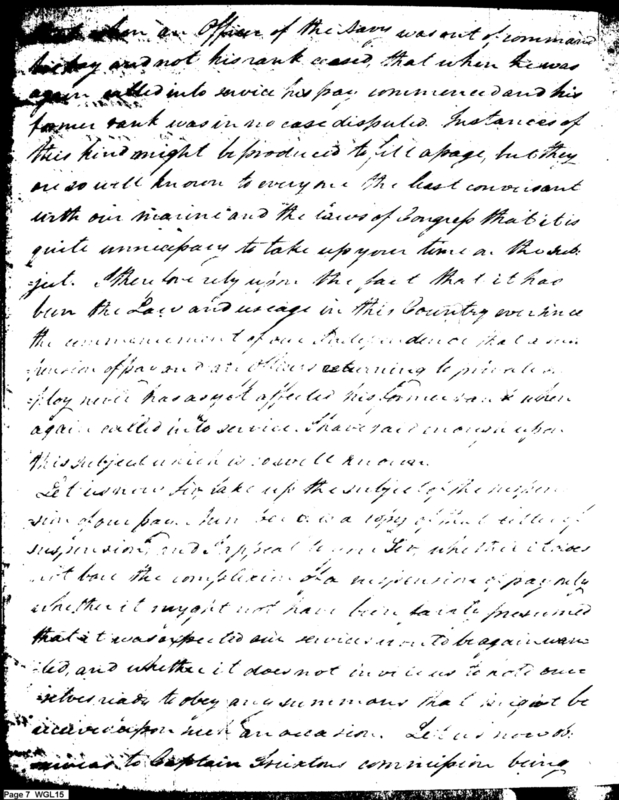
[that] when an Officer of the Navy was out of command his pay and not his rank ceased, that when he was again called into service his pay commenced and his former rank was in no case disputed. Instances of this kind might be produced to fill a page, but they are so well known to every one the best conversant with our Marine and the laws of Congress that it is quite unnecessary to take up your time on the subject. Therefore we rely upon the fact that it has been the Law and usage in this Country since the commencement of our Independence that a sus-pension of pay and an Officer returning to private employ never has as yet affected his former rank & when again called into service. I have said enough upon this subject which is so well known.
Let us now Sir take up the subject of the suspen-sion of our pay. Here is a copy of that letter of suspension, and I appeal to you Sir whether it does not have the complexion of a suspension of pay only, whether it might not have been taken to have presumed that it was expected our services were to be again wanted, and whether it does not invite us to hold ourselves ready to obey any summons that it might be deemed as proper to be received upon such an occasion. Let us now [ob]serve [what?] to Captain Truxtuns commission being
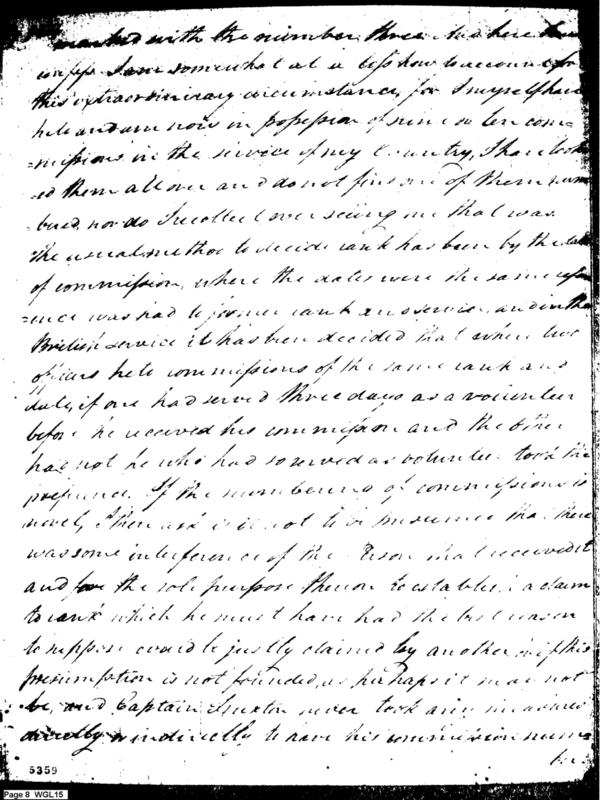
[marked?] with the number three — [I] confess I have somewhat at a loss how to account for this extraordinary circumstance, for I myself have held and am now in possession of nine or ten commissions in the service of my Country, I have looked at them all over and do not find one of them numbered, nor do I recollect ever seeing one that was the usual method to decide rank has been by the date of commission, where the dates were the same experience was had to former rank and service, and in the British service it has been decided that when two officers held commissions of the same rank and date, if one had served three days as a volunteer before he received his commission, and the other had not, he who had so served as volunteer took the preference. If the numbering of commissions is novel, I then submit it not to be presumed that there was some interference of the Person who received it and for the sole purpose thereon to establish a claim to rank which he must have had the best reasons to suppose could be justly claimed by another, and if this presumption is not founded, as perhaps it may not be, and Captain Truxtun never took any measures directly or indirectly to have his commission number[ed]
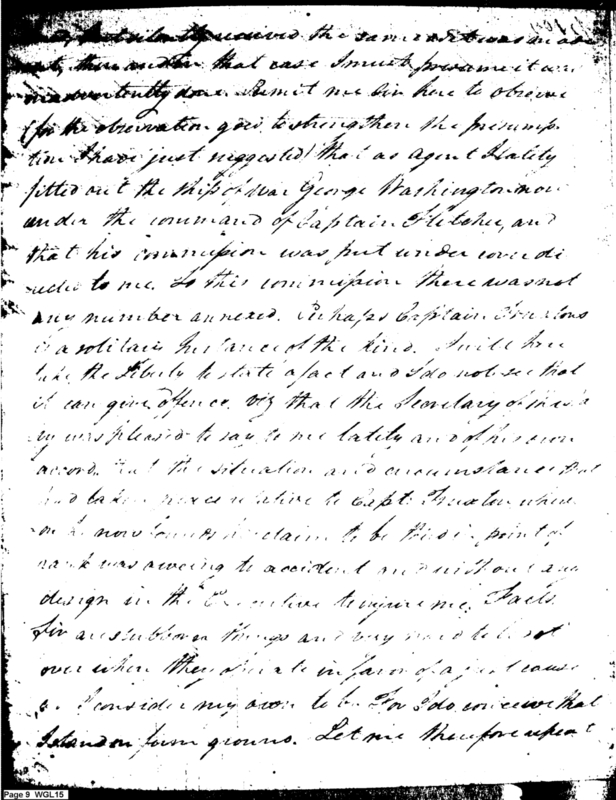
[for?] — [at?] [the?] received the same [number?] [undecipherable] — that case I much presume it can inavoidably done. Admit it Sir here to observe [for?] the observation goes to strengthen the presump-tion I have just suggested that as Agent [Hality?] fitted out the Ship the George Washington [undecipherable] under the command of Captain [undecipherable] and that his commission was put under cover di-rected to me. [In?] this commission there was not any number annexed. [Perhaps?] Captain Truxtun is a solitary [instance?] of the kind. I will take the liberty to state a fact and I do not see that it can give offence, [viz] that the Secretary of [War?] was pleased to say to me lately and of his own accord, that the situation and circumstances that had taken place relative to Capt. Truxtun when he now founds his claim to be the [first?] point of rank was owing to accident and without any design in the Executive to injure me. Facts Sir are stubborn things and very need to be not over when they [operate?] in favor of a just cause. I consider my own to be. For I do conceive that I abandon firm grounds. Let me therefore repeat
[the] indisputable fact, that in the [undecipherable] the undisputed rank in the army and navy of my Country while Captain Truxtun was in possession of his private fortune and had no rank that [I know?] of in either. That in the Year 1794 when the Executive was pleased to appoint Captain Truxtun, Captain Dale and myself to a command they did ordain and say that both Capt. Dale and myself must be higher in rank than Capt. Truxtun. That any advantages he may presume to have acquired since that time has been owing altogether to accident and not to any design in the Exe-cutive. It therefore follows that they have since from that time to the present day assumed to him [undecipherable] either [undecipherable] by me and, [for?] had they entertained such a wish I should not have bored you with any observations on the subject, not knowing that to be the case and having advanced [his?] opinion it becomes me now to report. Let us now examine the precedent con[tending?] this Captain Truxtun might [have?] established and whether such a doctrine as it regards the lives of rank would tend to the good of the service if you
[choose?] to engage therein. And to make the [argument?] more explicit I will state a case. Suppose [that?] was the fact that Captain Dale and myself are higher in rank in 1794, than Captain Trux-ton when an Algerine war took place. That on a peace being made with that Nation the pay of Capt. Dale and myself were suspended, that shortly after a French war is commenced and our Country again provides for an increase of the Navy. We are again called into service. But Capt. Truxtun being continued in pay and service we must serve under him and which we acquiesced in. Then let us sup-pose that in two years a peace is made with France, and Congress being desirous to lessen the ex-pence of the Country ordain that all the Ships in the service, just two or three small ones on the protection of the coast, against casualties, should be put out of commission and the pay [of those?] -ers suspended. In such a case it is [where?] those small [vessels?] that were continued in service, would be commanded by some of the last named Captains. Then let us also suppose that in two years after a war should happen between this Country
and Great Britain, and it should be found again necessary to augment our Naval Force and Naval commanders. If in such a case Captain Dale and myself should be again called into service, we must upon the same principle serve under those Captains that were continued in service and in pay at the time they were the youngest in commission and perhaps have never at one time served as our youngest Lieutenants. Is not a [suffi]ciently absurd [scenario?] we might live to see the way that would place a man who is now acting as a Midshipman in a command over the Person now the first Captain in our Navy. I have just an extreme case the more strongly to show to what lengths such a usage might lead and the effect such a retroactive prin-ciple of rank might have on the officers in the Service of the United States.
I am with great respect
Sir
your Obedient humble Servant
Major General Silas Talbot.
Hamilton Esqr.
Type
Autograph Letter Signed
Description
Talbot complains to Hamilton about his placement in the relative rank of Captains of the Navy. He is particulaly displeased with the placement of Capt. Truxton above him .He argues that when an officer of the Navy is out of command his pay ceases but not his rank which should remain the same when his service recommences.
Date
01/15/1799
Author
Recipient
Sent from
New York
Repository
Collection
Document number
1799011590001
Note
Partially illegible.
Notable persons
Alexander Hamilton
Silas Talbot
the Executive
Officers
Mr. [Benjamin] Stoddert
Capt. Thomas Truxton
Capt. Richard Dale
Congress
Capt. Barry
Capt. Nicholson
navy
officer
command
congress
Notable locations
New York
Notable items
relative rank of several persons
appointment as Captains in the Navy
good of the service
perfect justice to all
disrespect for his character
laws and usage of rank in service
ships of war
protection of our commerce
pay
commissions
law of Congress
war with Great Britain