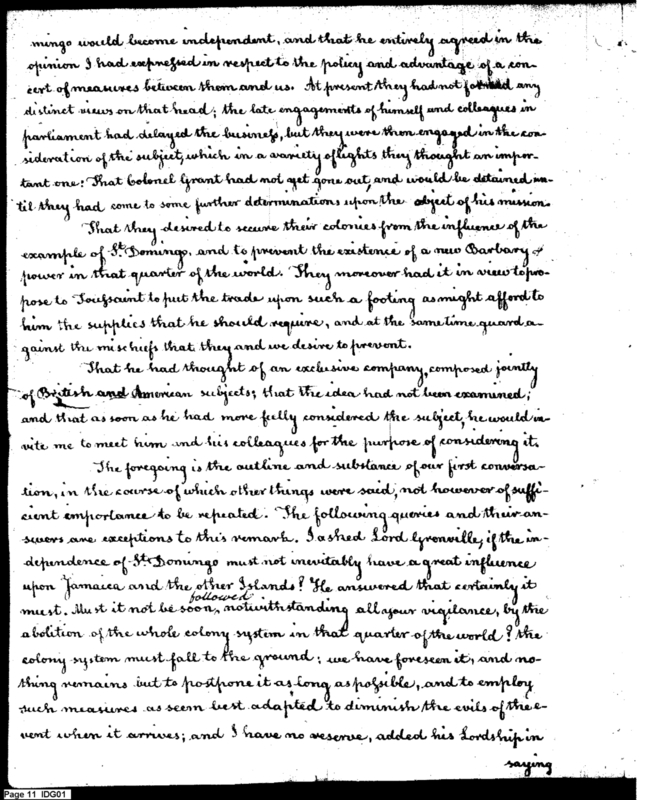
mischiefs that they and we desire to prevent.
That he had thought of an exclusive company, composed jointly of British and American subjects; that the idea had not been examined; and that as soon as he had more fully considered the subject, he would invite me to meet him and his colleagues for the purpose of considering it.
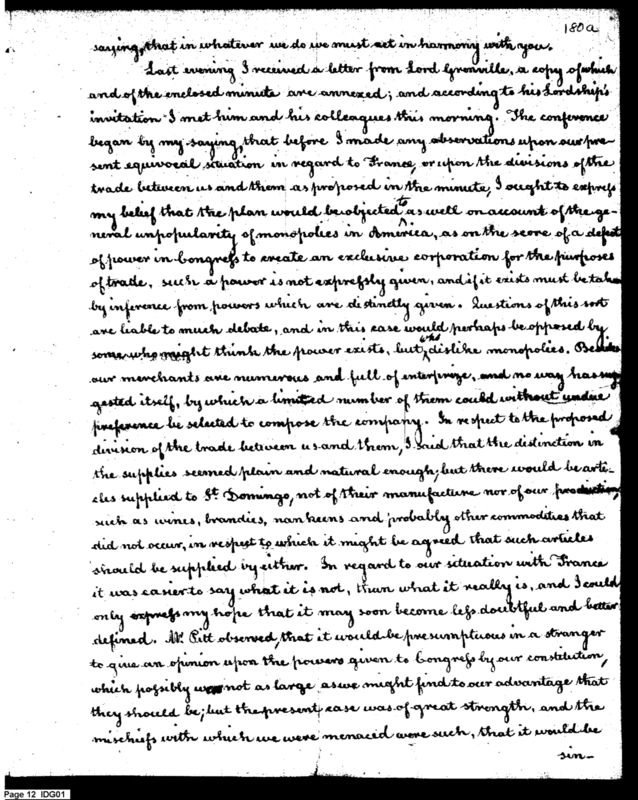
The foregoing is the outline and substance of our first conversation, in the course of which other things were said, not however of sufficient importance to be repeated. The following queries and their answers are exceptions to this remark. I asked Lord Grenville, if the independence of S.t Domingo must not inevitably have a great influence upon Jamaica and the other Islands? He answered that certainly it must. Must it not be soon, followed notwithstanding all your vigilance, by the abolition of the whole colony system in that quarter of the world? the colony system must fall to the ground; we have foreseen it, and nothing remains but to postpone it as long as possible, and to employ such measures as seem best adapted to diminish the evils of the event when it arrives; and I have no reserve, added his Lordship in saying, that in whatever we do we must act in harmony with you.
[180a]
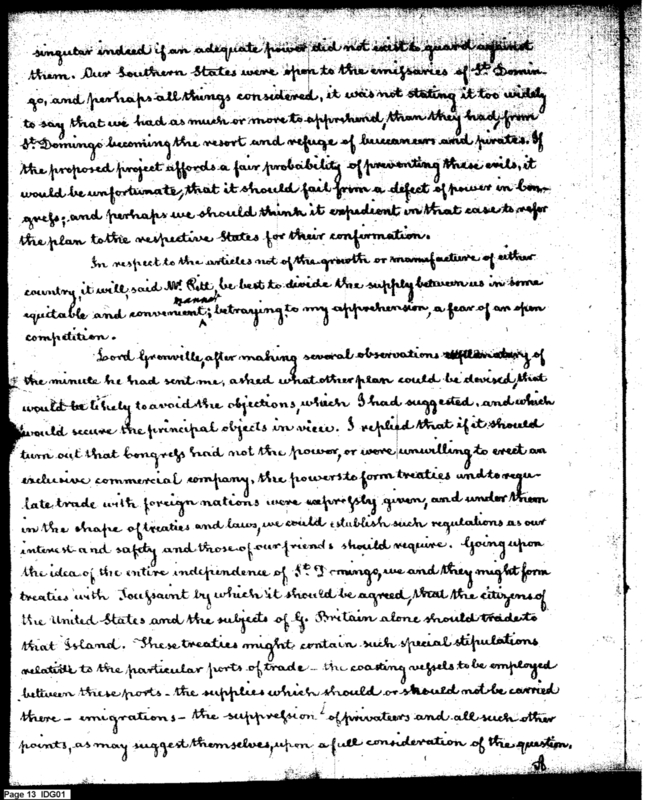
Last evening I received a letter from Lord Grenville, a copy of which and of the enclosed minute are annexed; and according to his Lordship's invitation I met him and his colleagues this morning. The conference began by my saying that before I made any observations upon our present equivocal situation in regard to France, or upon the divisions of the trade between us and them as proposed in the minute, I ought to express my belief that the plan would be objected to as well on account of the general unpopularity of monopolies in America, as on the score of a defect of power in Congress to create an exclusive corporation for the purposes of trade; such a power is not expressly given, and if it exists must be taken by inference from powers which are distinctly given. Questions of this sort are liable to much debate, and in this case would perhaps be opposed by some who might think the power exists, but dislike monopolies. Besides our merchants are numerous and full of enterprize, and no way has suggested itself, by which a limited number of them could without undue preference be selected to compose the company. In respect to the proposed division of the trade between us and them, I said that the distinction in the supplies seemed plain and natural enough; but there would be articles supplied to S.t Domingo, not of their manufacture nor of our production, such as wines, brandies, nankeens and probably other commodities that did not occur, in respect to which it might be agreed that such articles should be supplied by either. In regard to our situation with France it was easier to say what it is not, than what it really is, and I could only express my hope that it may soon become less doubtful and better defined. M.r Pitt observed that it would be presumptuous in a stranger to give an opinion upon the powers given to Congress by our constitution, which possibly were not as large as we might find to our advantage that they should be; but the present case was of great strength, and the mischiefs with which we were menaced were such, that it would be singular indeed if an adequate power did not exist to guard against them. Our Southern States were open to the emissaries of S.t Domingo, and perhaps all things considered, it was not stating it too widely to say that we had as much or more to apprehend, than they had, from S.t Domingo becoming the resort and refuge of buccaneers and pirates. If the proposed project affords a fair probability of preventing these evils, it would be unfortunate, that it should fail from a defect of power in Congress; and perhaps we should think it expedient in that case to refer the plan to the respective States for their confirmation.
In respect to the articles not of the growth or manufacture of either country, it will, said M.r Pitt, be best to divide the supply between us in some equitable and convenient; betraying to my apprehension, a fear of an open competition.
Lord Grenville, after making several observations [strikethrough: explanatory of] the minute he had sent me, asked what other plan could be devised, that would be likely to avoid the objections, which I had suggested, and which would secure the principal objects in view. I replied that if it should turn out that Congress had not the power, or were unwilling to erect an exclusive commercial company, the powers to form treaties and to regulate trade with foreign nations were expressly given, and under them in the shape of treaties and laws, we could establish such regulations as our interest and safety and those of our friends should require. Going upon the idea of the entire independence of S.t Domingo, we and they might form treaties with Toussaint by which it should be agreed, that the citizens of the United States and the subjects of G.t Britain alone should trade to that Island. These treaties might contain such special stipulations relative to the particular ports of trade — the coasting vessels to be employed between these ports — the supplies which should or should not be carried there — emigrations — the suppression of privateers and all such other points, as may suggest themselves upon a full consideration of the question.
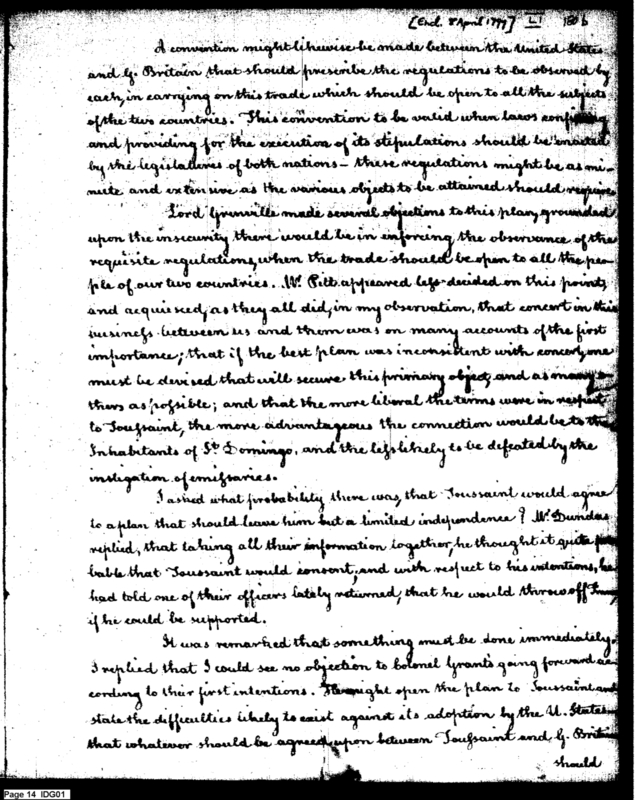
[Encl. 8 April 1799] [180b]
A convention might likewise be made between the United States and G.t Britain that should prescribe the regulations to be observed by each, in carrying on this trade which should be open to all the subjects of the two countries. This convention to be valid when laws confirming and providing for the execution of its stipulations should be enacted by the legislatures of both nations — these regulations might be as minute and extensive as the various objects to be attained should require.
Lord Grenville made several objections to this plan, grounded upon the insecurity there would be in enforcing the observance of the requisite regulations, when the trade should be open to all the people of our two countries. M.r Pitt appeared less decided on this point, and acquiesced, as they all did, in my observation, that concert in this business between us and them was on many accounts of the first importance; that if the best plan was inconsistent with concert, one must be devised that will secure this primary object, and as many others as possible; and that the more liberal the terms were in respect to Toussaint, the more advantageous the connection would be to the Inhabitants of S.t Domingo, and the less likely to be defeated by the instigation of emissaries.
I asked what probability there was, that Toussaint would agree to a plan that should leave him but a limited independence? M.r Dundas replied, that taking all their information together, he thought it quite probable that Toussaint would consent, and with respect to his intentions, he had told one of their officers lately returned, that he would throw off [undecipherable] if he could be supported.
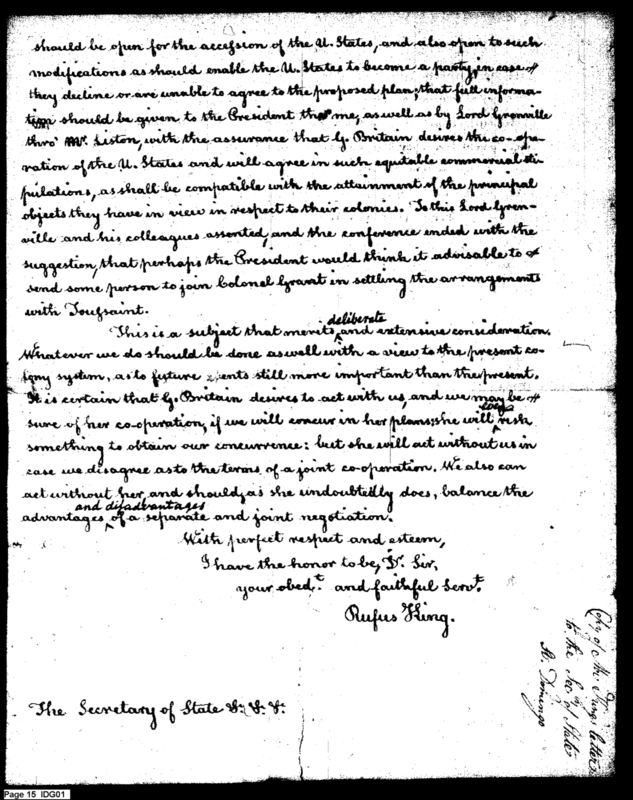
It was remarked that something must be done immediately. I replied that I could see no objection to Colonel Grant's going forward according to their first intentions. He might open the plan to Toussaint and state the difficulties likely to exist against its adoption by the U. States; that whatever should be agreed upon between Toussaint and G.t Britain should be open for the accession of the U. States, and also open to such modifications as should enable the U. States to become a party, in case they decline or are unable to agree to the proposed plan; that full information should be given to the President thro' me, as well as by Lord Grenville thro' M.r Liston, with the assurance that G.t Britain desires the co-operation of the U. States and will agree in such equitable commercial stipulations, as shall be compatible with the attainment of the principal objects they have in view in respect to their colonies. To this Lord Grenville and his colleagues assented, and the conference ended with the suggestion, that perhaps the President would think it advisable to send some person to join Colonel Grant in settling the arrangements with Toussaint.
This is a subject that merits deliberate and extensive consideration. Whatever we do should be done as well with a view to the present colony system, as to future events still more important than the present. It is certain that G.t Britain desires to act with us, and we may be sure of her co-operation, if we will concur in her plans; she will risk something to obtain our concurrence: but she will act without us in case we disagree as to the terms of a joint co-operation. We also can act without her, and should, as she undoubtedly does, balance the advantages and disadvantages of a separate and joint negotiation.
With perfect respect and esteem,
I have the honor to be, V.r Sir,
your obed.t and faithful Serv.t
Rufus King.
[Copy ele M. chargé to R. King
By the Sec.y of State]
The Secretary of State &c. &c. &c.
---
(Copy)
[Encl. 8 April 1799]
— 9 Jan.y 1799.
My dear Sir
In consequence of our conversation relative to S.t Domingo, I have, after discussing the subject with some of my colleagues, prepared the enclosed minute, which I send for your consideration, as the basis of an arrangement, which would, I think, provide equitably for the commercial interests of our two countries, as concerned in that business; and, what is infinitely more important, would afford as good Security, as the nature of things allows of, against the infinite dangers to which our Islands and your Southern Provinces would be exposed from an unrestrained intercourse with S.t Domingo in its present State.
If you should be at leisure and could meet M.r Pitt and M.r Dundas here, to morrow morning, at eleven, half an hour's discussion might probably so far terminate the business as to enable us to write to America, and dispatch Colonel Grant. If you had any wish to see me earlier, I shall be at home.
[Rufus King Esq.re
&c. &c. V.]
Believe me V.r &c.
Grenville.
---
Enclosure
The whole trade of export and import with Toussaint's part of S.t Domingo, to be confined to one port, viz. Port au Prince. The supply to be restricted, by agreement with Toussaint, and by compact between Great Britain and the United States, to a joint company, to be formed by the two governments, and to consist of British and American subjects. This company to be confined to furnish no manufactures but from the British territories, and no articles of produce or live stock but from America: To send the returns for the former in S.t Domingo produce to Jamaica or Great Britain, and for the latter to the United States only. An agent on the part of this company to reside at the specified port, and to have, on the part of the company, the exclusive conduct of the whole coasting trade, which he shall carry on by boats of the country, to a sufficient extent for the supply of the different parts of the Island under Toussaint's authority, and for bringing back their produce to Port au Prince. All British or American vessels, not belonging to the company, and all vessels belonging to France or any other power, or to any other in any part of the Island of S.t Domingo, and trading to or from any of its ports coastwise or otherwise, except
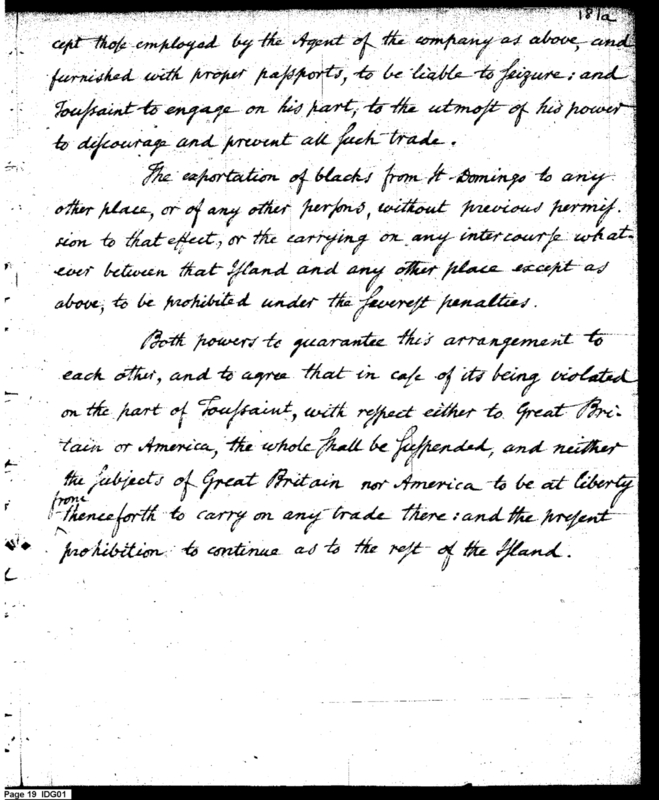
[181a]
cept those employed by the Agent of the company as above, and furnished with proper passports, to be liable to seizure; and Toussaint to engage on his part, to the utmost of his power to discourage and prevent all such trade.
The exportation of blacks from S.t Domingo to any other place, or of any other persons, without previous permission to that effect, or the carrying on any intercourse whatsoever between that Island and any other place except as above, to be prohibited under the severest penalties.
Both powers to guarantee this arrangement to each other, and to agree that in case of its being violated on the part of Toussaint, with respect either to Great Britain or America, the whole shall be suspended, and neither the subjects of Great Britain nor America to be at liberty from thenceforth to carry on any trade there: and the present prohibition to continue as to the rest of the Island.
---
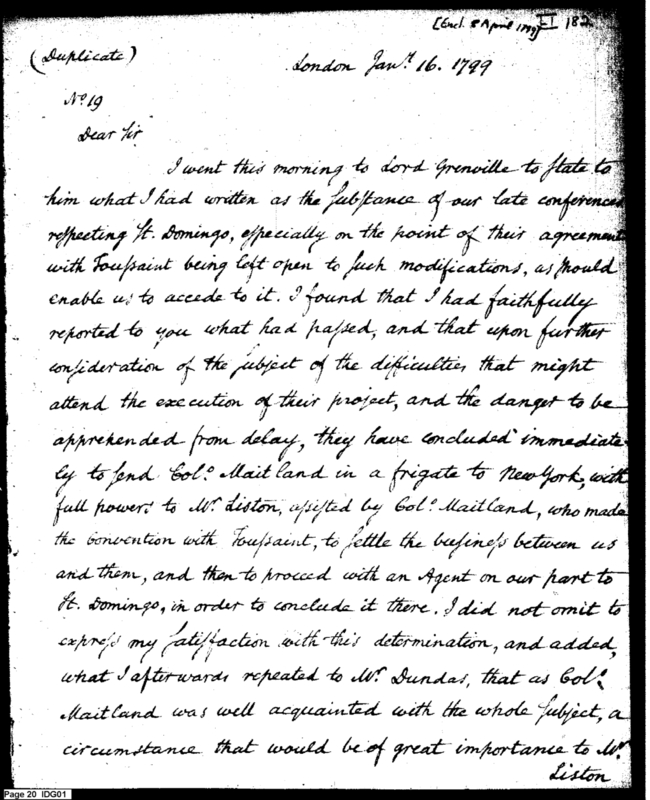
(Duplicate)
[Encl. 8 April 1799] [182]
London Jan.t 16. 1799
N.o 19
Dear Sir
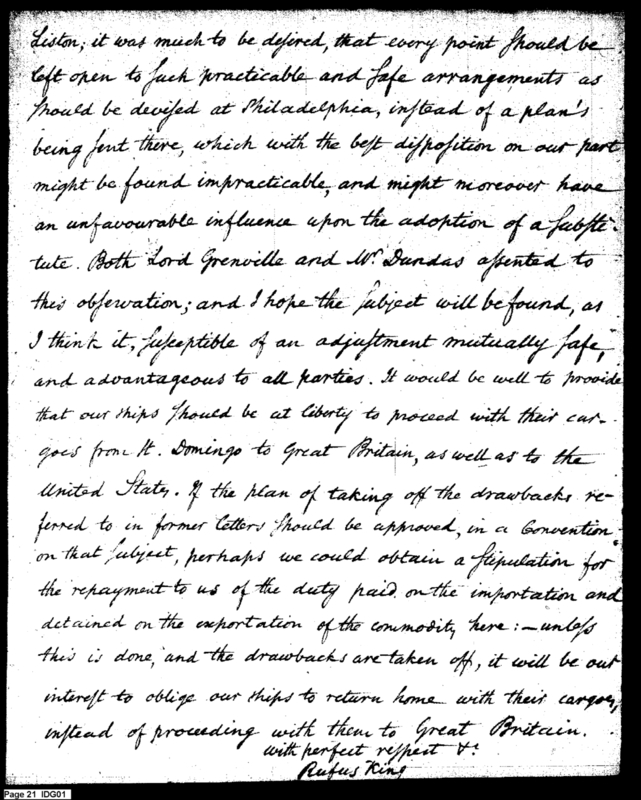
I went this morning to Lord Grenville to state to him what I had written as the substance of our late conference respecting S.t Domingo, especially on the point of their agreement with Toussaint being left open to such modifications, as should enable us to accede to it. I found that I had faithfully reported to you what had passed, and that upon further consideration of the subject of the difficulties that might attend the execution of their project, and the danger to be apprehended from delay, they have concluded immediately to send Col.o Maitland in a frigate to New York, with full powers to M.r Liston, assisted by Col.o Maitland, who made the convention with Toussaint, to settle the business between us and them, and then to proceed with an Agent on our part to S.t Domingo, in order to conclude it there. I did not omit to express my satisfaction with this determination, and added, what I afterwards repeated to M.r Dundas, that as Col.o Maitland was well acquainted with the whole subject, a circumstance that would be of great importance to M.r Liston, it was much to be desired, that every point should be left open to such practicable and safe arrangements as should be devised at Philadelphia, instead of a plan's being sent there, which with the best disposition on our part might be found impracticable, and might moreover have an unfavourable influence upon the adoption of a substitute. Both Lord Grenville and M.r Dundas assented to this observation; and I hope the subject will be found, as I think it, susceptible of an adjustment mutually safe, and advantageous to all parties. It would be well to provide that our ships should be at liberty to proceed with their cargoes from S.t Domingo to Great Britain, as well as to the United States. If the plan of taking off the drawbacks referred to in former letters should be approved, in a Convention on that subject, perhaps we could obtain a stipulation for the repayment to us of the duty paid on the importation and detained on the exportation of the commodity here: — unless this is done, and the drawbacks are taken off, it will be our interest to oblige our ships to return home with their cargoes, instead of proceeding with them to Great Britain.
with perfect respect &c.
Rufus King