

Uniforms for the Army of the United States
Document 1799Describes the uniforms of officers in order of descending rank: the Commander in Chief; other General officers; Major Generals; Aides of the Commander in Chief; the Inspector General; Infantry; Artillery; Colonels; Majors; Captains; Lieutenants; Cadets; Sergeant-Majors; Quartermaster Sergeants; Sergeants; Corporals; Chief Musicians; Musicians; Etc.
No human transcription currently available for this document.
This transcription was generated by machine using Anthropic's Claude Code (model sonnet 4.6). It may contain errors or inaccuracies. Please verify against the document image. Learn more about our generative AI methodology.
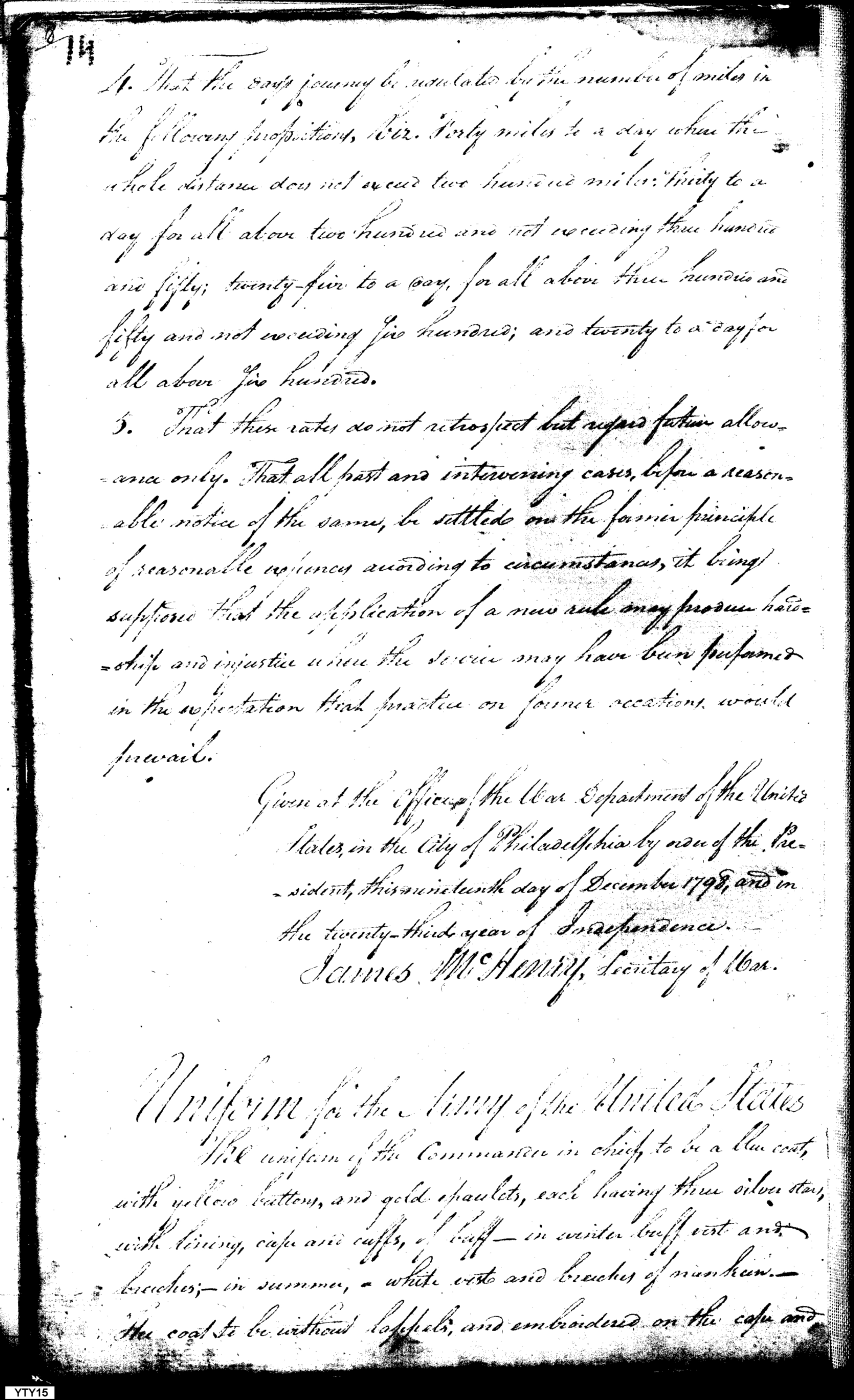
4. That the days journey be regulated by the number of miles in the following proportions, Viz: Forty miles to a day when the whole distance does not exceed two hundred miles: Thirty to a day for all above two hundreds and not exceeding three hundred and fifty; twenty-five to a day, for all above three hundred and fifty and not exceeding five hundred; and twenty to a day for all above five hundred.
5. That these rates do not retrospect but regard future allowance only. That all past and intervening cases, before a reasonable notice of the same, be settled on the former principle of reasonable allowance according to circumstances, it being supposed that the application of a new rule may produce hardship and injustice when the service may have been performed in the expectation that practice on former occasions would prevail.
Given at the Office of the War Department of the United States, in the City of Philadelphia by order of the President, this nineteenth day of December 1798, and in the twenty-third year of Independence.—
James McHenry, Secretary of War.
Uniform for the Army of the United States
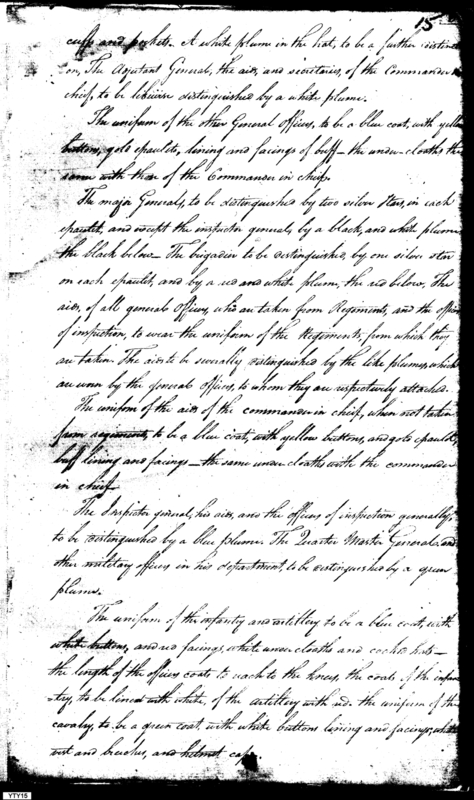
The uniform of the Commander in chief, to be a blue coat, with yellow buttons, and gold epaulets, each having three silver stars, with lining, cape and cuffs, of buff— in winter buff vest and breeches;— in summer, a white vests and breeches of nankeen— The coat to be without lappels, and embroidered on the cape and [underline: cuffs and pockets]. A white plume in the hat, to be a further distinction. The Adjutant General, the aids, and secretaries of the Commander in chief, to be likewise distinguished by a white plume.
The uniform of the other General Officers, to be a blue coat, with yellow buttons, gold epaulets, lining and facings of buff— the under-cloths the same with those of the Commander in Chief.
The major Generals, to be distinguished by two silver Stars, in each epaulet, and except the inspector general, by a black, and white plume, the black below. The brigadier to be distinguished, by one silver star on each epaulet, and by a red and white plume, the red below. The aids of all generals Officers, who are taken from Regiments, and the officers of inspection, to wear the uniform of the Regiments from which they are taken. The aids to be severally distinguished by the like plumes, which are worn by the general officers, to whom they are respectively attached.
The uniform of the aids of the commander in chief, when not taken from regiments, to be a blue coat, with yellow buttons, and gold epaulets, buff lining and facings— the same under-cloths with the commander in chief.
The Inspector general, his aids, and the officers of inspection generally, to be distinguished by a blue plume. The Quarter Master General and other military officers in his department, to be distinguished by a green plume.
The uniform of the infantry and artillery to be a blue coat, with white buttons, and red facings, white under-cloths and cockade hats— the length of the officers coats to reach to the knees, the coats of the infantry, to be lined with white, of the artillery with red. The uniform of the cavalry, to be a green coat, with white buttons lining and facings, white vest and breeches, and helmet cap.
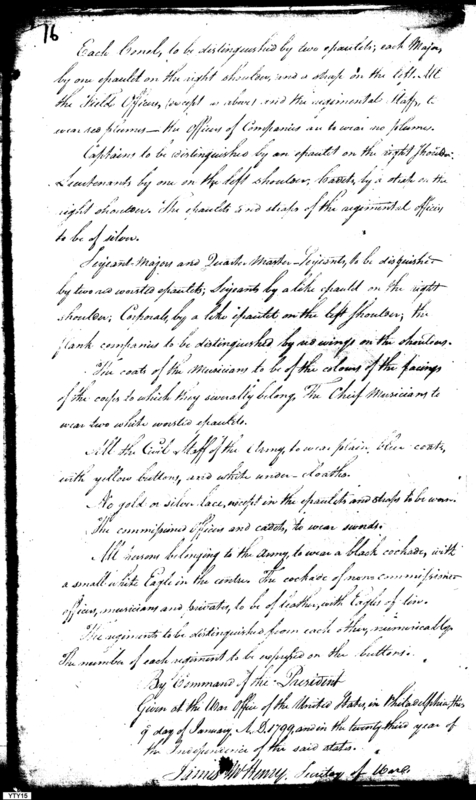
Each Colonel, to be distinguished by two epaulets; each Major, by one epaulet on the right shoulder, and a strap on the left. All the Field Officers, (except as above) and the regimental Staffs, to wear red plumes— the Officers of Companies are to wear no plumes.
Captains to be distinguished by an epaulet on the right shoulder. Lieutenants by one on the left shoulder; Cadets, by a strap on the right shoulder. The epaulets and straps of the regimental officers to be of silver.
Serjeant-Majors and Quarter-Master-Serjeants, to be distinguished by two red worsted epaulets; Serjeants by a like epaulet on the right shoulder; Corporals, by a like epaulet on the left shoulder; the flank companies to be distinguished by red wings on the shoulders.
The coats of the Musicians to be of the colour of the facings of the corps to which they severally belong. The Chief Musicians to wear two white worsted epaulets.
All the Civil Staff of the Army, to wear plain blue coats, with yellow buttons, and white under-cloths.
No gold or silver lace, except in the epaulets and straps to be worn.
The commissioned officers and cadets, to wear swords.
All persons belonging to the Army, to wear a black cockade, with a small white Eagle in the centre. The cockade of non-commissioned officers, musicians and privates, to be of leather, with Eagles of tin.
The regiments to be distinguished from each other numerically. The number of each regiment to be specified on the buttons.
By Command of the President
Given at the War Office of the United States, in Philadelphia this 9 day of January, A.D. 1799, and in the twenty-third year of the Independence of the said states.
James McHenry, Secretary of War
Type
Copy of Signed Document
Description
Describes the uniforms of officers in order of descending rank: the Commander in Chief; other General officers; Major Generals; Aides of the Commander in Chief; the Inspector General; Infantry; Artillery; Colonels; Majors; Captains; Lieutenants; Cadets; Sergeant-Majors; Quartermaster Sergeants; Sergeants; Corporals; Chief Musicians; Musicians; Etc.
Date
01/09/1799
Author
Sent from
Philadelphia
Document number
1799010900301
Page start
1
Notable persons
James McHenry
Commander in Chief
other General officers
Major Generals
Aides of the Commander in Chief
the Inspector General
Infantry
Artillery
Colonels
Majors
Captains
Lieutenants
Cadets
Sergeant-Majors
Quartermaster Sergeants
Sergeants
Corporals
Chief Musicians
Musicians
Notable locations
Philadelphia
Notable items
swords
black cockade
Regiments
plume
silver stars
epaulet
coat
buttons
coats
leather
tin
uniform
cape and cuffs
vest
breeches
embroidered
hats
under-clothes
caps
eagles of tin