No human transcription currently available for this document.
[Uniforms. from the War Office.]
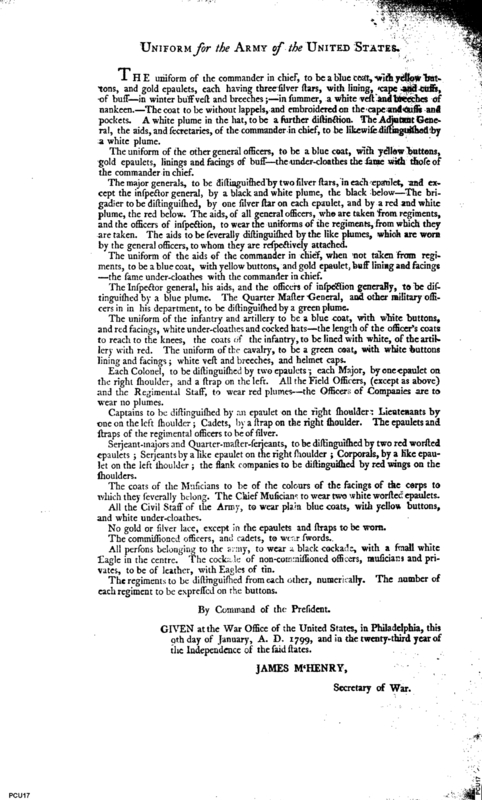
Uniform for the Army of the United States.
THE uniform of the commander in chief, to be a blue coat, with yellow buttons, and gold epaulets, each having three silver stars, with lining, cape and cuffs, of buff—winter waistcoat and breeches—in summer, a white vest and breeches of nankeen—The coat to be without lapels, and embroidered on the cape and cuffs and pockets. a white plume in the hat, to be a further distinction. The Adjutant General, the aids, and Secretary, of the commander in chief, to be likewise distinguished by a white plume.
The uniform of the other general officers, to be a blue coat, with yellow buttons, gold epaulets, lining and facings of buff—the under-cloaths the same with those of the commander in chief.
The major generally, to be distinguished by two silver stars, in each epaulet, and except the inspector general, by a black and white plume, the black below—The brigadier to be distinguished, by one silver star on each epaulet, and by a red and white plume, the red below. The aids, of all general officers, who are taken from regiments, and the officers of inspection, to wear the uniform of the regiments, from which they are taken. The aids to be severally distinguished by the like plumes, which are worn by the general officers, to whom they are respectively attached.
The uniform of the aids of the commander in chief, when not taken from regiments, to be a blue coat, with yellow buttons, and gold epaulet, half lining and facings —the same under-cloaths with the commander in chief.
The inspector general, his aids, and the officers of inspection generally, to be distinguished by a blue plume. The Quarter Master General, and other military officers in in his department, to be distinguished by a green plume.
The uniform of the infantry and artillery to be a blue coat, with white buttons, and red facings, white under-cloaths and cocked hats—the length of the officer's coats to reach to the knees, the coats of the infantry, to be lined with white, of the artillery with red. The uniform of the cavalry, to be a green coat, with white buttons lining and facings, white vest and breeches, and helmet caps.
Each Colonel, to be distinguished by two epaulets ; each Major, by one epaulet on the right shoulder, and a strap on the left. All re-Field Officers, (except as above) and the Regimental Staff, to wear red plumes—the Officers of Companies are to wear no plumes.
Captains to be distinguished by an epaulet on the right shoulder; Lieutenants by one on the left shoulder ; Cadets, by a strap on the right shoulder. The epaulets and straps of the regimental officers to be of silver.
Serjeants-major and Quarter-master-Serjeants, to be distinguished by two red worsted epaulets ; Serjeants by a like epaulet on the right shoulder ; Corporals, by a like epaulet on the left shoulder ; the flank companies to be distinguished by red wings on the shoulders.
The coats of the Musicians to be of the colours of the facings of the corps to which they severally belong. The Chief Musician to wear two white worsted epaulets.
All the Civil Staff of the Army, to wear plain blue coats, with yellow buttons, and white under-cloaths.
No gold or silver lace, except in the epaulets and straps to be worn.
The commissioned officers, and cadets, to wear swords.
All persons belonging to the army, to wear a black cockade, with a small white Eagle in the centre. The cockades of non-commissioned officers, musicians and privates, to be of leather, with Eagles of tin.
The regiments to be distinguished from each other, numerically. The number of each regiment to be expressed on the buttons.
By Command of the President.
GIVEN at the War Office of the United States, in Philadelphia, this 0th day of January, A. D. 1799, and in the twenty-third year of the Independence of the said States.
JAMES McHENRY,
Secretary of War.