

A Report to the President Relative to the Military Establishment
Document 1798The report suggests ways to improve the management and operations of the military. The report is partly inspired by the prospect of war with France and political events in Europe. McHenry outlines and explains his proposed organizational system.





No human transcription currently available for this document.
This transcription was generated by machine using Anthropic's Claude Code (model sonnet 4.6). It may contain errors or inaccuracies. Please verify against the document image. Learn more about our generative AI methodology.
MESSAGE
FROM THE
PRESIDENT of the UNITED STATES,
ACCOMPANYING
A REPORT
TO HIM, FROM THE
Secretary of War,
Of the 24th instant, relative to the
MILITARY ESTABLISHMENT.
31st December, 1798,
Referred to the committee appointed on the 14th instant, on so much of the President's speech, as relates to the "policy of extending and invigorating the measures of defence heretofore adopted by the government of the United States."
[Published by order of the House of Representatives.]
MESSAGE.
Gentlemen of the Senate, and
Gentlemen of the House of Representatives,
A Report of the Secretary of War, made to me on the twenty-fourth of this month, relative to the military eftablifhment, I think it my duty to tranfmit to Congrefs, and recommend to their confideration.
JOHN ADAMS.
December 31ft, 1798.
REPORT.
The Secretary of War, refpectfully reports to the Prefident of the United States,
THAT there are feveral fubjects, which, in his opinion, will deferve the attention of Congrefs, to render the military eftablifhment more manageable and fyftematic; and procure to it the means of further improvement.
It is not prefumed that Congrefs will think it prudent to relinquifh any of the meafures of fecurity which have been fo wifely adopted; nor need it be obferved, that any relaxation in thefe may fruftrate their object, by affording argument of weaknefs or irrefolution. It may be true, that fome late occurrences have rendered the profpect of invafion by France lefs probable, or more remote; yet duly confidering the rapid viciffitudes, at all times of political and military events; the extraordinary fluctuations which have been peculiarly characteriftic of the ftill fubfifting conteft in Europe; and the more extraordinary pofition of moft of the principal nations of that quarter of the globe; it can never be wife to vary our meafures of fecurity, with the continually varying afpect of European affairs.—On the contrary, a very obvious policy dictates to us, a ftrenuous endeavor, as far as may be practicable, to place our fafety out of the reach of cafualties which may befal the contending parties, and the powers more immediately within their vortices. Paying due refpect to this ftate of things; regarding the overthrow of a large portion of Europe as not entirely chimerical, and
ftanding as it were in the midft of falling empires, it will be our prudence to cultivate a fpirit of felf-dependence, and to endeavor, by unremitting vigilance and exertion, under the bleffing of providence, to hold the fcales of our deftiny in our own hands. In offering thefe preliminary obfervations, the Secretary prefents nothing new to the Prefident; moft, if not all of them having received, directly or impliedly, in his communications to Congrefs, his deliberate fanction and authority.
Circumftanced as the United States now are, the progrefs of public danger may render an extenfion of military preparations indifpenfable, and a proper organization for the troops of the United States extremely beneficial.
In proportion as the policy of the country is adverfe to extenfive military eftablifhments, it ought to be our care, to render the principles of our military fyftem as perfect as poffible, our endeavors to turn to the beft account, fuch force as we at any time may have on foot, and to provide an eligible ftandard for the augmentations to which particular emergencies may compel a refort.
In thefe views it is conceived the organization of our military force would be much improved by modelling it according to the following plan:—
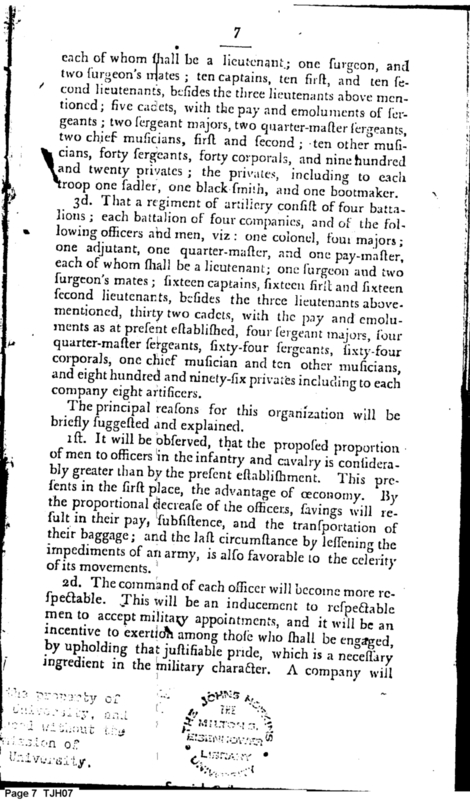
1ft. That a regiment of infantry, compofed as at prefent of two battalions, and each battalion of five companies, confift of, one colonel, two majors, a firft and fecond; one adjutant, one quarter mafter, and one pay-mafter, each of whom fhall be a lieutenant; one furgeon, and two furgeon's mates; ten captains, ten firft lieutenants, and ten fecond lieutenants, befides the three lieutenants above mentioned; two cadets, with the pay and emoluments of fergeants, two fergeant majors, two quarter-mafter fergeants, two chief muficians, firft and fecond, twenty other muficians, forty fergeants, forty corporals, and nine hundred and twenty privates.
2d. That a regiment of dragoons confift of ten troops, making five fquadrons, and the following officers and men, viz: one colonel, two majors, a firft and fecond; one adjutant, one quarter-mafter, and one pay mafter, each of whom fhall be a lieutenant; one furgeon, and two furgeon's mates; ten captains, ten firft, and ten fecond lieutenants, befides the three lieutenants above mentioned; five cadets, with the pay and emoluments of fergeants; two fergeant majors, two quarter-mafter fergeants, two chief muficians, firft and fecond; ten other muficians, forty fergeants, forty corporals, and nine hundred and twenty privates; the privates, including to each troop one fadler, one black fmith, and one bootmaker.
3d. That a regiment of artillery confift of four battalions; each battalion of four companies, and of the following officers and men, viz: one colonel, four majors; one adjutant, one quarter-mafter, and one pay-mafter, each of whom fhall be a lieutenant; one furgeon and two furgeon's mates; fixteen captains, fixteen firft and fixteen fecond lieutenants, befides the three lieutenants above-mentioned, thirty two cadets, with the pay and emoluments as at prefent eftablifhed, four fergeant majors, four quarter-mafter fergeants, fixty-four fergeants, fixty-four corporals, one chief mufician and ten other muficians, and eight hundred and ninety-fix privates including to each company eight artificers.
The principal reafons for this organization will be briefly fuggefted and explained.
1ft. It will be obferved, that the propofed proportion of men to officers in the infantry and cavalry is confiderably greater than by the prefent eftablifhment. This prefents in the firft place, the advantage of œconomy. By the proportional decreafe of the officers, favings will refult in their pay, fubfiftence, and the tranfportation of their baggage; and the laft circumftance by leffening the impediments of an army, is alfo favorable to the celerity of its movements.
2d. The command of each officer will become more refpectable. This will be an inducement to refpectable men to accept military appointments, and it will be an incentive to exertion among thofe who fhall be engaged, by upholding that juftifiable pride, which is a neceffary ingredient in the military character. A company will
then admit of an eligible fub-divifion into platoons, fections, and demi-fections, each of a perfect front.
3d. Each battalion will be of the fize judged proper for a manœuvring column in the field, and it is that portion of an army, which in the moft approved fyftem of tactics is deftined to fulfil this object.—A battalion, according to the beft judges, fanctioned by experience, ought neither to be too unwieldy for rapid movements, nor fo fmall as to multiply too much the fub-divifions, and render each incapable, either of a vigorous impulfe or refiftance.
4th. The proportion of officers to men ought not to be greater than is adequate to the due management and command of them.—A careful examination of this point will fatisfy every judge, that the number now propofed will be adequate to both: And it is illuftrated by the expectation, that our fundamental orders, in conformity with thofe of the nations of Europe generally, ought to place our infantry in three ranks, to oppofe to an enemy who fhall be in the fame order, an equal mafs for attack or defence.
But it is not intended to recommend a prefent augmentation of the number of rank and file, to the propofed ftandard. It is only wifhed that it may be adopted provifionally, as that of the war eftablifhment.
The regiments which have been authorized may continue in this refpect upon the footing already prefcribed; leaving the actual augmentation to depend on events which may create a neceffity for the encreafe of our force.
The other alterations recommended have relation rather to fyftematic propriety, than to very important military effects.
1ft. The term lieutenant-colonel, in our prefent eftablifhment, has a relative fignification, without any thing, in fact, to which it relates: It was introduced during our revolutionary war to facilitate exchanges of prifoners, as our then enemy united the grade of colonel with that of general. But the permanent forms of our military fyftem ought to be regulated by principle, not by the change-
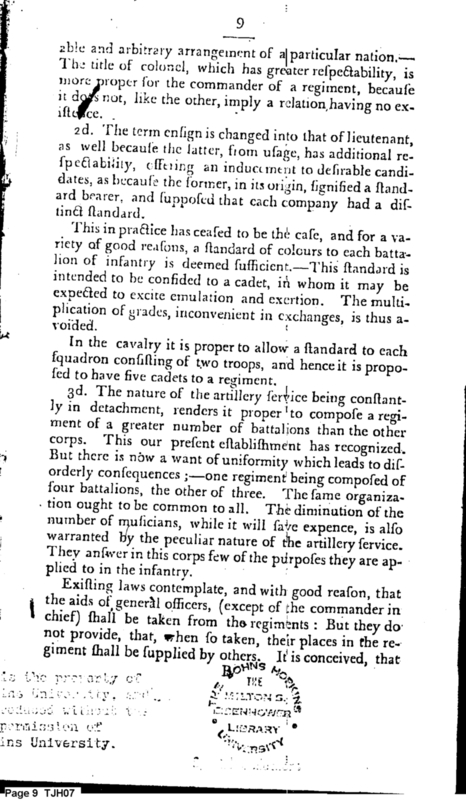
able and arbitrary arrangement of a particular nation.— The title of colonel, which has greater refpectability, is more proper for the commander of a regiment, becaufe it does not, like the other, imply a relation having no exiftence.
2d. The term enfign is changed into that of lieutenant, as well becaufe the latter, from ufage, has additional refpectability, offering an inducement to defirable candidates, as becaufe the former, in its origin, fignified a ftandard bearer, and fuppofed that each company had a diftinct ftandard.
This in practice has ceafed to be the cafe, and for a variety of good reafons, a ftandard of colours to each battalion of infantry is deemed fufficient.—This ftandard is intended to be confided to a cadet, in whom it may be expected to excite emulation and exertion. The multiplication of grades, inconvenient in exchanges, is thus avoided.
In the cavalry it is proper to allow a ftandard to each fquadron confifting of two troops, and hence it is propofed to have five cadets to a regiment.
3d. The nature of the artillery fervice being conftantly in detachment, renders it proper to compofe a regiment of a greater number of battalions than the other corps. This our prefent eftablifhment has recognized. But there is now a want of uniformity which leads to diforderly confequences;—one regiment being compofed of four battalions, the other of three. The fame organization ought to be common to all. The diminution of the number of muficians, while it will fave expence, is alfo warranted by the peculiar nature of the artillery fervice. They anfwer in this corps few of the purpofes they are applied to in the infantry.
Exifting laws contemplate, and with good reafon, that the aids of general officers, (except of the commander in chief) fhall be taken from the regiments: But they do not provide, that, when fo taken, their places in the regiment fhall be fupplied by others. It is conceived, that
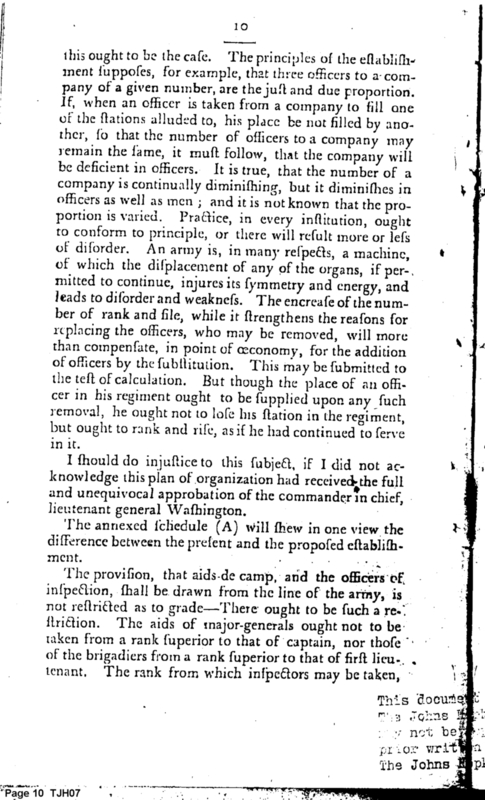
this ought to be the cafe. The principles of the eftablifhment fuppofes, for example, that three officers to a company of a given number, are the juft and due proportion. If, when an officer is taken from a company to fill one of the ftations alluded to, his place be not filled by another, fo that the number of officers to a company may remain the fame, it muft follow, that the company will be deficient in officers. It is true, that the number of a company is continually diminifhing, but it diminifhes in officers as well as men; and it is not known that the proportion is varied. Practice, in every inftitution, ought to conform to principle, or there will refult more or lefs of diforder. An army is, in many refpects, a machine, of which the difplacement of any of the organs, if permitted to continue, injures its fymmetry and energy, and leads to diforder and weaknefs. The encreafe of the number of rank and file, while it ftrengthens the reafons for replacing the officers, who may be removed, will more than compenate, in point of œconomy, for the addition of officers by the fubftitution. This may be fubmitted to the teft of calculation. But though the place of an officer in his regiment ought to be fupplied upon any fuch removal, he ought not to lofe his ftation in the regiment, but ought to rank and rife, as if he had continued to ferve in it.
I fhould do injuftice to this fubject, if I did not acknowledge this plan of organization had received the full and unequivocal approbation of the commander in chief, lieutenant general Wafhington.
The annexed fchedule (A) will fhew in one view the difference between the prefent and the propofed eftablifhment.
The provifion, that aids-de camp, and the officers of infpection, fhall be drawn from the line of the army, is not refticted as to grade—There ought to be fuch a reftiction. The aids of major-generals ought not to be taken from a rank fuperior to that of captain, nor thofe of the brigadiers from a rank fuperior to that of firft lieutenant. The rank from which infpectors may be taken,
ought, in like manner, to be limited; thofe of brigades, to the rank of captain; thofe of divifions to that of major. This will guard againft the multiplication of the fuperior grades by removals to fill fuch ftations.
The two companies which it is propofed to add to the actual number of the cavalry, it is defirable fhould be raifed immediately. If this is agreed to, they might receive the denomination of hufar companies—a defcription of cavalry extremely ferviceable in an army.
It is incidentally noticed, that the act of laft feffion, augmenting the dragoon corps to eight companies, and affigning to it a lieutenant-colonel, and other officers, to conftitute it a regiment, has not provided a furgeon or mate. This omiffion will require attention.
If there fhall be occafion for the actual employment of military force, a corps of riflemen will be, for feveral purpofes, extremely ufeful. The eligible proportion of riflemen to infantry of the line, may be taken at a twentieth. It is fubmitted, whether a fpecific provifion to this effect, will not be proper in arranging the army for a war eftablifhment.
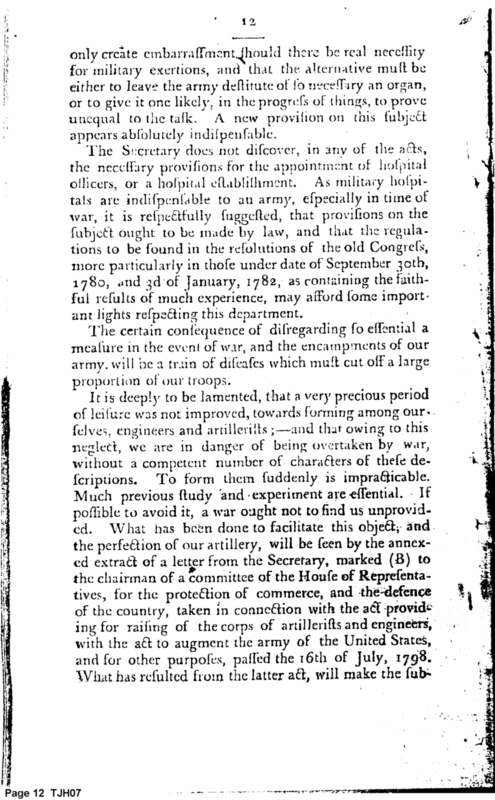
The only provifion for the appointment of a quarter-mafter general, is to be found in the act of the 28th of May, authorizing the Prefident to raife a provifional army, which limits his rank and emoluments to thofe of lieutenant-colonel;—This provifion is conceived to be entirely inadequate for a war eftablifhment. The military duties of the office are of a nature to render it of the *firft importance* in an army; demanding great and peculiar abilities, and a character every way worthy of truft;—accordingly, it is the general practice, founded upon very fubftantial reafons, to confide it to an officer of high military rank. The probability is, that without a fimilar arrangement on our part, we fhall not be able to command a fit character, and in taking one of inferior pretenfions, we fhall fubject the fervice to difadvantages out of all proportion to any objections which may be fuppofed to militate againft the conferring of fuch rank. It is feared that an appointment under fuch a provifion will
only create embarraffment, fhould there be real neceffity for military exertions, and that the alternative muft be either to leave the army deftitute of fo neceffary an organ, or to give it one likely, in the progrefs of things, to prove unequal to the tafk. A new provifion on this fubject appears abfolutely indifpenfable.
The Secretary does not difcover, in any of the acts, the neceffary provifions for the appointment of hofpital officers, or a hofpital eftablifhment. As military hofpitals are indifpenfable to an army, efpecially in time of war, it is refpectfully fuggefted, that provifions on the fubject ought to be made by law, and that the regulations to be found in the refolutions of the old Congrefs, more particularly in thofe under date of September 30th, 1780, and 3d of January, 1782, as containing the faithful refults of much experience, may afford fome important lights refpecting this department.
The certain confequence of difregarding fo effential a meafure in the event of war, and the encampments of our army, will be a train of difeafes which muft cut off a large proportion of our troops.
It is deeply to be lamented, that a very precious period of leifure was not improved, towards forming among ourfelves, engineers and artillerifts;—and that owing to this neglect, we are in danger of being overtaken by war, without a competent number of characters of thefe defcriptions. To form them fuddenly is impracticable. Much previous ftudy and experiment are effential. If poffible to avoid it, a war ought not to find us unprovided. What has been done to facilitate this object, and the perfection of our artillery, will be feen by the annexed extract of a letter from the Secretary, marked (B) to the chairman of a committee of the Houfe of Reprefentatives, for the protection of commerce, and the defence of the country, taken in connection with the act providing for raifing of the corps of artillerifts and engineers, with the act to augment the army of the United States, and for other purpofes, paffed the 16th of July, 1798. What has refulted from the latter act, will make the fub-
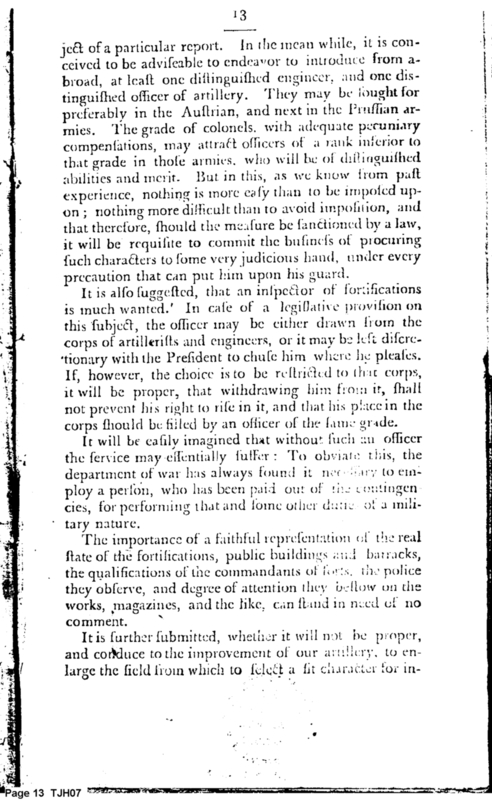
ject of a particular report. In the mean while, it is conceived to be advifeable to endeavor to introduce from abroad, at leaft one diftinguifhed engineer, and one diftinguifhed officer of artillery. They may be fought for preferably in the Auftrian, and next in the Pruffian armies. The grade of colonels, with adequate pecuniary compenfations, may attract officers of a rank inferior to that grade in thofe armies, who will be of diftinguifhed abilities and merit. But in this, as we know from paft experience, nothing is more eafy than to be impofed upon; nothing more difficult than to avoid impofition, and that therefore, fhould the meafure be fanctioned by a law, it will be requifite to commit the bufinefs of procuring fuch characters to fome very judicious hand, under every precaution that can put him upon his guard.
It is alfo fuggefted, that an infpector of fortifications is much wanted. In cafe of a legiflative provifion on this fubject, the officer may be either drawn from the corps of artillerifts and engineers, or it may be left difcretionary with the Prefident to chufe him where he pleafes. If, however, the choice is to be refticted to that corps, it will be proper, that withdrawing him from it, fhall not prevent his right to rife in it, and that his place in the corps fhould be filled by an officer of the fame grade.
It will be eafily imagined that without fuch an officer the fervice may effentially fuffer: To obviate this, the department of war has always found it neceffary to employ a perfon, who has been paid out of the contingencies, for performing that and fome other duties of a military nature.
The importance of a faithful reprefentation of the real ftate of the fortifications, public buildings and barracks, the qualifications of the commandants of forts, the police they obferve, and degree of attention they beftow on the works, magazines, and the like, can ftand in need of no comment.
It is further fubmitted, whether it will not be proper, and conduce to the improvement of our artillery, to enlarge the field from which to felect a fit character for in-
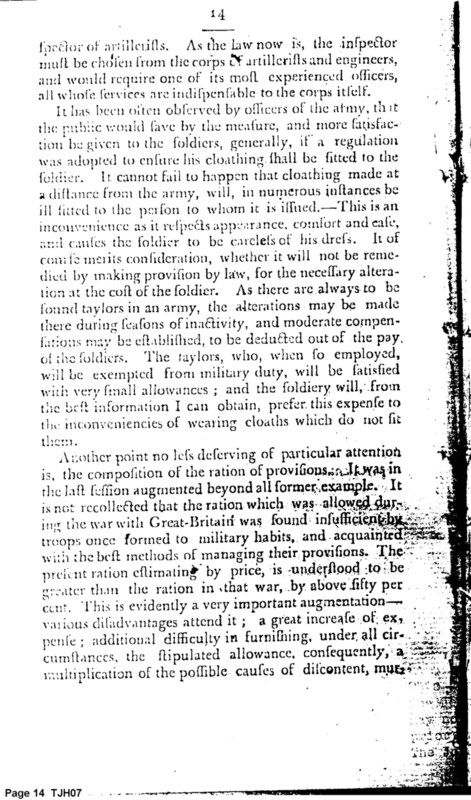
fpector of artillerifts. As the law now is, the infpector muft be chofen from the corps of artillerifts and engineers, and would require one of its moft experienced officers, all whofe fervices are indifpenfable to the corps itfelf.
It has been often obferved by officers of the army, that the public would fave by the meafure, and more fatisfaction be given to the foldiers, generally, if a regulation was adopted to enfure his cloathing fhall be fitted to the foldier. It cannot fail to happen that cloathing made at a diftance from the army, will, in numerous inftances be ill fitted to the perfon to whom it is iffued.—This is an inconvenience as it refpects appearance, comfort and eafe, and caufes the foldier to be carelefs of his drefs. It of courfe merits confideration, whether it will not be remedied by making provifion by law, for the neceffary alteration at the coft of the foldier. As there are always to be found taylors in an army, the alterations may be made there during feafons of inactivity, and moderate compenfations may be eftablifhed, to be deducted out of the pay of the foldiers. The taylors, who, when fo employed, will be exempted from military duty, will be fatisfied with very fmall allowances; and the foldiery will, from the beft information I can obtain, prefer this expenfe to the inconveniencies of wearing cloaths which do not fit them.
Another point no lefs deferving of particular attention is, the compofition of the ration of provifions. It was in the laft feffion augmented beyond all former example. It is not recollected that the ration which was allowed during the war with Great-Britain was found infufficient by troops once formed to military habits, and acquainted with the beft methods of managing their provifions. The prefent ration eftimating by price, is underftood to be greater than the ration in that war, by above fifty per cent. This is evidently a very important augmentation—various difadvantages attend it; a great encreafe of expence; additional difficulty in furnifhing, under all circumftances, the ftipulated allowance, confequently, a multiplication of the poffible caufes of difcontent, mur-
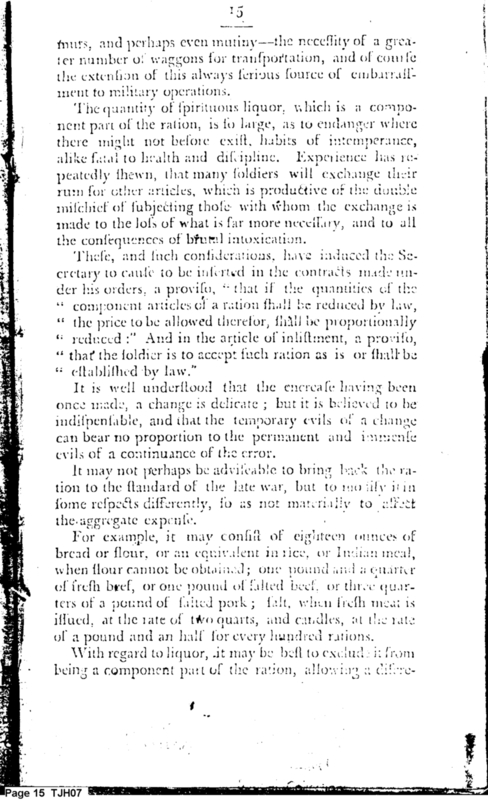
murs, and perhaps even mutiny—the neceffity of a greater number of waggons for tranfportation, and of courfe the extenfion of this always ferious fource of embarraffment to military operations.
The quantity of fpirituous liquor, which is a component part of the ration, is fo large, as to endanger where there might not before exift, habits of intemperance, alike fatal to health and difcipline. Experience has repeatedly fhewn, that many foldiers will exchange their rum for other articles, which is productive of the double mifchief of fubject thofe with whom the exchange is made to the lofs of what is far more neceffary, and to all the confequences of brutal intoxication.
Thefe, and fuch confiderations, have induced the Secretary to caufe to be inferted in the contracts made under his orders, a provifio, "that if the quantities of the component articles of a ration fhall be reduced by law, the price to be allowed therefor, fhall be proportionally reduced:" And in the article of inliftment, a provifio, "that the foldier is to accept fuch ration as is or fhall be eftablifhed by law."
It is well underftood that the encreafe having been once made, a change is delicate; but it is believed to be indifpenfable, and that the temporary evils of a change can bear no proportion to the permanent and immenfe evils of a continuance of the error.
It may not perhaps be advifeable to bring back the ration to the ftandard of the late war, but to modify it in fome refpects differently, fo as not materially to affect the aggregate expence.
For example, it may confift of eighteen ounces of bread or flour, or an equivalent in rice, or Indian meal, when flour cannot be obtained; one pound and a quarter of frefh beef, or one pound of falted beef, or three quarters of a pound of falted pork; falt, when frefh meat is iffued, at the rate of two quarts, and candles, at the rate of a pound and an half for every hundred rations.
With regard to liquor, it may be beft to exclude it from being a component part of the ration, allowing a difcre-
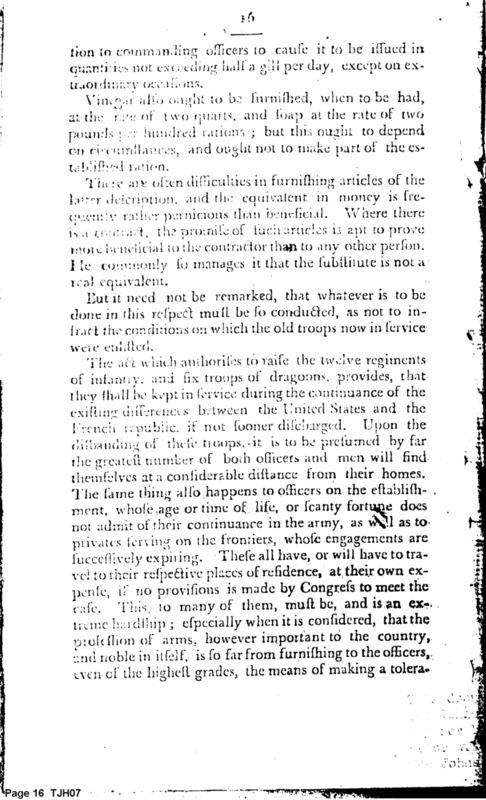
tion to commanding officers to caufe it to be iffued in quantities not exceeding half a gill per day, except on extraordinary occafions.
Vinegar alfo ought to be furnifhed, when to be had, at the rate of two quarts, and foap at the rate of two pounds per hundred rations; but this ought to depend on circumftances, and ought not to make part of the eftablifhed ration.
There are often difficulties in furnifhing articles of the latter defcription, and the equivalent in money is frequently rather pernicious than beneficial. Where there is a contract, the promife of fuch articles is apt to prove more beneficial to the contractor than to any other perfon. He commonly fo manages it that the fubftitute is not a real equivalent.
But it need not be remarked, that whatever is to be done in this refpect muft be fo conducted, as not to infringe the conditions on which the old troops now in fervice were enlifted.
The act which authorifes to raife the twelve regiments of infantry, and fix troops of dragoons, provides, that they fhall be kept in fervice during the continuance of the exifting differences between the United States and the French republic, if not fooner difcharged. Upon the difbanding of thefe troops, it is to be prefumed by far the greateft number of both officers and men will find themfelves at a confiderable diftance from their homes. The fame thing alfo happens to officers on the eftablifhment, whofe age or time of life, or fcanty fortune does not admit of their continuance in the army, as well as to privates ferving on the frontiers, whofe engagements are fucceffively expiring. Thefe all have, or will have to travel to their refpective places of refidence, at their own expenfe, if no provifion is made by Congrefs to meet the cafe. This, to many of them, muft be, and is an extreme hardship; efpecially when it is confidered, that the profeffion of arms, however important to the country, and noble in itfelf, is fo far from furnifhing to the officers, even of the higheft grades, the means of making a tolera-
ble provifion out of the favings of their pay, for the future fupport of themfelves and families, in advanced old age, or when their fervices may be difpenfed with by the public, that it requires them to obferve the greateft œconomy to be able to proceed in their career, and defray the expenfe of their neceffary wants.
In the Englifh fervice, the officer, when difbanded, receives half-pay;—the private foldier in the cavalry has his horfe, and an allowance for his fword, with fourteen days' pay to carry him home;—the infantry have likewife fourteen days' pay granted them for the fame purpofe.
It is refpectfully fuggefted, whether it would not comport with juftice, and have a tendency to encourage men to enter into the army, if a provifion was made for an allowance to each officer and foldier, on quitting the fervice, or being difbanded, equivalent to the expenfe he muft incur in returning home.
The act authorizing the Prefident of the United States to raife a provifional army, is too important to the peace and fafety of the union not to require from Congrefs fuch a matured revifion as may render it effectual to the purpofes for which it was framed.
The firft fection, by which the Prefident was vefted with the power to raife ten thoufand troops, has expired by its own limitation.
It is conceived advifeable, and founded on the foundeft policy, that the power to raife fuch troops as are contemplated by this claufe, fhould be extended at leaft to twenty thoufand. To be on fafe ground, our preparations and fupplies ought to contemplate an army of fifty thoufand men.
The act in queftion contemplates alfo an auxiliary force, under the denomination of volunteer companies, who fhall be armed, cloathed, and equipped at their own expenfe.
It is highly pleafing to mention, that fufficient evidence has appeared, that the patriotifm of our independ-
ent citizens will not fhrink from this meafure of defence; the number of volunteer companies which have offered their fervices being already confiderable.
As it may be queftioned, whether the act enables the Prefident to appoint all appropriate officers to thefe companies when organized into regiments, brigades and divifions; it is defireable that fuch power fhould be exprefsly given.
A fpecific provifion for the pay and rations to volunteers during the days it may be neceffary to affemble them in bodies in each year for the pupofe of general difcipline and manœuvres would be very beneficial.
To form effective foldiers at this moment, and at fo light an expenfe to the public, muft be looked upon as an object of great national concern, efpecially when we take into view the difficulty of getting men, trained to arms, in time of actual war.
The value of thofe patriotic bands of volunteers, who deftine themfelves to the front of danger, is inappreciable. If well inftructed and difciplined, they will, in the event of fudden invafion, be of immenfe utility and importance. Befides the direct effects of their own exertions in refifting the enemy, till they can be fuccoured by the regular force, if at a diftance, the militia, rallying to them, would derive from their example and countenance, additional courage and perfeverance. They would, thus difciplined, and aided by the regular force, though fmall, give a confiftency and ftability to our firft efforts; of which thefe would otherwife be deftitute, and would tend powerfully to prevent, great, though perhaps partial calamities.
It is impoffible to contemplate the duties of the office of infpector-general, without perceiving, that their due difcharge will require the exercife of extraordinary fkill and labour, and that the exifting law has affigned no compenfation whatever for the exercife of this fkill and labour.
In the cafe of officers taken from the line to perform the fpecific duties of affiftant infpectors, quarter-mafters, &c. we find the law has made a fpecific allowance. The prin-
ciple applies, and with augmented force, to the infpector-general, who has not only to create regulations, but to fuperintend their execution, in addition to his duties as a general officer.
To difcharge, with effect, the duties of his office, he muft make frequent journies from one part of the army to another, when it is encamped in different and diftant places. It muft be conceived, that the expenfes of fuch journies muft quickly eat out the narrow allowance of a major-general. If filled by a man of talents, without a fortune to meet fuch expenfes, he muft either compromit his reputation, and that of the government, by not producing the refults to be expected from his department, or he muft ruin himfelf in performing fervices for which there is no adequate compenfation. The precedent of laft war eftablifhes the propriety of an extra allowance for the extra fervices and expenfes to this officer; and it would be infinitely more agreeable, and lefs embarraffing to the department of war, that the latter, or his expenfes on journies from one part of the army to another, fhould be fettled by a fixed allowance by law, inftead of being chargeable to the contingencies of the war department. A further arrangement is neceffary to give full effect to the infpector-general's department. During our war with Great Britain, this officer was allowed fecretaries, in addition to his aides as major-general. It is thought that one fecretary to the prefent officer is indifpenfable.
It is proper, before clofing this reference, to mention a circumftance intimately connected with our military fyftem.
Owing to the encreafe of the naval and military eftablifhments, the bufinefs of purveyor of public fupplies, has been fo augmented, as to require for the war department alone, the exclufive and uninterupted fervices, of fuch an officer.
It feems to be improper, that the head of the war department fhould be obliged to employ himfelf in any other manner in the bufinefs of the purveyor, than merely to make requifitions for articles wanted; to prefcribe the
quantities, the times and places of delivery; and that the whole refponfibility for the execution of the order fhould reft upon the purveyor. A Secretary of War, will always find ample employment in the general fuperintendance and direction of the great operations of his department: If a portion of his time is to be occupied in the details of leffer concerns, it is morally certain, that the greater muft languifh or fuffer.
Befides thefe duties, the purveyor fhould be charged exclufively with the difpofing of all returns from the Indian factories, correfponding with thefe, keeping all accounts, and conducting all concerns relative to them, under the direction of the Secretary.
He might alfo be the agent and organ to procure the means of tranfportation for all fupplies fent from the feat of government, or elfwhere, to the army, agents or quarter-mafters, to arfenals and diftant places of depofit.
The Secretary takes leave to recapitulate, for the purpofe of prefenting, in a concife view, the propofitions, refpectfully recommended to attention, by the foregoing obfervations.
1ft. A new modification of the military, fo as to admit of an encreafe of numbers, to the companies, and regiments, in cafe of war; an alteration in the denomination of certain grades; and a perfect uniformity of arrangements in corps of the fame fpecies of troops.
2d. Regulations to preferve to the companies and regiments, their competent number of officers, in cafes where any are taken from the line to act as aides-de-camp, infpectors, pay-mafters, quarter mafters, &c.
3d. To defignate the grades, from which aides-de-camp, and officers of infpection may be taken, in order to prevent the multiplication of the higher grades.
4th. To add to the exifting eftablifhment, two companies of horfe, to be denominated and act as huffars; and a furgeon and mates to the regiment of cavalry.
5th. To include in the arrangement for the war eftablifhment, a proportion of riflemen, eftimated at one twentieth of the whole number of infantry.
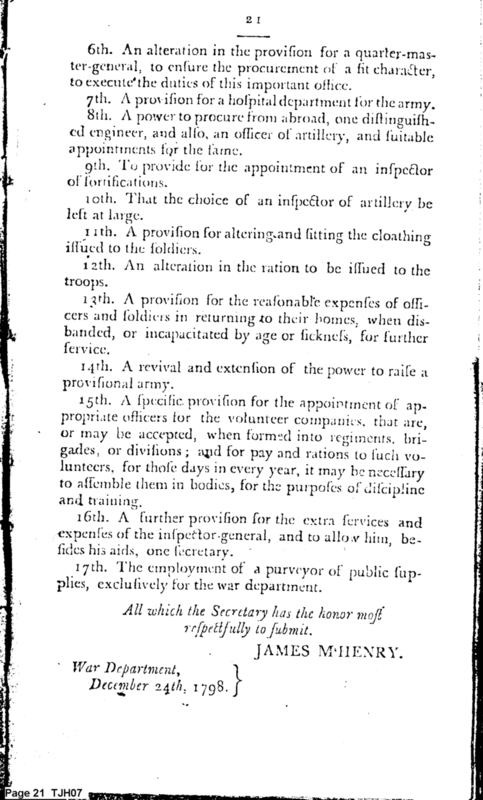
6th. An alteration in the provifion for a quarter-mafter-general, to enfure the procurement of a fit character, to execute the duties of this important office.
7th. A provifion for a hofpital department for the army.
8th. A power to procure from abroad, one diftinguifhed engineer, and alfo, an officer of artillery, and fuitable appointments for the fame.
9th. To provide for the appointment of an infpector of fortifications.
10th. That the choice of an infpector of artillery be left at large.
11th. A provifion for altering and fitting the cloathing iffued to the foldiers.
12th. An alteration in the ration to be iffued to the troops.
13th. A provifion for the reafonable expenfes of officers and foldiers in returning to their homes, when difbanded, or incapacitated by age or ficknefs, for further fervice.
14th. A revival and extenfion of the power to raife a provifional army.
15th. A fpecific provifion for the appointment of appropriate officers for the volunteer companies, that are, or may be accepted, when formed into regiments, brigades, or divifions; and for pay and rations to fuch volunteers, for thofe days in every year, it may be neceffary to affemble them in bodies, for the purpofes of difcipline and training.
16th. A further provifion for the extra fervices and expenfes of the infpector-general, and to allow him, befides his aids, one fecretary.
17th. The employment of a purveyor of public fupplies, exclufively for the war department.
All which the Secretary has the honor moft refpectfully to fubmit.
JAMES McHENRY.
War Department,
December 24th, 1798.
Type
Printed Document
Description
The report suggests ways to improve the management and operations of the military. The report is partly inspired by the prospect of war with France and political events in Europe. McHenry outlines and explains his proposed organizational system.
Date
12/24/1798
Author
Collection
Document number
1798122400001
Page start
1
Notable persons
James McHenry
President John Adams
Congress
House of Representatives
troops of the United States
regiment
infantry
colonel
major
adjutant
quarter master
paymaster
lieutenant
surgeon
surgeons mates
captains
cadets
sergeants
musicians
corporals
privates
dragoons
sadler
blacksmith
bootmaker
artillery
artificer
cavalry
respectable men
battalions
lieutenant-colonel
ensign
General George Washington
Commander in Chief
aids-de-camp
officers of inspection
riflemen
Quarter Master General
hospital officers
artillerists and engineers
Austrian army
Prussian army
inspectors
tailors
Great Britain
French Republic
volunteer companies
secretaries
purveyor
Notable items
military establishment
further improvement
measures of security
prospect of invasion
our safety
military preparations
proper organization
military system
battalions
pay and emoluments
proportional decrease
economy
movement
military character
management
command
provisionally
war establishment
Revolutionary war
exchange of prisoners
standard of colors
artillery service
want of uniformity
practice
principle
disorder
approbation
annexed schedule
grade
rank
hospital
encampments
fortifications
public buildings
barracks
clothing
ill fitted
alterations
small allowances
rations
liquor
intoxication
bread or flour
rice
Indian meal
vinegar
soap
travel to their respective places of residence
extreme hardship
expense
returning home
pay and rations to volunteers
pay and rations
extra allowance
extra services
naval establishments
public supplies
Indian factories
regulations