

Desire for Moderation and Peace, Etc.
Document 1798Although it seems that the French are expressing a desire for moderation and peace, McHenry argues that it is too early to relax America's efforts to bolster its fleets and armies. One might expect that increased prospects of peace would diminish the election prospects of anti-federal characters but it should be remembered that local concerns have the greatest impact on voters' choices.
No human transcription currently available for this document.
This transcription was generated by machine using Anthropic's Claude Code (model sonnet 4.6). It may contain errors or inaccuracies. Please verify against the document image. Learn more about our generative AI methodology.
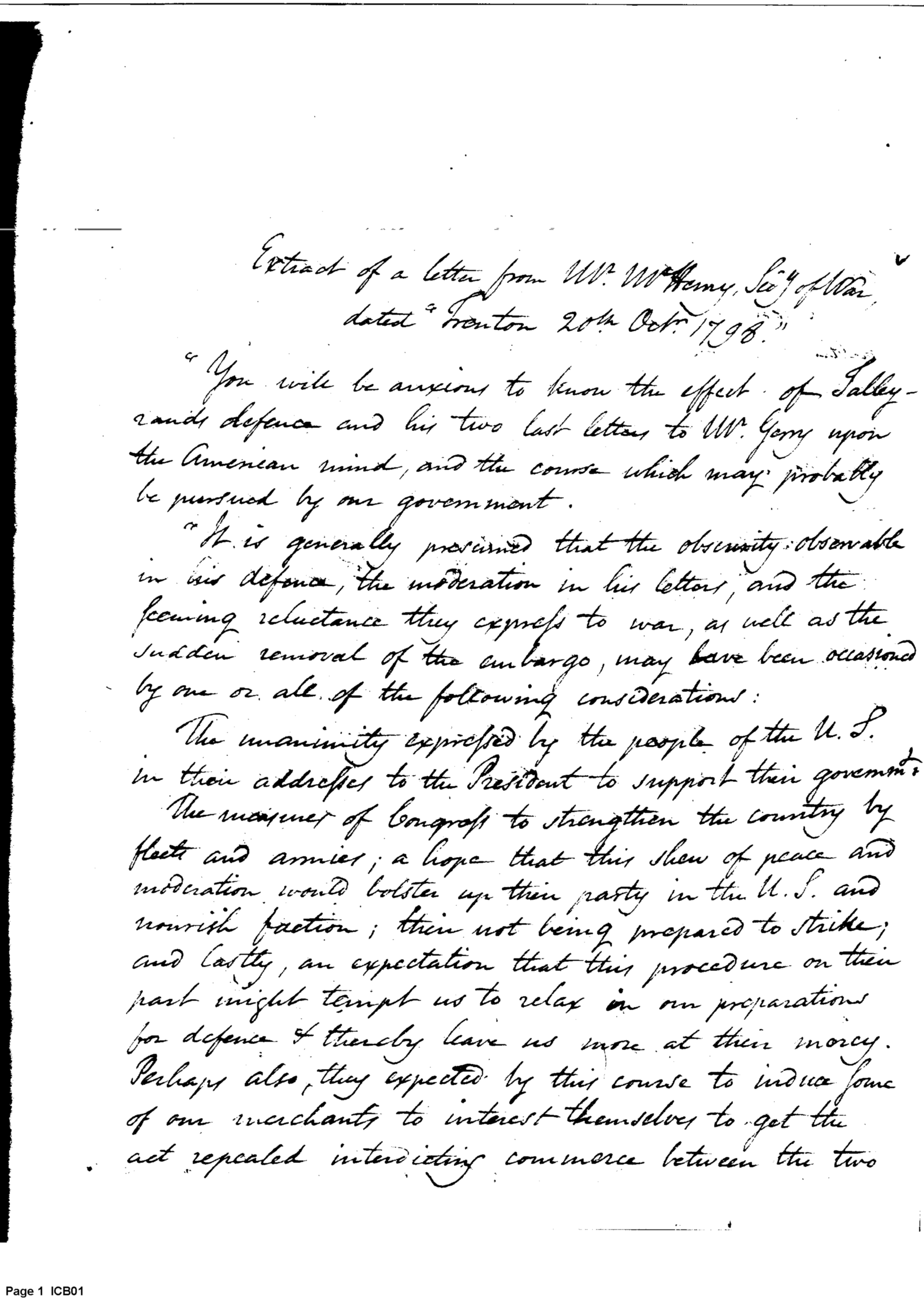
Extract of a letter from Wm McHenry, Secy of War,
dated "Trenton 20th Octr 1798."
"You will be anxious to know the effect of Talleyrand's defence and his two last letters to Wm Gerry upon the American mind, and the course which may probably be pursued by our government.
"It is generally presumed that the obscurity observable in his defence, the moderation in his letters, and the seeming reluctance they express to war, as well as the sudden removal of the embargo, may have been occasioned by one or all of the following considerations:
The unanimity expressed by the people of the U.S. in their addresses to the President to support their government:
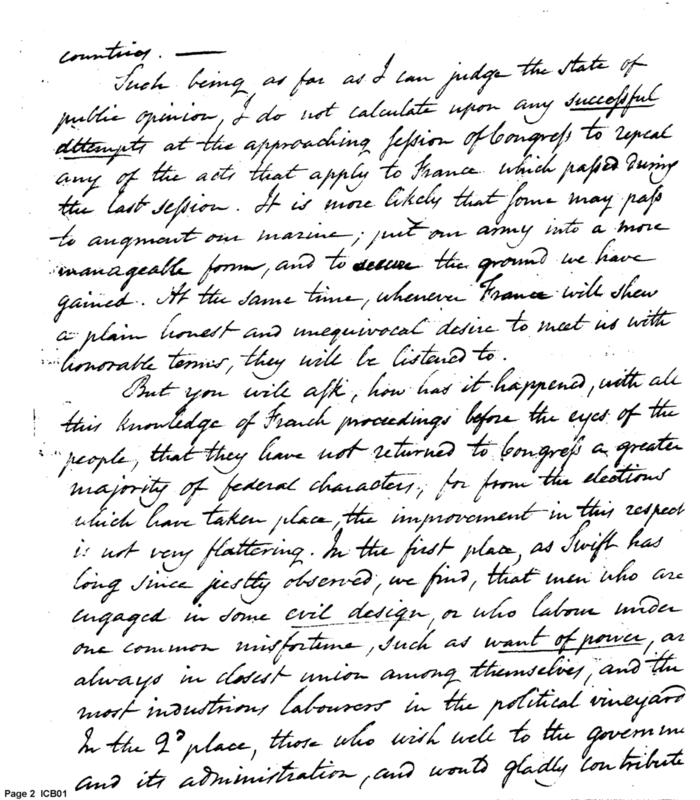
The measures of Congress to strengthen the country by fleets and armies; a hope that this shew of peace and moderation would bolster up their party in the U.S. and nourish faction; their not being prepared to strike; and lastly, an expectation that this procedure on their part might tempt us to relax in our preparations for defence & thereby leave us more at their mercy. Perhaps also, they expected by this course to induce some of our merchants to interest themselves to get the act repealed interdicting commerce between the two countries. —
Such being, as far as I can judge the state of public opinion, I do not calculate upon any [underline: successful attempts] at the approaching session of Congress to repeal any of the acts that apply to France which passed during the last session. It is more likely that some may pass to augment our marine; put our army into a more manageable form, and to [strikethrough: secure] the ground we have gained. At the same time, whenever France will shew a plain honest and unequivocal desire to meet us with honorable terms, they will be listened to.
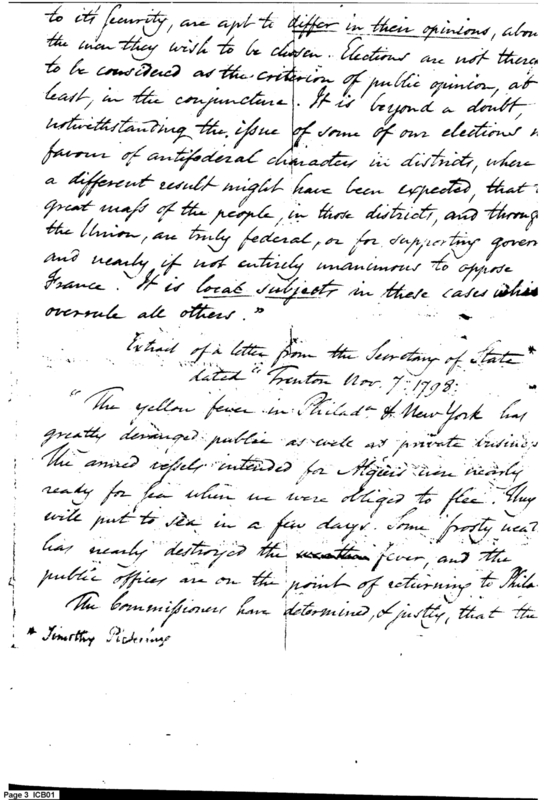
But you will ask, how has it happened, with all this knowledge of French proceedings before the eyes of the people, that they have not returned to Congress a greater majority of federal characters; for from the elections which have taken place, the improvement in this respect is not very flattering. In the first place, as Swift has long since justly observed, we find, that men who are engaged in some evil design, or who labour under one common misfortune, such as want [underline: of power], are always in closest union among themselves, and the most industrious labourers in the political vineyard. In the 2d place, those who wish well to the government and its administration, and would gladly contribute to its security, are apt to [underline: differ] in [underline: their] opinions, about the men they wish to be chosen. Elections are not there to be considered as the criterion of public opinion, at least, in the conjuncture. It is beyond a doubt, notwithstanding the issue of some of our elections in favour of antifederal characters in districts, where a different result might have been expected, that the great mass of the people, in those districts, and through the Union, are truly federal, or for supporting government and nearly, if not entirely unanimous to oppose France. It is [underline: local subjects] in these cases which overrule all others."
Extract of a letter from the Secretary of State*
dated "Trenton Nov. 7. 1798:
"The yellow fever in Philada & New York has greatly deranged public as well as private business. The armed vessels intended for Algiers were nearly ready for sea when we were obliged to flee. They will put to sea in a few days. Some frosty weather has nearly destroyed the [strikethrough: [undecipherable]] fever, and the public offices are on the point of returning to Phila.
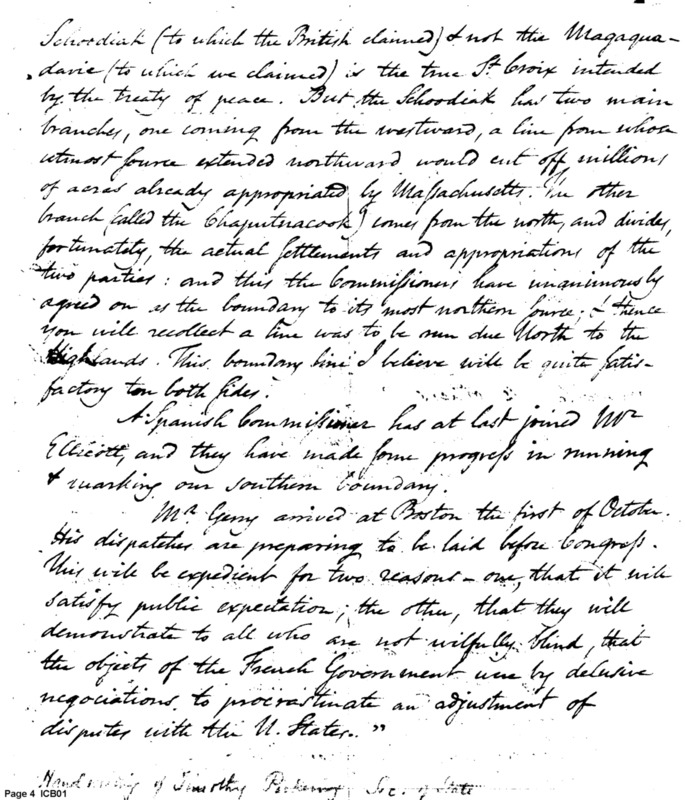
The Commissioners have determined, & justly, that the Schoodiak (to which the British claimed) & not the Magaquadavie (to which we claimed) is the true St. Croix intended by the treaty of peace. But the Schoodiak has two main branches, one coming from the westward, a line from whose utmost source extended northward would cut off millions of acres already appropriated by Massachusetts. The other branch called the Chagutnacook comes from the north, and divides, fortunately, the actual settlements and appropriations of the two parties: and this the Commissioners have unanimously agreed on as the boundary to its most northern source. Hence you will recollect a line was to be run due North to the Highlands. This boundary line I believe will be quite satisfactory to both sides.
A Spanish Commissioner has at last joined Mr Ellicott, and they have made some progress in running & marking our southern boundary.
Mr Gerry arrived at Boston the first of October. His dispatches are preparing to be laid before Congress. This will be expedient for two reasons - one, that it will satisfy public expectation; the other, that they will demonstrate to all who are not wilfully blind, that the objects of the French Government were by delusive negotiations to procrastinate an adjustment of disputes with the U. States."
* Timothy Pickering
[Handwriting of Timothy Pickering, Secy of State]
Type
Extract of Letter
Description
Although it seems that the French are expressing a desire for moderation and peace, McHenry argues that it is too early to relax America's efforts to bolster its fleets and armies. One might expect that increased prospects of peace would diminish the election prospects of anti-federal characters but it should be remembered that local concerns have the greatest impact on voters' choices.
Date
10/20/1798
Author
Recipient
Sent from
Trenton
Repository
Collection
Document number
1798102000001
Page start
1
Notable persons
Timothy Pickering,Secretary of State
James McHenry, Secretary of War
Tallyrand
[Elbridge] Gerry
Congress
our merchants
[Jonathan] Swift
industrious laborers in the political vineyards
antifederal characters
Notable locations
Trenton
France
Notable items
Tallyrand's defense
the American mind
reluctance they express to war
removal of the embargo
addresses to the President [Adams]
fleets and armies
show of peace and moderation
faction
preparations for defense
act repealed interdicting commerce between the two countries
state of public opinion
session of Congress
acts that apply to France
our marine
honorable terms
a greater majority of federal characters
elections
want of power
security
the Union