Now I have all available pages. Here is the transcription of the pages rendered from this document (pages 37–58 of what appears to be a longer narrative):
---
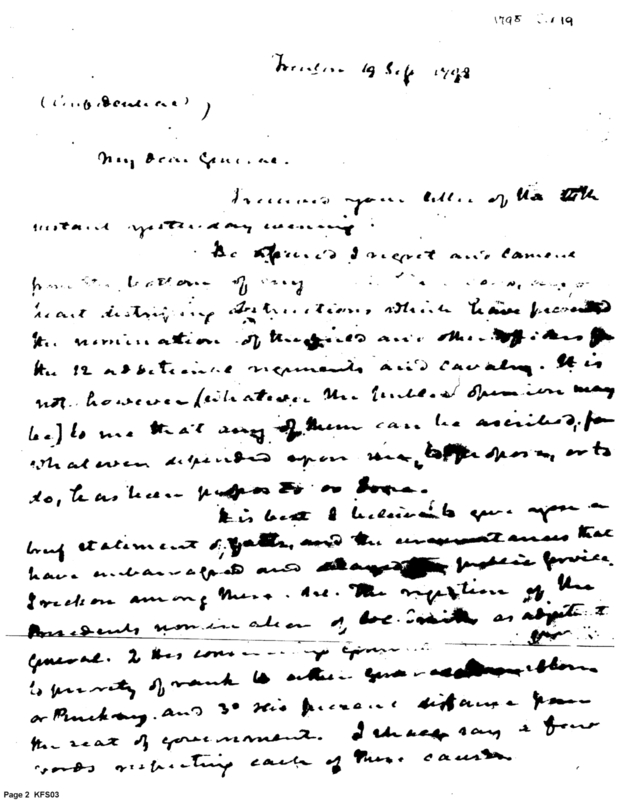
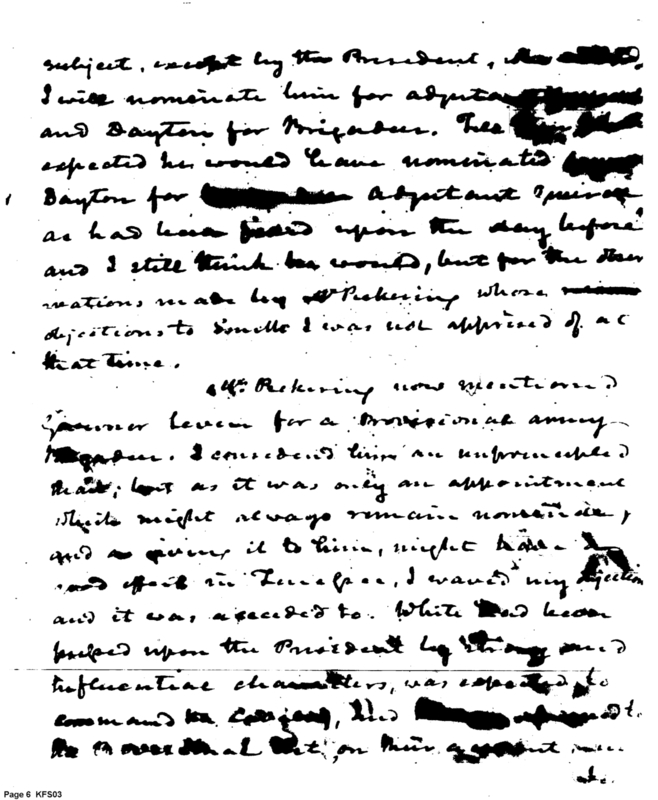
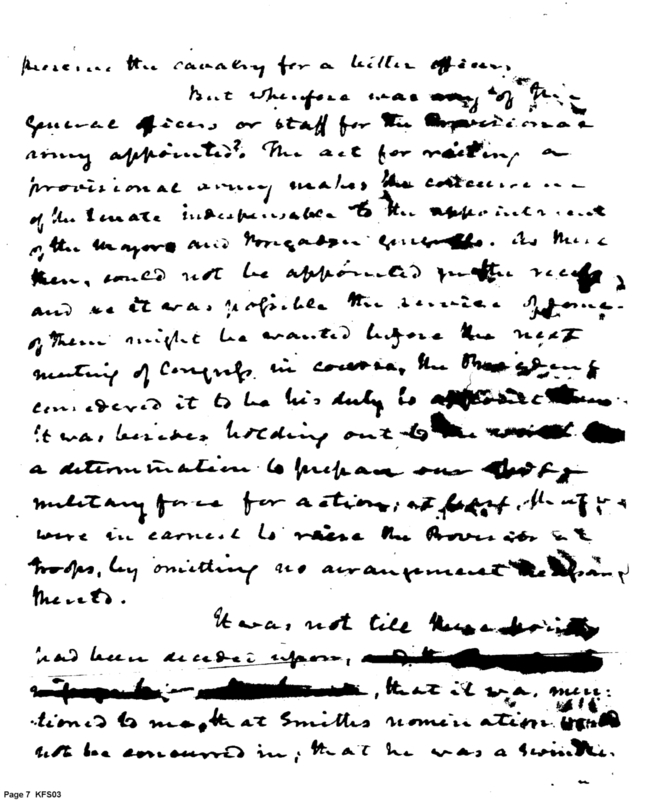
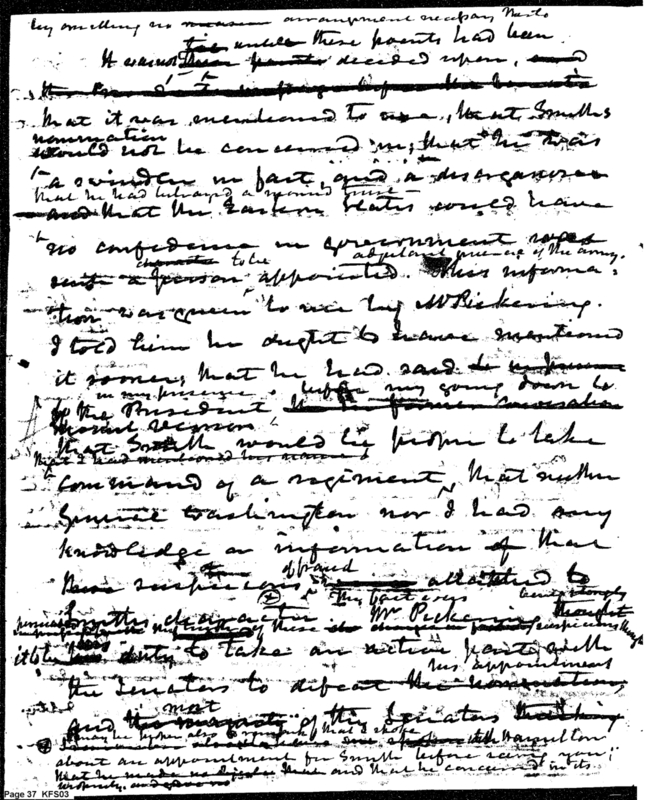
by omitting no measure arrangement necessary [undecipherable]
time until these points had been.
It was [strikethrough: these] points decided upon, and [strikethrough: it] [undecipherable] to [undecipherable] [undecipherable] the [undecipherable] that it was mentioned to us, that Smith's
nomination would not be concerned in; that he was
a swindler in fact, and a [dishonourable?]
that he had [betrayed?] a young [undecipherable] —
and that the Eastern States could have
no confidence in government [undecipherable]
[character] to be [strikethrough: adjutant general of the army.]
such a person appointed. This informa-
tion was given to me by Mr. Pickering.
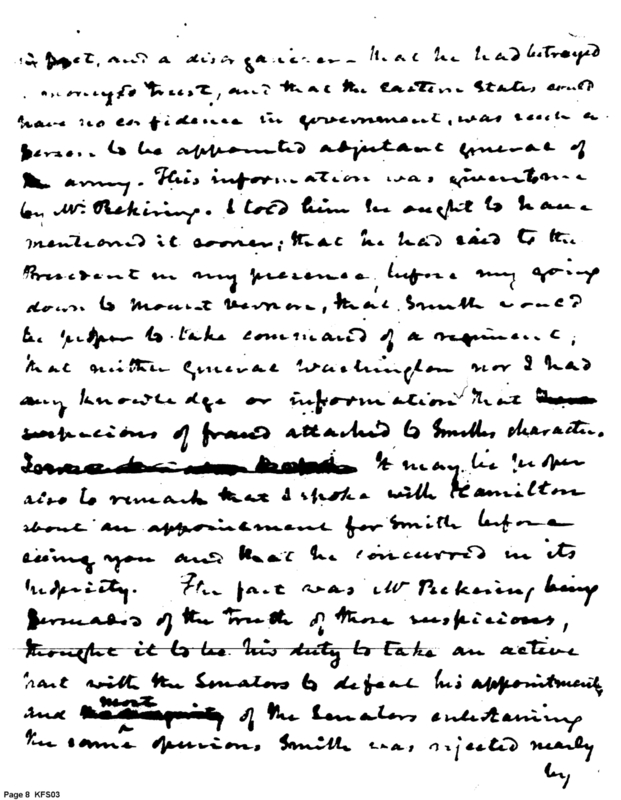
I told him he ought to have mentioned
it sooner, that he had said it [undecipherable]
in my presence, before my going down to
the President [strikethrough: it] the former conversation
[Thomas?] [Nixon?].
that Smith would be proven to take
[strikethrough: first] I had mentioned his name [undecipherable]
[command] of a regiment, that neither
General Washington nor I had any
knowledge or information of these
[strikethrough: his suspicions] [strikethrough: is] [undecipherable] alluded to
[undecipherable] Mr. Pickering thought
[undecipherable] the [undecipherable] [undecipherable]
it [was?] his duty to take an active [part?] with
his appointment
the Senators to defeat the nomination,
and the majority of the Senators [undecipherable]
[undecipherable] also to remark that I chose
[undecipherable] also [undecipherable] done after [undecipherable] [Hamilton?]
about an appointment for Smith before seeing you;
that he made no [scruple?] [there?] and that he concerned in its
[undecipherable] and [undecipherable]
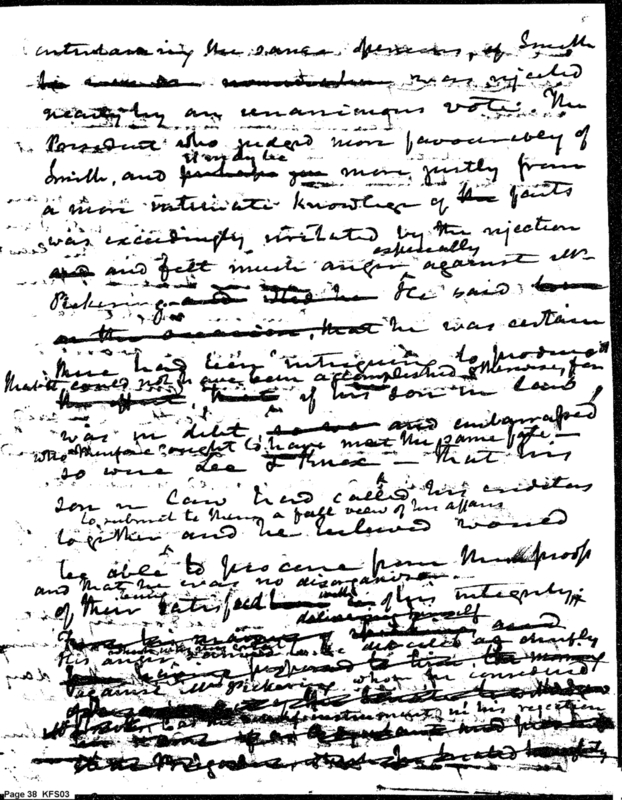
introducing the same persons, of Smith
his [undecipherable] nomination was rejected
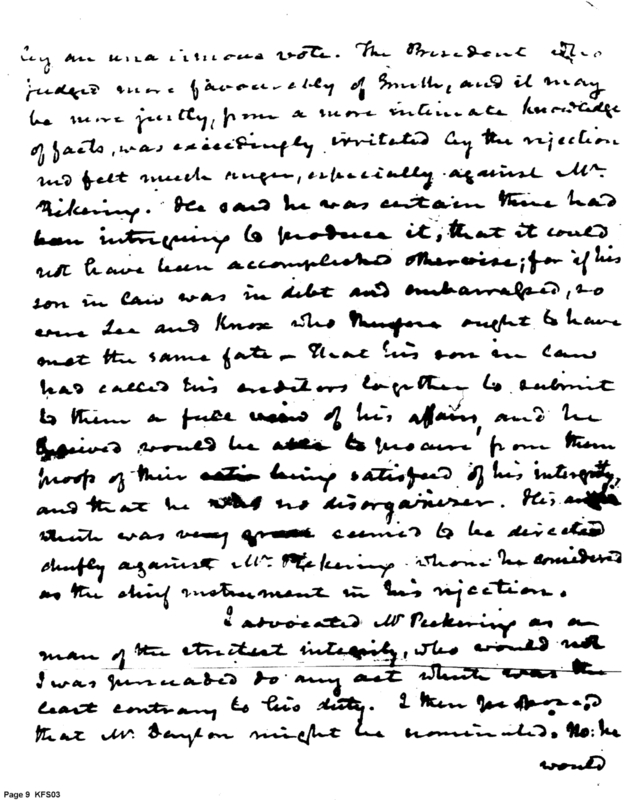
nearly by an unanimous vote. The
President who judged more favourably of
Smith, and perhaps yet more partly from
a more intimate knowledge of the facts
was exceedingly [irritated?] by the rejection
and felt much anger especially against Mr.
Pickering and [undecipherable] he said [undecipherable]
at the occasion, that he was certain
there had been intriguing to produce it
that it could not have been accomplished otherwise, for
[undecipherable] the [undecipherable] of his son in law
was in debt [undecipherable] and embarrassed
who therefore ought to have met his same fate —
so were Lee & Knox — that his
son in law had called his creditors
to submit to him a general view of his affairs
together and he believed would
be able to procure from [undecipherable]
and that he was no disorganiser
of their being satisfied [undecipherable] of his integrity;
[undecipherable] directed himself and
his anger from [undecipherable] [undecipherable]
[undecipherable] proposed to [undecipherable] the money
[against?] Mr. Pickering whom he [insured?]
[undecipherable] of his [undecipherable] in his rejection
[undecipherable] [undecipherable] and [undecipherable]
[strikethrough: that the greatest was the whole]
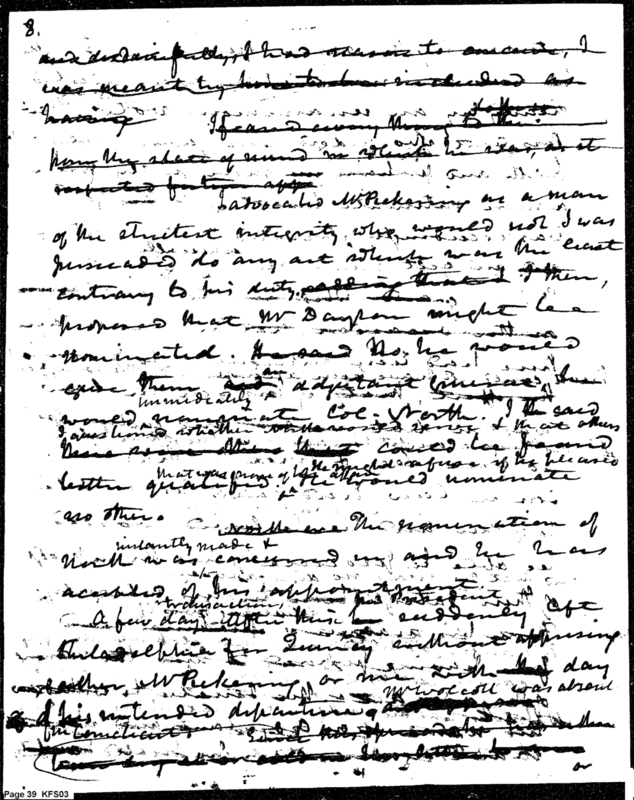
8.
[undecipherable] fully, I had reason to [concede?], I
was meant by him to have included as
having [undecipherable] [undecipherable] If I [undecipherable] everything to the
[undecipherable] my state of mind in [undecipherable]
[undecipherable] [undecipherable]
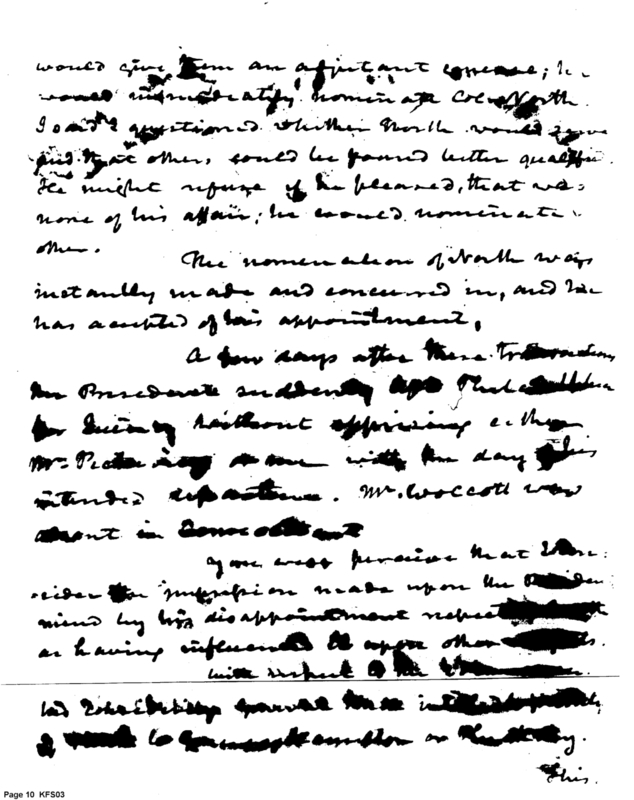
advocated Mr. Pickering as a man
of the strictest integrity, who would not I was
persuaded do any act which was the least
contrary to his duty, [undecipherable] them,
proposed that Mr. Dayton might be
nominated. He said No, he would
give them [undecipherable] Adjutant General, then
would immediately [undecipherable] Col. North. I
[undecipherable] whether [undecipherable] [undecipherable] & that others
there were [undecipherable] that could be found
better [undecipherable] [undecipherable] the [undecipherable] [undecipherable] of his [undecipherable]
[undecipherable] qualified, he [undecipherable] nominate
aso them.
[undecipherable] was the nomination of
North instantly made &
North was concerned in [undecipherable] he was
acceded of his [undecipherable]
[undecipherable] transactions [undecipherable] the [undecipherable]
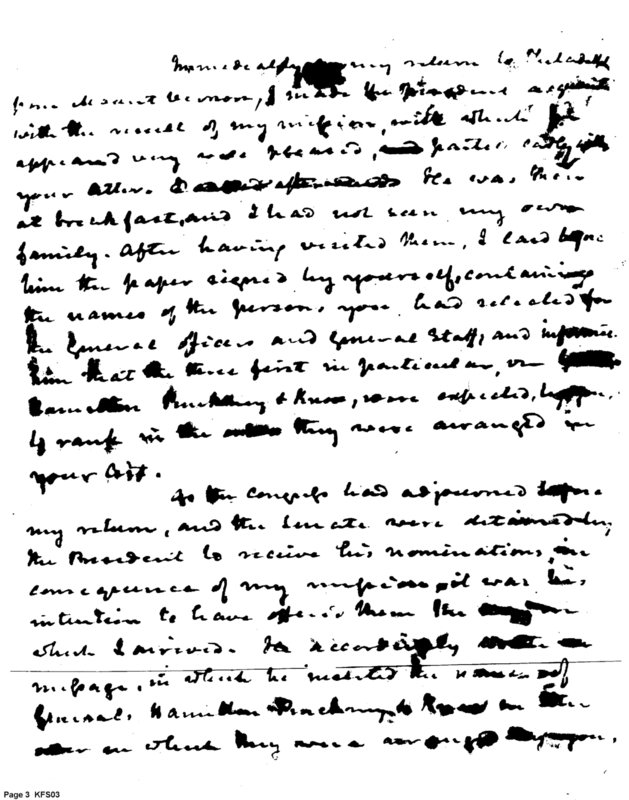
A few days after this he suddenly [went to]
Philadelphia for [undecipherable] without apprising
[undecipherable] or me with [undecipherable]
[undecipherable] Wolcott was about
[undecipherable] of his intended departure for
[undecipherable] Connecticut; [undecipherable] and [undecipherable] then
[undecipherable] a departure with a [undecipherable] to
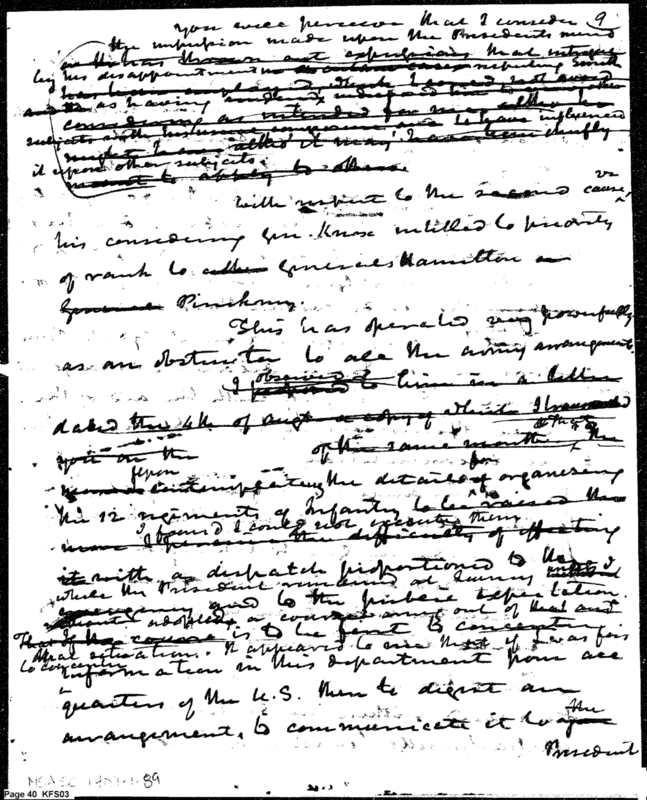
9
you were perceive that I consider
the impression made upon the President's mind
in their [undecipherable] and [undecipherable] [undecipherable]
by his disappointments [undecipherable] each [undecipherable] resulting [undecipherable]
[undecipherable] I [undecipherable] that I [undecipherable] [undecipherable]
[undecipherable] as having [undecipherable] [undecipherable] [undecipherable]
[undecipherable] as intended for [undecipherable] others [undecipherable]
subjects with [undecipherable] [undecipherable] to have influenced
[undecipherable] [undecipherable] [undecipherable] — [undecipherable] I [undecipherable] been chiefly
it upon other subjects, to draw
[undecipherable] to apply to those.
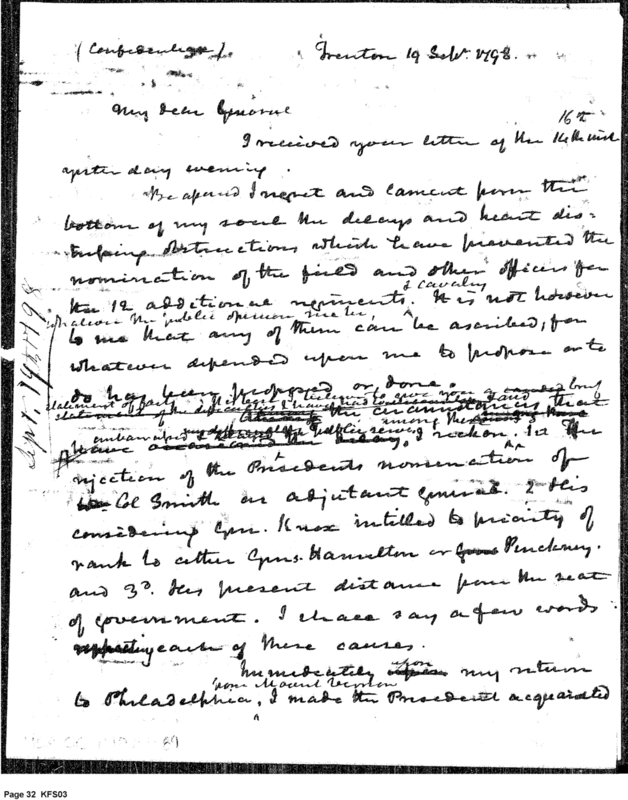
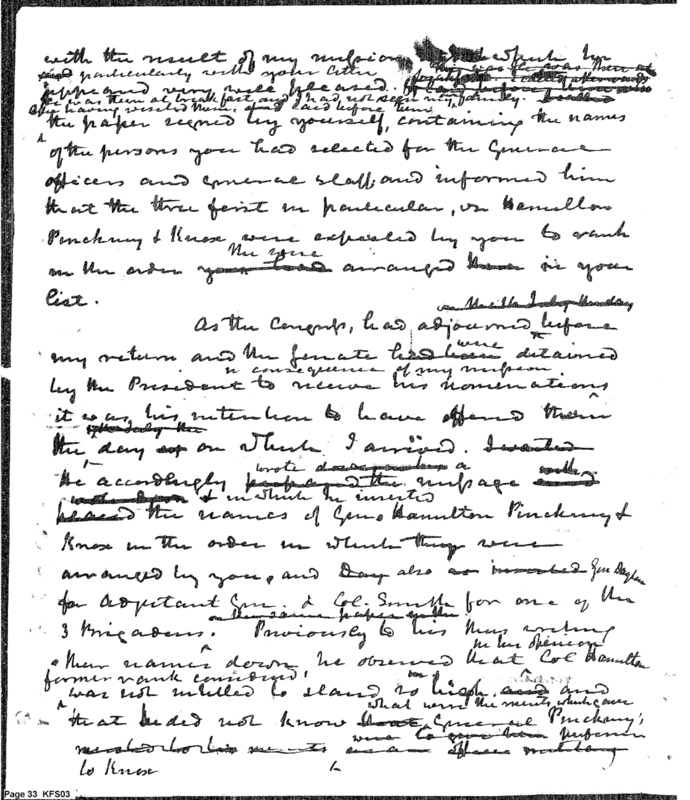
with respect to the second cause,
his considering Gen. Knox entitled to priority
of rank to call General Hamilton or
Governor Pinckney.
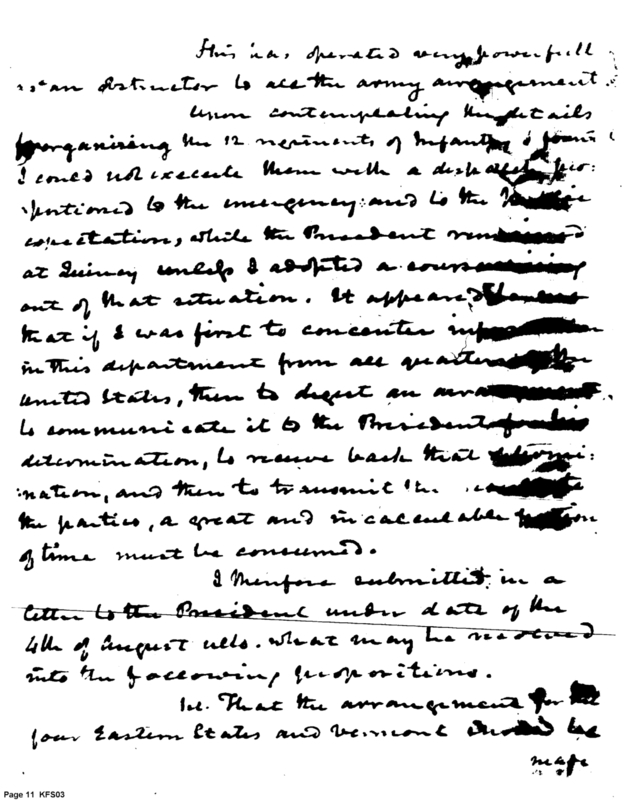
This has operated very powerfully
as an obstacle to all the army arrangements.
I [submitted?] to him in a letter
dated the 4th of Aug[us]t a copy of which I
give on the [undecipherable] of the same month, the
from
[undecipherable] contemplating the details of organising
the 12 regiments of infantry to be raised the
[undecipherable] I found I could not [undecipherable] them,
more [undecipherable] the difficulty of effecting
it with a despatch proportioned to [undecipherable] [undecipherable]
while the President remained at [undecipherable] [undecipherable]
[undecipherable] and to the public expectation.
[undecipherable] without [undecipherable] a course [undecipherable] of these and
That his course is to be first to concentrate.
That it appeared to me most [undecipherable] for
to [concentrate?] attention in this department from all
quarters of the U.S. then to digest an
arrangement, to communicate it to the President
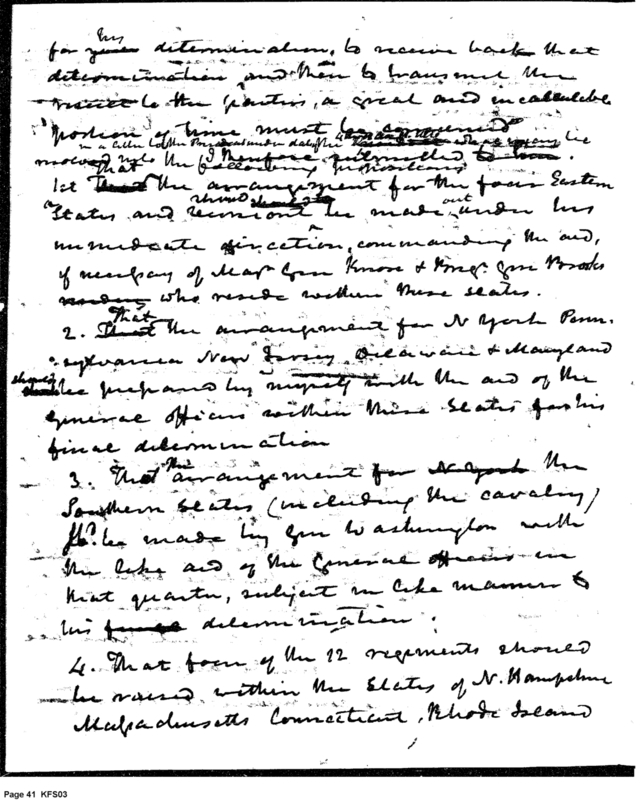
for your determination, to receive back that
determination and then to transmit the
[matter?] to the parties, a great and incalculable
portion of time must [undecipherable]
[strikethrough: in a letter to the President under delay] [undecipherable] the
[undecipherable] that the [undecipherable] [undecipherable] to him.
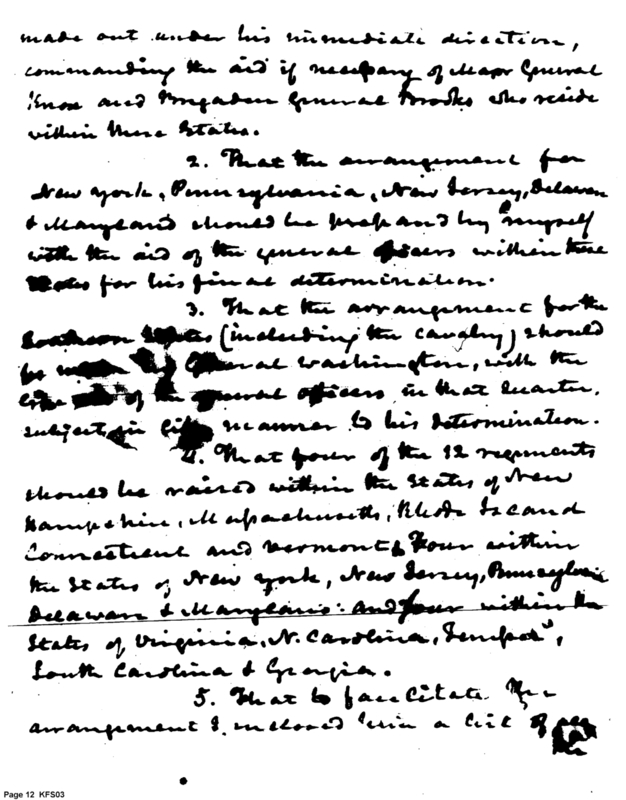
that [undecipherable] the arrangement for the four Eastern
States and Vermont [undecipherable] be made under his
immediate direction, commanding the aid,
if necessary of Major Gen. Knox & Major Gen. Brooks
[undecipherable] who reside within those States.
2. That the arrangement for N. York Penn.
[undecipherable] New Jersey, Delaware & Maryland
[undecipherable] be prepared by [undecipherable] with the aid of the
General Officers within those States for his
final determination.
3. That the arrangement for [undecipherable] the
Southern States (including the cavalry)
[undecipherable] be made by Gen. Washington with
the aid of the General Officers in
that quarter, subject in like manner to
his [undecipherable] determination:
4. That four of the 12 regiments should
be raised within the States of N. Hampshire
Massachusetts, Connecticut, Rhode Island
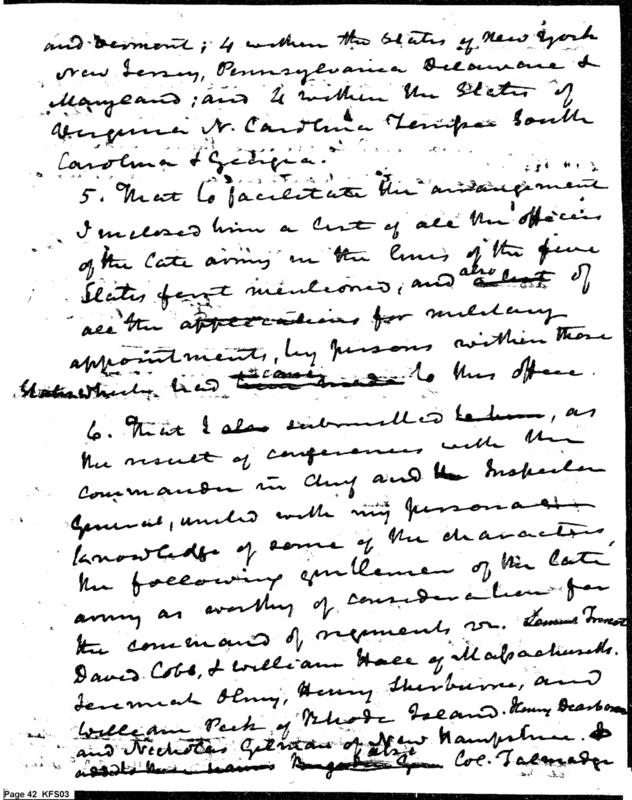
and Vermont; 4 within the States of New York
New Jersey, Pennsylvania, Delaware &
Maryland; and 4 within the States of
Virginia, N. Carolina, Tennessee, South
Carolina & Georgia.
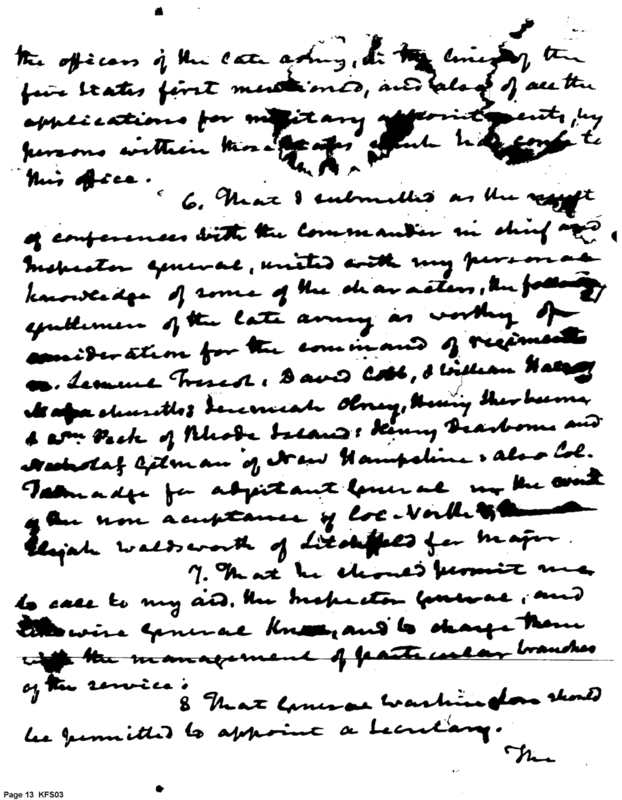
5. That to facilitate the arrangement
I enclosed him a list of all the Officers
of the late army on the lines of the five
States first mentioned; and [strikethrough: also] a list of
all the applications for military
appointments, by persons within those
States, which had [undecipherable] to this office.
6. That I also submitted to him, as
the result of conferences with the
Commander in Chief and the Inspector
General, united with my personal
knowledge of some of the characters,
the following gentlemen of the late
army as worthy of consideration for
the command of regiments, viz. Samuel Turner,
David Cobb, & William Hall of Massachusetts.
Jeremiah Olney, Henry Sherburne, and
William Peck of Rhode Island. Henry Dearborn
and Nicholas Gilman of New Hampshire. &
[undecipherable] Col. Talmadge
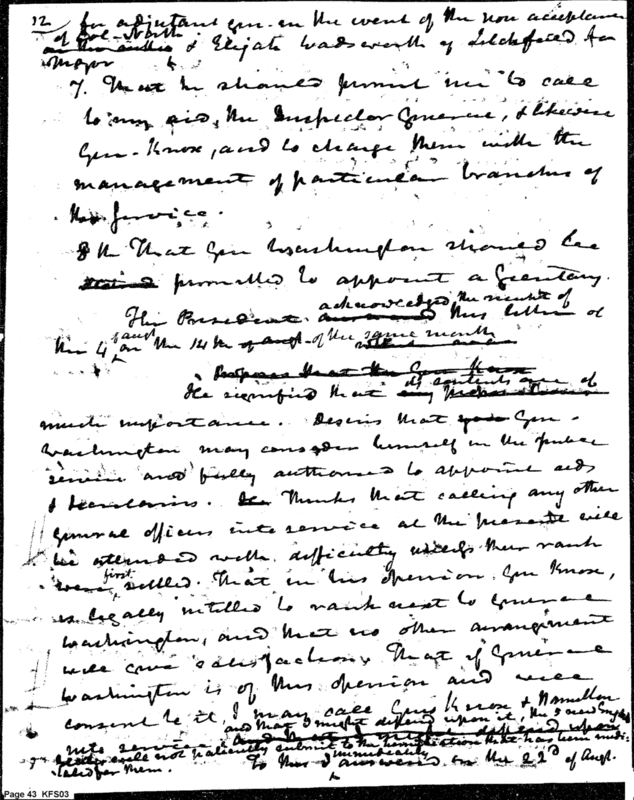
12
for adjutant gen. in the event of the non-acceptance
of Col. North; [undecipherable] of Elijah Wadsworth of [undecipherable] for
Major.
7. That he should permit me to call
to my aid, the Inspector General, & likewise
Gen. Knox, and to charge them with the
management of particular branches of
this service.
8. That Gen. Washington should be
[undecipherable] permitted to appoint a Secretary.
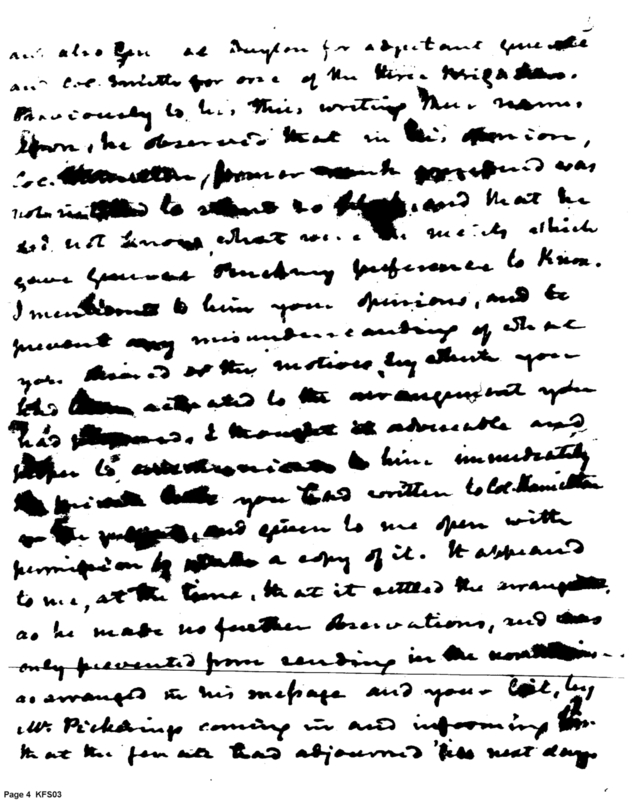
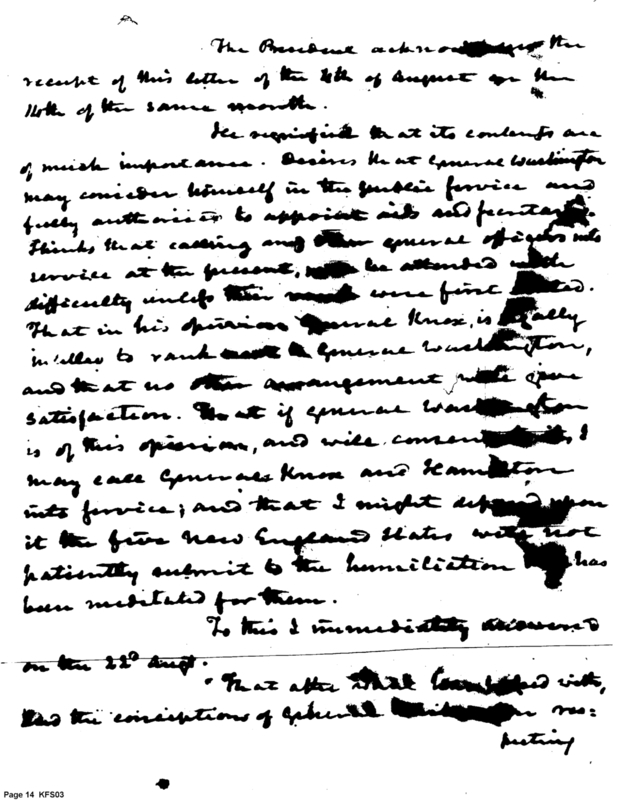
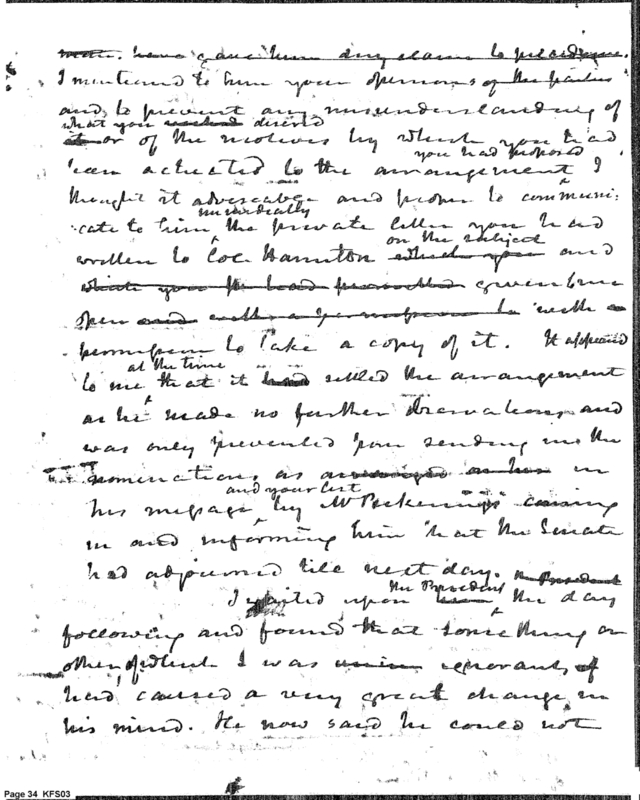
The President acknowledged the merit of
his letter of
the 4th, on the 14th of [undecipherable] the same month.
[undecipherable]
He signified that the contents were of
much importance. Desires that Gen.
Washington may consider himself in the public
service and fully authorised to appoint aids
& [undecipherable]. He thinks that calling any other
General Officers into service at the present will
be attended with difficulty unless their rank
being first settled. That in his opinion Gen. Knox,
is legally entitled to rank next to General
Washington, and that no other arrangement
will come satisfactorily. That if General
Washington is of this opinion and will
consent to it, I may call Gen. Knox & Hamilton
and that I must depend upon it, he [undecipherable]
[undecipherable] to the nominations that he has been indi-
[undecipherable] called for them.
To his I answered on the 22d of Aug[us]t.
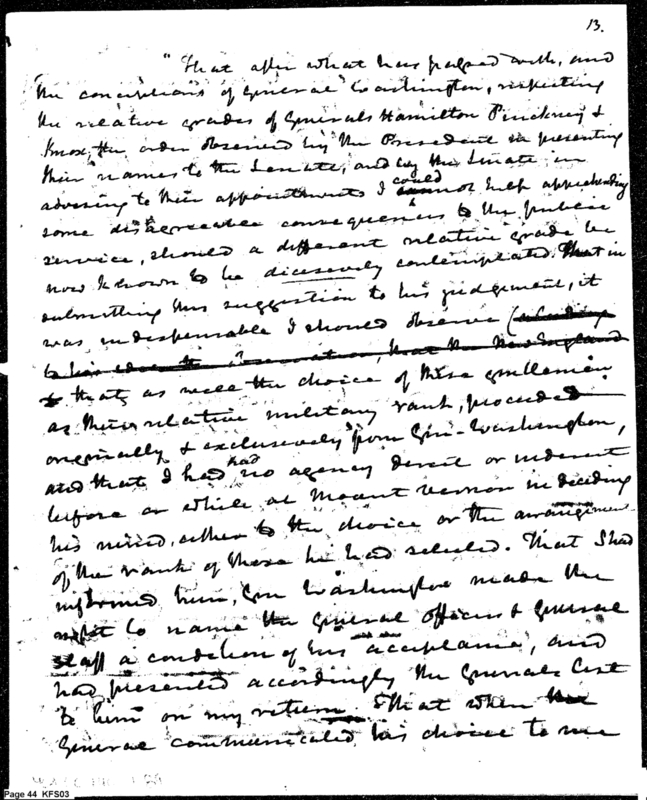
13.
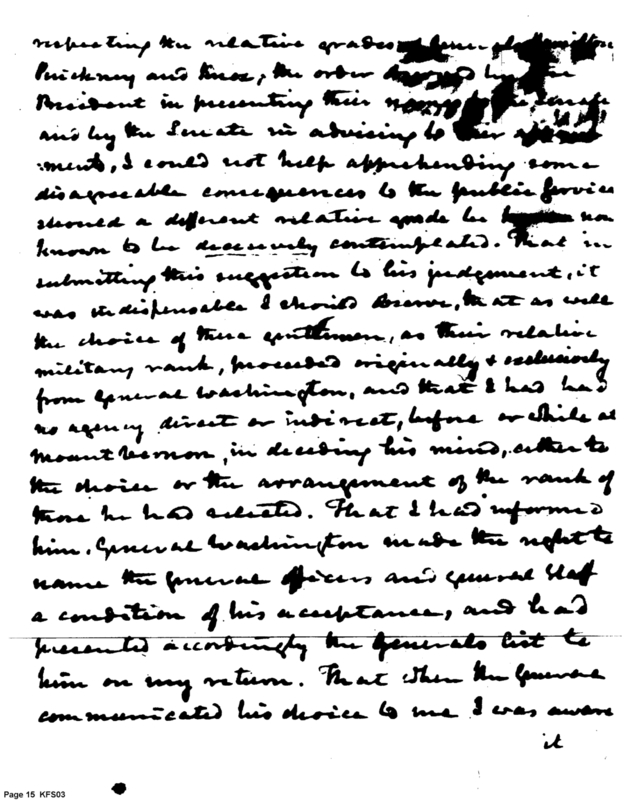
"That after what has passed with, and
the conclusions of General Washington, respecting
the relative grades of Generals Hamilton, Pinckney &
Knox, the order observed by the President in presenting
their names to the Senate, and by the Senate in
advising to their appointments I could not help apprehending
some disagreeable consequences to the public
service, should a different relative grade be
now known to be differently contemplated. That in
submitting this suggestion to his judgement, it
was indispensable I should observe [including?]
to him the [undecipherable] [undecipherable] of these gentlemen
to that as well the choice of these gentlemen
as their relative military rank, proceeded
originally & exclusively from Gen. Washington,
and that I had had no agency direct or
indirect before or while at Mount Vernon in deciding
his mind, either to the choice or the arrangement
of the rank of those he had selected. That I had
informed him, Gen. Washington made the
effort to name the General Officers & [made?]
staff a condition of his acceptance, and
had presented accordingly the Generals List
to him on my return. That when the
General communicated his choice to me
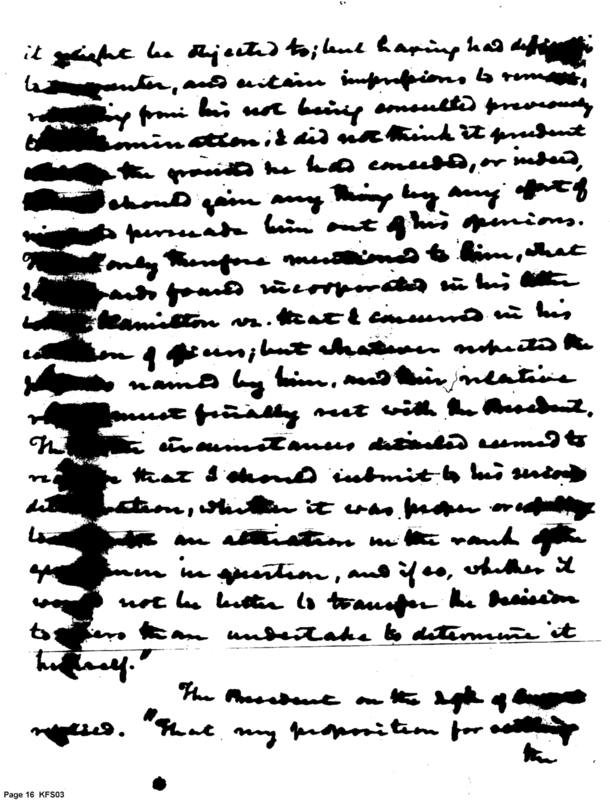
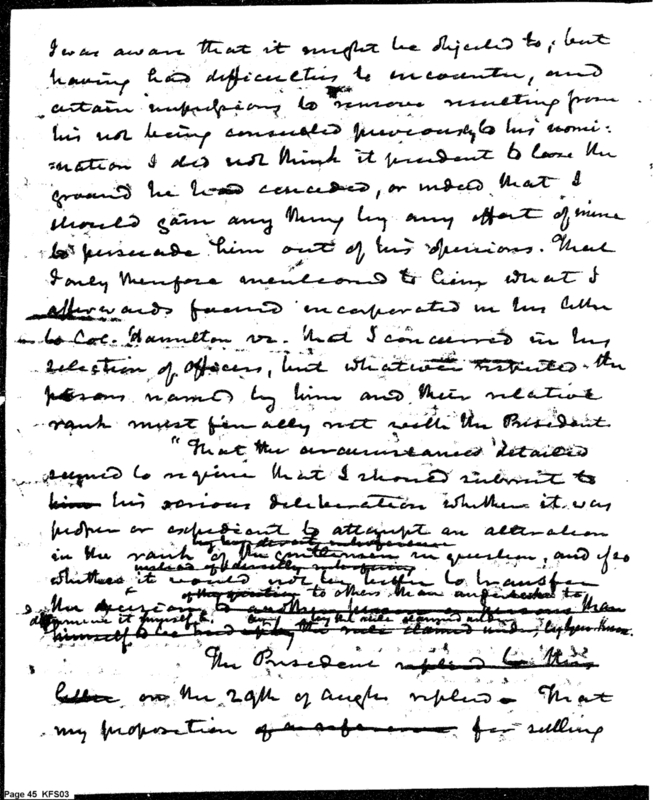
I was aware that it might be objected to; but
having had difficulties to encounter, and
certain suspicions to remove resulting from
his not being consulted previously to his nomination,
I did not think it prudent to lose the
ground he had conceded, or indeed that I
should gain any thing by any effort of mine
to persuade him out of his opinions. That
I only therefore mentioned to him what I
afterwards found incorporated in his letter
to Col. Hamilton viz. That I concurred in his
selection of Officers, but whatever transpired, the
persons named by him and their relative
rank must finally rest with the President.
"That the circumstances detailed
seemed to require that I should submit to
him his serious deliberation whether it was
proper or expedient to attempt an alteration
in the rank of the gentlemen in question; and if so,
whether it would not be better to transfer
the opinion to others than an interested party
determine it myself; any general officer serving under
himself to be the one claiming under him."
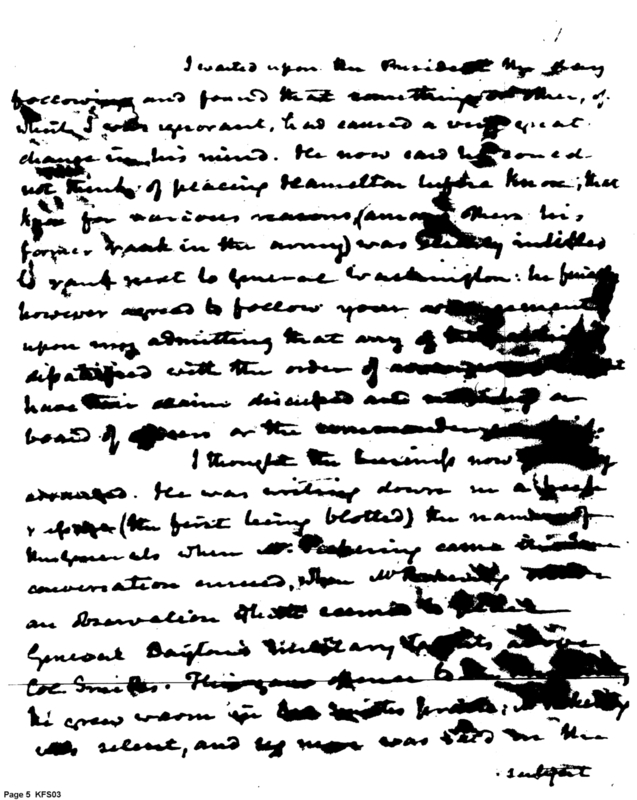
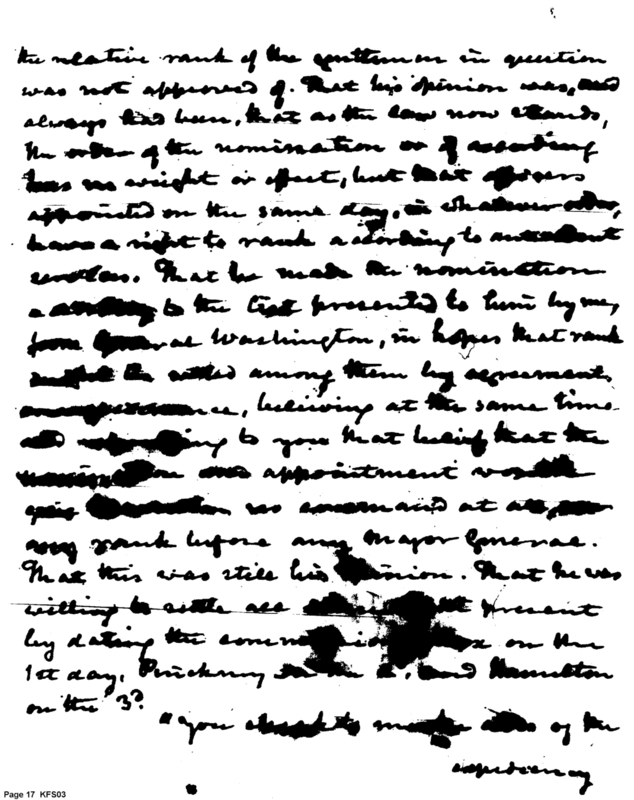
The President replied to this
letter on the 29th of August replied. That
my proposition [undecipherable] for settling
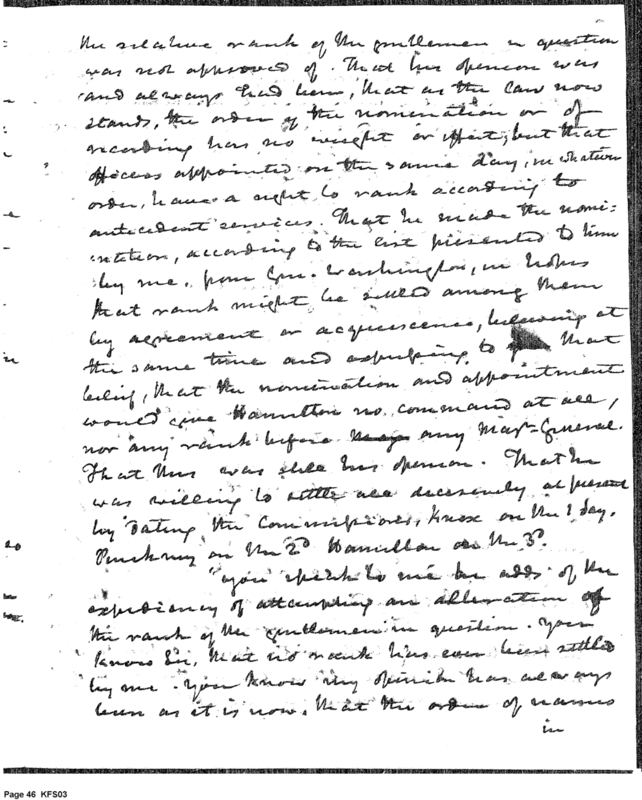
the relative rank of the gentlemen in question
was not approved of. That his opinion was
and always had been, that as the law now
stands, the order of nomination or of
recording has no weight or effect; but that
Officers appointed on the same day, in whatever
order, have a right to rank according to
antecedent services. That he made the nomination, according to the list presented to him
by me, from Gen. Washington, in whose
order that rank might be settled among them
by agreement or acquiescence, believing at
the same time and assuming to him that
belief, that the nomination and appointment
would give Hamilton no command at all,
nor any rank before [undecipherable] any Maj. General.
That this was also his opinion. That he
was willing to settle it decently at present
by dating the Commissions; Knox on the 1st day.
Pinckney on the 2d; Hamilton on the 3d.
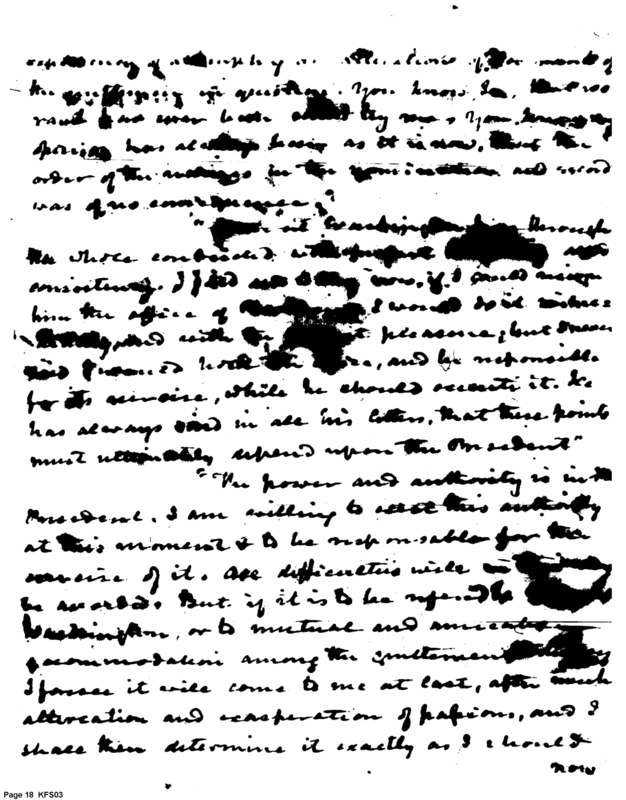
"you speak to me the odds of the
expediency of attempting an alteration of
the rank of the gentlemen in question. You
know Sir, that no rank has ever been settled
by me. You know my opinion has always
been as it is now. That the order of names in
16
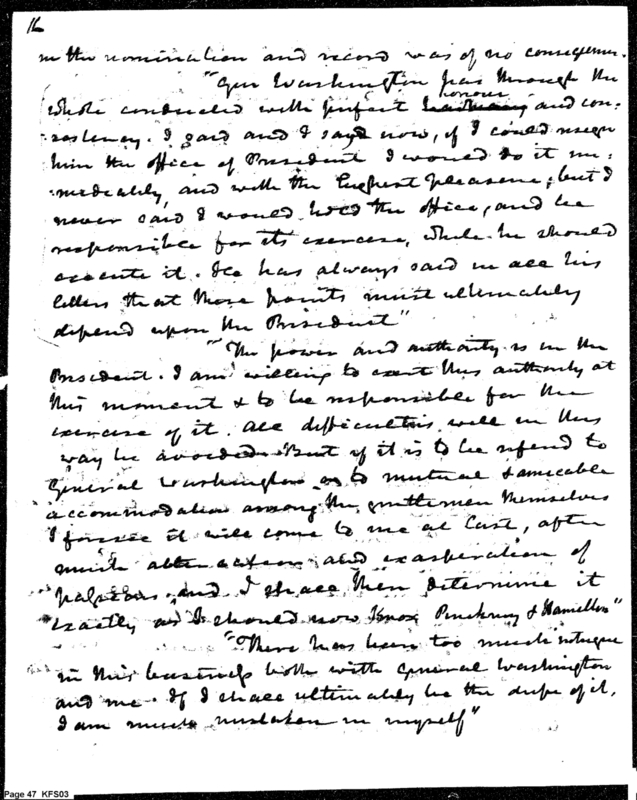
in the nomination and record was of no consequence.
"Gen. Washington has always conducted with perfect [honour]
and consistency. I said and I say now, if I could mean
him the office of President I would do it immediately, and with the highest pleasure; but I
never said I would hold the office, and be
responsible for its exercise, while he should
execute it. He has always said in all his
letters that those points must ultimately
depend upon the President"
"The power and authority is in the
President. I am willing to exert this authority at
this moment & to be responsible for the
exercise of it. All difficulties will in this
way be avoided. But if it is to be referred to
General Washington or to mutual & amicable
accommodation among the gentlemen themselves,
I foresee it will come to me at last, after
much altercation and exasperation of
'palates', and I shall then determine it
exactly as I should now: Knox, Pinckney & Hamilton"
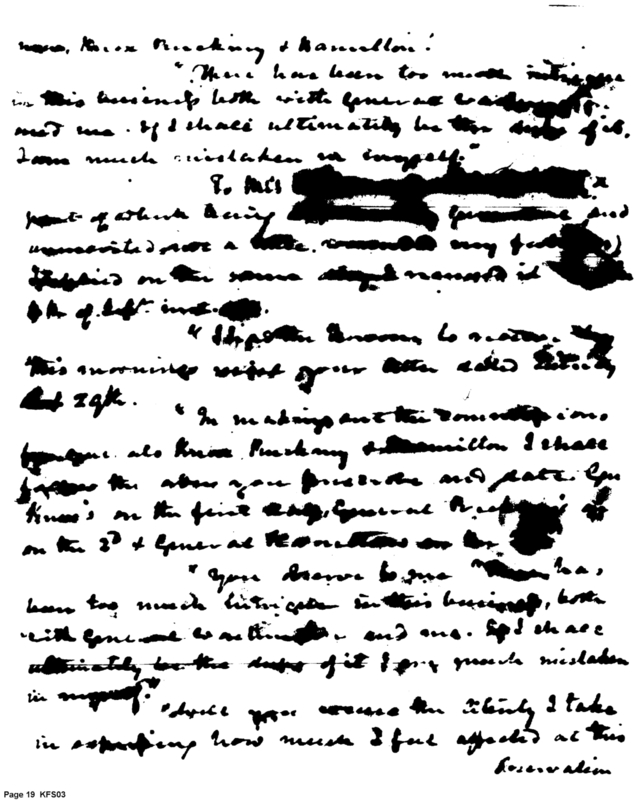
"There has been too much intrigue
in this business, both with General Washington
and me. If I shall ultimately be the dupe of it,
I am much mistaken in myself."
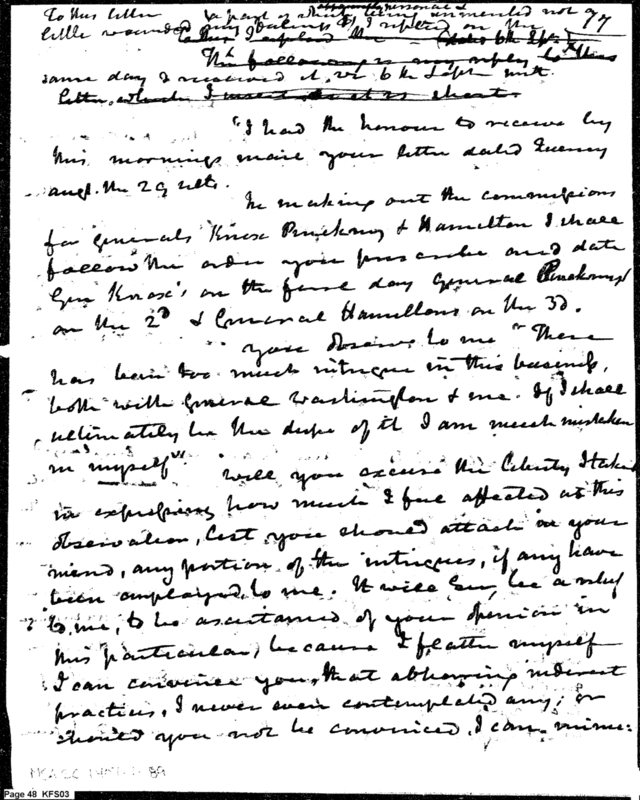
To this letter [strikethrough: a great many things, unmentioned] not a
little wounded [strikethrough: [undecipherable]] I replied, on the [strikethrough: [undecipherable]]
same day I received it, viz 6 the latter inst[ant].
letter, [strikethrough: which I need not] [undecipherable].
"I had the honour to receive by
his mornings' made your letter dated Tuesday
Augt. the 29 ulto.
In making out the commissions
for Generals Knox, Pinckney & Hamilton I shall
follow the order you prescribe and date
Gen. Knox's, on the first day General Pinckney's
on the 2d; & I General Hamilton's on the 3d.
"... you observe to me 'There
has been too much intrigue in this business,
both with General Washington & me. If I shall
ultimately be the dupe of it I am much mistaken
in myself.' Will you excuse the liberty I
take in expressing how much I have affected at this
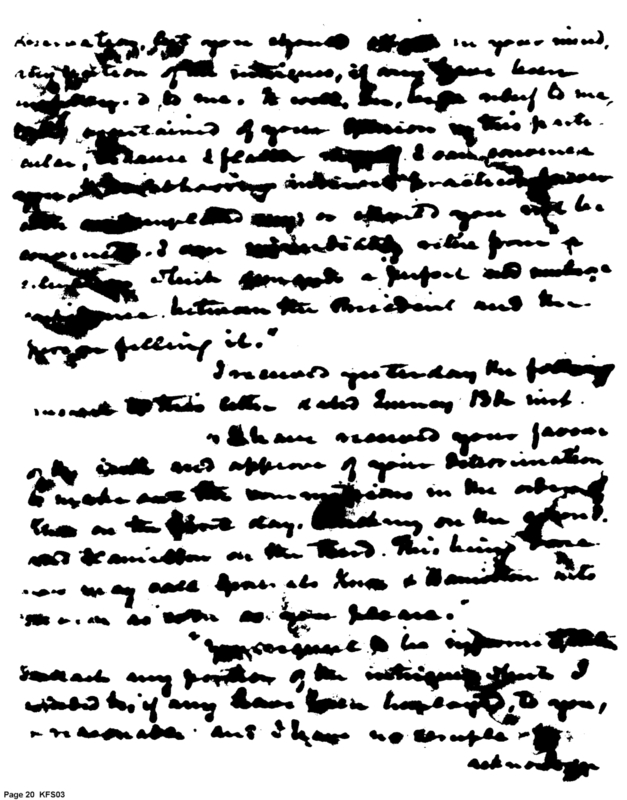
observation, lest you should attach on your
mind, any portion of the intrigues, if any have
been employed, to me. It will ever be a duty
to me, to be ascertained of your opinion in
this particular, because I flatter myself
I can convince you, that abhorring indirect
practices, I never even contemplated any; or
should you not be convinced I can
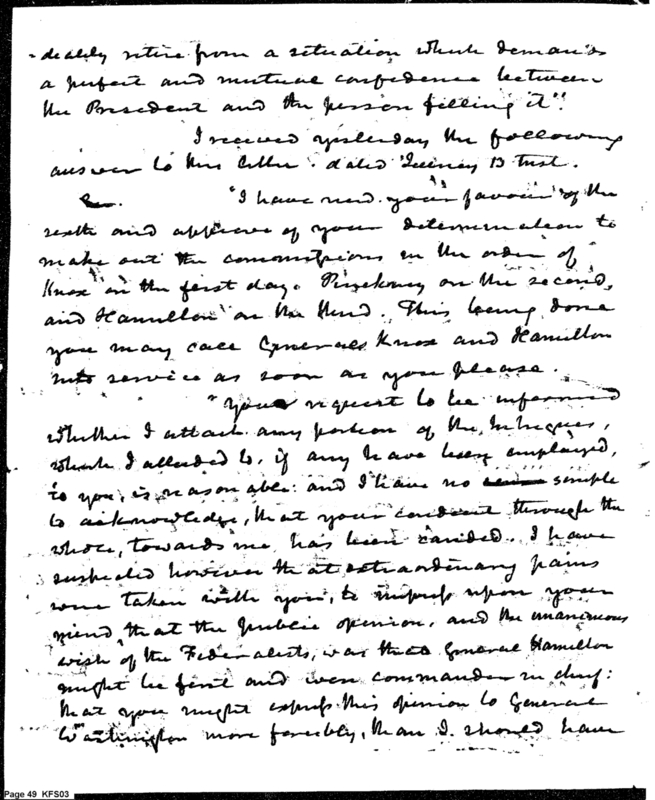
-decidely retire from a situation which demands
a perfect and mutual confidence between
the President and the person filling it".
I received yesterday the following
answer to this letter: dated 'December 13 Inst[ant].'
[undecipherable]. "I have read your favour of the
result and approbation of your determination to
make out the commissions in the order of
Knox on the first day, Pinckney on the second,
and Hamilton on the third. This being done
you may call Generals Knox and Hamilton
into service as soon as your please.
"Your request to be informed
whether I attach any portion of the intrigues,
which I alluded to, if any have been employed,
to you, is reasonable. and I have no [undecipherable] simple
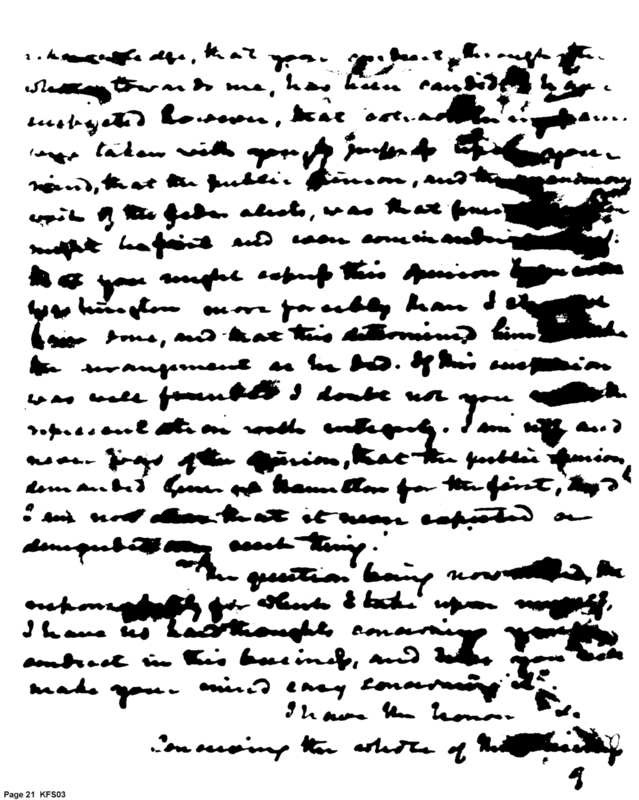
to acknowledge, that your conduct throughout the
whole, towards me has been candid. I have
suspected however that extraordinary pains
were taken with you, to impress upon your
mind that the public opinion, and the unanimous
wish of the Federalists, was that General Hamilton
ought he first and even commander in chief:
that you might express this opinion to General
Washington more forcibly than I should have
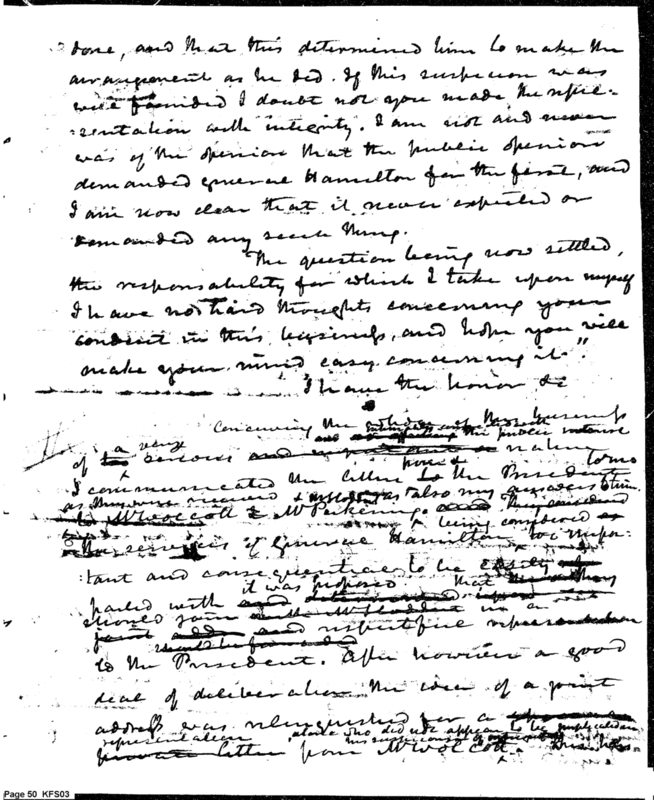
done, and that this determined him to make the
arrangement as he did. If this suspicion was
well founded I doubt not you made the representation with integrity. I am not and never
was of the opinion that the public opinion
demanded General Hamilton for the first, and
I am now clear that it never expected or
demanded any such thing.
The question being now settled,
the responsibility for which I take upon myself,
I have no hard thoughts concerning your
conduct in this business, and hope you will
make your mind easy concerning it.
I have the honour to be"
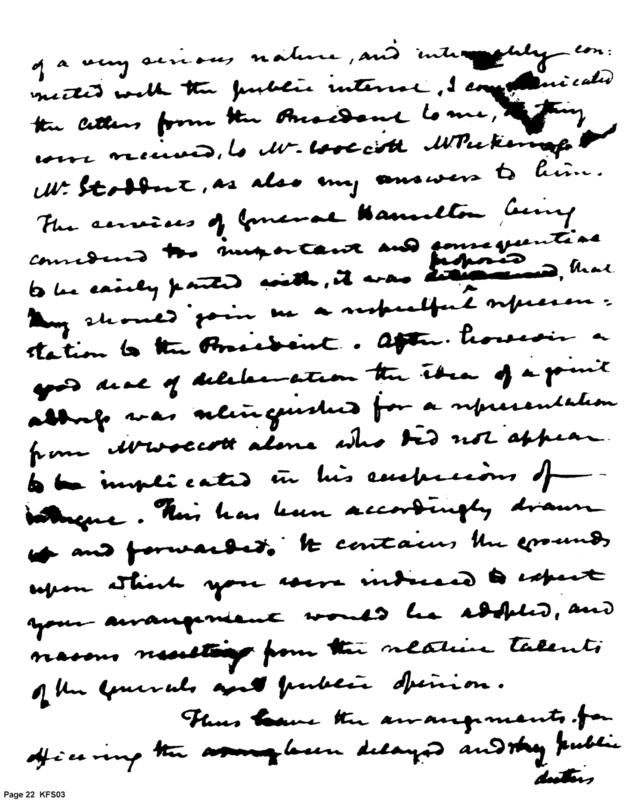
"Concerning the [undecipherable] other serious and
important matter relating [undecipherable] to me;
I communicated the letter to the President [undecipherable]
as [undecipherable] received & also my answer to
Mr. Wolcott & Mr. Pickering. They considered [undecipherable]
[undecipherable] services of General Hamilton [undecipherable]
important and consequential to be [undecipherable]
parted with [undecipherable] importance; it was proposed, that [undecipherable]
should join [undecipherable] and [undecipherable] in a
joint and [undecipherable] representation
to the President. After however a good
deal of deliberation, the idea of a joint
address was relinquished for a [undecipherable] alone,
[undecipherable] who did not appear to be [undecipherable];
[undecipherable] letter from [Wolcott?]. This
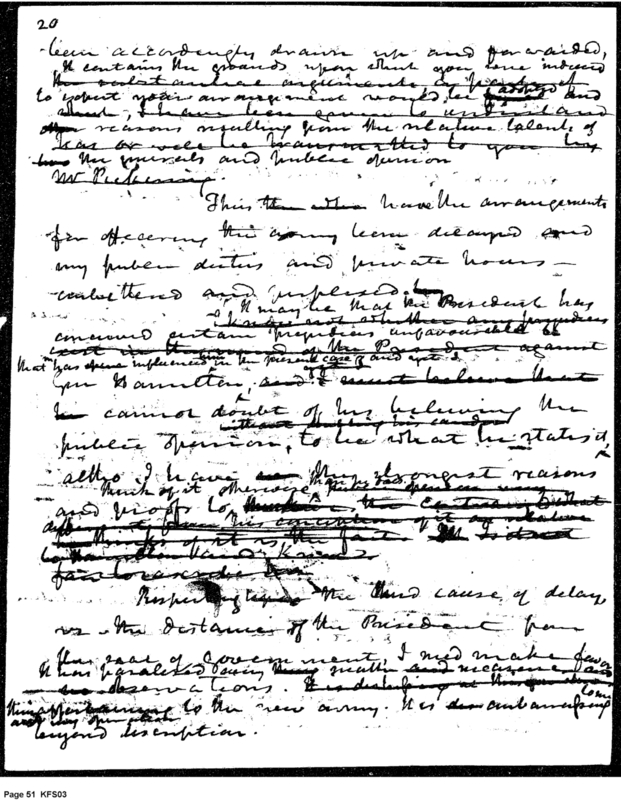
20
been accordingly drawn up and forwarded.
It contains the grounds upon which you have induced
the substance [undecipherable] by [undecipherable]
to govern your arrangement was [undecipherable] and
above, I have been drawn to understand
other reasons resulting from the relative talents of
[undecipherable] or well be warranted to you by
[undecipherable] and public opinion.
Mr. Pickering.
Thus the other have the arrangements
for officering the army been delayed and
my public duties and private hours —
continued and unpleasant.
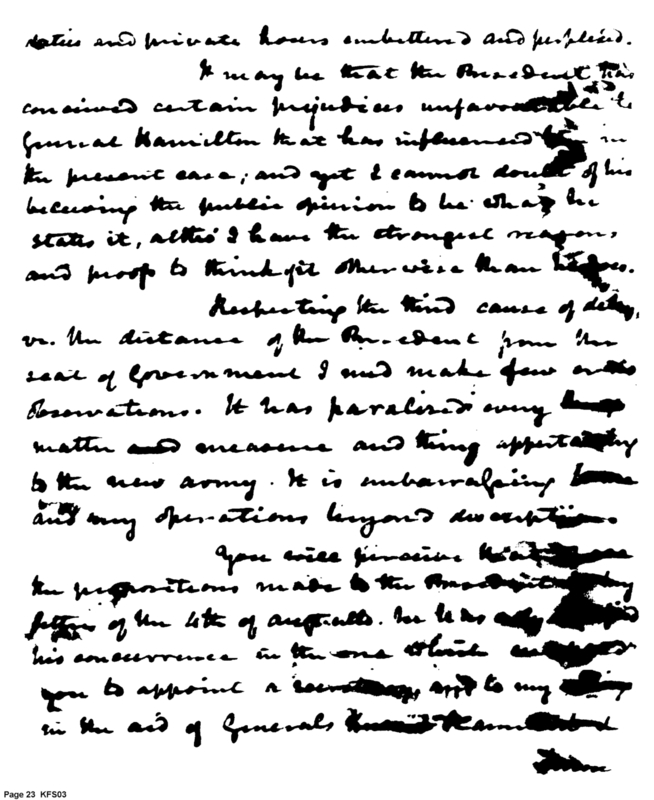
"It may be that the President has
[undecipherable] certain members unfavourably [undecipherable]
[undecipherable] the ground of the President against
[undecipherable] that has been influenced in the present case [undecipherable] and yet
I believe that
he cannot doubt of his believing the
public opinion, to be what he states it,
altho I have [undecipherable] many [undecipherable] strongest reasons
and think of it otherwise. [undecipherable]
and proofs to [undecipherable] the [undecipherable]
[undecipherable] [undecipherable] [undecipherable].
Respecting the third cause of delay
was the distance of the President from
the seat of Government, I need make few
observations. It has paraleled during the matter and necessary
observations. It is distressing [undecipherable]
things appertaining to the new army. It is discouraging and [undecipherable]
beyond description.
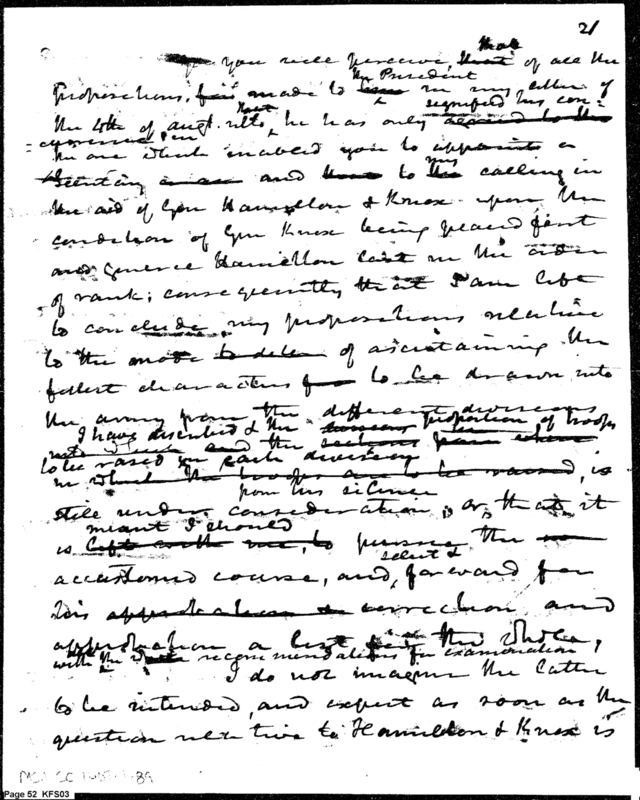
21
you will perceive that of all the
Propositions, [undecipherable] made to the President
in my letter of
the 4th of Augt. ulto, he has only [strikethrough: agreed to] signified his
concurrence in
the one that enabled you to appoint a
[strikethrough: Secretary] [undecipherable] and [undecipherable] to the calling in
the aid of Gen. Hamilton & Knox upon the
condition of Gen. Knox being placed first
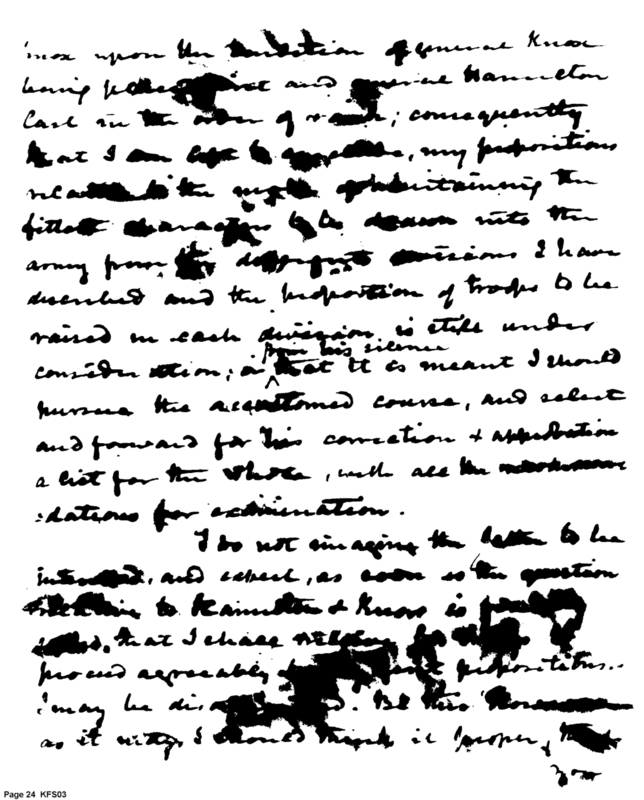
and General Hamilton last in the order
of rank; consequently that I am able
to conclude my propositions relative
to the mode to determine of ascertaining the
fullest characters for to be drawn into
the army from the different [undecipherable];
I have described the [undecipherable] apportionment of troops
[undecipherable] to be raised in each [undecipherable],
and [undecipherable] the [undecipherable],
the troops already to be raised, is
still under consideration or that is [undecipherable]
meant I should
is left with me, to pursue the
accustomed course, and, forward for
his approbation [undecipherable] a correction, and
approbation from a list [undecipherable] the States;
with the [undecipherable] recommendations for examination;
I do not imagine the latter
to be intended, and expect as soon as the
question relative to Hamilton & Knox is
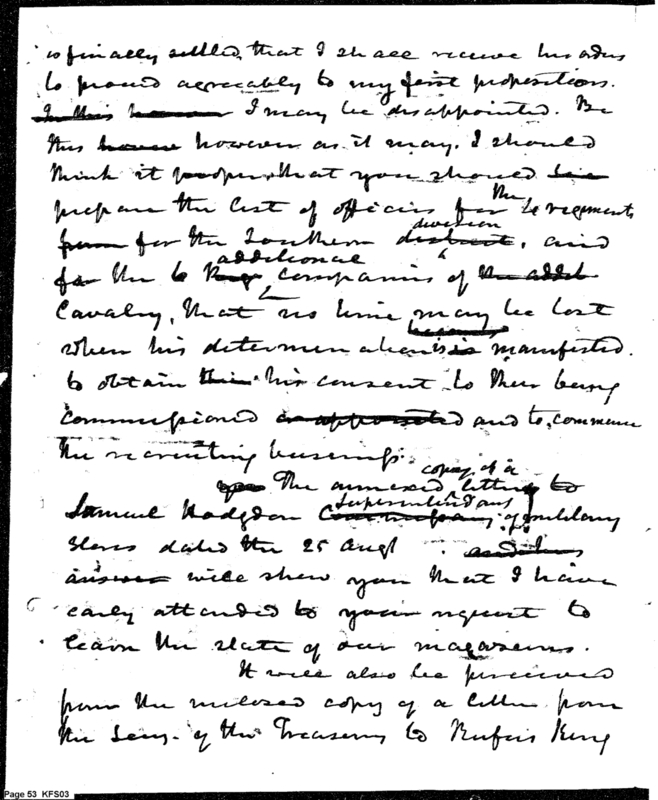
is finally settled, that I shall receive his advice
to proceed agreeably to my first propositions.
In this I may be disappointed. Be
the matter however as it may, I should
think it [prudent?] that you should have
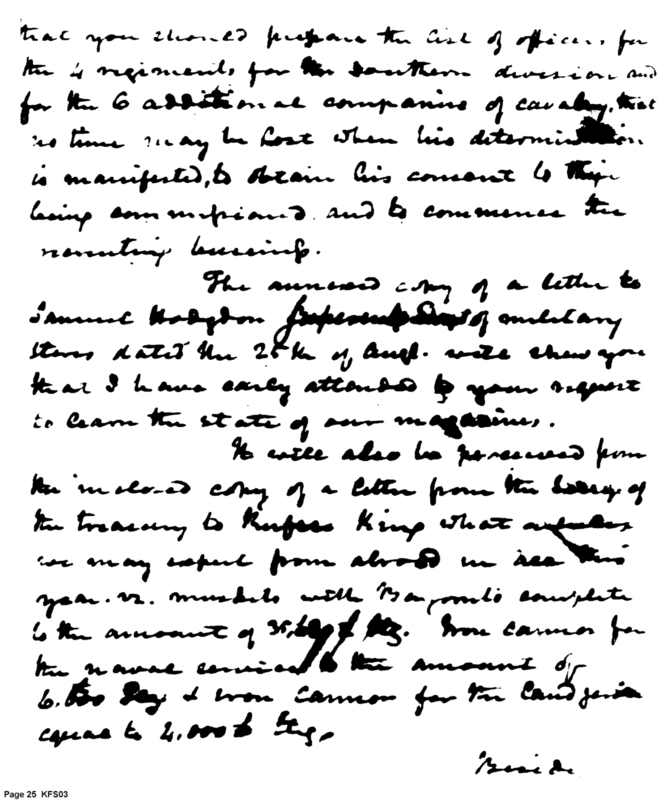
prepared the list of officers for the regiments
from for the Southern district, and
for the 6 [undecipherable] companies of the [undecipherable]
Cavalry, that no time may be lost
when his determination is manifested,
to obtain them his consent to them being
commissioned [undecipherable] and to commence
the recruiting business. Copy of a
[open?] the annexed letter to
Samuel Hodgdon, Commissary [Superintendent?] of Military
Stores dated the 25 Aug[us]t [undecipherable] and [undecipherable]
answers will show you that I have
early attended to your request to
learn the state of our magazines.
It will also be perceived
from the enclosed copy of a letter from
the Sec[retary] of the Treasury to Rufus King
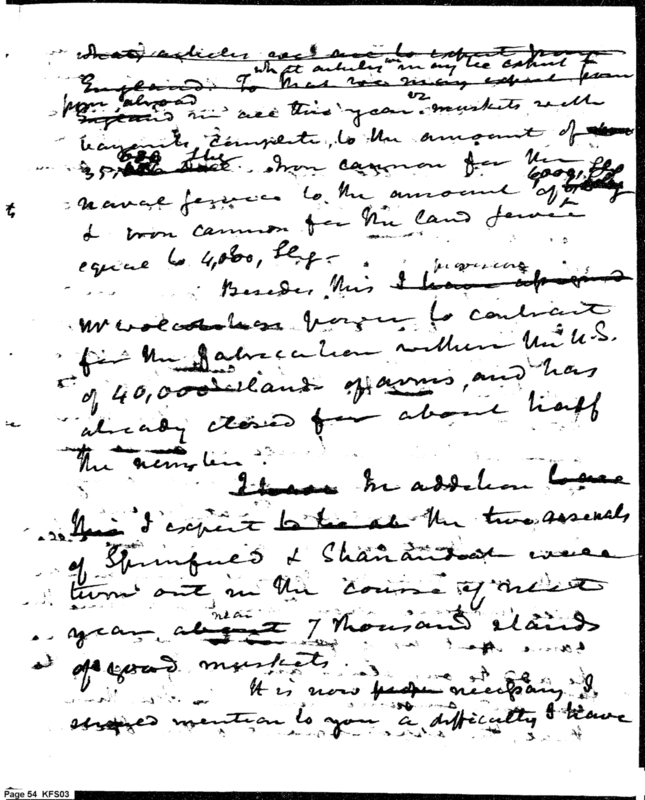
what articles can now be obtained from
England. To that we may many expect from
abroad, means in all this year — muskets with
bayonets complete, to the amount of [undecipherable]
& [undecipherable] iron cannon for the
naval service to the amount of [undecipherable]
& iron cannon for the land service
equal to 4,000 [undecipherable].
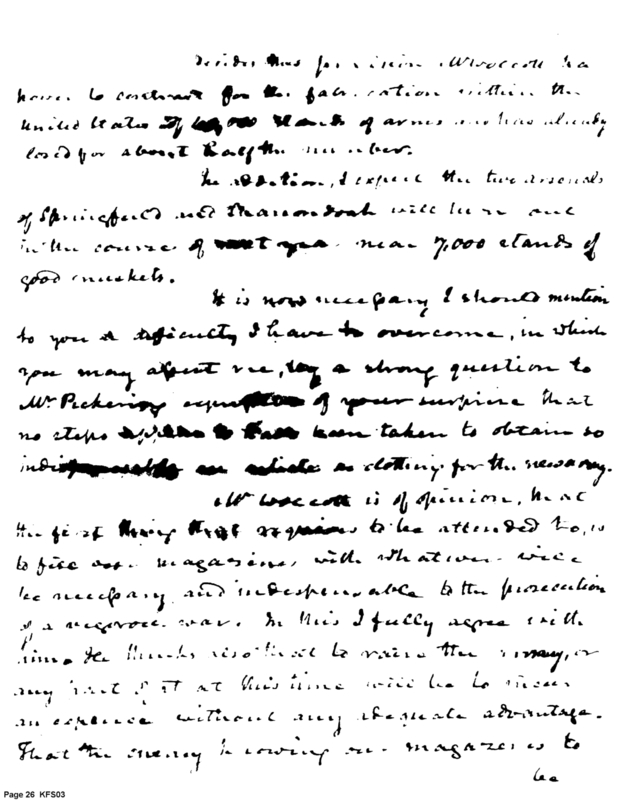
Besides this I have [undecipherable]
Mr. Wolcott begun to contract
for the fabrication within the U.S.
of 40,000 stands of arms, and has
already closed for about half
the number.
It [undecipherable] in addition I also [undecipherable]
and I expect it to be all the two arsenals
of Springfield & Shenandoah were
turned out in the course of next
year about 7 thousand stands
of good muskets.
It is now perhaps necessary I
should mention to you a difficulty I have
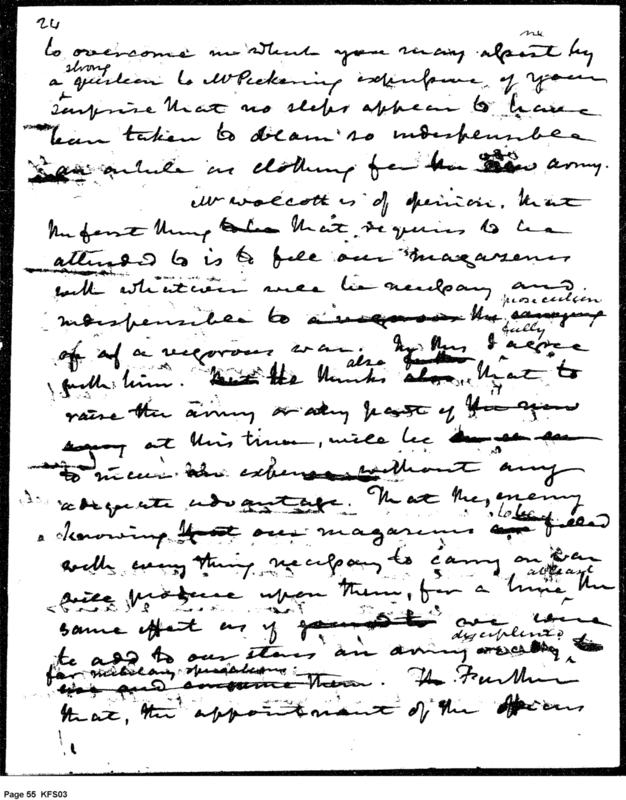
24
to overcome me which you may abate by
a strong question to Mr. Pickering [undecipherable] of your
surprise that no steps appear to have
been taken to obtain so indispensable
an article as clothing for the new army.
Mr. Wolcott is of opinion, that
the first thing [undecipherable] that it requires to be
attended to is to fill our magazines
with whatever will be necessary and
indispensable to [undecipherable] the [undecipherable]
of a vigorous war. By this I agree fully
with him. But he thinks also that to
raise the army or any part of [undecipherable]
at this time, will be [undecipherable]
to incur the expense without any
adequate advantage. That the enemy
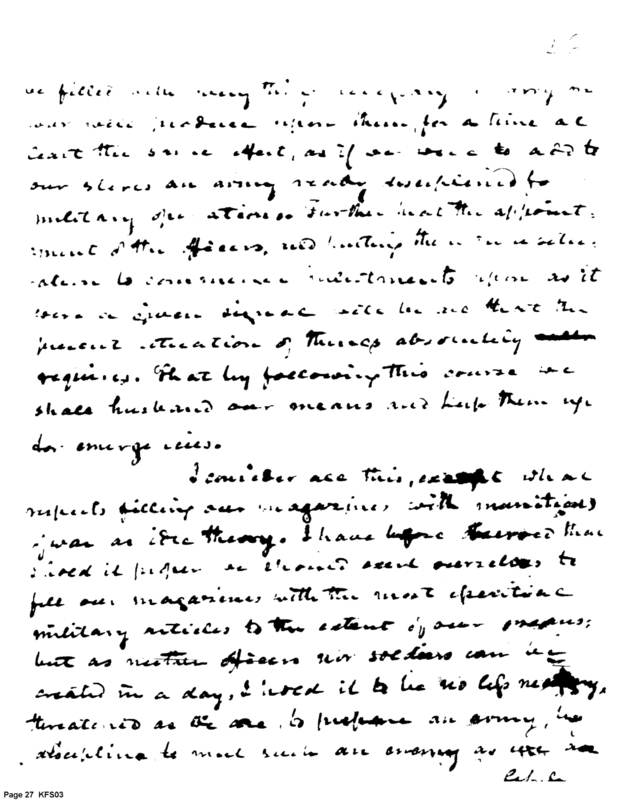
knowing that our magazines are filled
with every thing necessary to carry on war
will produce upon them for a time the
same effect as if [undecipherable] we were disciplined
to add to our stores an army [undecipherable]
disciplines for [undecipherable] purposes and [undecipherable] arrange them. The further
that, the appointment of the Officers
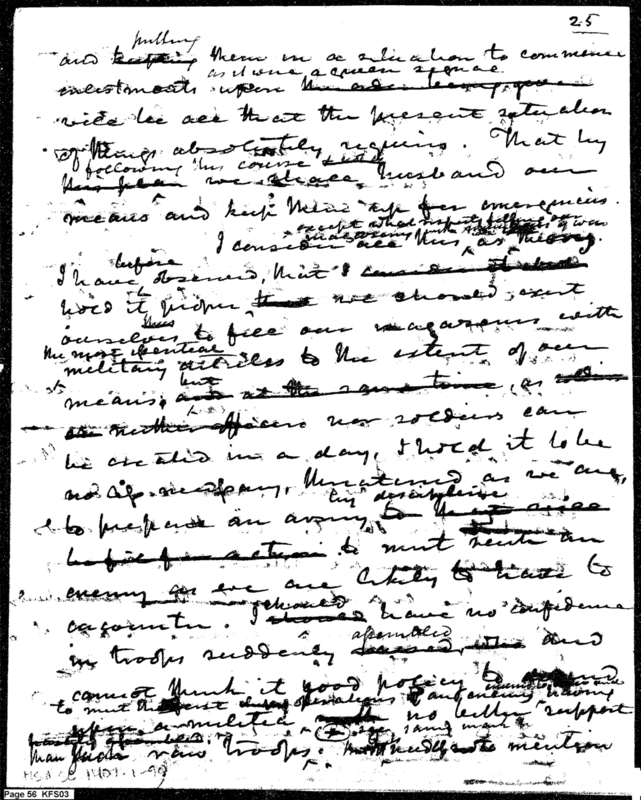
25
and keeping them in a situation to commence
[undecipherable] as it was a [undecipherable] expense,
investments upon [undecipherable]
you will see that the present situation
of things absolutely requires. That by
following his course [undecipherable]
[undecipherable] plan we shall have saved our
means and keep these up for emergencies.
I consider all this, as [undecipherable].
I before
have observed, that I consider [undecipherable]
used it [undecipherable] that we should exert
ourselves to fill our magazines with
the most essential
military articles to the extent of our
means; but at the same time, as [undecipherable]
neither Officers nor soldiers can
be created in a day, I hold it to be
no [dispensary?]; threatened as we are,
to prepare an army, to [undecipherable]
before [undecipherable] action to meet [undecipherable]
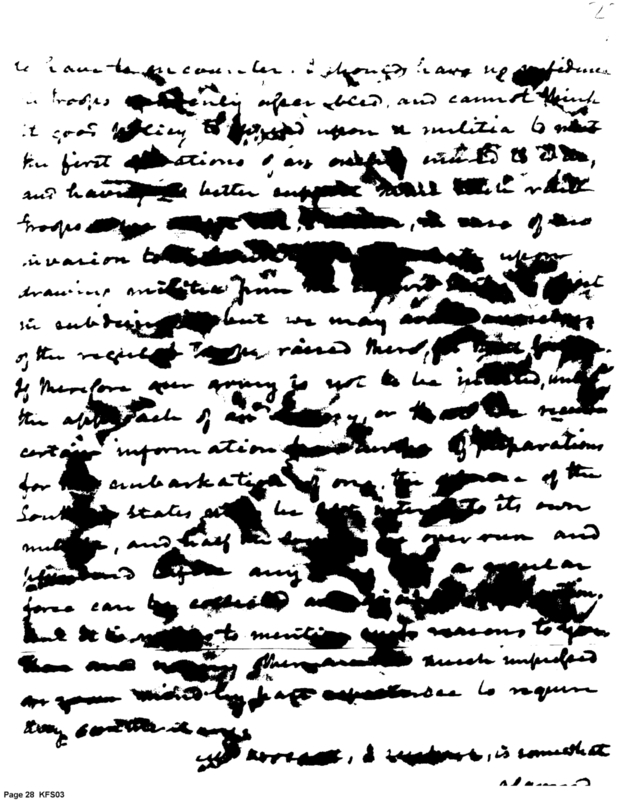
an enemy as we are likely [undecipherable] to
encounter. I should have no confidence
in troops suddenly assembled [undecipherable] and
cannot think it good policy [undecipherable]
to meet the first [undecipherable] operations [undecipherable]
with no better support
than [undecipherable] raw troops. [strikethrough: I need]
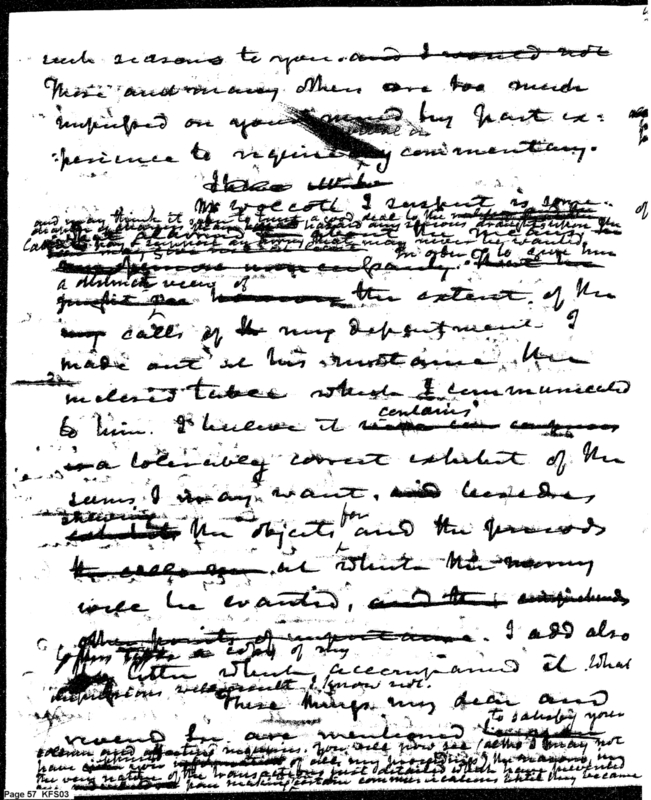
such reasons to you and I need not write
these and many others are too much
impressed on your [undecipherable] by past experience to require any commentary.
[strikethrough: I also write]
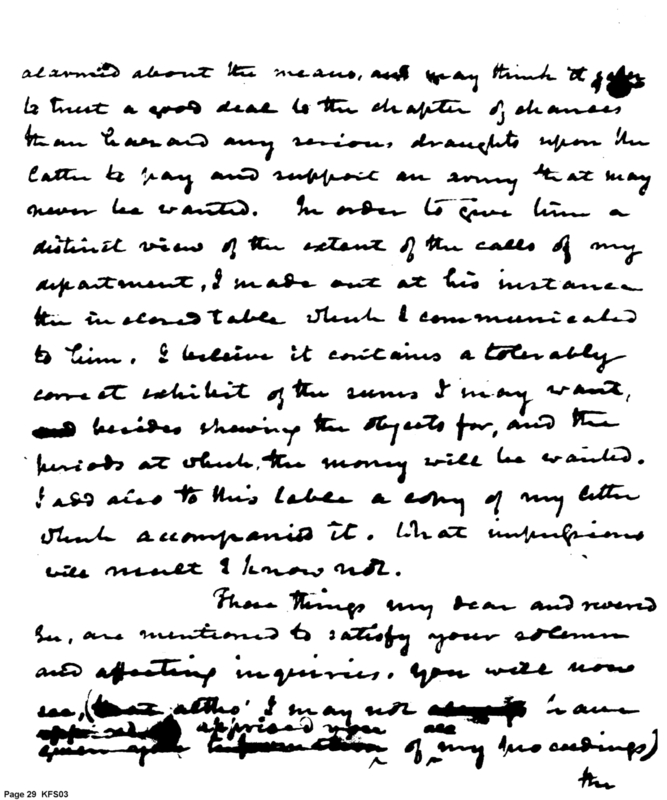
Mr. Wolcott I suspect is [undecipherable]
and may think it [undecipherable] [undecipherable] [undecipherable]
a distinct view of [undecipherable] the extent of the
[undecipherable] calls of the war department. I
made out at his most[?] request the
[undecipherable] tabular state which I communicated
to him. I believe it certainly
is a tolerably correct exhibit of the
items I may want, and besides,
showing for the objects and the process
to call upon at what time the money
would be wanted, and the [undecipherable]
the points of importance. I add also
[undecipherable] a copy of my
letter which accompanied it. What
[undecipherable] will result I know not.
These things my dear and
[undecipherable] [friend?] to satisfy you
[undecipherable] I [undecipherable] and affecting [undecipherable].
You will thus see (as [undecipherable] may not
have seen [undecipherable] of all, my [undecipherable]
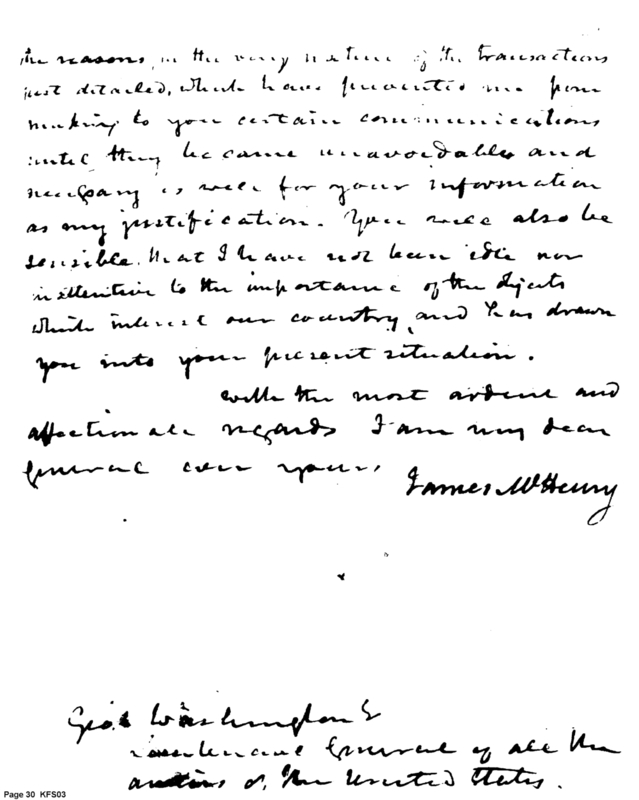
[undecipherable] by the managers, in
the very nature of the transactions first detailed which have prevented
the [undecipherable] from making certain communications which they became
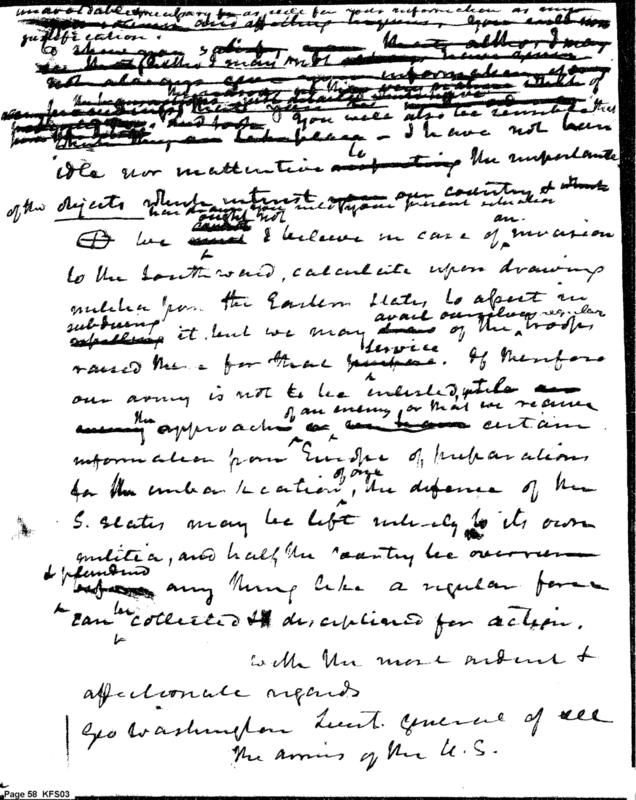
unavoidable [undecipherable] for your information as [undecipherable]
[undecipherable] justification.
[undecipherable] To show you [undecipherable] altho[ugh] I may
[undecipherable] the letter I may not [undecipherable]
not always [undecipherable] your information [undecipherable]
you will also see [undecipherable] [undecipherable]
— I have not been
idle nor inattentive [undecipherable] the importance
of the subjects which interest our country & [undecipherable]
your present situation. [undecipherable]
[undecipherable] I believe in case of invasion
to the Southward, calculate upon drawing
militia from the Eastern States to assist in
subduing it. But we may avail ourselves very [undecipherable]
of the troops raised them for that service.
If therefore
our army is not to be enlisted [undecipherable] until
an enemy or that we receive certain
information from Europe of preparations
for the embarkation of [undecipherable],
the defence of the S. States may be left entirely to its own
militia, and [undecipherable] the country be overrun [undecipherable]
any thing like a regular force
can be collected [undecipherable] disciplined for action.
With the more ardent &
affectionate regards
Geo Washington Lieut. General of all
the armies of the U.S.