

Letter from James McHenry to William Loughton Smith on developments with France
Document 1798On Talleyrand's defense of the XYZ Affair, the course that will probably be pursued by the U.S. government, and the embargo. McHenry also weighs in on public opinion and the influence on elections, insisting that anti-Federalists are in the minority and that American opinion is nearly unanimous in opposing France.

No human transcription currently available for this document.
This transcription was generated by machine using Anthropic's Claude Code (model sonnet 4.6). It may contain errors or inaccuracies. Please verify against the document image. Learn more about our generative AI methodology.
[41]
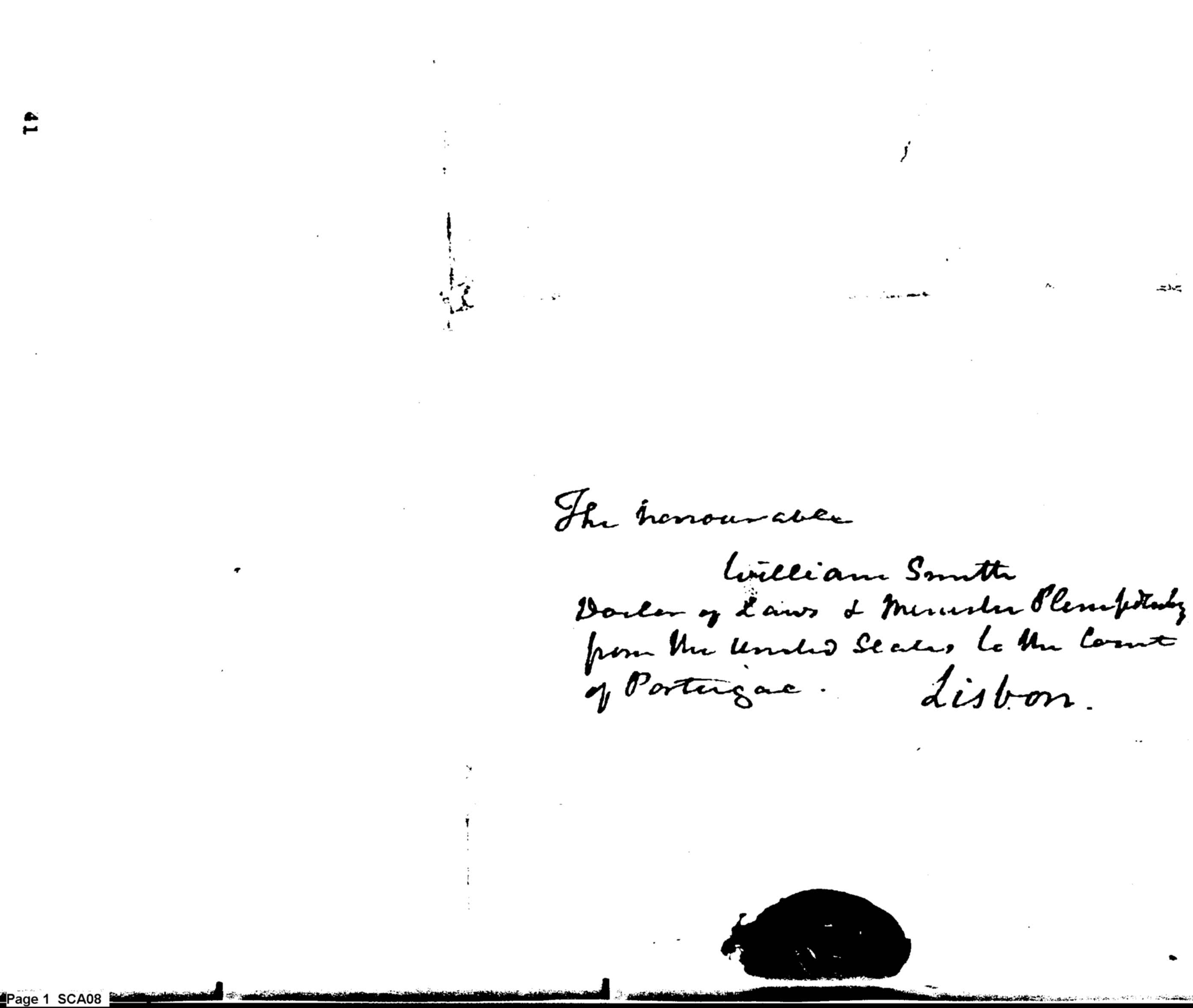
The honourable
William Smith
Doctor of Laws & Minister Plenipotentiary
from the United States to the Court
of Portugae. Lisbon.
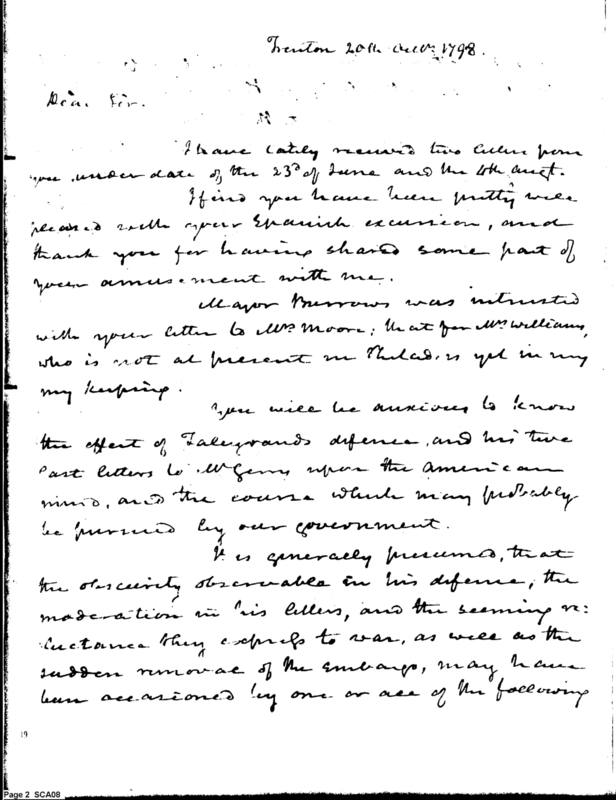
Trenton 20th Octo. 1798.
Dear Sir.
I have lately received two letters from you under date of the 23d of June and the 4th Aug.t
I find you have been pretty well pleased with your Spanish excursion, and thank you for having shared some part of your amusement with me.
Major Burrows was entrusted with your letter to Mr Moore: that for Mr Williams, who is not at present in Philad.a yet in my keeping.
You will be anxious to know the effect of Talegrands defence, and his two past letters to M. Gerry upon the American mind, and the course which may probably be pursued by our government.
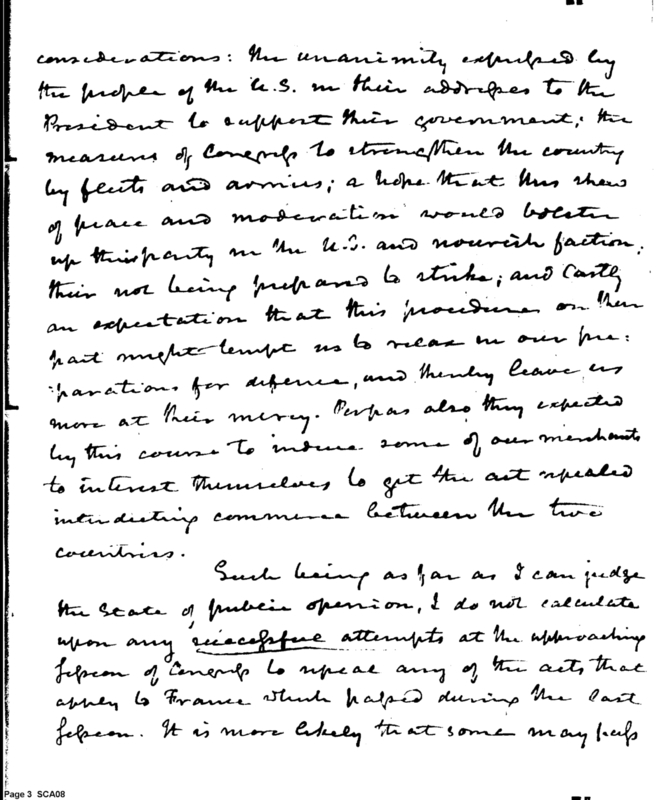
It is generally presumed, that the obscurity observable in his defence, the moderation in his letters, and the seeming reluctance they express to war, as well as the sudden removal of the embargo, may have been occasioned by one or all of the following considerations: The unanimity exhibited by the people of the U.S. in their addresses to the President to support their government; the measures of Congress to strengthen the country by fleets and armies; a hope that this shew of peace and moderation would bolster up this party in the U.S. and nourish faction; their not being prepared to strike; and lastly an expectation that this procedure on their part might tempt us to relax in our preparations for defence, and thereby leave us more at their mercy. Perhaps also they expected by this course to induce some of our merchants to interest themselves to get the act repealed interdicting commerce between the two countries.
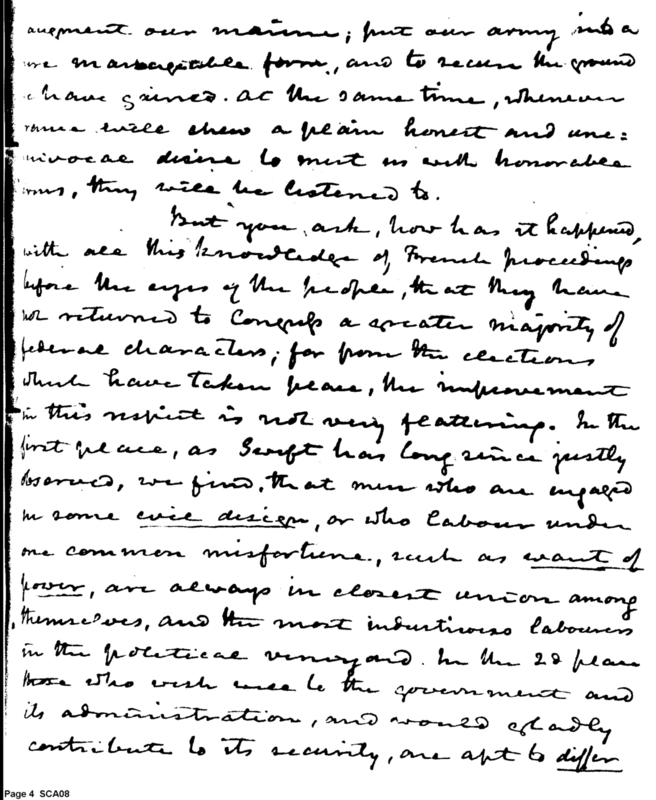
Such being as far as I can judge the State of publick opinion, I do not calculate upon any [underline: successful] attempts at the approaching Session of Congress to repeal any of the acts that apply to France which passed during the last Session. It is more likely that some may help augment our marine; put our army into a more marsceptible form, and to secure the ground I have gained. At the same time, whenever France will shew a plain honest and unequivocal desire to meet us with honorable terms, they will be listened to.
But you ask, how has it happened, with all this knowledge of French proceedings before the eyes of the people, that they have returned to Congress a greater majority of federal characters; for from the elections that have taken place, the improvement in this respect is not very flattering. In the first place, as Swift has long since justly observed, we find, that men who are engaged in some [underline: evil design], or who Labour under one common misfortune, such as [underline: want of power], are always in closest union among themselves, and the most industrious labourers in the political vineyard. In the 2d place those who wish well to the government and its administration, and would gladly contribute to its security, are apt to differ in their opinions about the men they wish to be chosen. [strikethrough: [undecipherable]]. Elections are not therefore to be considered as the criterion of publick opinions, at least in the present conjuncture. It is beyond a doubt, notwithstanding the issue of some of our elections in favour of antifederal characters, in districts, where a different result might have been expected, that the great mass of the people, in those districts and throughout the union, are truly [strikethrough: for supporting government] federal, and [strikethrough: in] nearly if not entirely unanimous to oppose France. It is local subjects, in these cases that over rules all others.
Yours sincerely &
Affectly. James McHenry
[written vertically in right margin: [undecipherable]]
His Excy.
W. S. Smith.
Type
Autograph Letter Signed
Description
On Talleyrand's defense of the XYZ Affair, the course that will probably be pursued by the U.S. government, and the embargo. McHenry also weighs in on public opinion and the influence on elections, insisting that anti-Federalists are in the minority and that American opinion is nearly unanimous in opposing France.
Date
08/20/1798
Author
Recipient
Sent from
Trenton
Repository
Collection
Document number
1798082000001
Page start
1
Notable persons
William Loughton Smith
James McHenry
Spanish
Talleyrand
French
Anti-Federalists
Republicans
Federalists
Notable locations
Lisbon
Trenton
France
Paris
Notable items
Navy
army