

Proving of cannon and discussion on windage and accuracy
Document 1798Will send officers from Corps of Artillerists and Engineers to prove guns. Requests a number of ball in order to test naval gunnery for purpose of experiment, calculating windage. Technical discussion on the the manufacture of weapons, calibers, bores, issue of attaining higher level of accuracy.

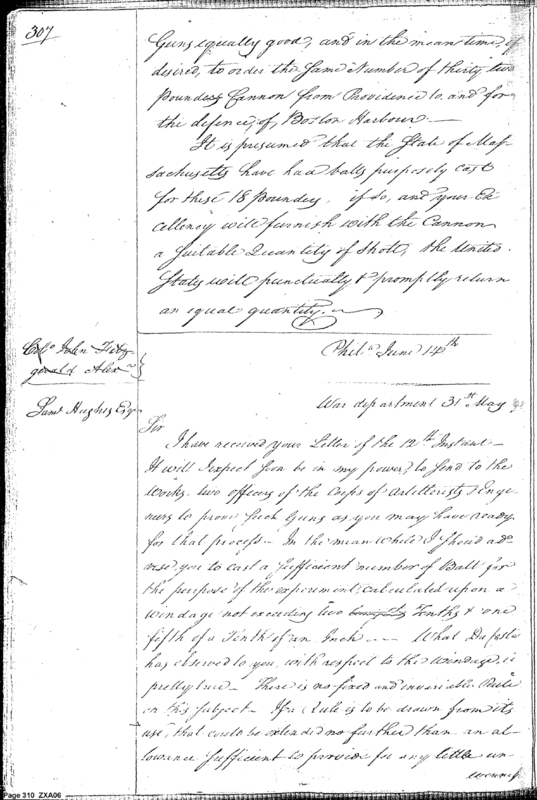

No human transcription currently available for this document.
This transcription was generated by machine using Anthropic's Claude Code (model sonnet 4.6). It may contain errors or inaccuracies. Please verify against the document image. Learn more about our generative AI methodology.
[Col. John Fitz gerald Alex.]
Guns equally good, and in the mean time if desired, to order the Same number of thirty two pounders Cannon from Providence to and for the defence of Boston Harbour.—
It is presumed that the State of Massachusetts have had balls purposely cast for these 18 pounders, if so, and Your Excellency will furnish with the Cannon a Suitable Quantity of Shott, the United States will punctually & promptly return an equal quantity.
Phil.° June 14th
[Gen. Hughes Esqr] War department 31st May
Sir,
I have received your Letter of the 12th Instant.— It will I expect be in my power, to Send to the Works, two officers of the Corps of Artillery & Engineers to prove Such Guns as you may have ready for that process— In the mean while I Should advise you to cast a Sufficient number of Ball for the purpose of the experiment, calculated upon a windage not exceeding two [strikethrough: hundredths] Tenths & one fifth of a Tenth of an Inch .— What Du P[undecipherable] has Shewed to you, with respect to the Windage, is pretty true— There is no fixed and invariable Rule on this Subject— No Rule is to be drawn from its use, that could be extended no further than an allowance Sufficient to provide for any little un-evenness on the bore of the Gun, or on the Surface of the Shot, and admit of the Balls being drawn out by the Ladle whenever that operation Should be necessary—
It is certain that if the Caliber of a Cannon is perfectly cylindric and concentric— and if Balls could be made to fit the Same with as much Justness and precision as Leaden Balls a Musket, it would be unnecessary to allow any Windage Whatever, with a view to prevent the bursting of the piece.— It is certain also, that Shott has the greatest velocity, when the windage is in the ratio of twenty three to twenty two, and that any deviation from this proportion diminishes the velocity— I mention these facts to shew that
Guns formed of Good Metal, well proportioned, and properly bored, cannot be injured by being proved with Smooth, and perfectly Spherical Shott, altho' there Should be no Windage allowed.—
I request when the examination is to be made, that you will stand yourself at the Works, or authorize [strikethrough: Such] persons to act for you on the points requiring your concurrence agreeably to the 5th [undecipherable] Articles of your contract— I Shall give you notice in another Letter, when you may expect the officers down—
Type
Letterbook
Description
Will send officers from Corps of Artillerists and Engineers to prove guns. Requests a number of ball in order to test naval gunnery for purpose of experiment, calculating windage. Technical discussion on the the manufacture of weapons, calibers, bores, issue of attaining higher level of accuracy.
Date
05/31/1798
Recipient
Sent from
Philadelphia
Document number
1798053100055
Page start
310
Notable persons
Samuel Hughes
James McHenry
Josiah Fox
Mr. DaCosta
Secretary War
War Department
Notable locations
War Department
Philadelphia
Notable items
windage
cannon
balls
bore
caliber
gun
leaden balls
metal