

Outlines Authority and Jurisdiction for Sea Vessels
Document 1798The Secretary of War will immediately provide instructions for army vessels to protect coasts. Theorizes about the constitutionally-based powers of the President over the army and the navy. Refers to the act of 1 July 1797. Outlines regulations for prisoners on vessels.

No human transcription currently available for this document.
This transcription was generated by machine using Anthropic's Claude Code (model sonnet 4.6). It may contain errors or inaccuracies. Please verify against the document image. Learn more about our generative AI methodology.
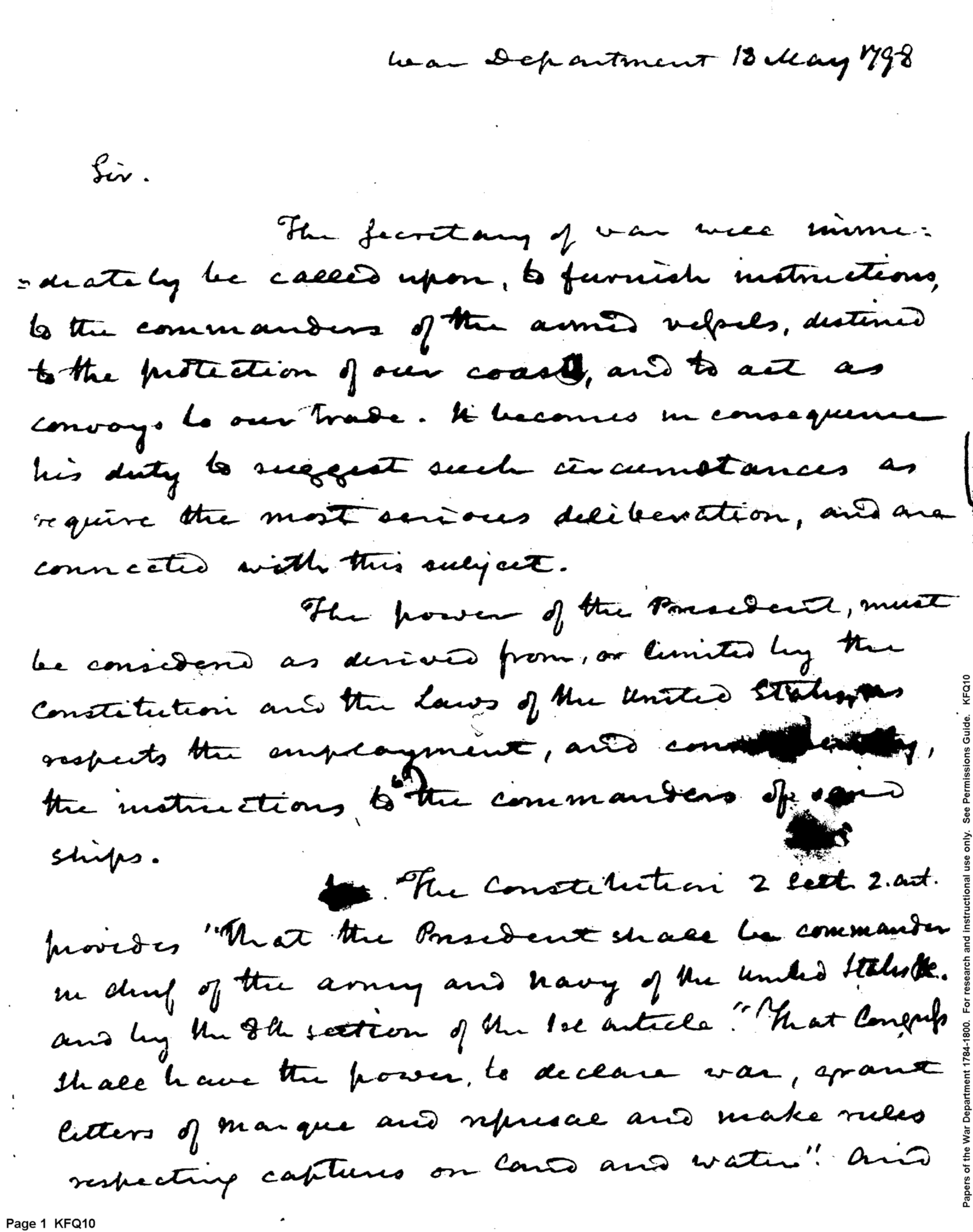
War Department 13 May 1798
Sir.
The Secretary of war will imme-diately be called upon, to furnish instructions, to the commanders of the armed vessels, destined to the protection of our coasts, and to act as convoys to our Trade. It becomes in consequence his duty to suggest such circumstances as require the most serious deliberation, and are connected with this subject.
The power of the President, must be considered as derived from, or limited by the Constitution and the laws of the United St[undecipherable], respects the employment, and com[undecipherable], the instructions to the commanders of [undecipherable] ships.
The Constitution 2 [undecipherable] 2.at. provides "That the President shall be commander in chief of the army and navy of the United [undecipherable: probable reading "States"]. and by the 8th section of the 1st article "That Congress shall have the power to declare war, grant letters of Marque and reprisals and make rules respecting captures on land and water". And
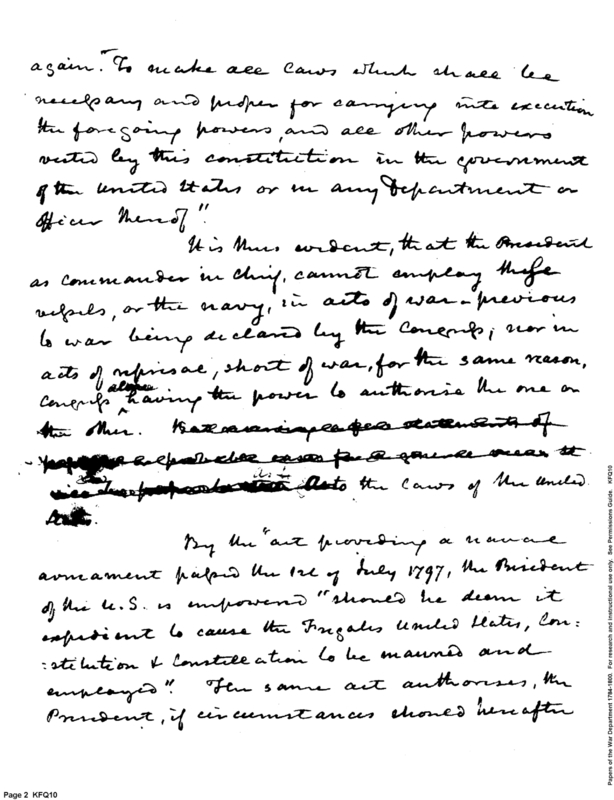
again. To make all laws which shall be necessary and proper for carrying into execution the foregoing powers, and all other powers vested by this constitution in the government of the United States or in any Department or Officer thereof".
It is thus evident, that the President as commander in chief, cannot employ these vessels, or the navy, in acts of war - previous to war being declared by the Congress; nor in acts of reprisal, short of war, for the same reason, Congress alone having the power to authorise the one or the [undecipherable: probable reading "other"]. [strikethrough: [undecipherable]] [undecipherable] the laws of the United [undecipherable].
By the "act providing a naval armament passed the 1st of July 1797, the President of the U.S. is empowered "should he deem it expedient to cause the Frigates United States, Constitution & Constellation to be manned and employed". The same act authorises, the President, if circumstances should hereafter
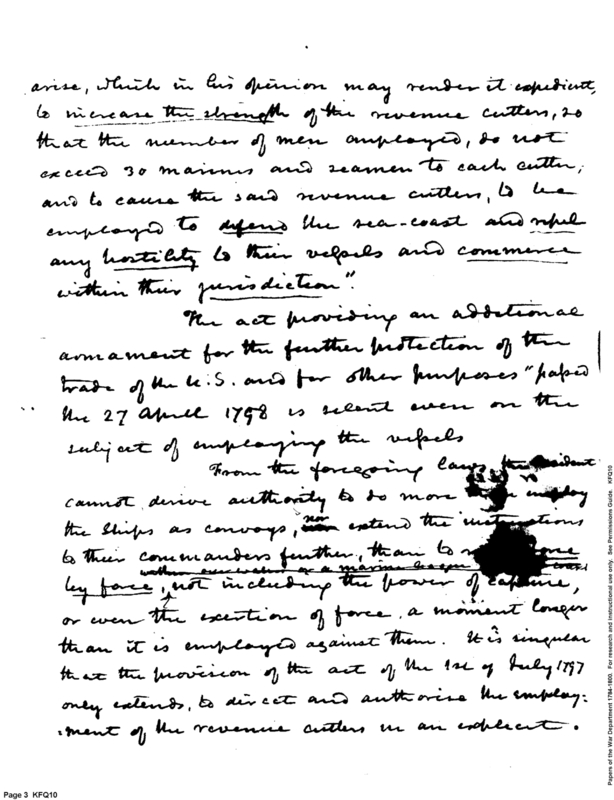
arise, which in his Opinion may render it expedient, to increase the [underline: strength] of the revenue cutters, so that the number of men employed, do not exceed 30 marines and seamen to each cutter, and to cause the said revenue cutters, to be employed to [underline: defend] the sea-coast and [underline: repel] any [underline: hostility] to their vessels and [underline: commerce] [underline: within their jurisdiction]".
The act providing an additional armament for the further protection of the trade of the U.S. and for other purposes "passed the 27 April 1798 is silent even on the subject of employing the vessels
From the foregoing [undecipherable], [undecipherable] cannot derive authority to do more [undecipherable] the ships as convoys, [undecipherable] extend the [undecipherable] instructions to their commanders further, than to [undecipherable] [undecipherable] [underline: by force], not including the power of capture, or even the exertion of force a moment longer than it is employed against them. It is singular that the provision of the act of the 1st of July 1797 only extends, to direct and authorise the employment of the revenue cutters in an explicit
manner - viz. "to defend the sea coast and repel any hostility to their vessels and commerce [underline: within their jurisdiction]".
This is the extent to which the instructions, can by any construction be carried. All beyond is considered to come within the sphere of reprisals and to require the explicit sanction of that branch of [strikethrough: [undecipherable]] the government, which is alone constitutionally authorised to grant letters of marque and reprisal.
A case or two may serve to fix the attention to the points they embrace. 1st an armed vessel is employed as a convoy, or [undecipherable], to secure a safe passage to one or a fleet of our merchantmen. One [undecipherable] of these are taken possession of by an [undecipherable] vessel of another country, the convoy retakes the possession, and conveys the vessel safely to her destined port. Here as we are not at war with any nation, not having declared it, a claim is made under the original capture. What is to be done? A recapture comes, it is supposed within the idea of captures, which Congress
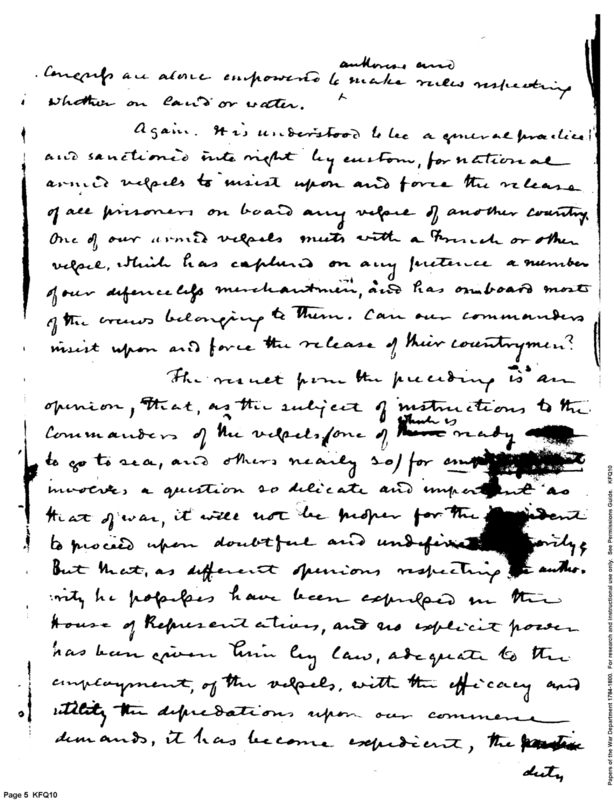
Congress are alone empowered [undecipherable] to make rules respecting [undecipherable] whether on land or water.
Again. It is understood to be a general practice and sanctioned into right by custom, for national armed vessels to insist upon and force the release of all prisoners on board any vessel of another country. One of our armed vessels meets with a French or other vessel, which has captured on any pretence a number of our defenceless merchantmen, and has onboard most of the crews belonging to them. Can our commanders insist upon and force the release of their countrymen?
The result from the preceding is an opinion, That, as the subject of instructions to the Commanders of the vessels [one of [undecipherable] nearly [undecipherable]] to go to sea, and others nearly so) for [undecipherable] involves a question so delicate and important as that of war, it will not be proper for the [undecipherable] to proceed upon doubtful and undefined [undecipherable]; But that, as different opinions respecting [the?] authority he [undecipherable: probable reading "possesses"] have been expounded in the House of Representatives, and no explicit power has been given him by law, adequate to the employment, of the vessels, with the efficacy and utility the depredations upon our commerce demands, it has become expedient, the [strikethrough: [undecipherable]] duty
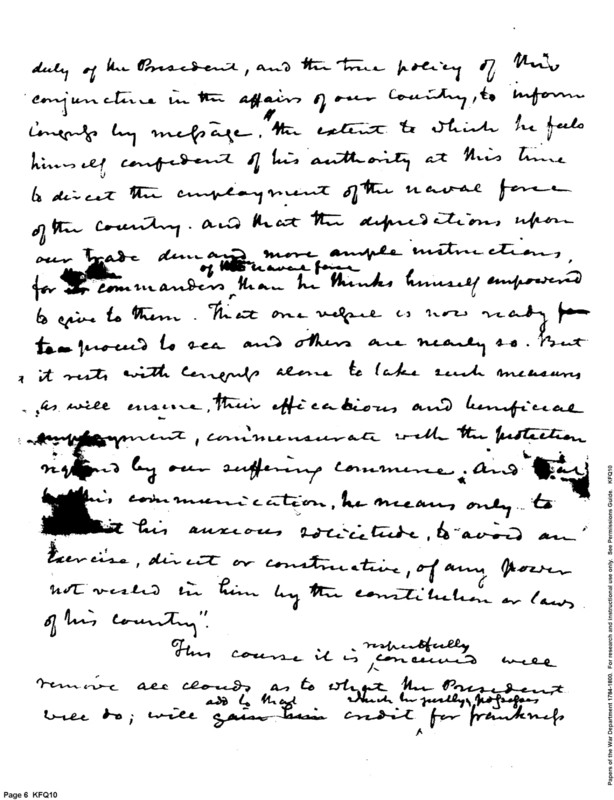
duty of the President, and the true policy of this conjuncture in the affairs of our Country, to inform Congress by message, "the extent to which he feels himself confident of his authority at this time to direct the employment of the naval force of the country. And that the depredations upon our trade demand more ample instructions, for [strikethrough: [undecipherable]] commanders of the naval force than he thinks himself empowered to give to them. That one vessel is now ready to proceed to sea and others are nearly so. But it rests with Congress alone to take such measures, as will ensure, their efficacious and beneficial [strikethrough: [undecipherable]], commensurate with the protection required by our suffering commerce. And [undecipherable] communication, he means only to [undecipherable] his anxious solicitude, to avoid an exercise, direct or constructive, of any power not vested in him by the constitution or laws of his country".
This course it is respectfully conceived will remove all clouds as to what the President [strikethrough: [undecipherable]] [undecipherable] will do; will gain him credit for frankness
and an unwillingness to chicane the constitution, and will return upon Congress the question in a shape which cannot be eluded.
with the greatest respect I have the honour to be Sir
your most Obt.
James McHenry
Type
Autograph Draft Letter Signed
Description
The Secretary of War will immediately provide instructions for army vessels to protect coasts. Theorizes about the constitutionally-based powers of the President over the army and the navy. Refers to the act of 1 July 1797. Outlines regulations for prisoners on vessels.
Date
05/18/1798
Author
Recipient
Sent from
War Department
Repository
Collection
Document number
1798051800201
Page start
1
Notable persons
John Adams
James McHenry
Congress
the President
Commanders
Notable locations
War Department