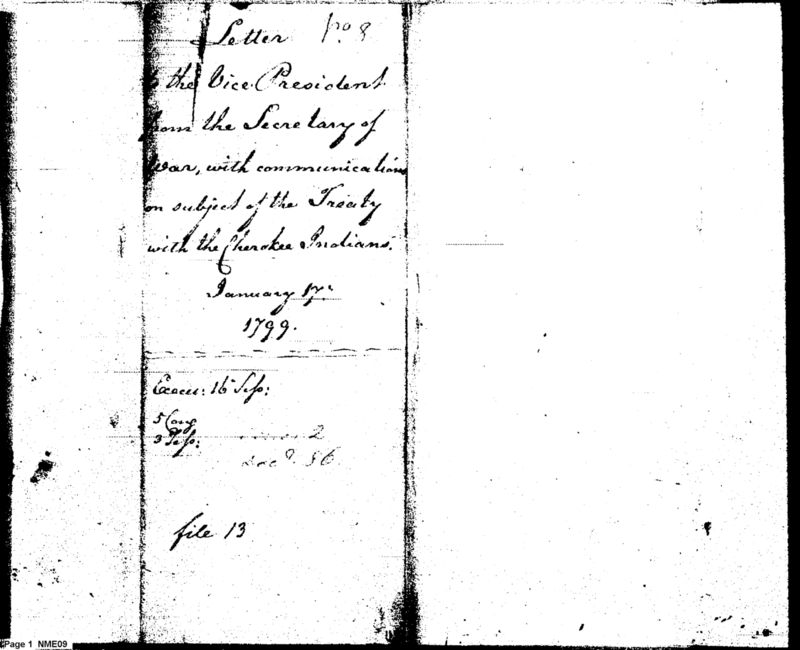
[Letter N°8 / [to] the Vice President / from the Secretary of / War, with communications / on subject of the Treaty / with the Cherokee Indians. / January 17th / 1799. / Execes: 16 Sess: / 5 Cong / 3 Sess: 2 / Doc 36 / file 13]
War Department,
January 16, 1799
Sir,
Conformably to orders from the President of the United States, I have the honor to lay before the Senate, the following papers, viz:
1st Copy of the Instructions to Alfred Moore, George Walton, and John Steele, Esquires, Commissioners for negotiating and concluding a Treaty with the Cherokee Nation, dated the 30th March, 1798.
2nd Copy of additional Instructions to George Walton, Esquire, and Lieutenant Colonel Thomas Butler, Commissioners for the aforesaid purpose, dated the 27th August, 1798.
3rd A Talk of the President of the United States to the Chiefs and Warriors of the Cherokee Nation, dated the 27th August, 1798.
4th The original Journal of the Proceedings of the Commissioners appointed to hold a treaty with the Cherokee Indians, under the authority of the United States.
It is requested that the Journal, being a Document necessary to the War Department, may be returned.
I have the honor to be,
with the greatest Respect, Sir,
Your most obed.t Able Servant,
James McHenry
The Vice President
of the United States.
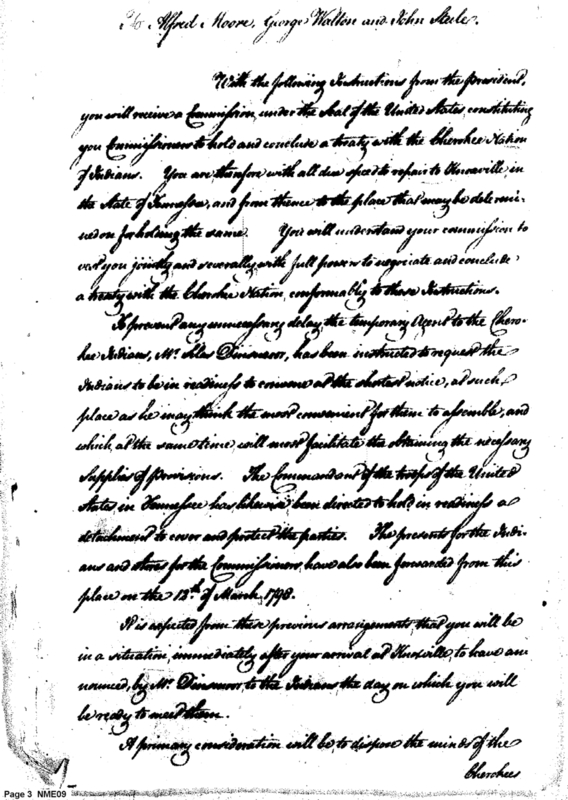
To Alfred Moore, George Walton and John Steele.
With the following Instructions from the President, you will receive a Commission, under the Seal of the United States constituting you Commissioners to hold and conclude a treaty with the Cherokee Nation of Indians. You are therefore with all due speed to repair to Knoxville, in the State of Tennessee, and from thence to the place that may be determined on for holding the same. You will understand your commission to vest you jointly and severally with full power to negotiate and conclude a treaty with the Cherokee Nation, conformably to these Instructions.
To prevent any unnecessary delay, the temporary Agent to the Cherokee Indians, Mr. Silas Dinsmore, has been instructed to request the Indians to be in readiness to convene at the shortest notice, at such place as he may think the most convenient for them to assemble, and which, at the same time, will most facilitate the obtaining the necessary Supplies of Provisions. The Commandant of the troops of the United States in Tennessee has likewise been directed to hold in readiness a detachment to cover and protect the parties. The presents for the Indians and stores for the Commissioners have also been forwarded from this place on the 13th of March, 1798.
It is expected from these previous arrangements that you will be in a situation, immediately after your arrival at Knoxville, to have announced, by Mr. Dinsmore, to the Indians the day on which you will be ready to meet them.
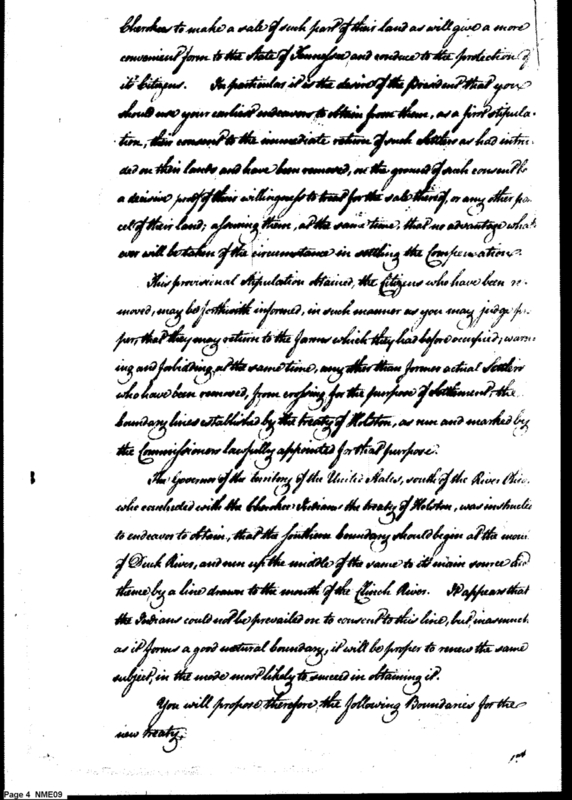
A primary consideration will be to dispose the minds of the Cherokees to make a sale of such part of their land as will give a more convenient form to the State of Tennessee and conduce to the protection of its citizens. In particular it is the desire of the President that you should use your earliest endeavors to obtain from them, as a first stipulation, their consent to the immediate return of such Settlers as had intruded on their lands and have been removed, on the ground of such consent be a decisive proof of their willingness to treat for the sale thereof, or any other parcel of their land; assuring them, at the same time, that no advantage whatever will be taken of the circumstances in settling the Compensation.
This provisional Stipulation obtained, the Citizens who have been removed, may be forthwith informed, in such manner as you may judge proper, that they may return to the farms which they had before occupied; warning and forbidding, at the same time, any other than former actual Settlers who have been removed, from crossing for the purpose of Settlement, the boundary lines established by the treaty of Holston, as run and marked by the Commissioners lawfully appointed for that purpose.
The Governor of the territory of the United States, south of the River Ohio, who concluded with the Cherokee Indians the treaty of Holston, was instructed to endeavor to obtain, that the Southern boundary should begin at the mouth of Duck River, and run up the middle of the same to its main source and thence by a line drawn to the mouth of the Clinch River. It appears that the Indians could not be prevailed on to consent to this line, but, inasmuch as it forms a good natural boundary, it will be proper to renew the same subject, in the mode most likely to succeed in obtaining it.
You will propose therefore the following Boundaries for the new treaty:
[Red dotted line.]
1st A line from a point on the ridge dividing the waters of Cumberland from Tennessee River, in a South west direction, until it strikes the mouth of Duck River; thence, down the middle of Duck River from its mouth to its main source; thence by a line over the highest ridges of the Cumberland Mountains to the mouth of Clinch; thence down the middle of the Tennessee River, till it strikes the divisional line lately marked by the Commissioners of the United States; thence along the said line to where it crosses Cherokee Creek running into Puchargy, the Eastern branch of the Tennessee; thence to the Great Iron Mountain; thence a south easterly course to where the most southerly branch of Little River crosses the divisional line leading to Hugolo River.
If this cannot be obtained, then
[A double red line.]
2nd A line beginning at the point forty miles above Nashville, as ascertained by the Commissioners, and laid down on the annexed Map; thence due east till it strikes the dotted line on Cumberland Mountains; thence along the said dotted line on Mountains, to the junction of Clinch River with the Tennessee; and thence, down the middle of the Tennessee River to the extent of the boundary as described in the first proposition.
If this cannot be obtained, then
[A blue dotted line.]
3rd A line beginning at a point fifty or six miles from the point forty miles above Nashville, on the north east divisional line, being one and an half miles south of the road called Waltons or Beans fork Road; thence on a course at the same distance from the said Road to where it crosses Clinch River; thence, resuming the remaining boundary, as described in the first proposition.
If this cannot be obtained, then
[A double blue line.]
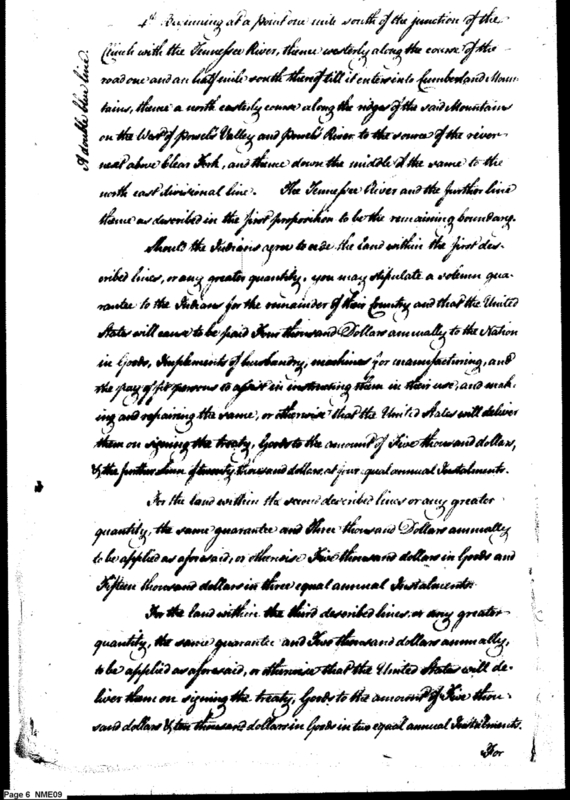
4th Beginning at a point one mile south of the junction of the Clinch with the Tennessee River, thence westerly along the course of the road one and an half miles south thereof till it enters into Cumberland Mountains, thence a north easterly course along the ridge of the said Mountains on the West of Powells Valley and Powells River to the source of the river next above Clear Fork, and thence down the middle of the same to the north east divisional line. The Tennessee River and the further line thence as described in the first proposition to be the remaining boundary.
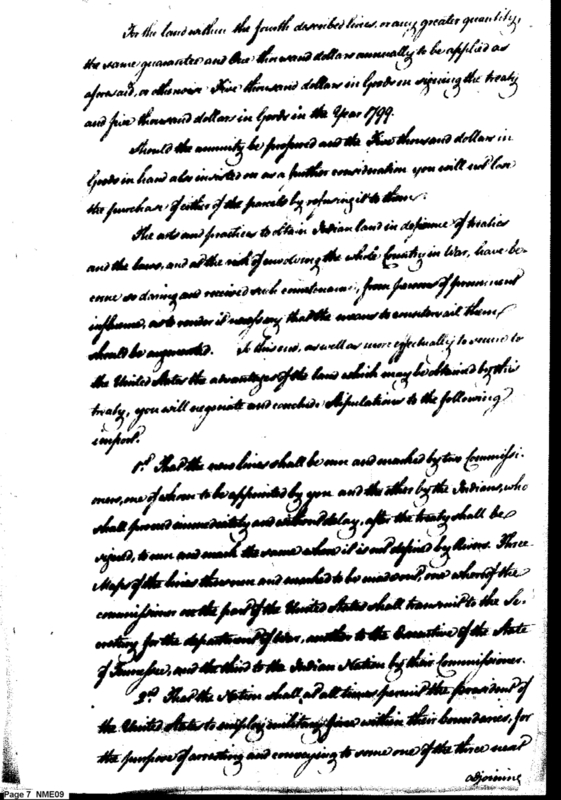
Should the Indians agree to cede the land within the first described lines, or any greater quantity, you may stipulate a solemn guarantee to the Indians for the remainder of their country and that the United States will cause to be paid Four thousand Dollars annually to the Nation in Goods, Implements of husbandry, machines for manufacturing, and the pay of fit persons to assist in instructing them in their use, and making and repairing the same; or otherwise that the United States will deliver them on signing the treaty, Goods to the amount of Five thousand dollars, & the further sum of twenty thousand dollars, at four equal annual Instalments.
For the land within the second described lines or any greater quantity, the same guarantee and Three thousand Dollars annually, to be applied as aforesaid; or otherwise Five thousand dollars in Goods and Fifteen thousand dollars in three equal annual Instalments.
For the land within the third described lines, or any greater quantity, the same guarantee and Two thousand dollars annually, to be applied as aforesaid, or otherwise that the United States will deliver them on signing the treaty, Goods to the amount of Five thousand dollars & ten thousand dollars in Goods in two equal annual Instalments.
For the land within the fourth described lines, or any greater quantity, the same guarantee and One thousand dollars annually to be applied as aforesaid, or otherwise Five thousand dollars in Goods on signing the treaty and five thousand dollars in Goods in the Year 1799.
Should the annuity be proposed and the Five thousand dollars in Goods in hand also insisted on as a further consideration, you will not lose the purchase of either of the parcels by refusing it to them.
The arts and practices to obtain Indian land in defiance of treaties and the laws, and at the risk of involving the white Country in War, have become so daring and received such connivance, from persons of prominent influence, as to render it necessary that the means to counteract them should be augmented. To this end, as well as more effectually to secure to the United States the advantages of the land which may be obtained by this treaty, you will negotiate and conclude Stipulations to the following import:
1st That the new lines shall be run and marked by two Commissioners, one of whom to be appointed by you and the other by the Indians, who shall proceed immediately and without delay, after the treaty shall be signed, to run and mark the same where it is not defined by Rivers. Three Maps of the lines thereon and marked to be made out, one whereof the Commissioner on the part of the United States shall transmit to the Secretary for the department of War, another to the Executive of the State of Tennessee, and the third to the Indian Nation by their Commissioner.
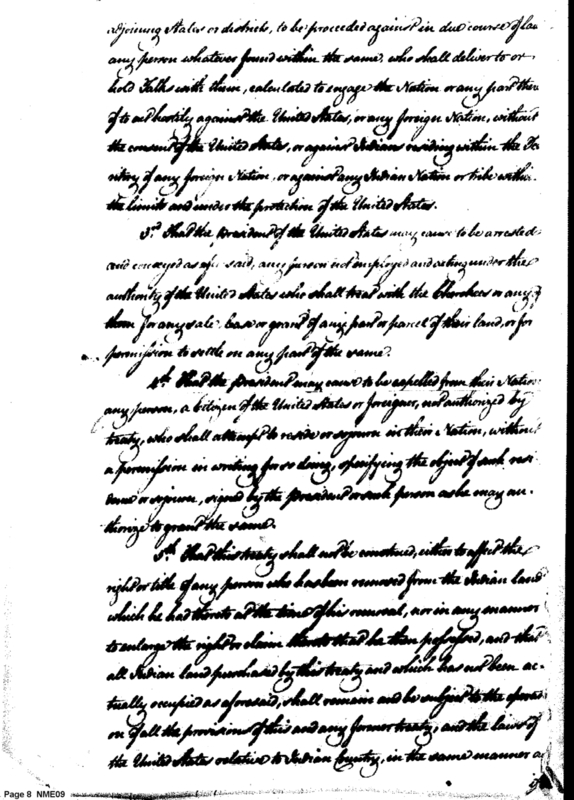
2nd That the Nation shall, at all times permit the President of the United States to employ military persons within their boundaries, for the purpose of arresting and conveying to one of the three next adjoining States or districts, to be proceeded against in due course of law, any person whatever found within the same, who shall deliver to or hold Talks with them, calculated to engage the Nation or any part thereof to act hostilely against the United States, or any foreign Nation, without the consent of the United States, or against Indians residing within the territory of any foreign Nation, or against any Indian Nation or tribe within the limits and under the protection of the United States.
3rd That the President of the United States may cause to be arrested and conveyed as aforesaid, any person not employed and acting under the authority of the United States who shall treat with the Cherokees or any of them for any sale, lease or grant of any part or parcel of their land, or for a permission to settle on any part of the same.
4th That the President may cause to be expelled from their Nation any person, a citizen of the United States or foreigner, not authorized by treaty, who shall attempt to reside or sojourn in their Nation, without a permission in writing for so doing, specifying the object of such residence or sojourn, signed by the President or such person as he may authorize to grant the same.
5th That this treaty shall not be construed, either to affect the right or title of any person who has been removed from the Indian land which he had thereon at the time of his removal, nor in any manner to enlarge the right or claim to lands that he then possessed, and that all Indian land purchased by this treaty and which has not been actually occupied as aforesaid, shall remain and be subject to the operation of all the provisions of this and any former treaty, and the laws of the United States relative to Indian Country, in the same manner as if this treaty had not been made until such time as the same land shall be sold by and under the authority of the United States. This provision is meant to prevent any further intrusions on any part or parcel ceded by the State of North Carolina to the United States, as also upon the lands of the land relinquished to the Cherokee Indians by the State of North Carolina by an act of the said State passed the 17th May, 1783 and described in the said act as follows, viz: "Beginning on the Tennessee where the southern boundary of this State intersects the same nearest to the Chickamauga Towns, thence up the middle of the Tennessee and Holston to the middle of French Broad; thence up the middle of French Broad River (which lines are not to include any Island or Islands in the said River) to the mouth of Big Pidgeon River, thence up the same to the head thereof, thence along the dividing Ridge between the waters of Pidgeon River & Purchagy River, to the southern boundary of this State." Provided that any person or persons, who under the laws of North Carolina and in conformity to the regulations and provisions thereof have entered, surveyed, located, or obtained grants of any land (other than the land relinquished to the Cherokees as aforesaid) ceded by the said State to the United States previous to the acceptance thereof by the United States, which said grants would have vested a good title in them under the laws of the said State of North Carolina, if such cession had not been made to the United States, may enter upon, occupy and possess the same; if lying within the limits of this purchase.
6th That such military Sites may be chosen from time to time, and Garrisons established of the regular troops of the United States within the Indian boundary as may be thought necessary to protect their land and carry into effect the Stipulations of treaties and laws of the United States.
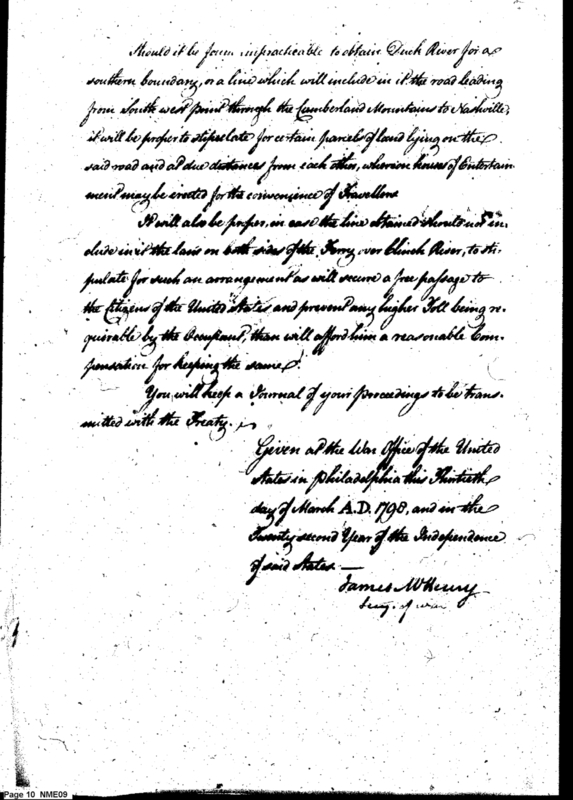
Should it be found impracticable to obtain Duck River for a southern boundary, or a line which will include in it the road leading from South west point through the Cumberland Mountains to Nashville, it will be proper to stipulate for certain parcels of land lying on the said road and at due distances from each other, wherein houses of Entertainment may be erected for the convenience of Travellers.
It will also be proper, in case the line obtained should not include in it the land on both sides of the Ferry over Clinch River, to stipulate for such an arrangement as will secure a free passage to the citizens of the United States and prevent any higher Toll being requirable by the Occupant, than will afford him a reasonable Compensation for keeping the same.
You will keep a Journal of your proceedings to be transmitted with the Treaty.
Given at the War Office of the United States in Philadelphia this Thirtieth day of March A.D. 1798, and in the twenty second Year of the Independence of said States.
James McHenry
Secy. of War
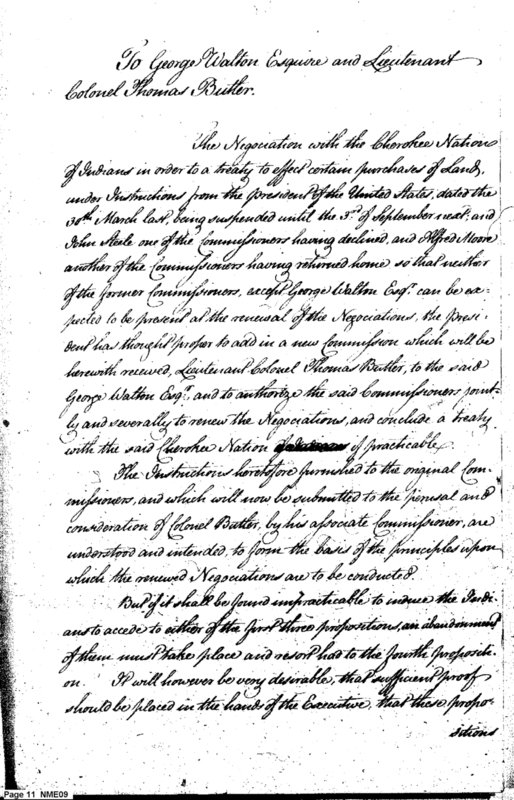
To George Walton Esquire and Lieutenant Colonel Thomas Butler.
The Negotiation with the Cherokee Nation of Indians in order to a treaty to effect certain purchases of Land, under Instructions from the President of the United States, dated the 30th March last, being suspended until the 3rd of September next; and John Steele one of the Commissioners having declined, and Alfred Moore another of the Commissioners having returned home, so that neither of the former Commissioners, except George Walton Esq. can be expected to be present at the renewal of the Negotiations, the President has thought proper to add in a new Commission which will be herewith received, Lieutenant Colonel Thomas Butler, to the said George Walton Esq., and to authorize the said Commissioners jointly and severally to renew the Negotiations, and conclude a treaty with the said Cherokee Nation [strikethrough: of Indians] if practicable.
The Instructions heretofore furnished to the original Commissioners, and which will now be submitted to the perusal and consideration of Colonel Butler, by his associate Commissioner, are understood and intended, to form the basis of the principles upon which the renewed Negotiations are to be conducted.
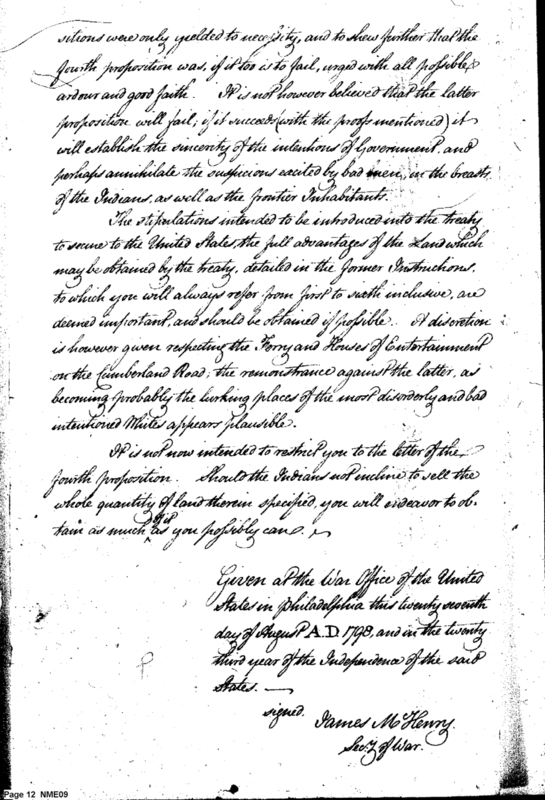
But if it shall be found impracticable to induce the Indians to accede to either of the first three propositions, an abandonment of them must take place and resort had to the fourth Proposition. It will however be very desirable, that sufficient proof should be placed in the hands of the Executive, that these propositions were only yielded to necessity, and to shew further that the fourth proposition was, if it too is to fail, urged with all possible ardour and good faith. It is not however believed that the latter proposition will fail; if it succeeds (with the proof mentioned) it will establish the sincerity of the intentions of Government, and perhaps annihilate the suspicions excited by bad men, in the breasts of the Indians, as well as the frontier Inhabitants.
The Stipulations intended to be introduced into the treaty to secure to the United States the full advantages of the Land which may be obtained by the treaty, detailed in the former Instructions, to which you will always refer from first to sixth inclusive, are deemed important, and should be obtained if possible. A discretion is however given respecting the Ferry and Houses of Entertainment on the Cumberland Road; the remonstrance against the latter, as becoming probably the lurking places of the most disorderly and bad intentioned Whites appears plausible.
It is not now intended to restrict you to the letter of the fourth Proposition. Should the Indians not incline to sell the whole quantity of land therein specified, you will endeavor to obtain as much as you possibly can.
Given at the War Office of the United States in Philadelphia this twenty seventh day of August A.D. 1798, and in the twenty third year of the Independence of the said States.
signed. James McHenry.
Sec'y of War.